New Discoveries of Vivaldi in Dresden
Abstract
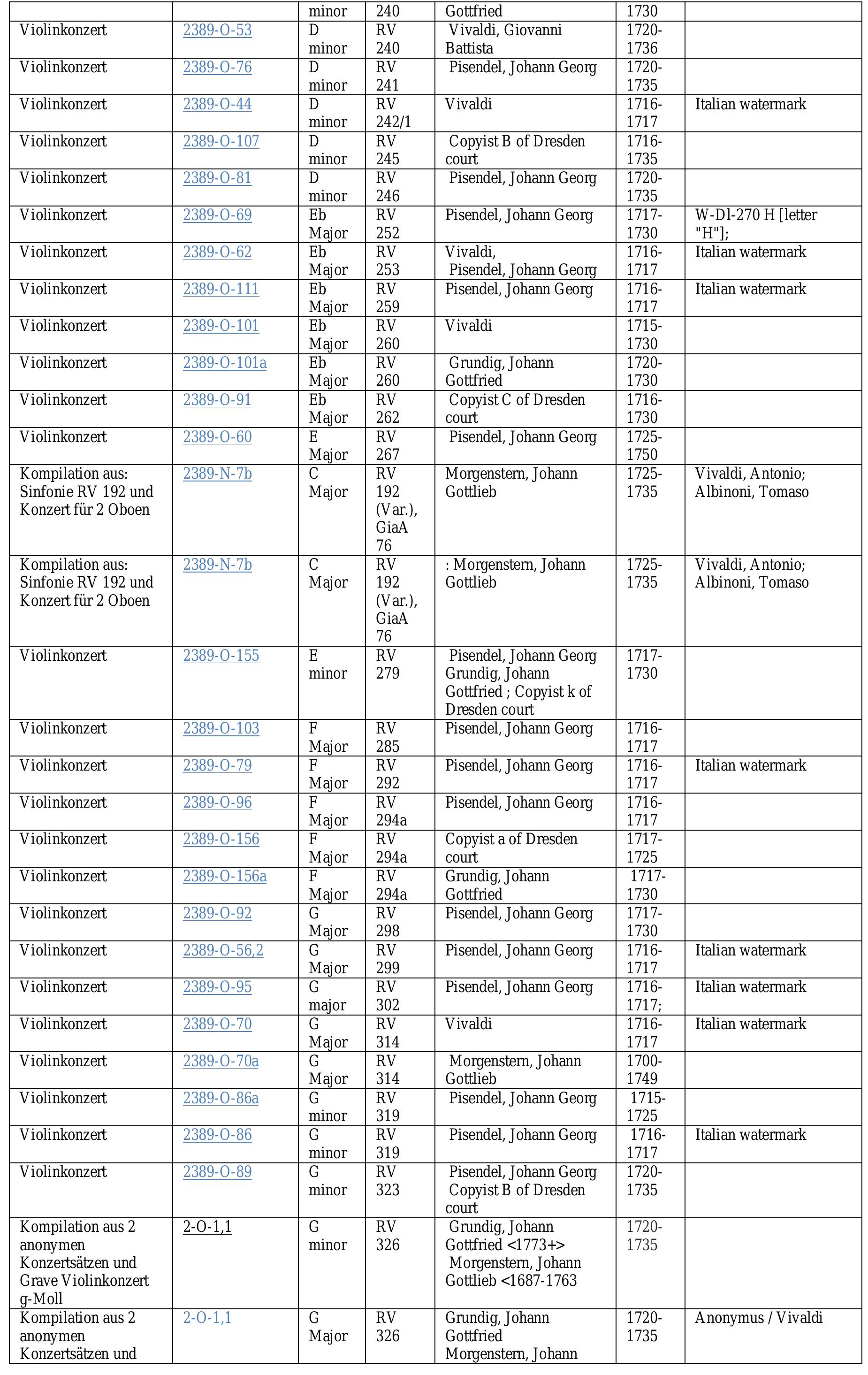
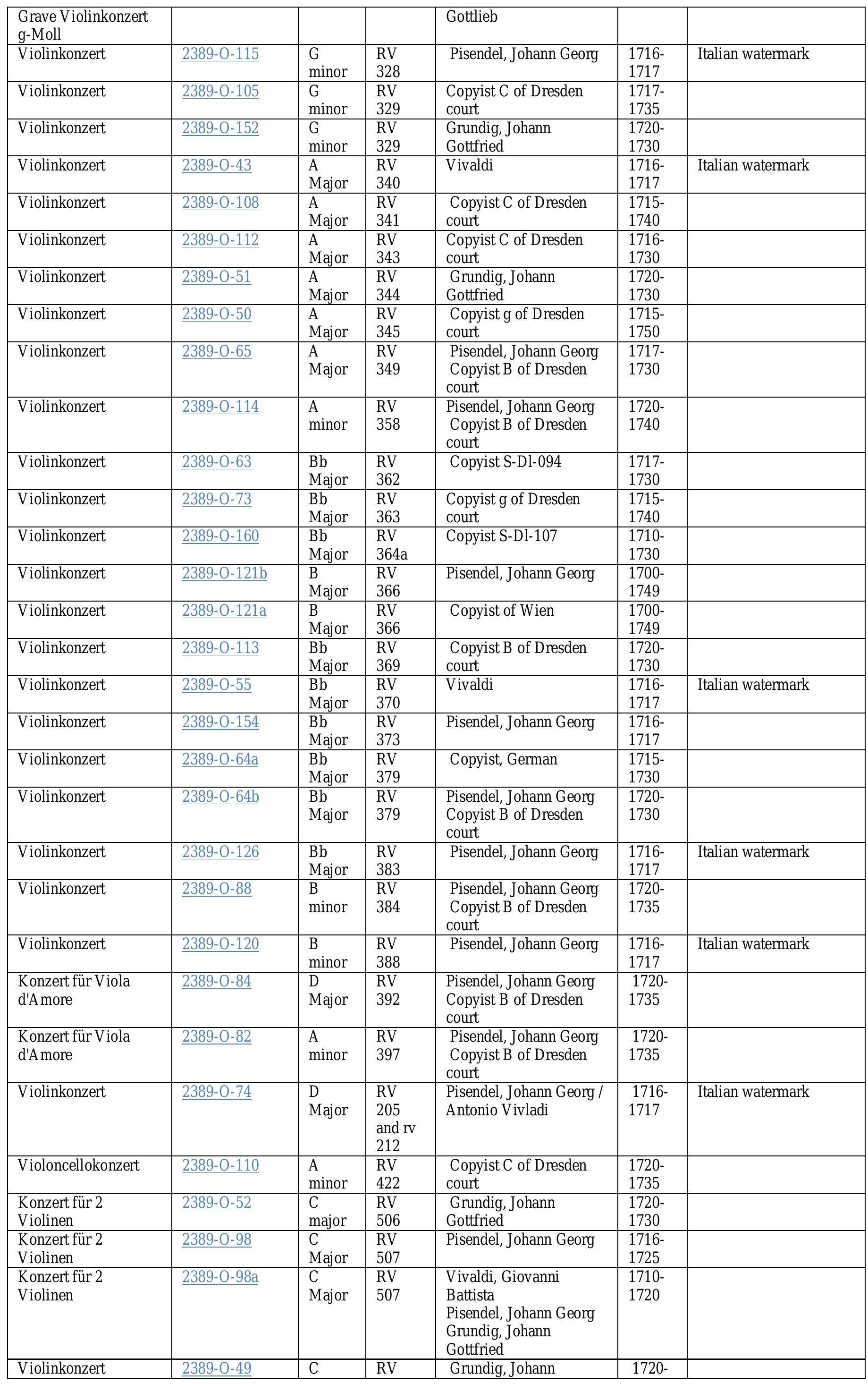
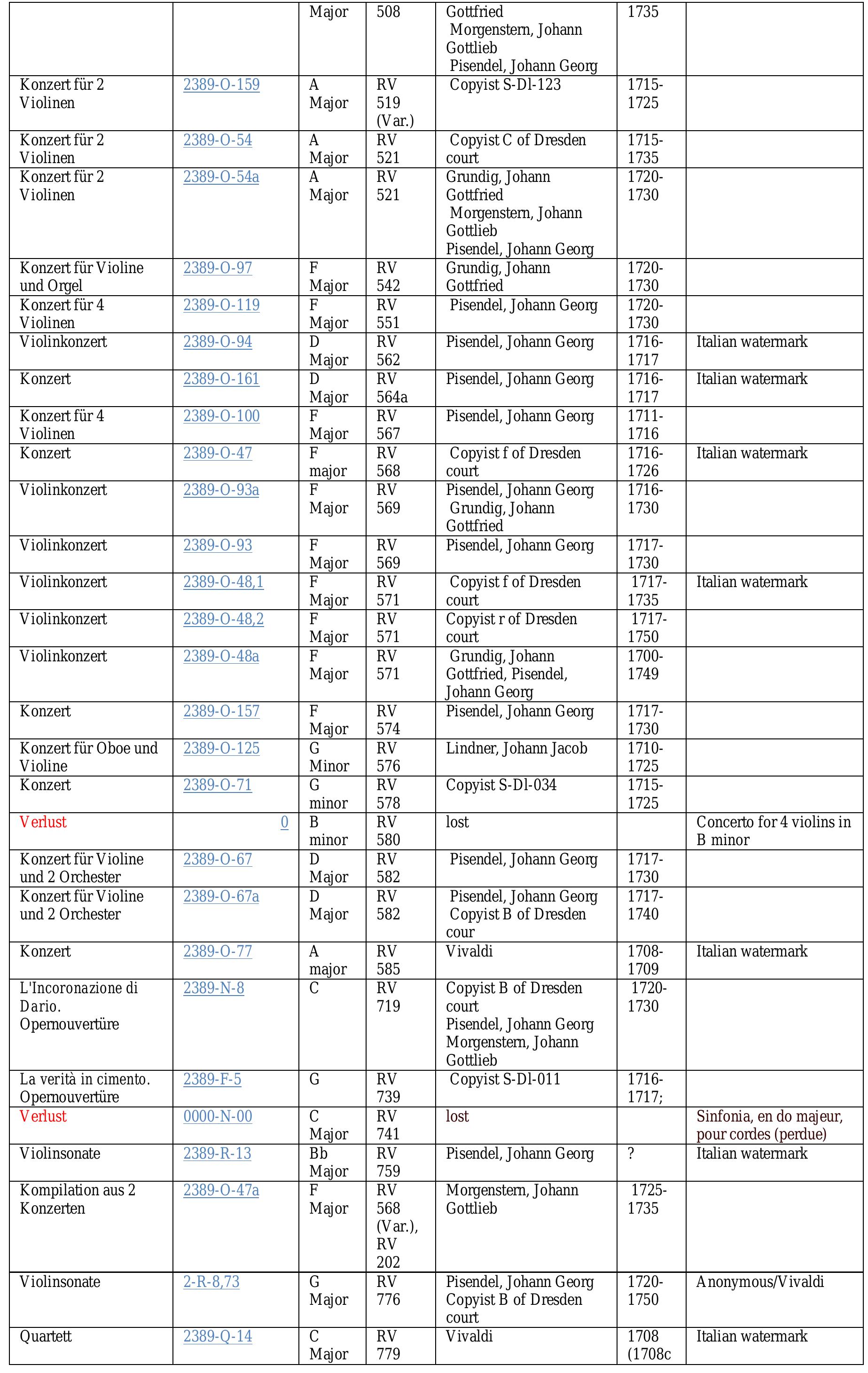
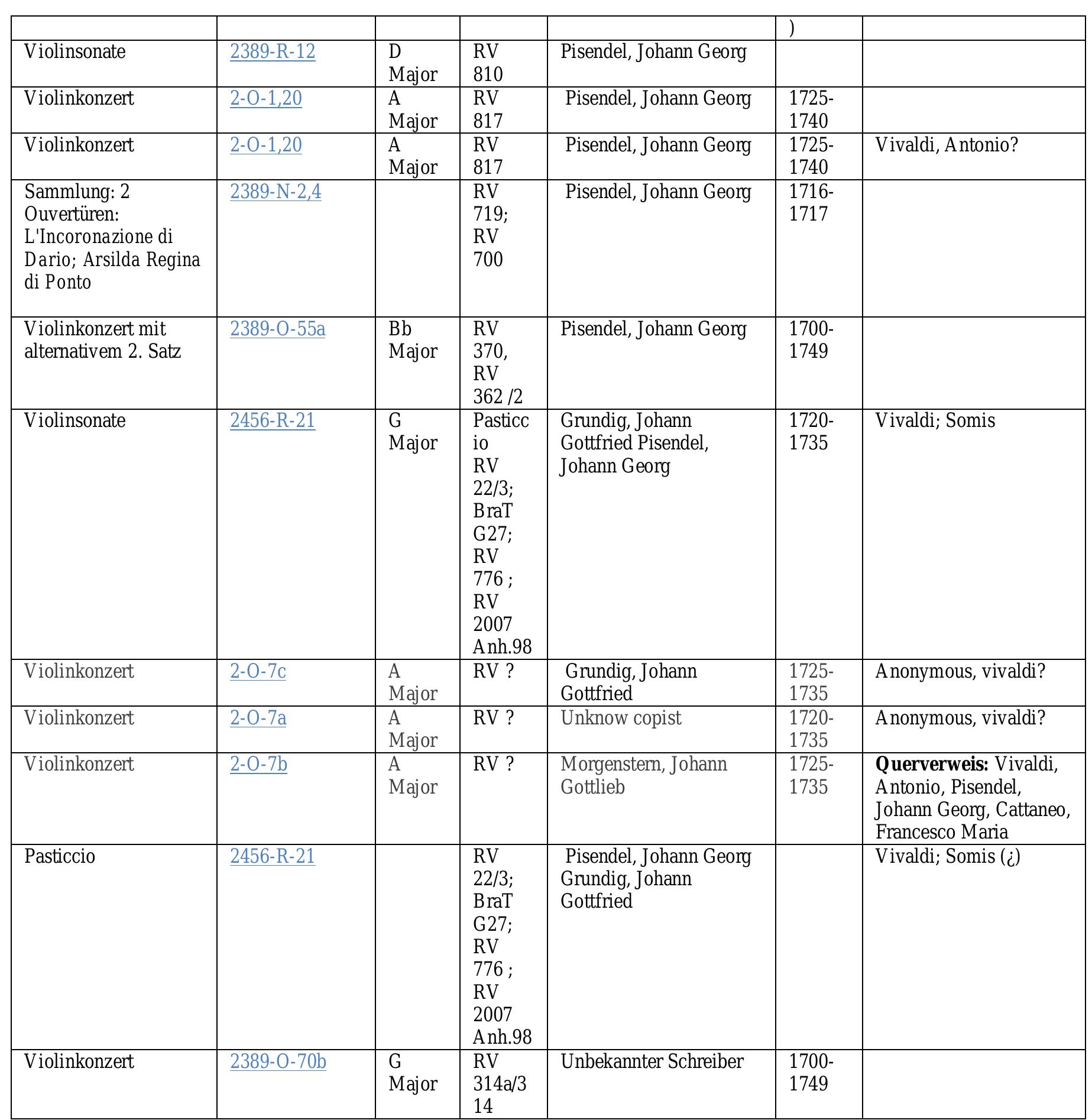
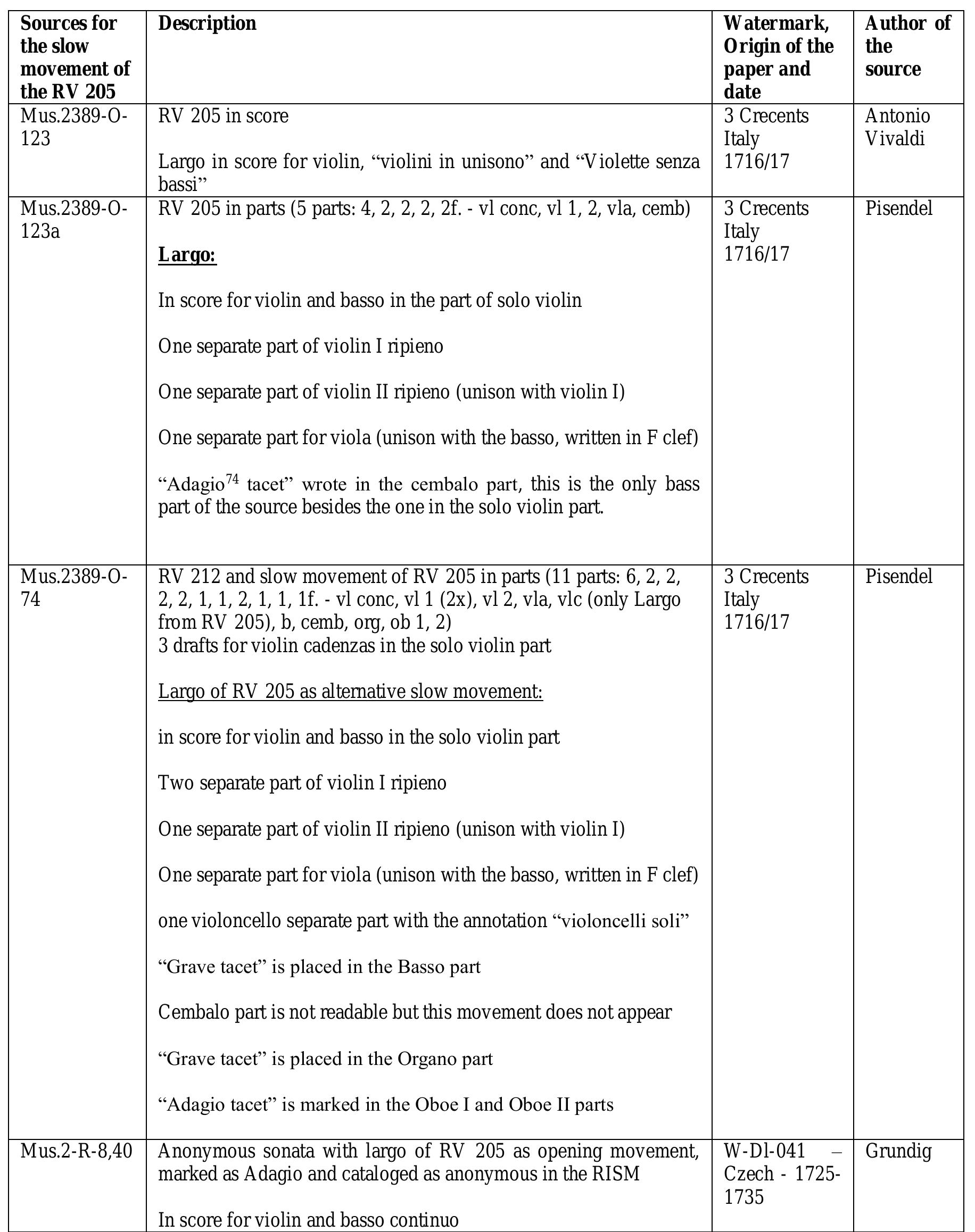
The Schrank II (Cabinet II) collection from the Die Sächsische Landesbibliothek – Staats- und Universitätsbibliothek Dresden (SLUB) is not only one of the most interesting archives open to the worldwide audience thanks to the new technologies but also one of the major archives of Vivaldi's instrumental music. Although the archive had been digitized and studied there are more than 60 sonatas for violin and continuo, around 12 string trio sonatas and most than 50 concertos remaining anonymous. A Sonata for violin and continuo, a Trio Sonata for violin, violoncello and continuo and a Concerto for violin and orchestra captured my attention due its similarities with Vivaldi. Through the analysis of the external features of the sources (paper, watermarks, copyist, etc.) and the analysis of the style and language of Vivaldi and its characteristics, the final goal of this work is to highlight the possibility Vivaldi an authorship as much as possible. In other words, attempting to put together the strongest proofs and facts that can be used to point to Vivaldi as author of the analyzed pieces. In the light of the results of the present research the Vivaldian attribution is very consistent.
Key takeaways
AI
AI
- The Schrank II collection houses over 60 anonymous Vivaldi works, including sonatas and concertos.
- Research identifies strong stylistic concordances linking anonymous pieces to Vivaldi, suggesting possible authorship.
- The study highlights the importance of both external and internal evidence in authenticating Vivaldi's works.
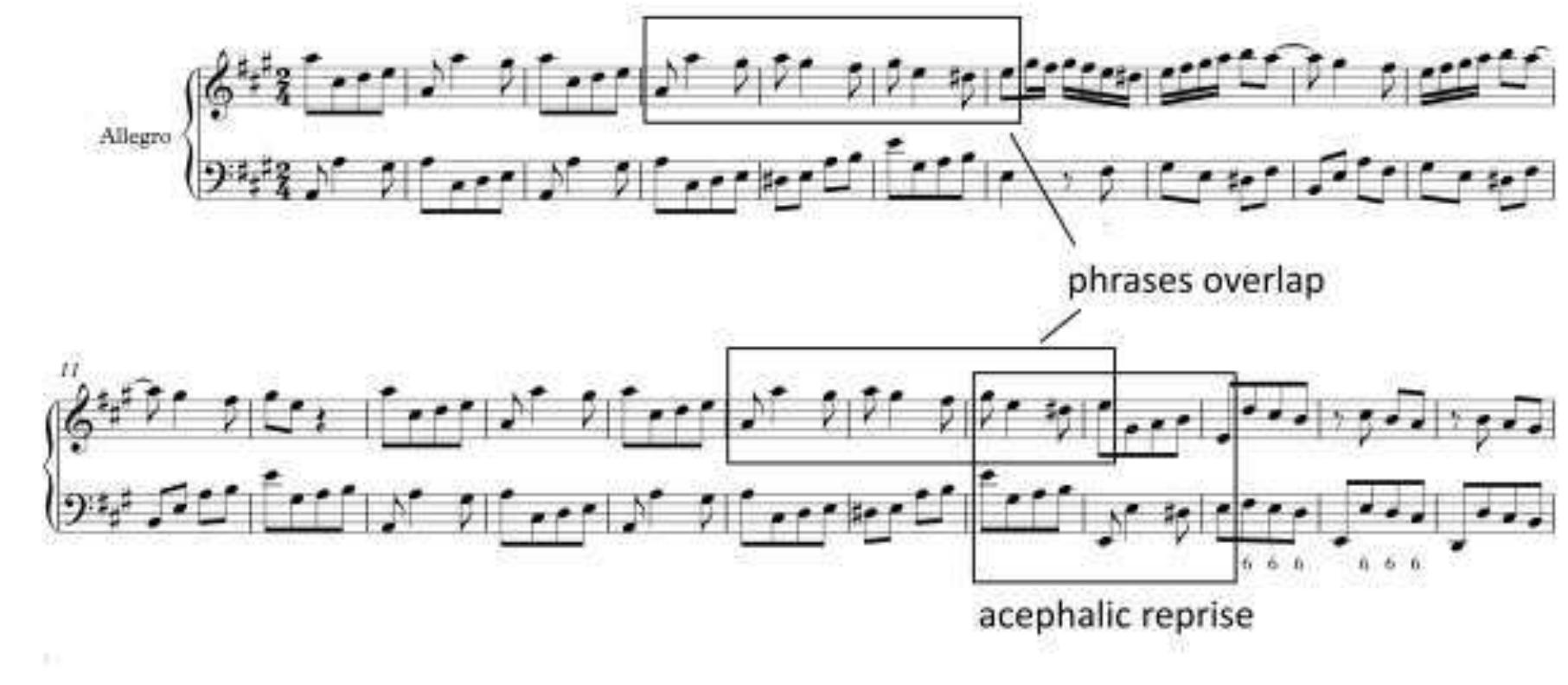
- Vivaldi's unique stylistic features, such as the 'acephalic' reprise and modular composition, facilitate attribution.
- New discoveries include a possible complete Vivaldi sonata and connections to RV 205 and RV 212.
References (110)
- - Talbot, Michael New Grove. Vivaldi. Points of Style - Pincerle, Marc. Vivaldi. Norton & Company, New York, 1955, Chapter II, Vivaldi's Music: Style and Form - Kolneder, Walter, Melodietypen bei Vivaldi, Amadeus Verlag, 1973
- - Brover-Lubovsky, Bella. Tonal Space in the Music of Antonio Vivaldi, Indiana University Press, 2008 - Michael Talbot. "Vivaldi, Antonio." Grove Music Online. Oxford Music Online. Oxford University Press, accessed August 8, 2014 http://www.oxfordmusiconline.com/subscriber/article/grove/music/40120pg7.
- Brover-Lubovsky, Bella. Tonal Space in the Music of Antonio Vivaldi, Indiana University Press, 2008, p. 202
- Brover-Lubovsky, Bella. Tonal Space in the Music of Antonio Vivaldi, Indiana University Press, 2008, p. 202 -203
- Talbot, Michael. Vivaldi. J.M. Dent, London, 1993, Chapter V. "Vivaldi´s Musical Style" 91
- Talbot, Michael. Vivaldi. J.M. Dent, London, 1993, Chapter V. "Vivaldi´s Musical Style" - Talbot, Michael New Grove. Vivaldi. Points of Style - Talbot, Michael. The Vivaldi Compendium. The Boydell Press, 2012
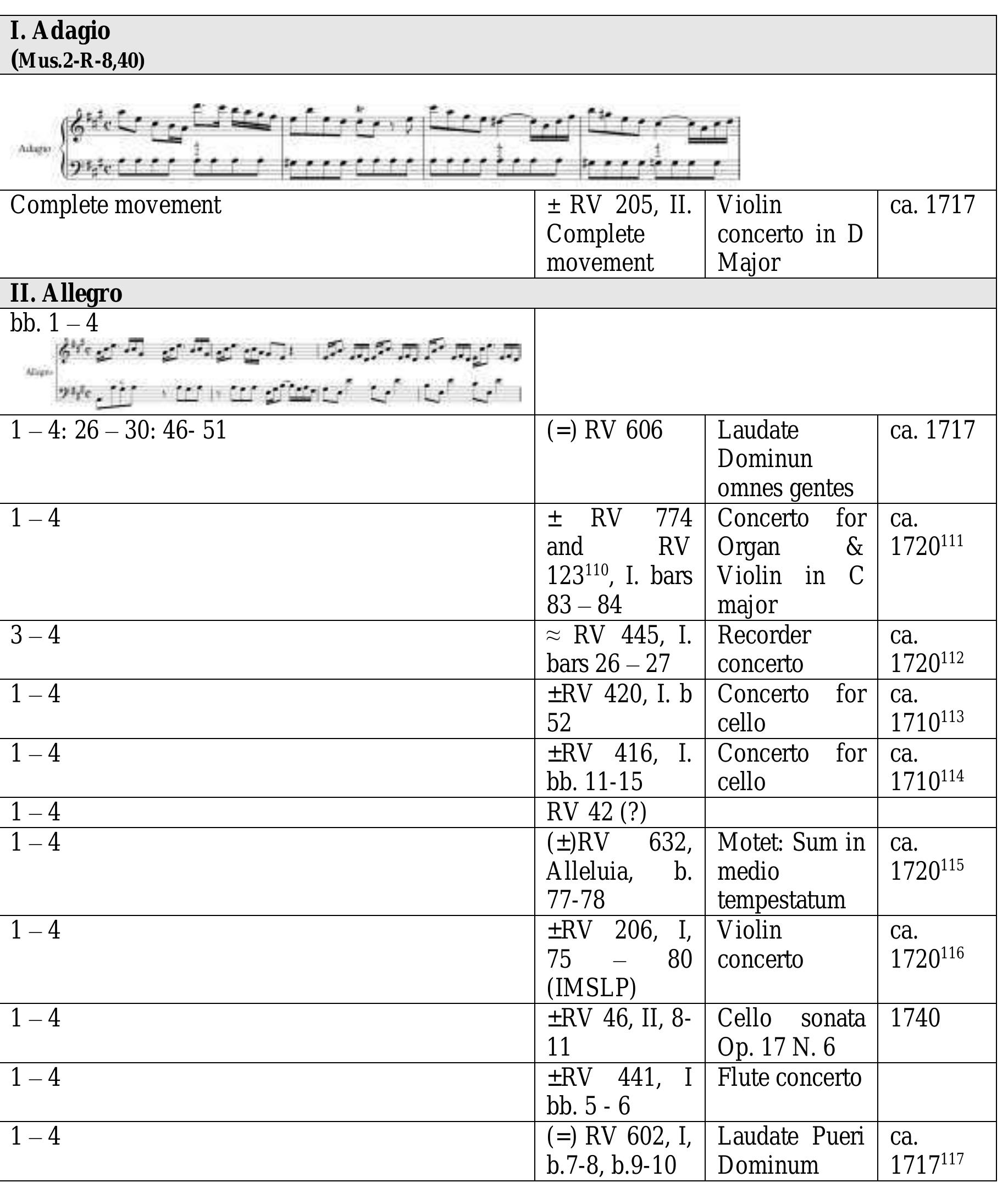
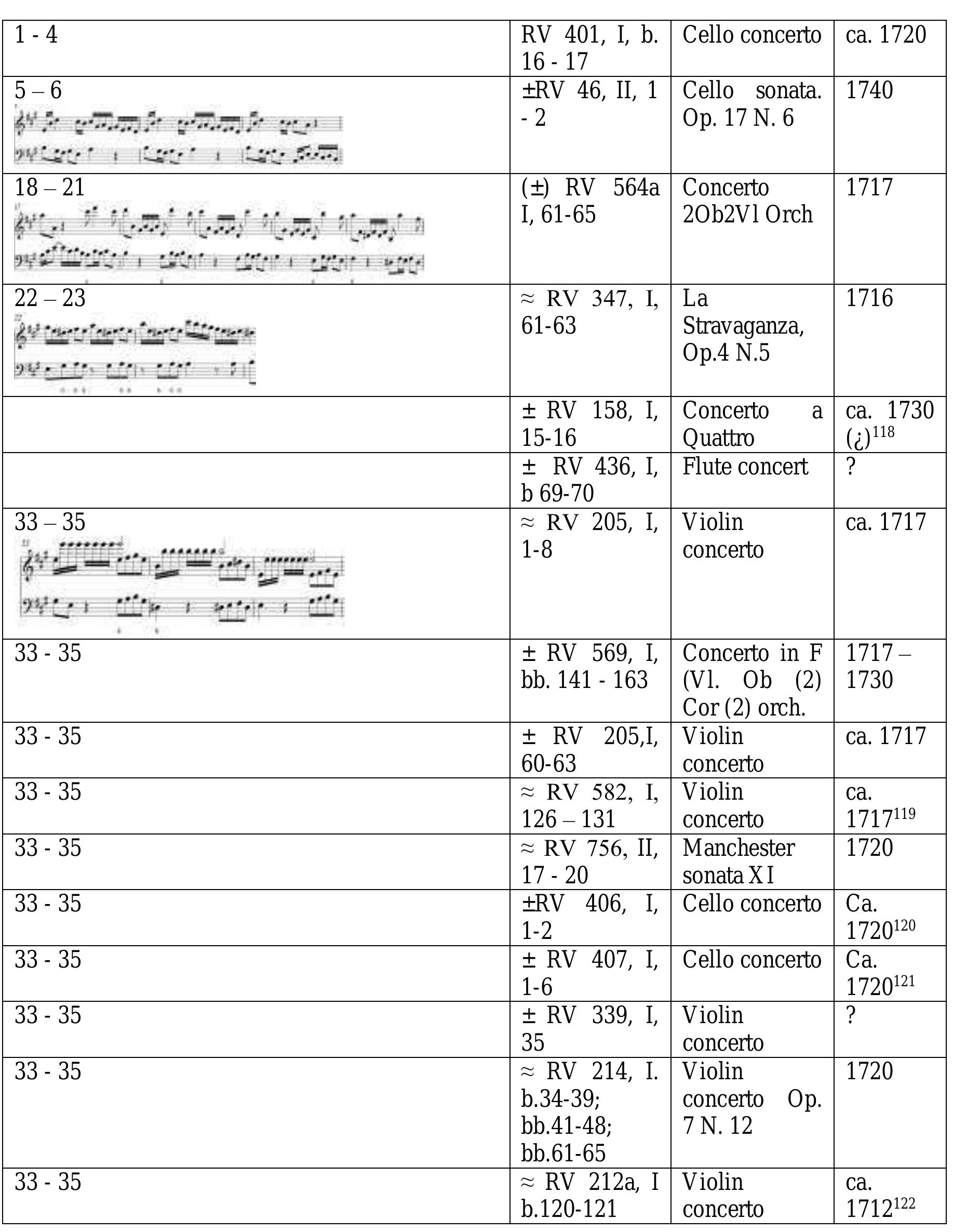
- - Pincherle, Marc. Vivaldi. Norton & Company, New York, 1955, Chapter II, Vivaldi's Music: Style and Form - Brover-Lubovsky, Bella. Tonal Space in the Music of Antonio Vivaldi, Indiana University Press, 2008 102 "un moto di semicrome spezate ove una voce inferiore esegue il 'bassetto' ad una voce superiore che ribate". Sardelli, Federico Maria. Catalogo delle concordanze musicali vivaldiane, L. S. Olschki Editore, 2012, p. LIX 110 First movement is similar in RV 775 and RV 123
- Ryom, Peter Antonio Vivaldi Thematisch-systematisches Verzeichnis seiner Werke (RV) Weisbaden, Breitkopf & Härtel, 2007, p. 55
- Heller, Karl. Vivaldi, The Red Priest. Amadeus Press, USA, 1997, p. 182
- Heller, Karl. Vivaldi, The Red Priest. Amadeus Press, USA, 1997, p. 76
- Heller, Karl. Vivaldi, The Red Priest. Amadeus Press, USA, 1997, p. 76 115 RISM ID no.: 212000235 116 RISM-A/II-212001661
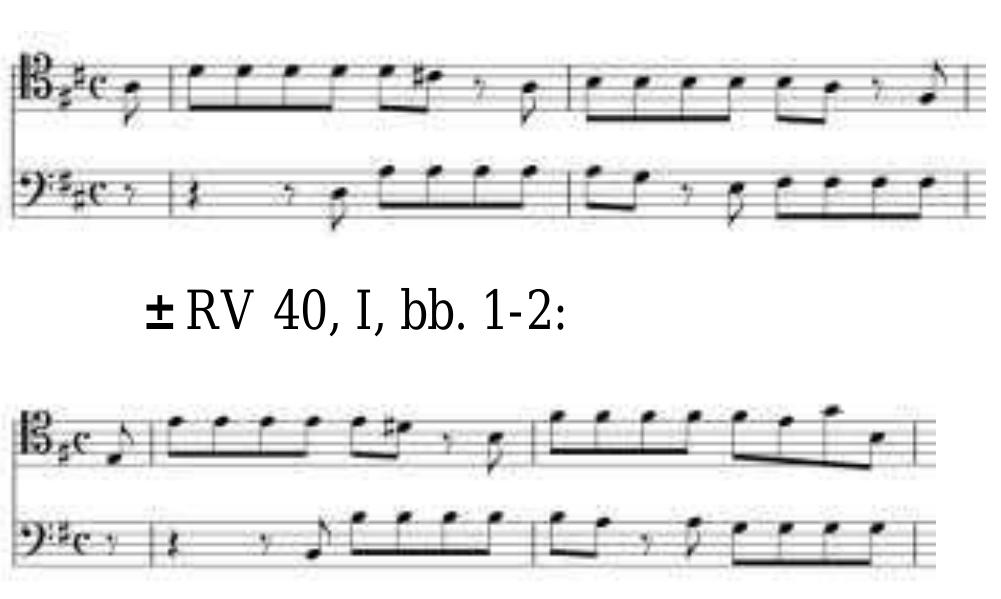
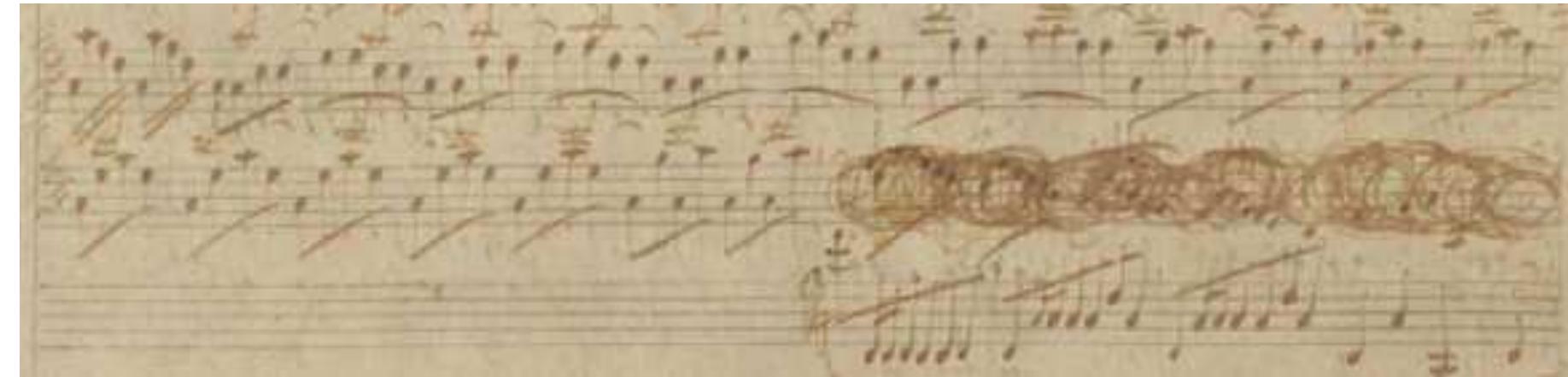
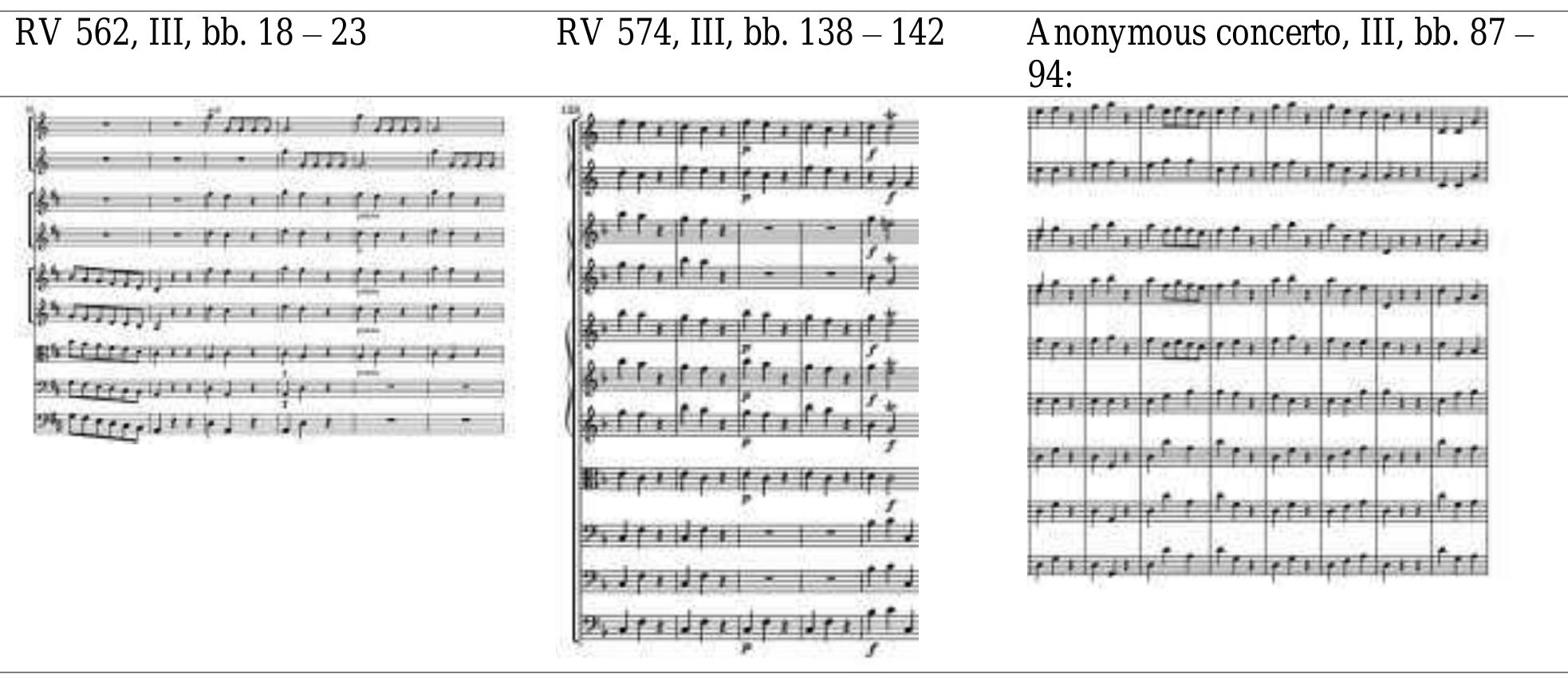
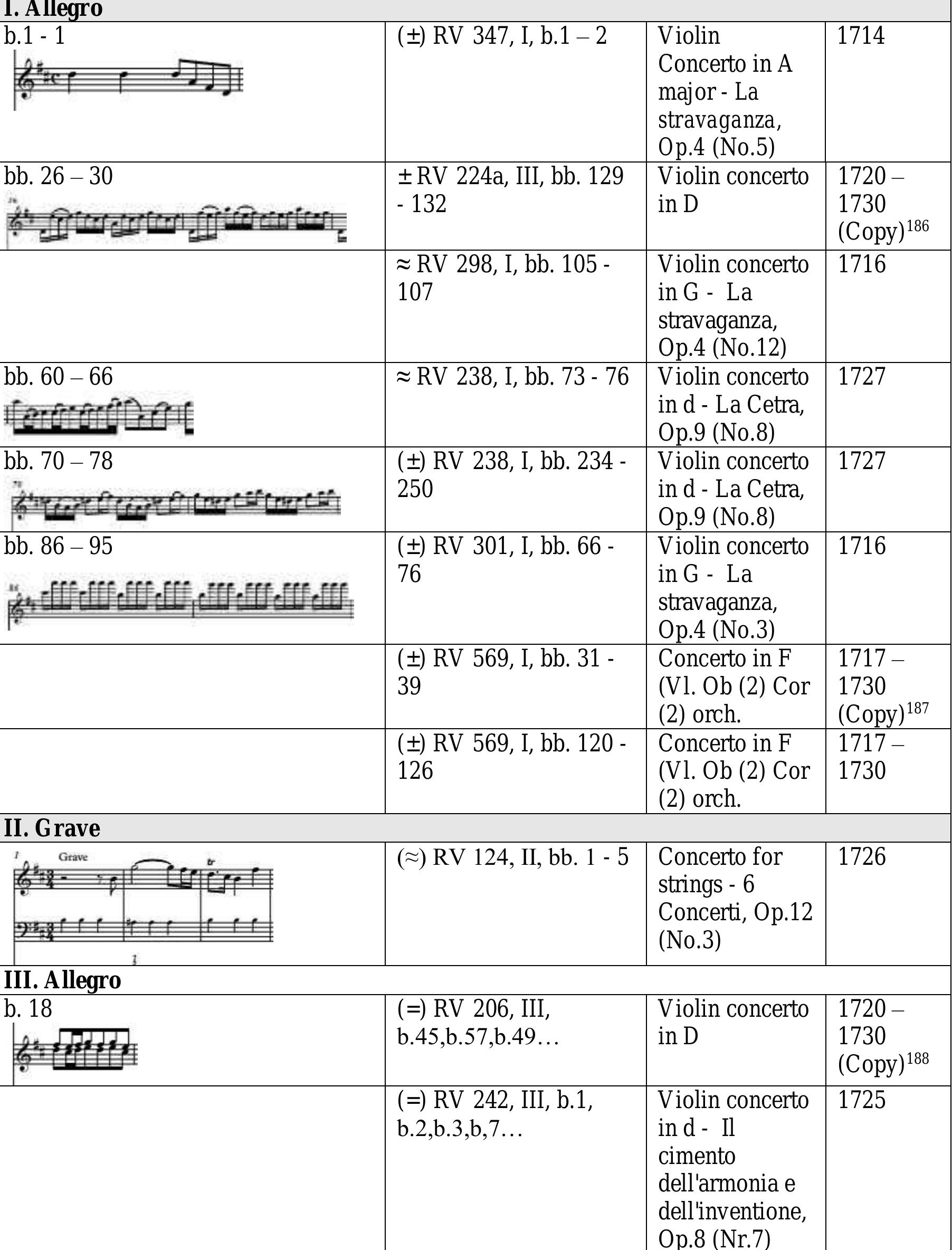
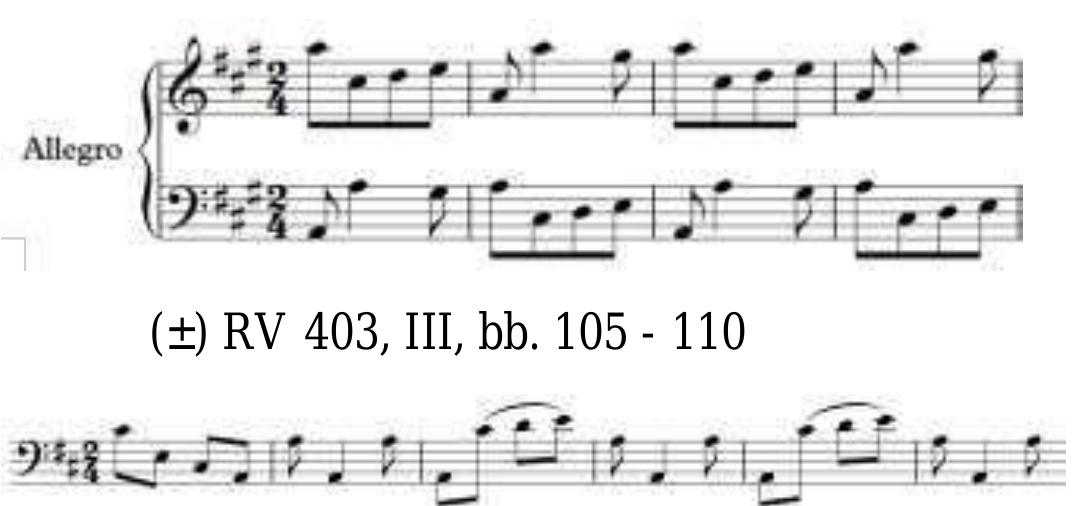
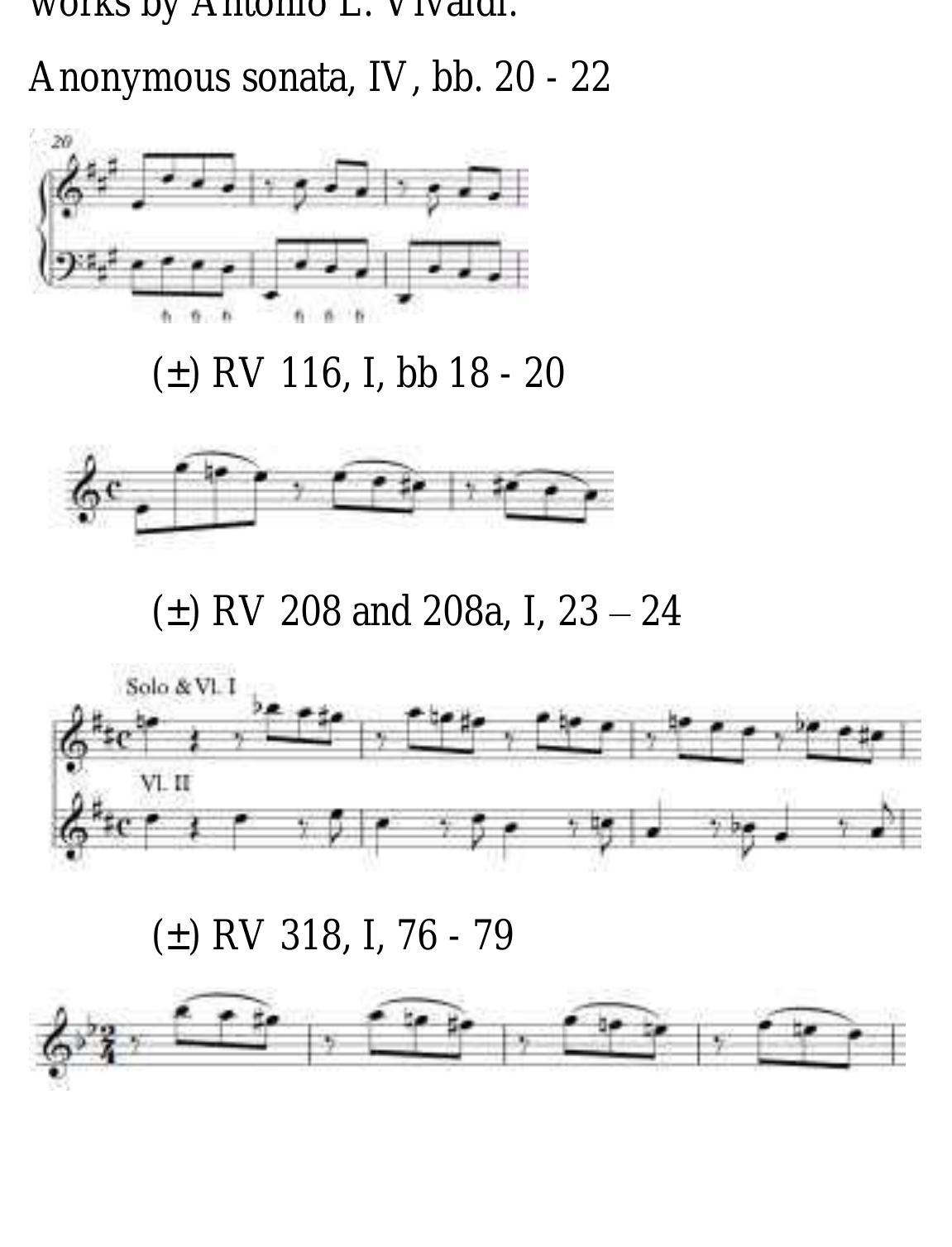
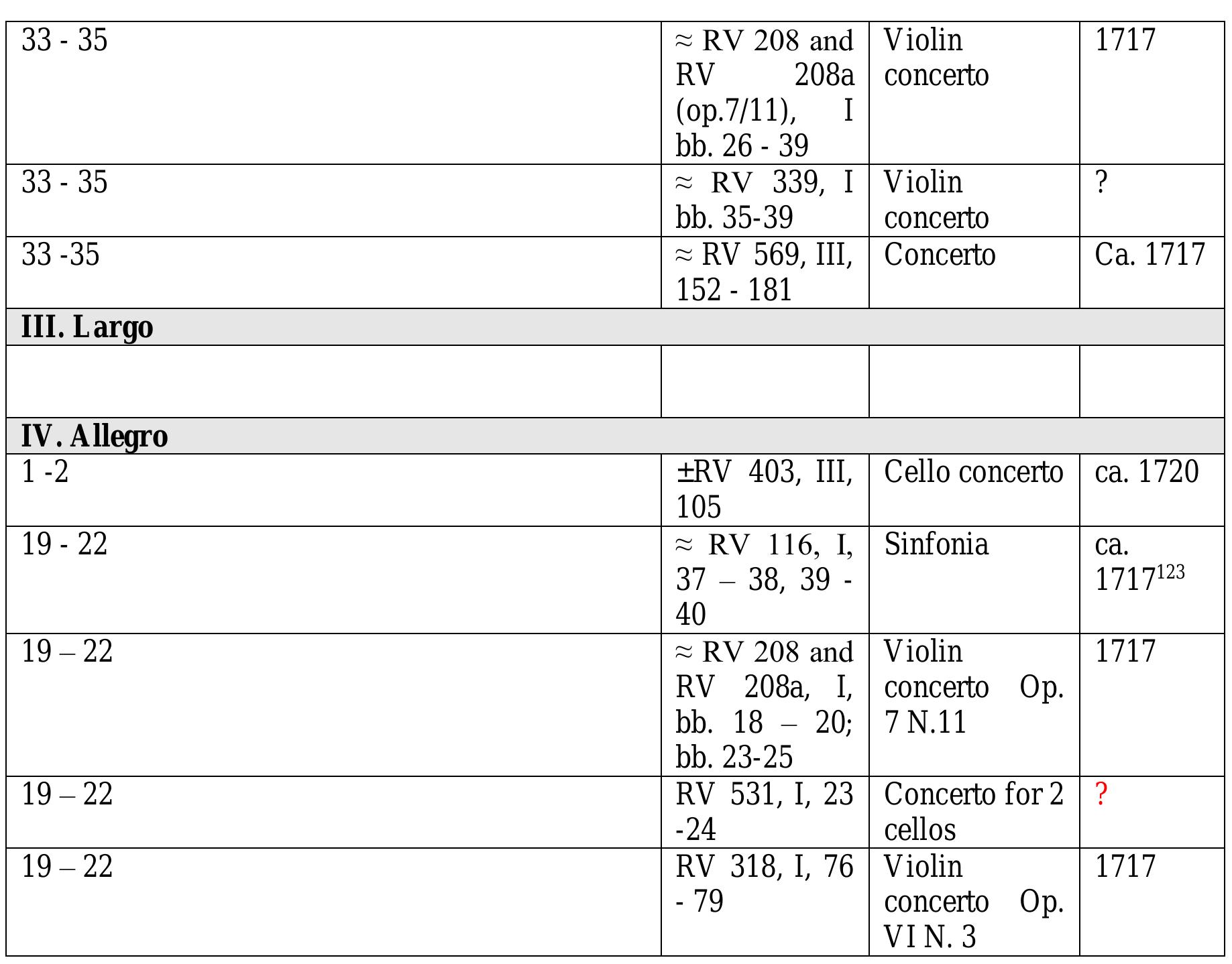
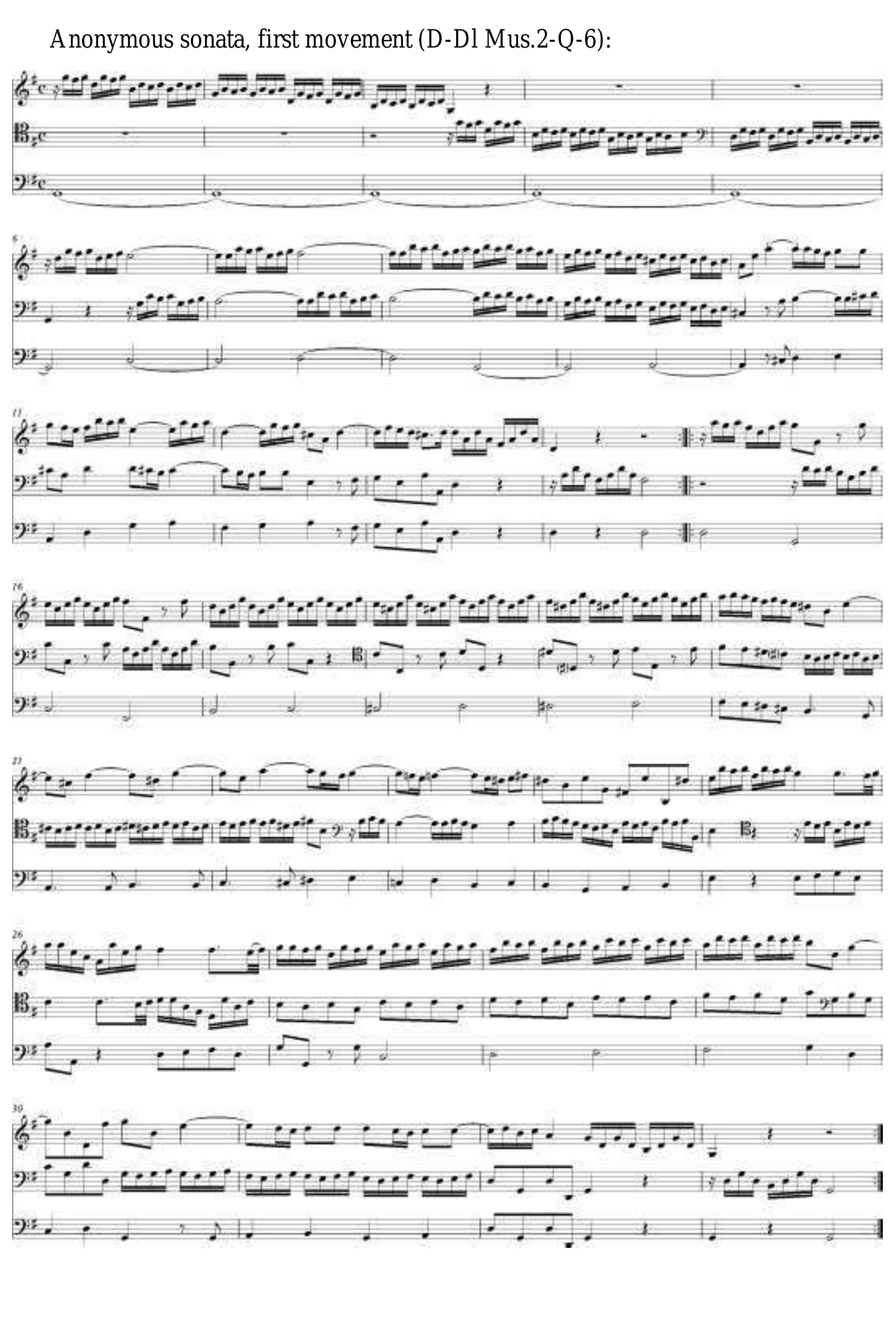
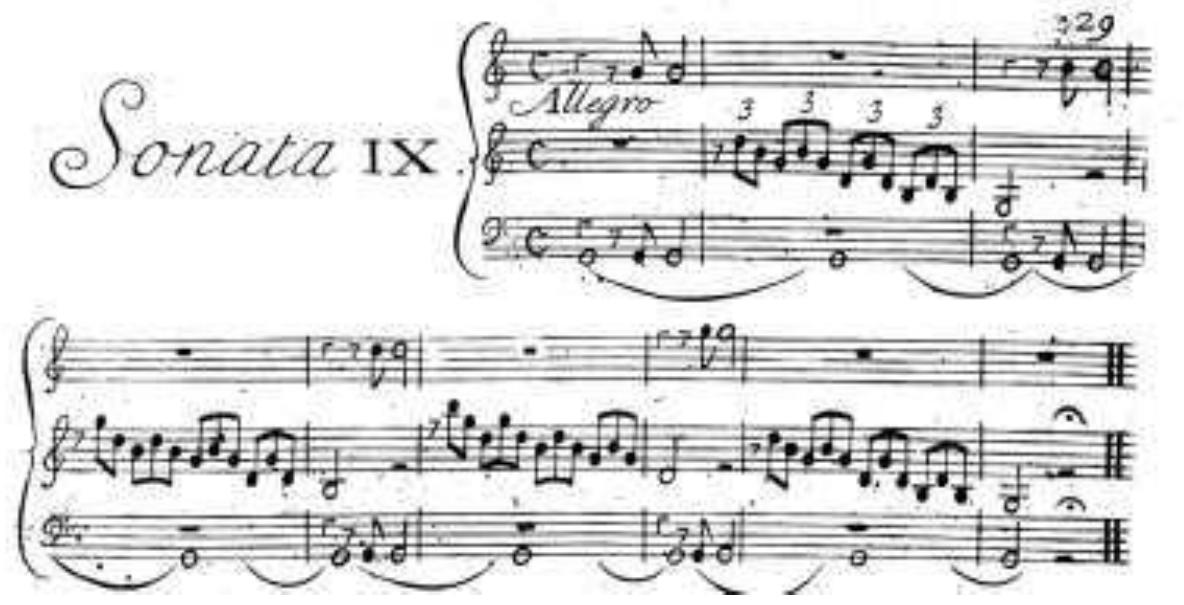
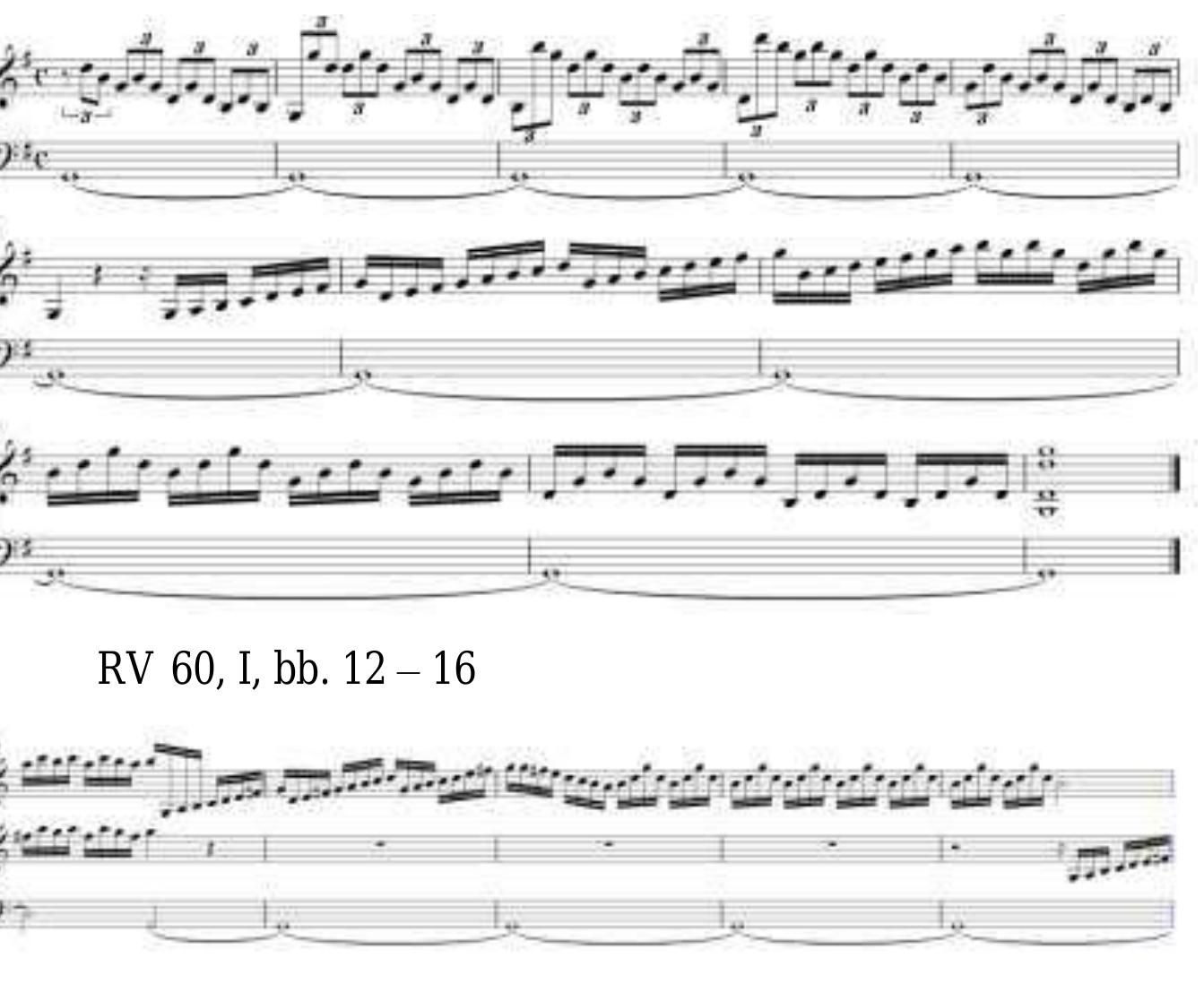
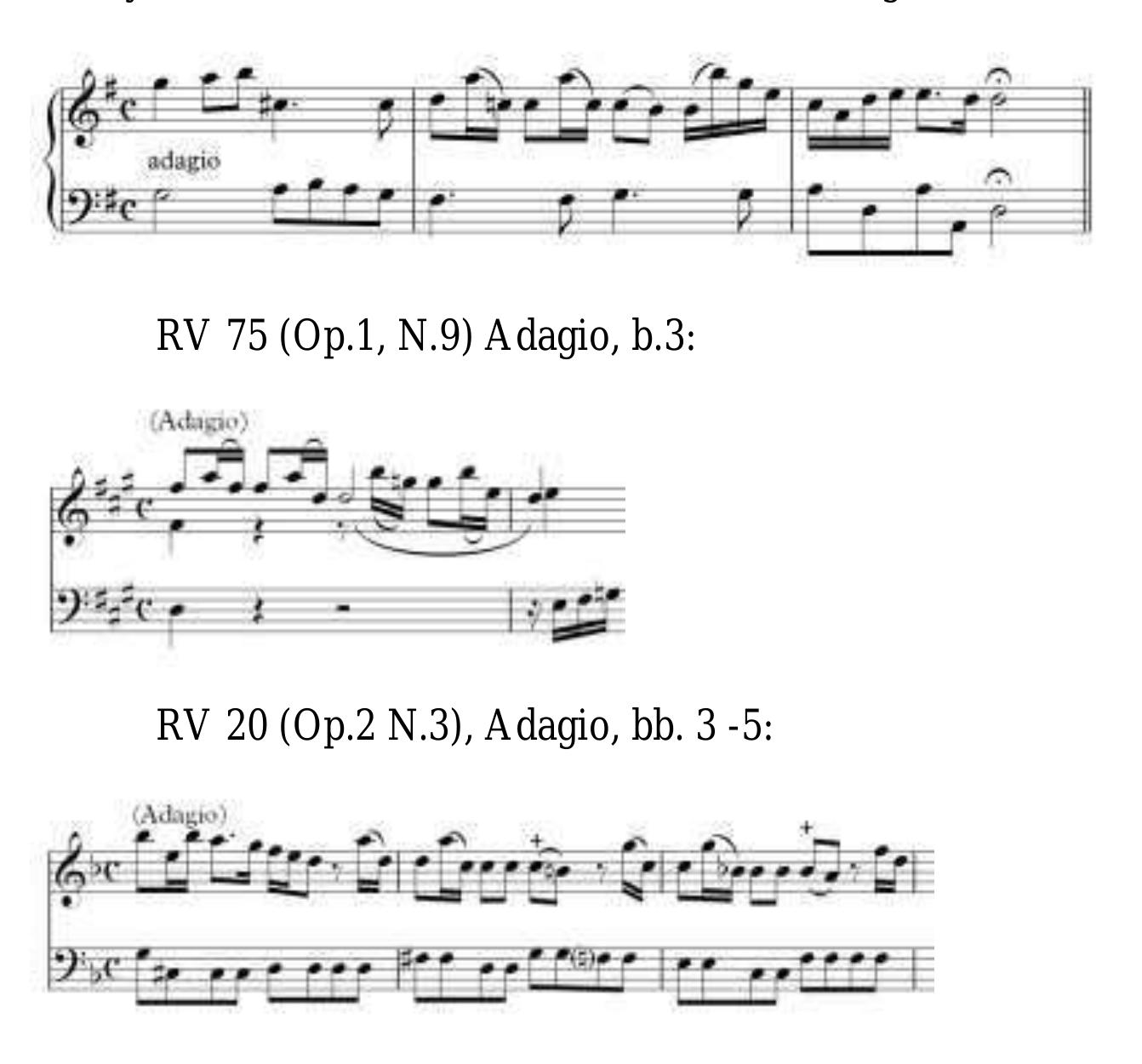
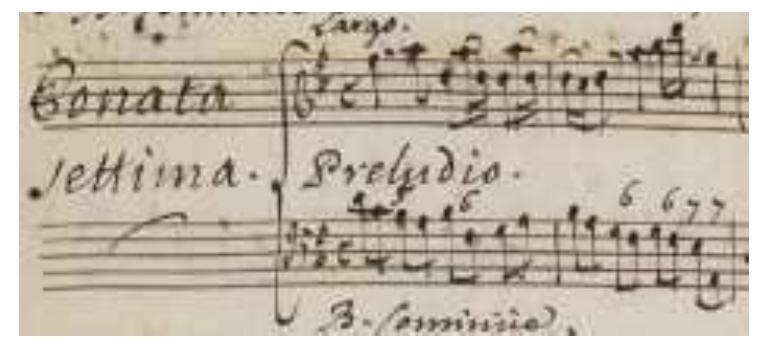
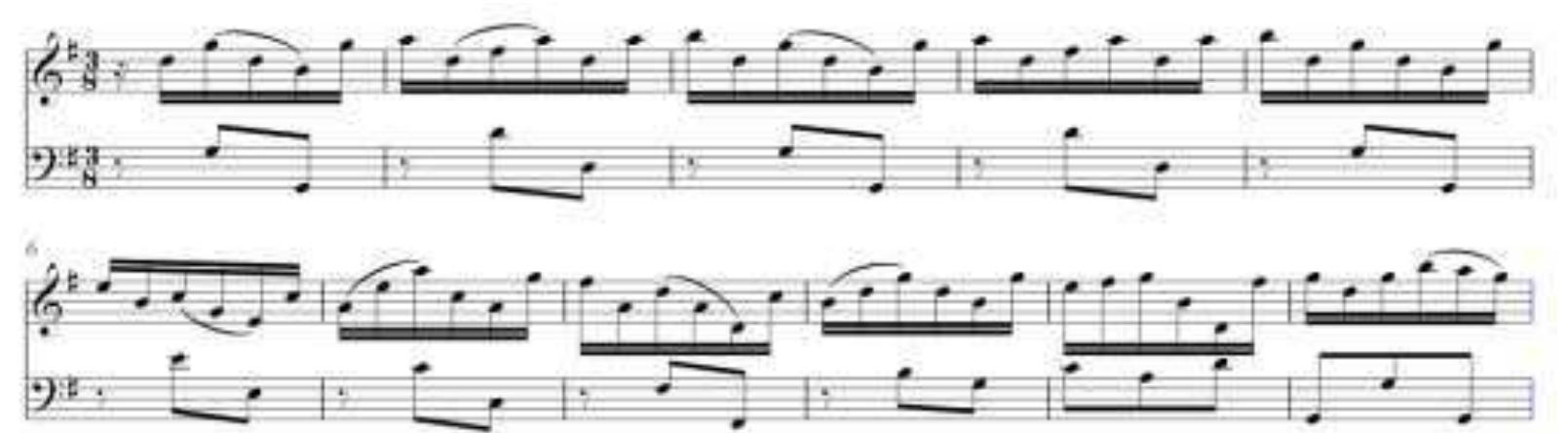
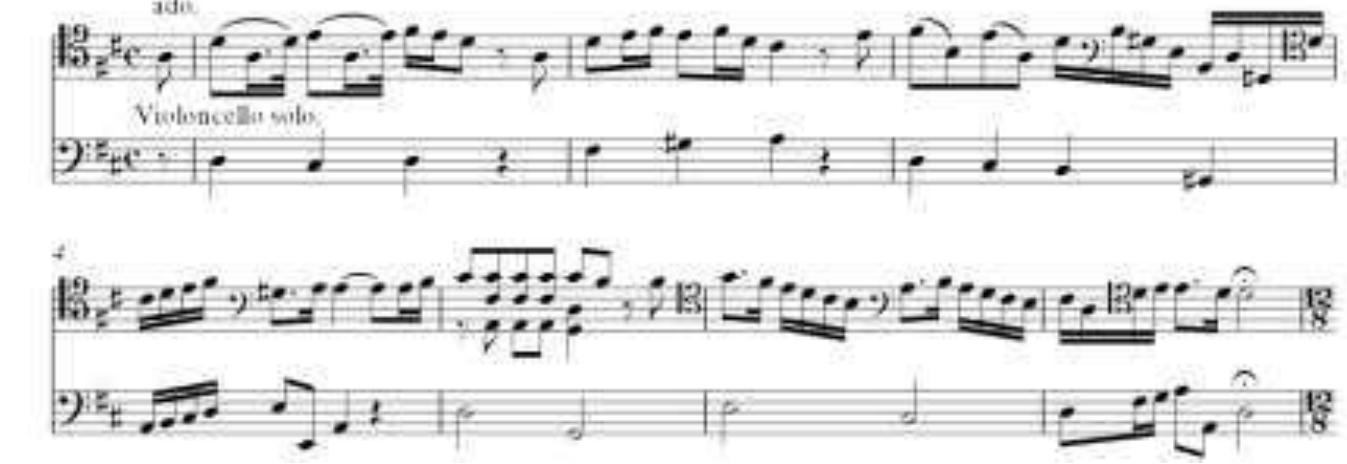
- Talbot, Michael, Vivaldi, Laudate Pueri Dominum, Edizione Critica, Ricordi Milano, 1995. Note Critiche, p. 115 Anonymous sonata, first movement (D-Dl Mus.2-Q-6): bass. The word is in works attributed to Torelli". This feature is used widely also by Vivaldi and demonstrates the influence of Torelli and Corelli on Vivaldi's early works. See: Talbot, Michael. Vivaldi. J.M. Dent, London, 1993, p. 140 and Talbot, Michael. The Vivaldi Compendium. The Boydell Press, 2012, p. 139 RV 75 (Op. 1 N.9), Incipit: RV 60, first movement: RV 562, I, bb. 76 -77: RV 569, III, bb. 159 -162: RV 212, Cadenza II, beginning: Anonymous concerto, I, bb. 31 -33: B. -"One -three formula". In other words, a single note followed by three repeated notes. Usually, those repeated notes are use as harmonic pedal note.
- Autograph, RV 690. Mio cor, povero cor. Aria XVII. Ad infiammar quel seno, bb. 6-7:
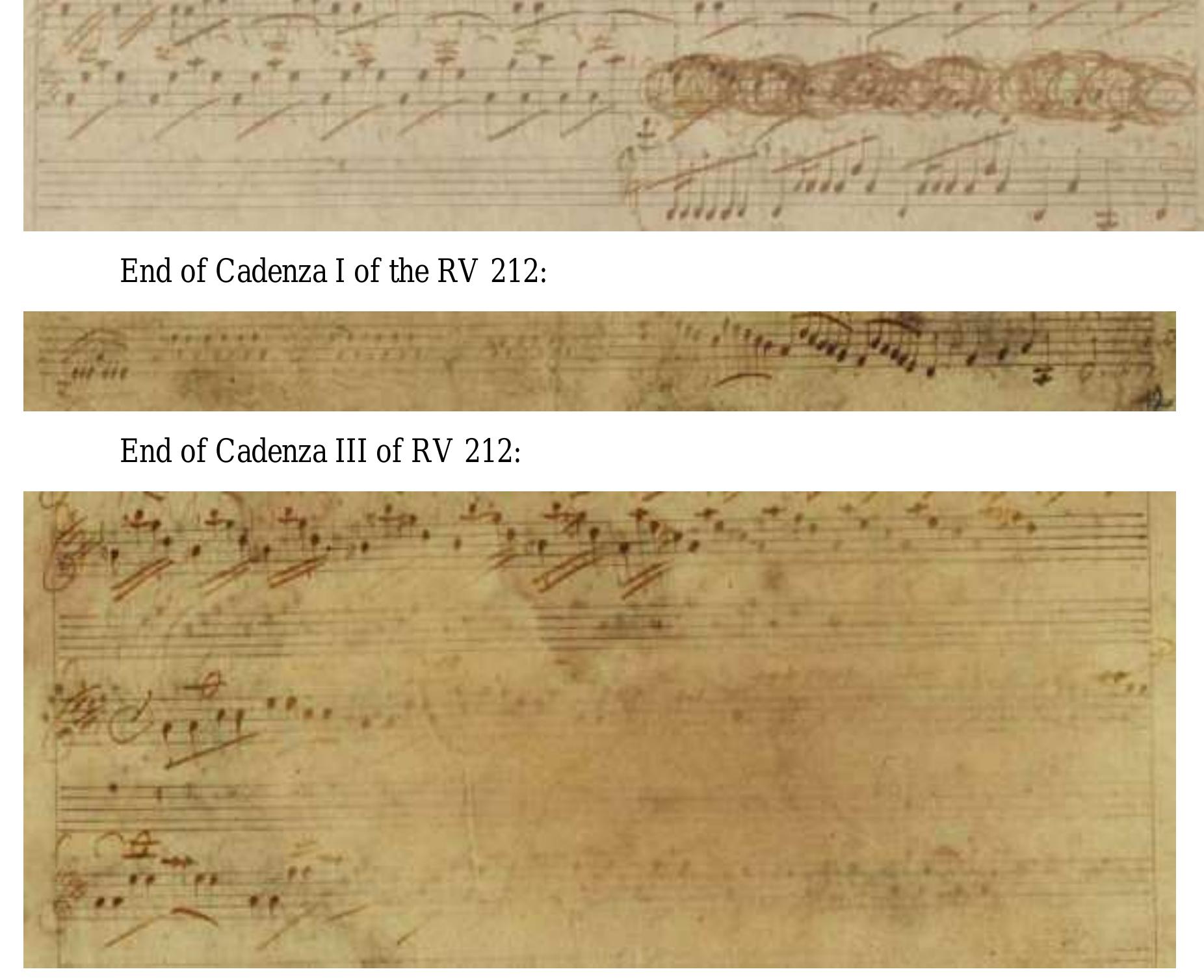
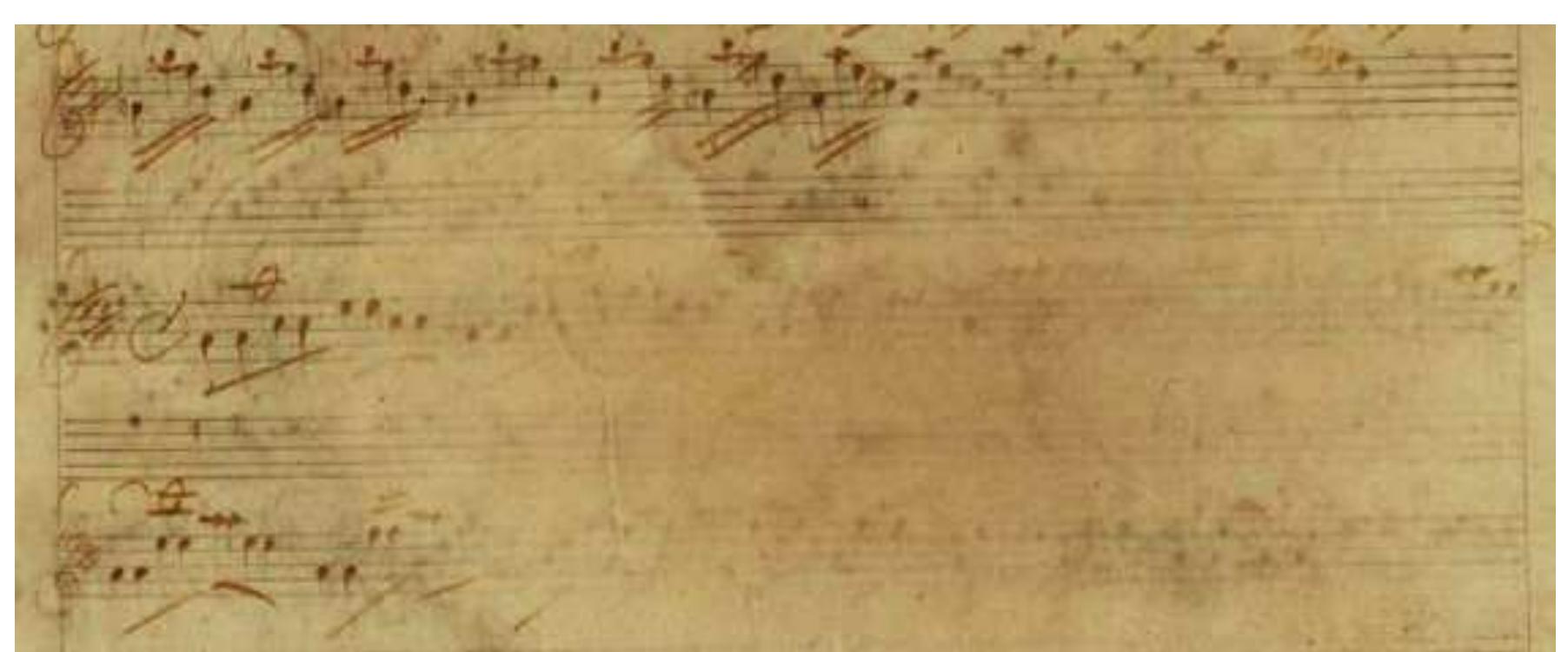
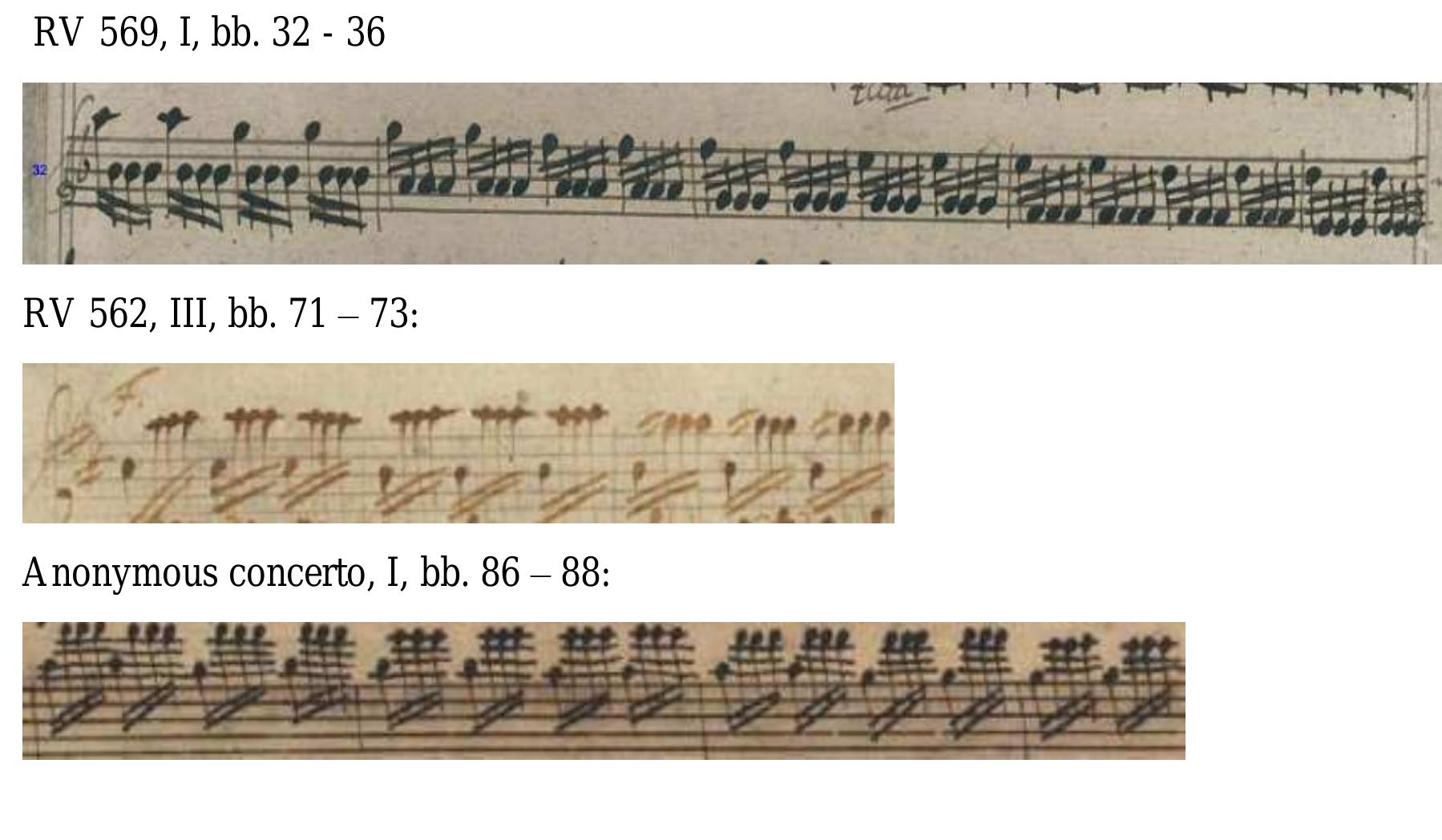
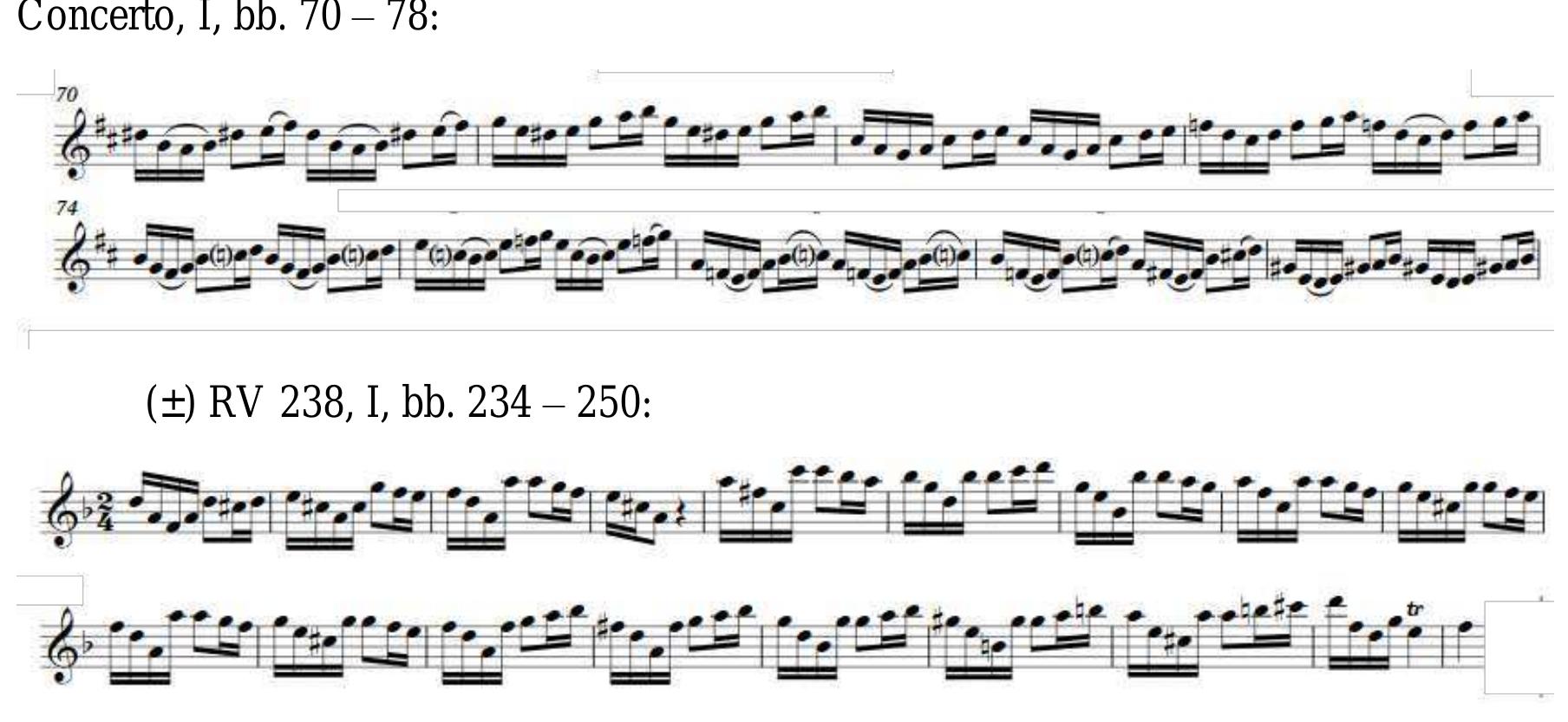
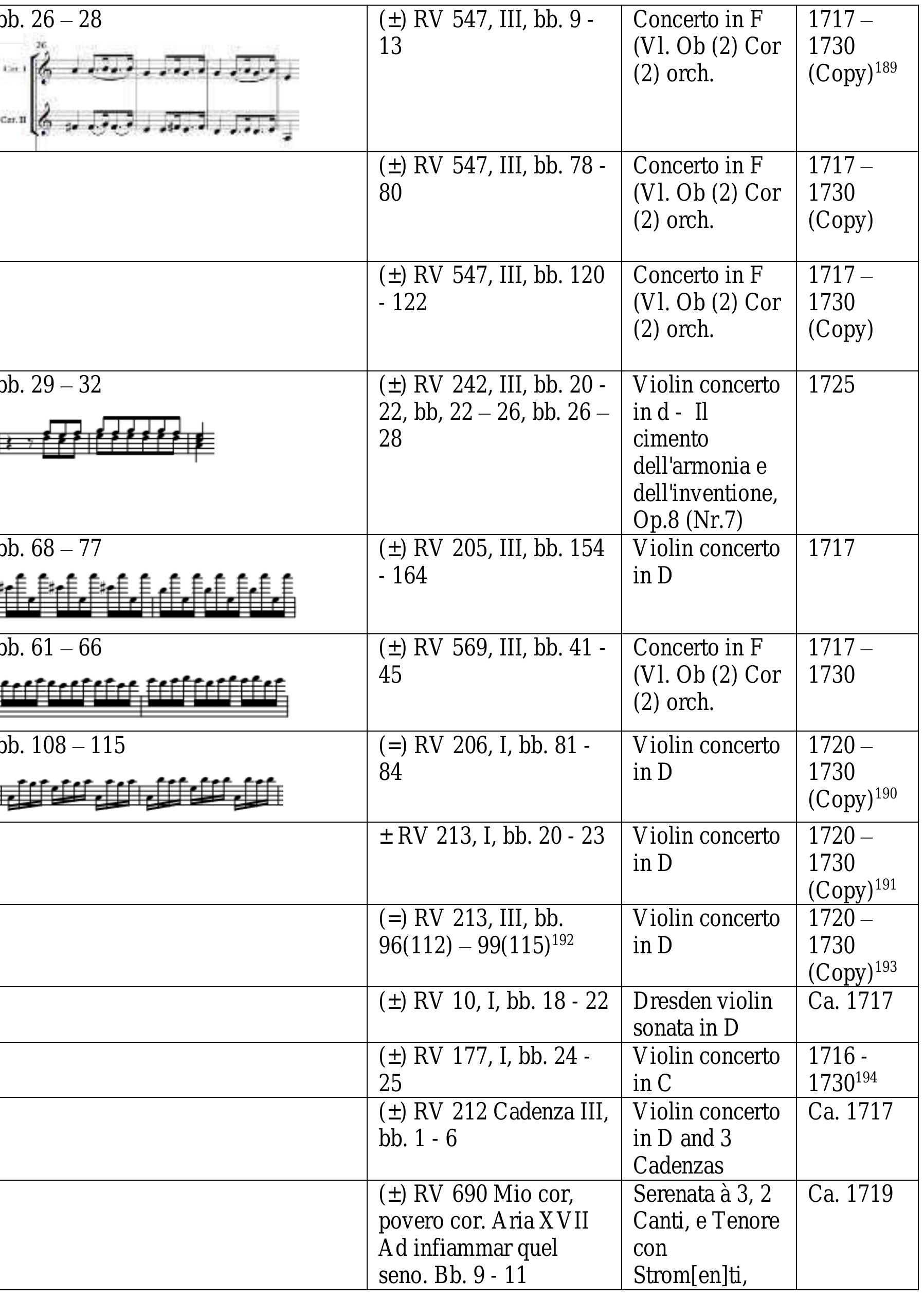
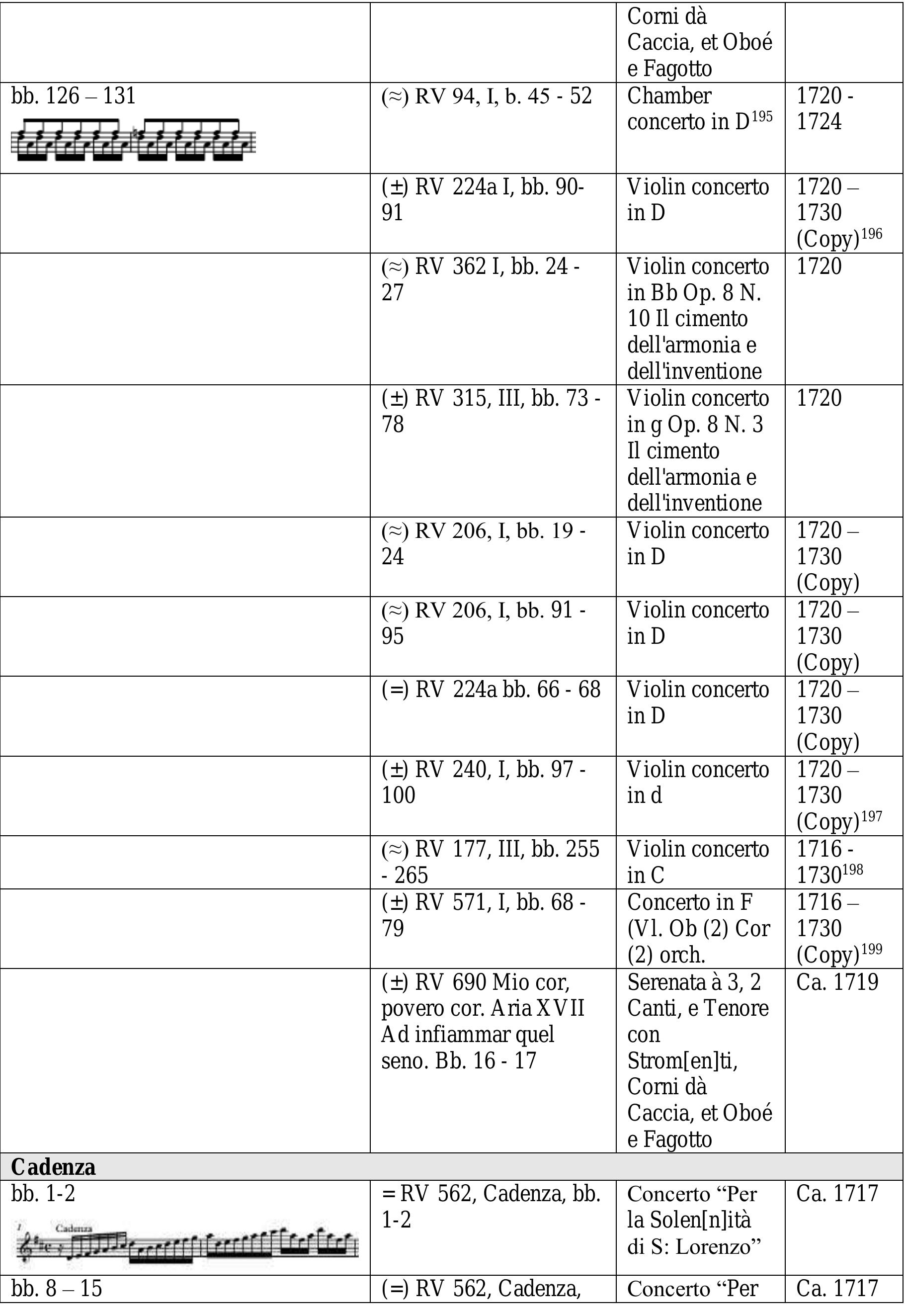
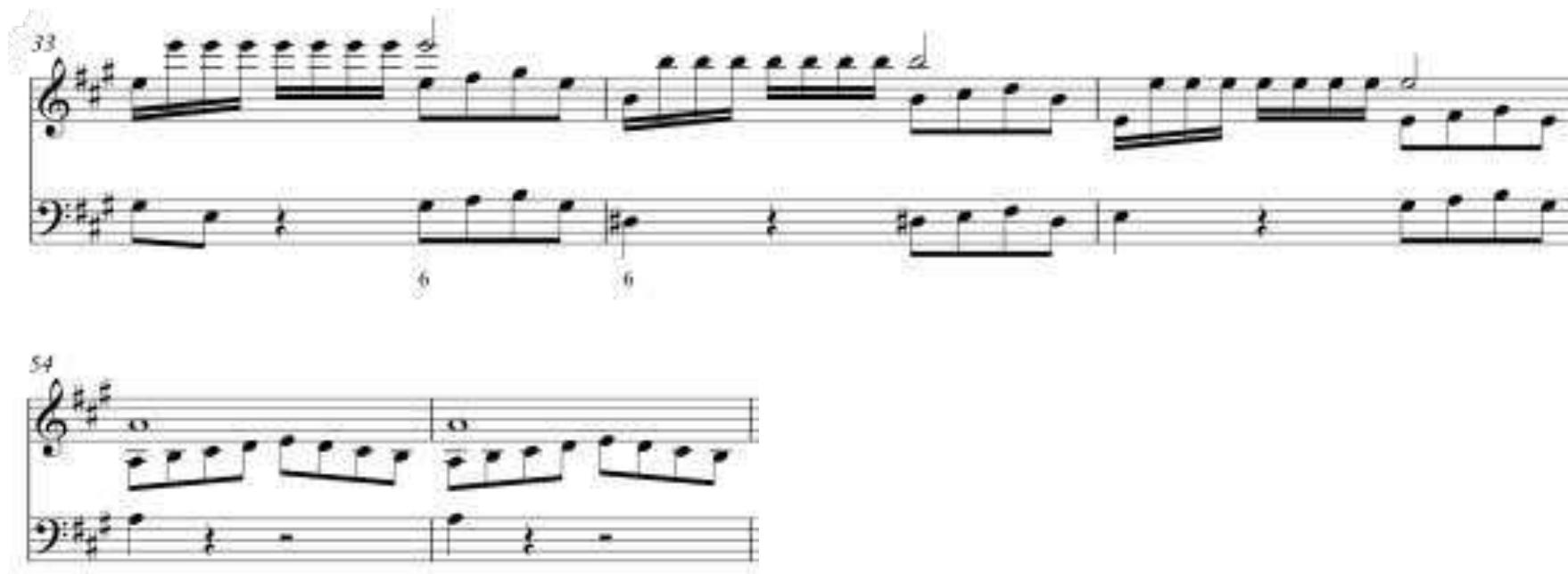
- See Appendix I. Ostinato and Pedal notes. 176 See page 35 177 "un moto di semicrome spezate ove una voce inferiore esegue il 'bassetto' ad una voce superiore che ribate". Sardelli, Federico Maria. Catalogo delle concordanze musicali vivaldiane, L. S. Olschki Editore, 2012, p. LIX RV 574, I, bb.83 -85: RV 562, I, bb. 54 -55: A common resource is to use this "one-three formula" to develop a harmonic progression 7 -6. 178 RV 569, I, bb. 32 -36 RV 562, III, bb. 71 -73: Anonymous concerto, I, bb. 86 -88: C. -Ascending sequences to very high notes, using open strings as pedal note. RV 574, I, bb. 76 -78 RV 212, Cadenza III, beginning: RV 205, III, bb. 249 -253
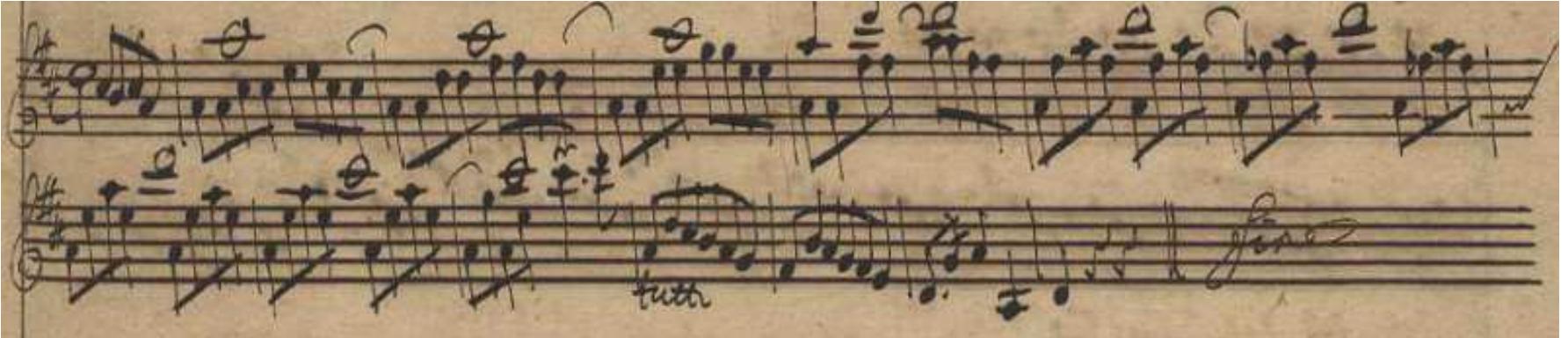
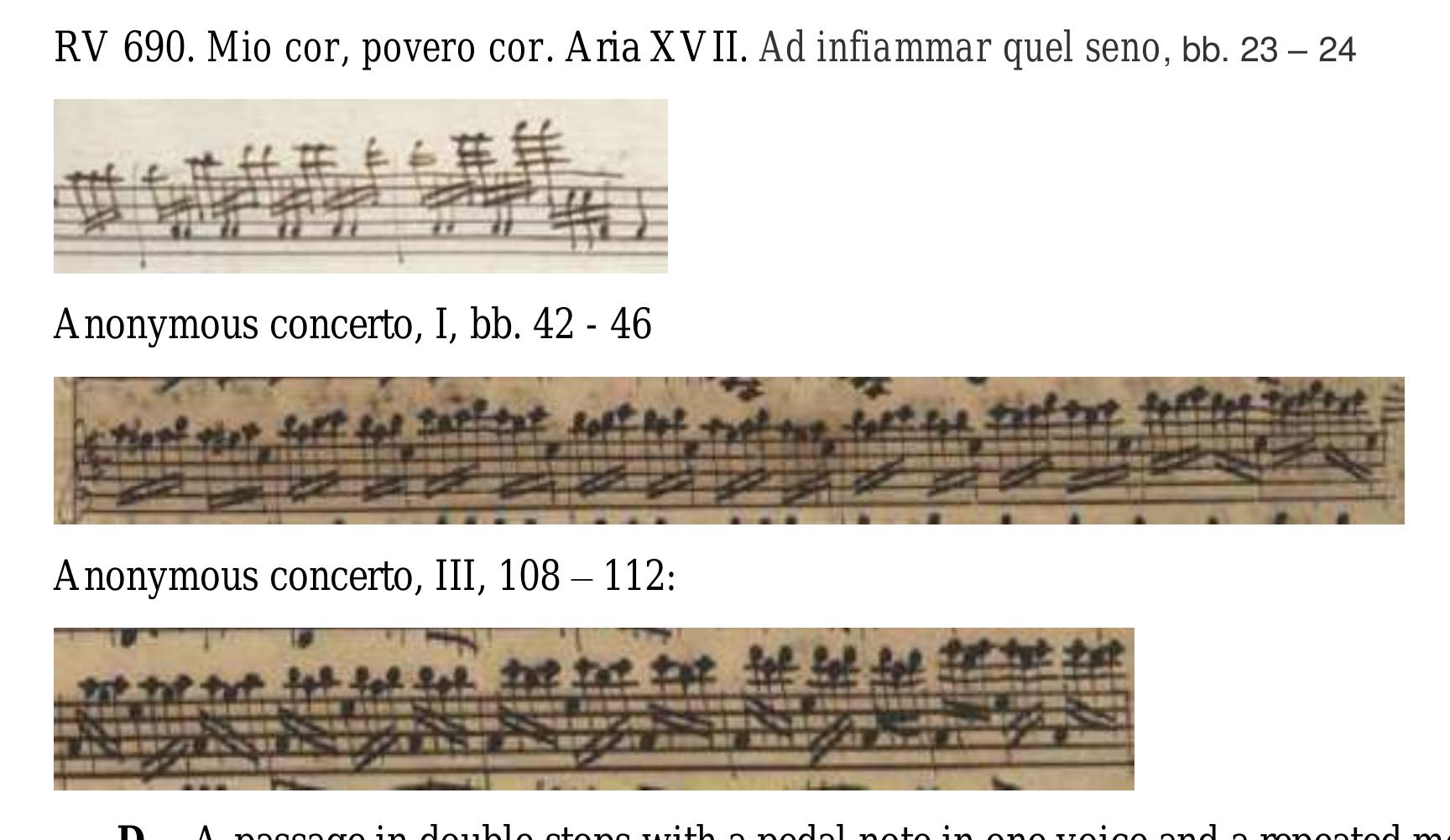
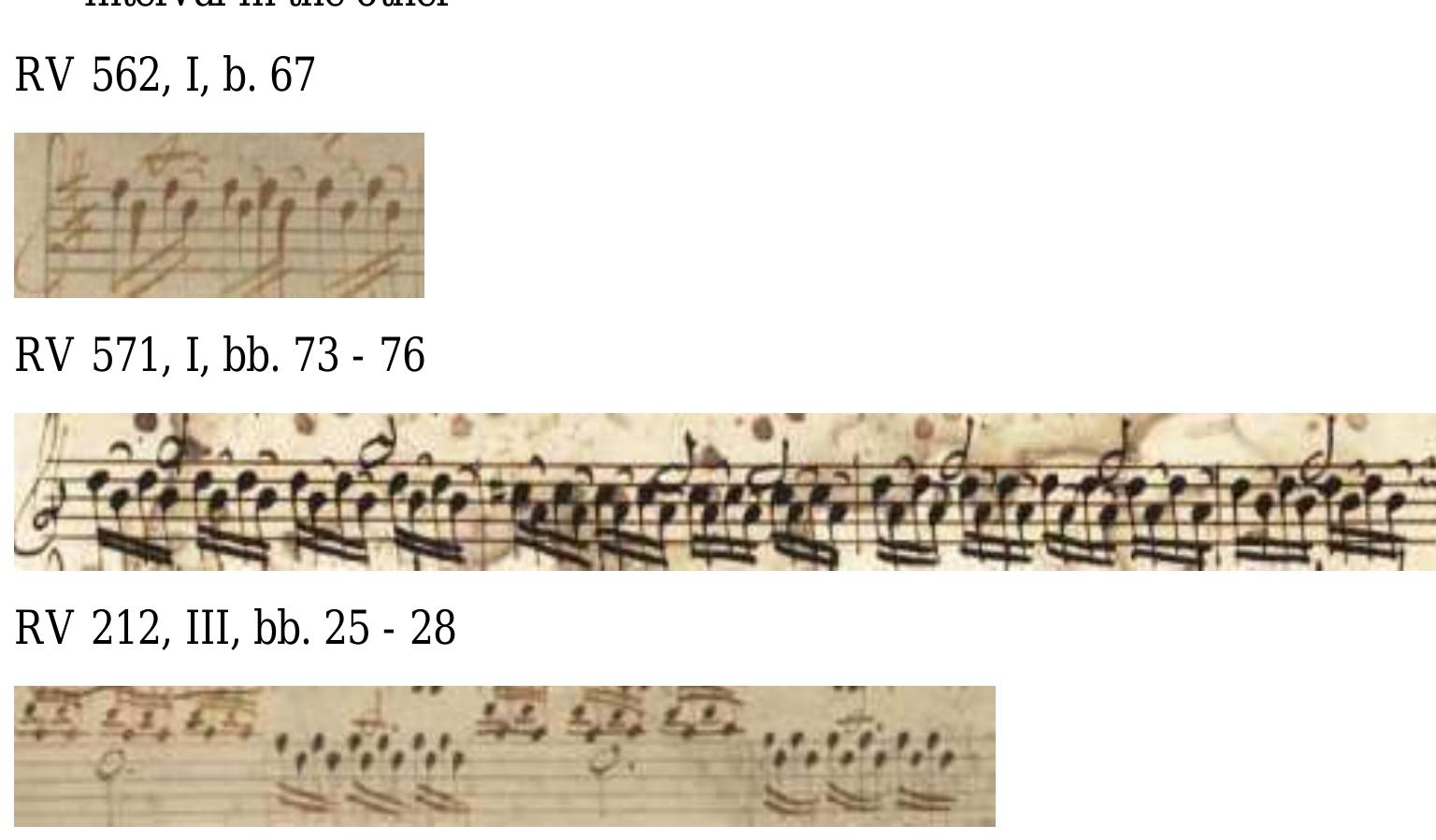
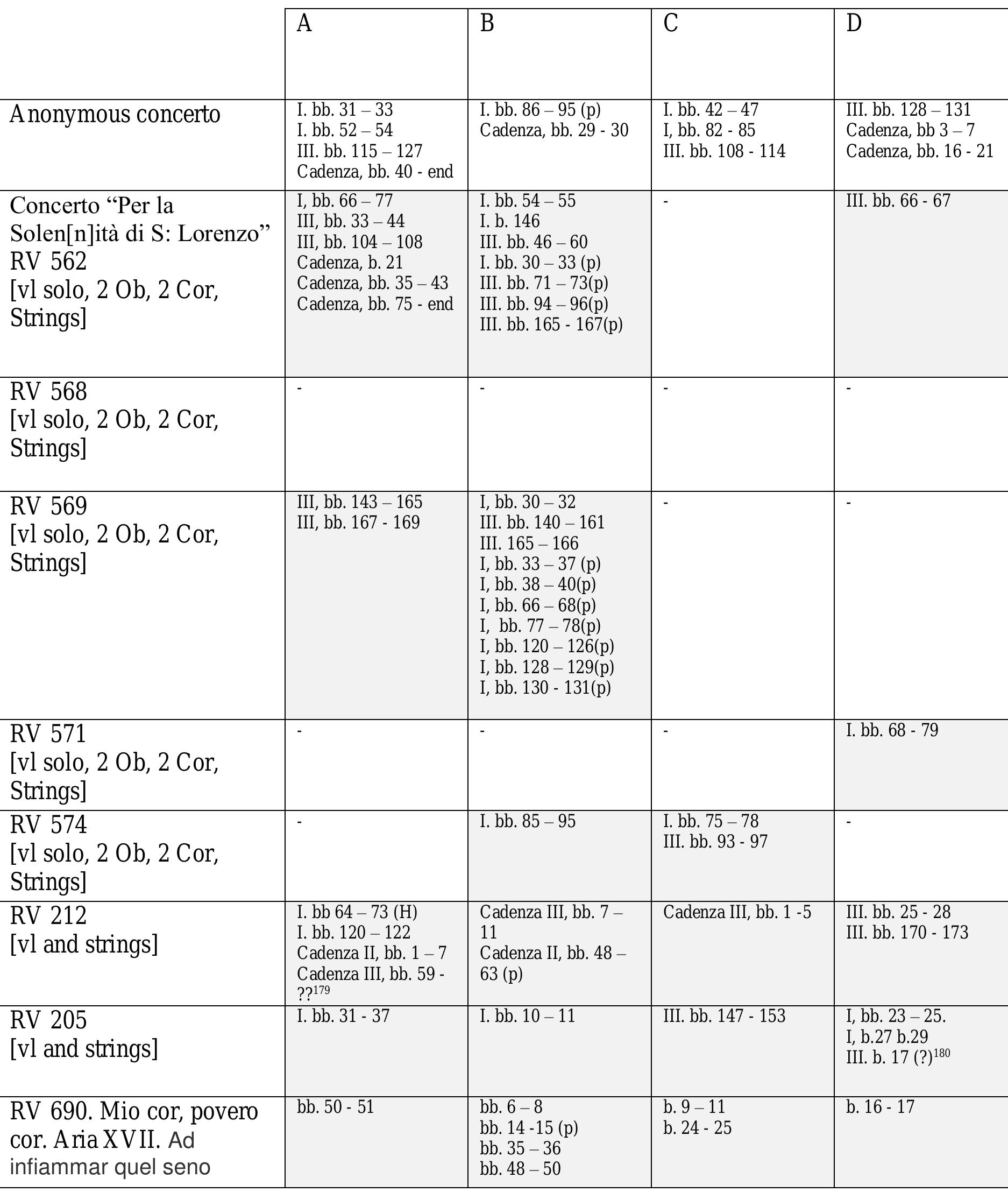
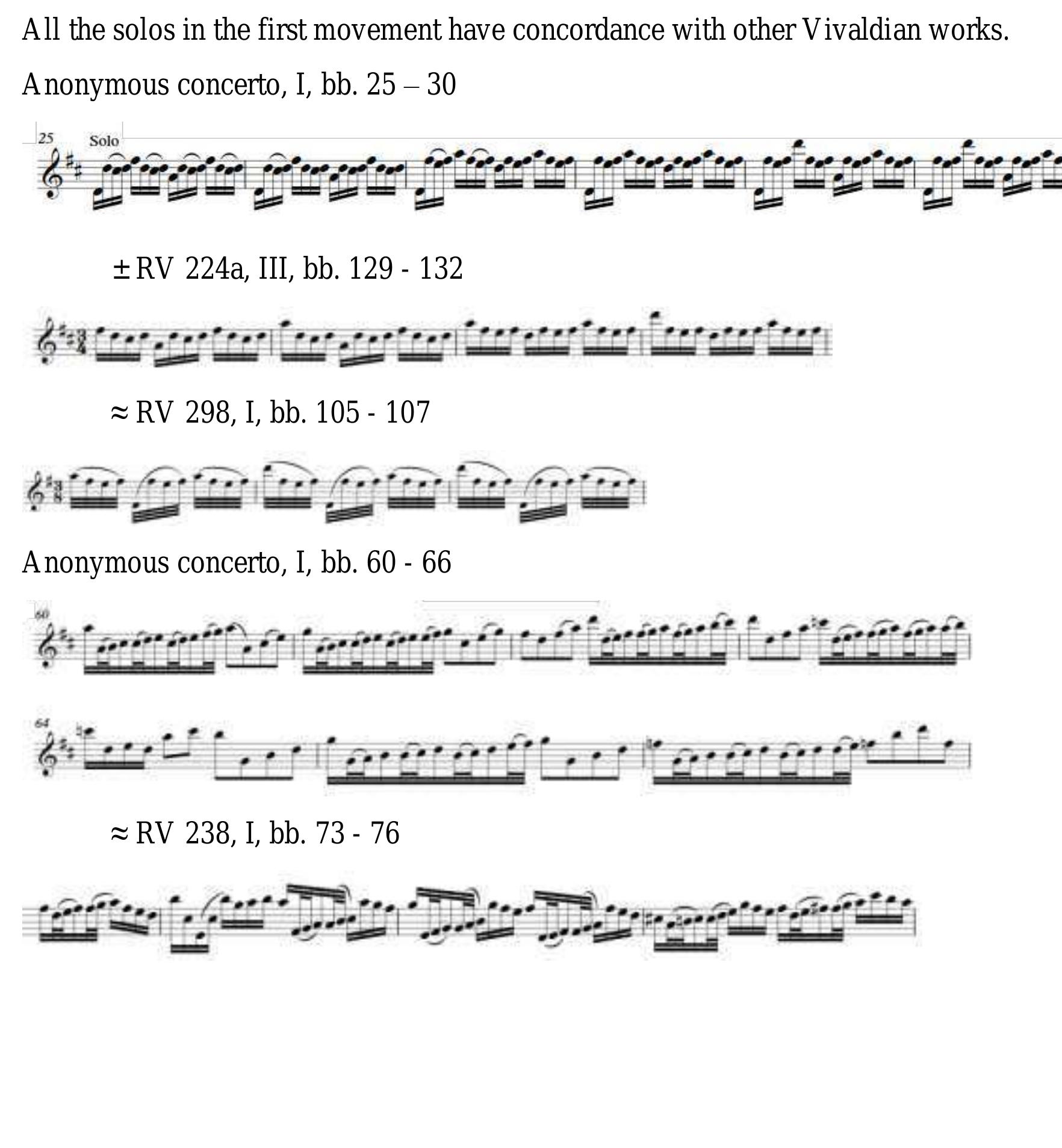
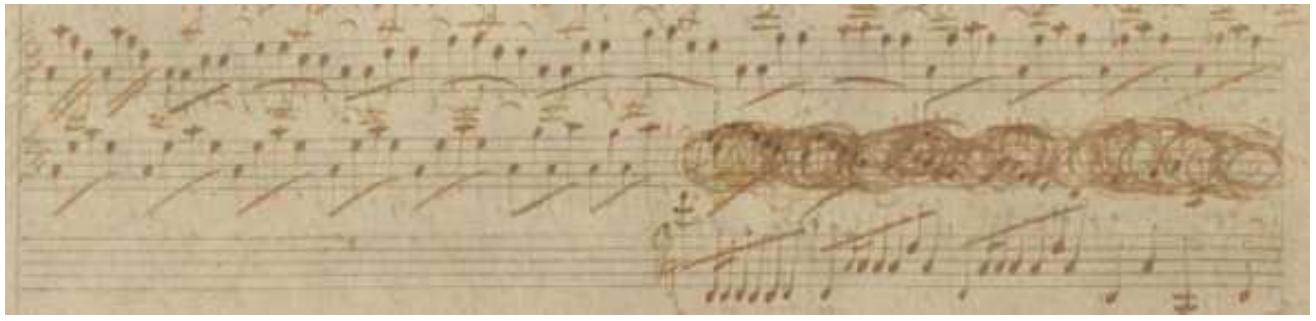
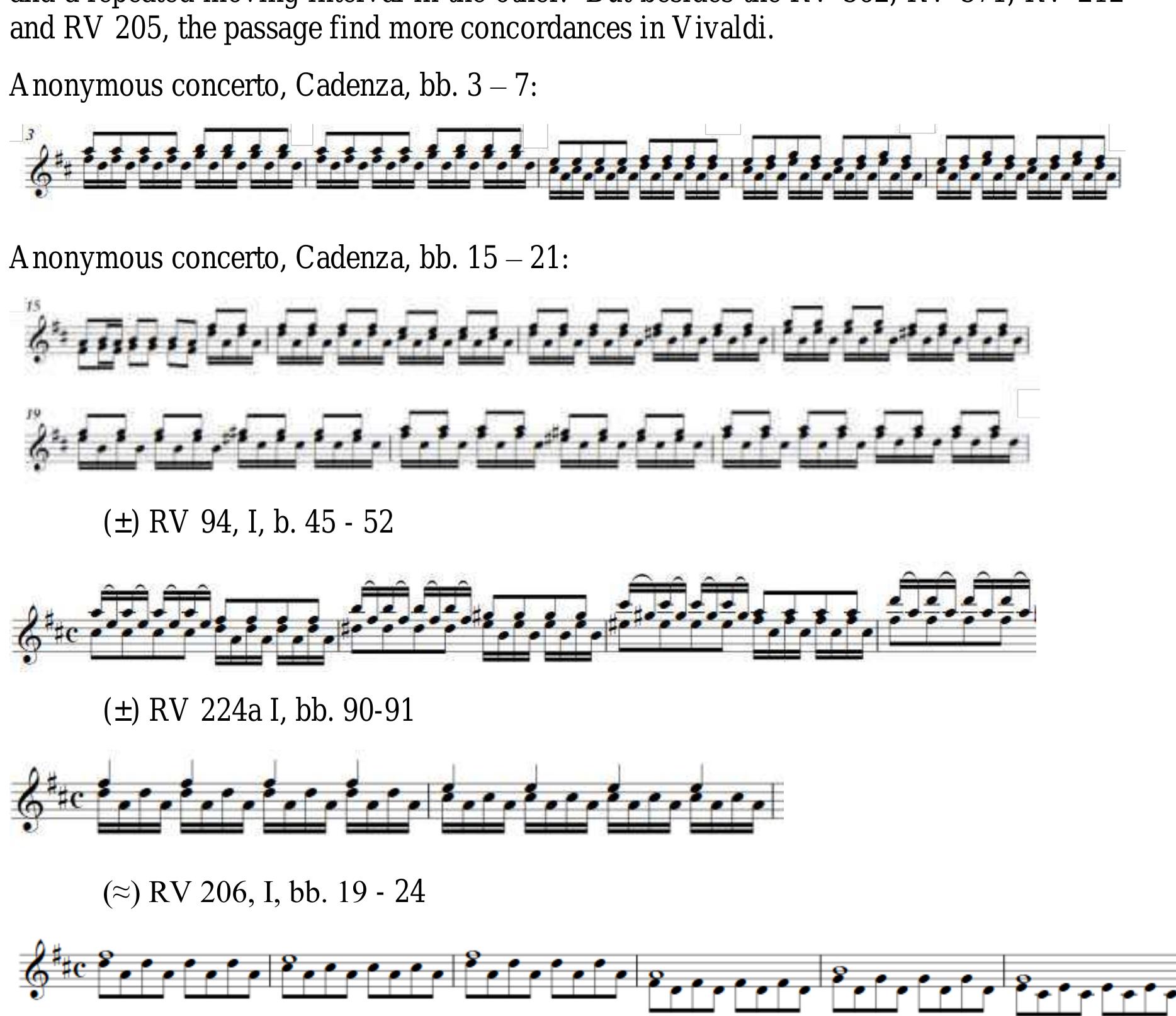
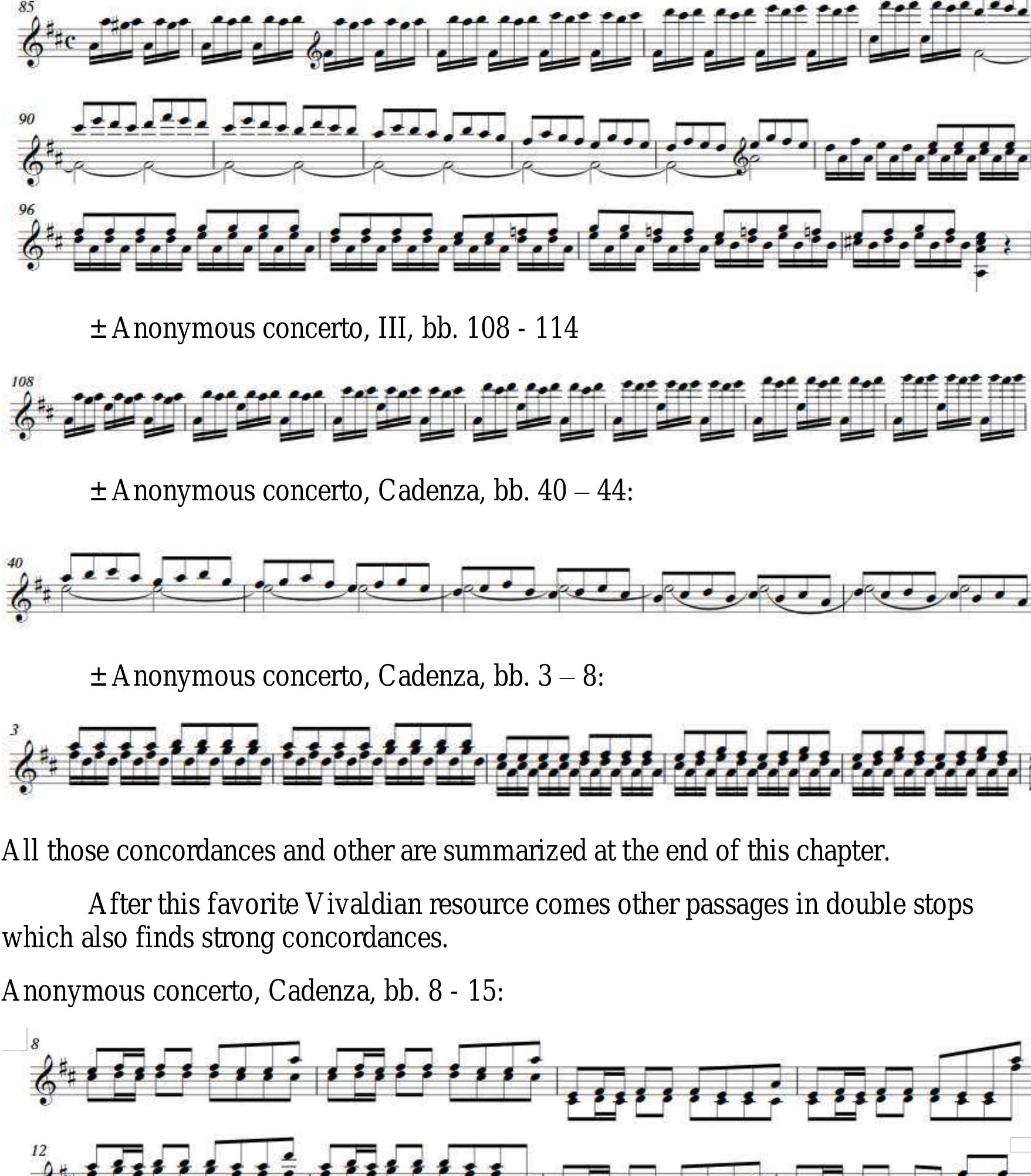
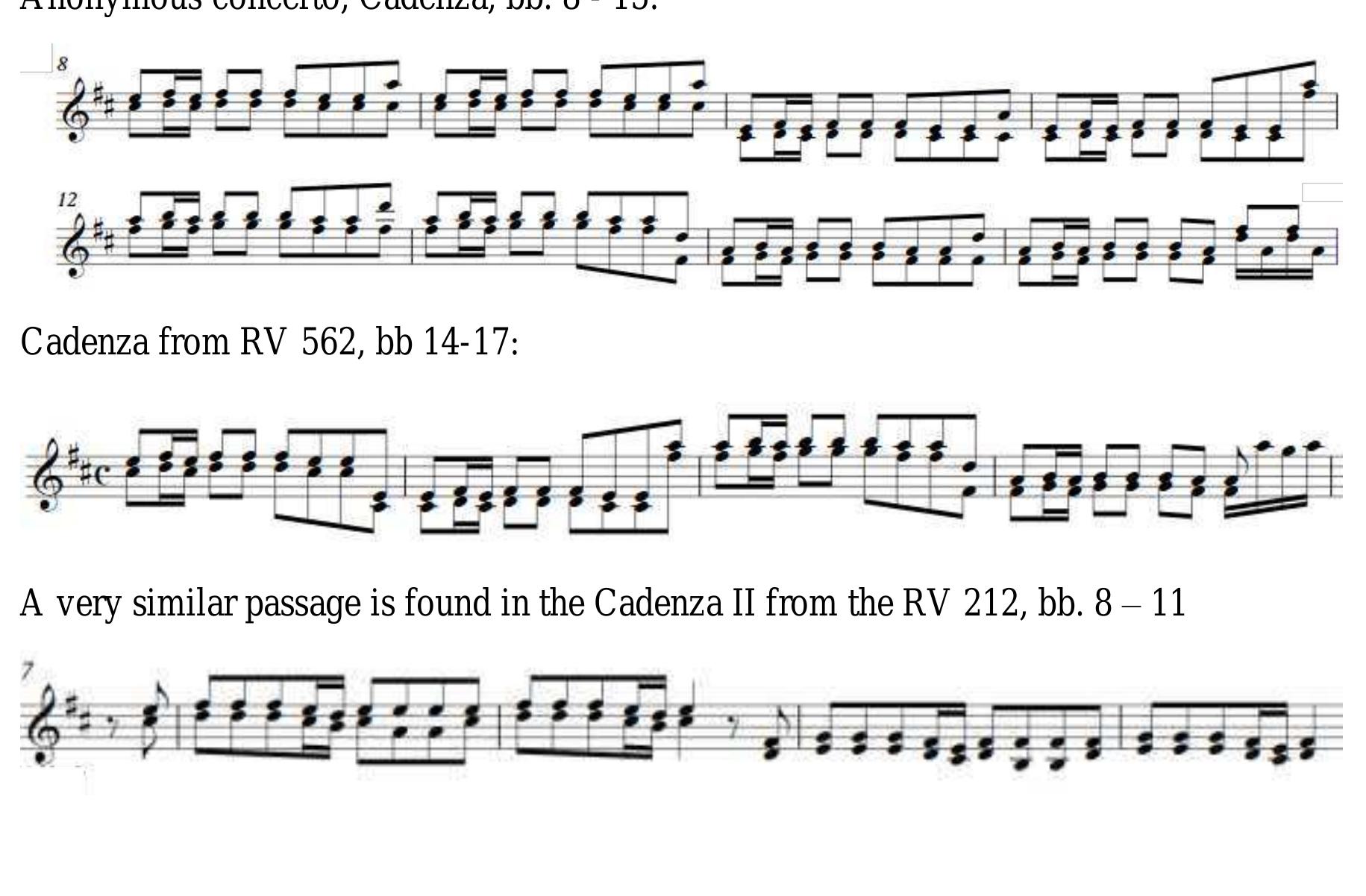
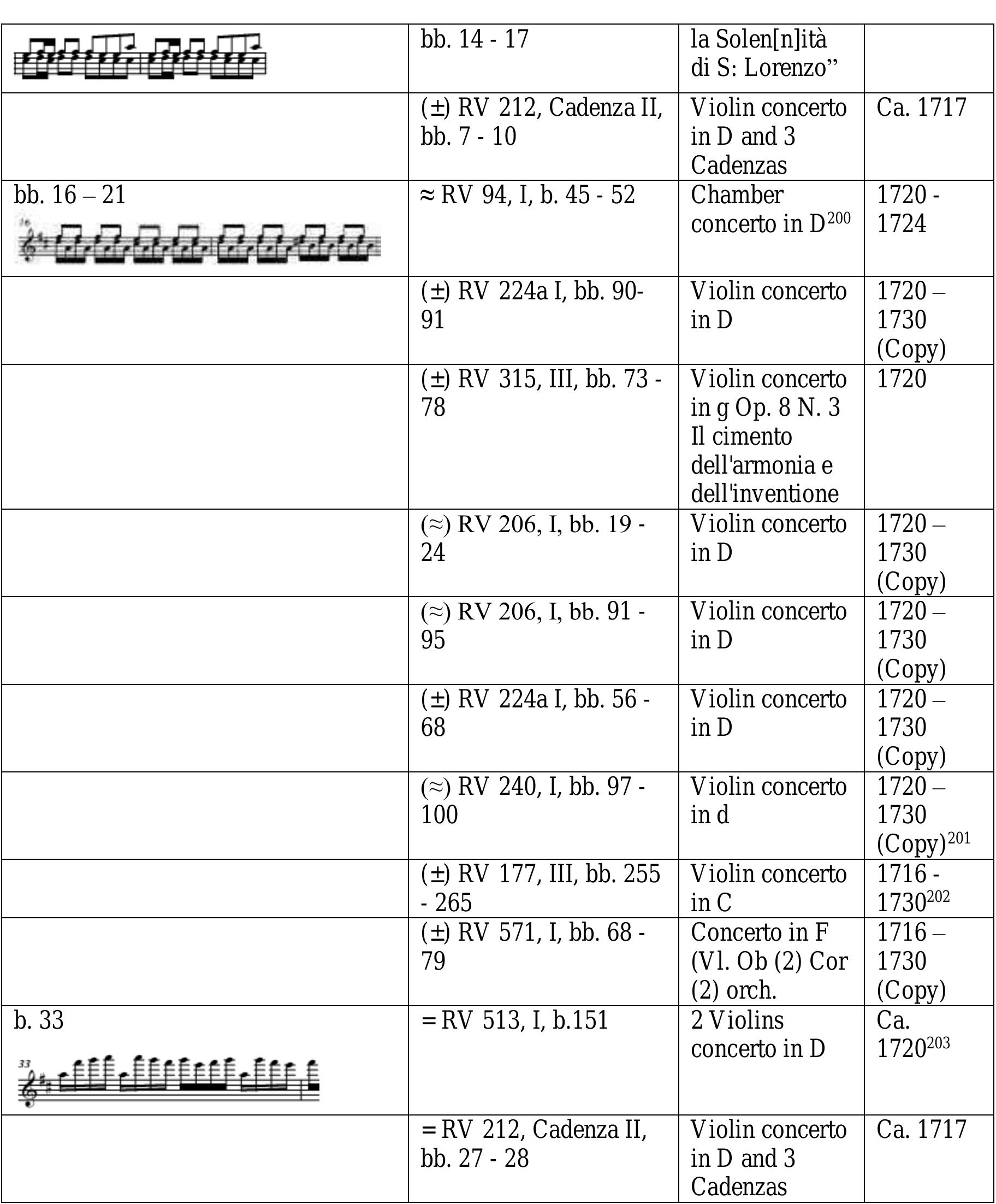
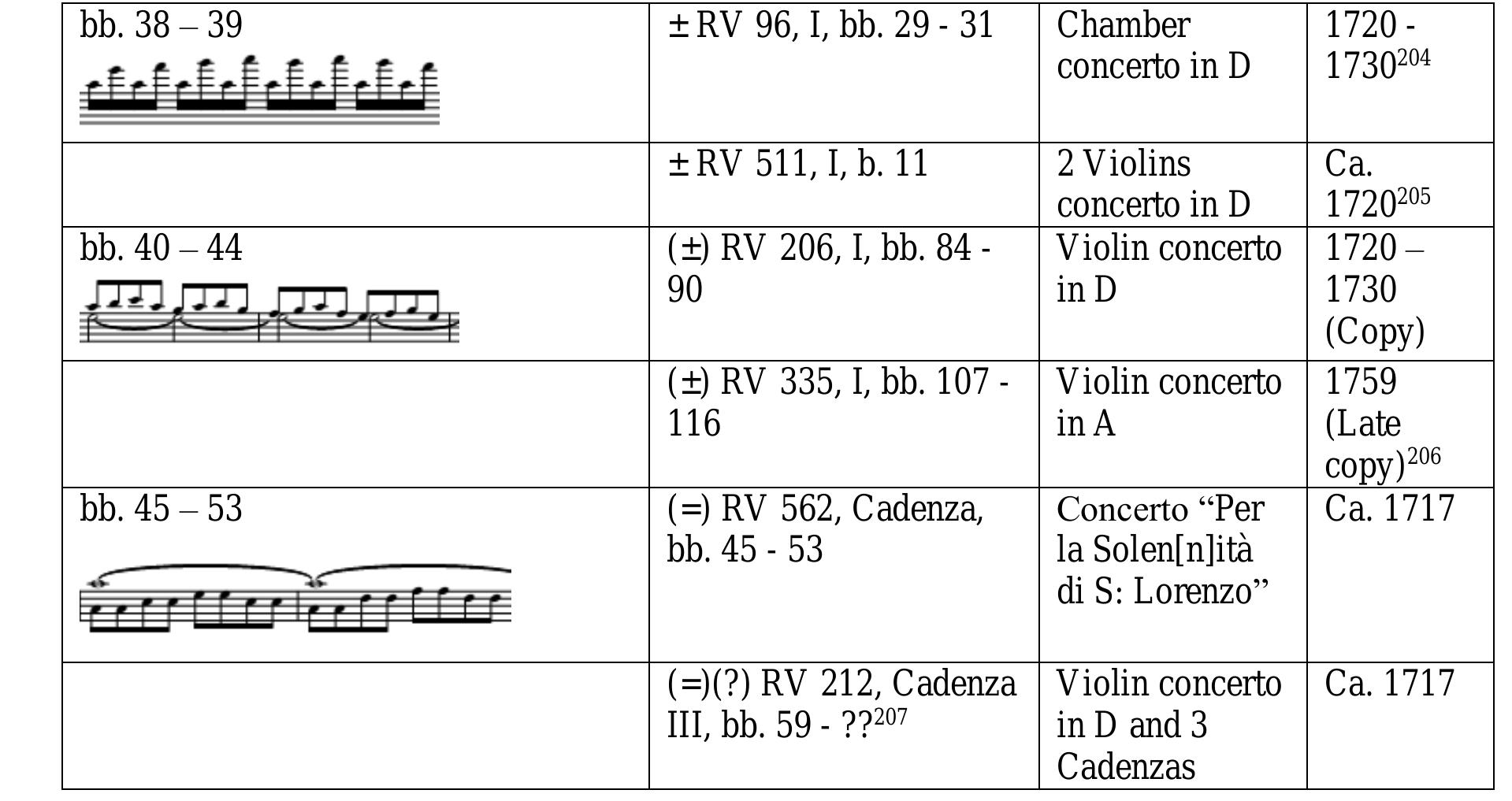
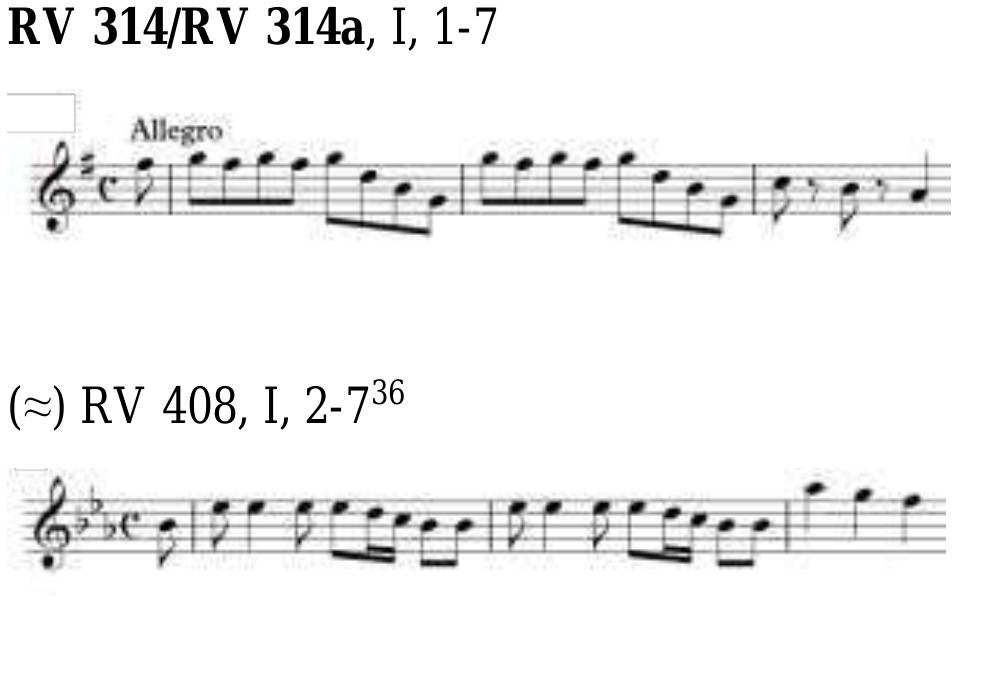
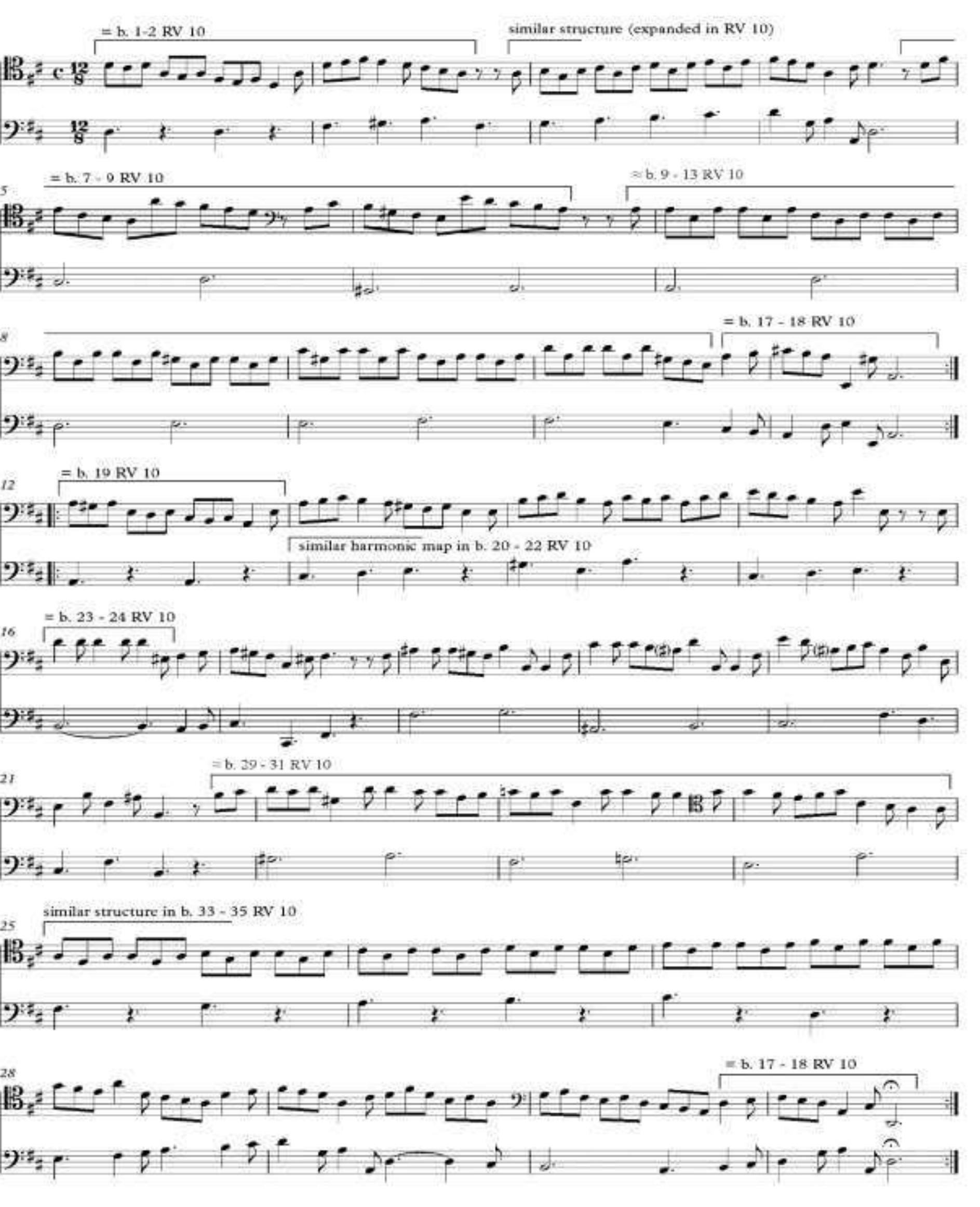
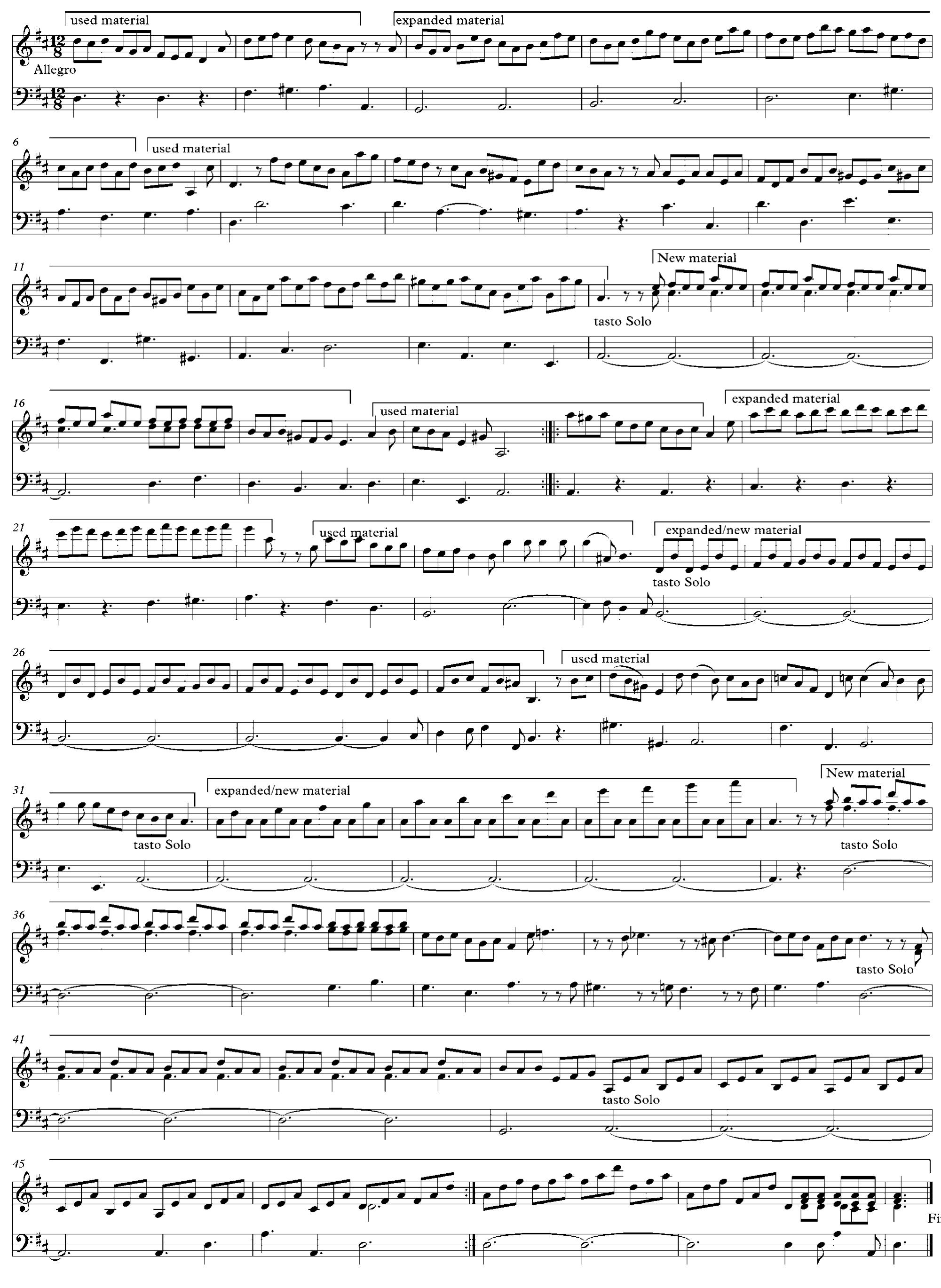
- Marked with (p) in the following chart RV 690. Mio cor, povero cor. Aria XVII. Ad infiammar quel seno, bb. 23 -24 Anonymous concerto, I, bb. 42 -46 Anonymous concerto, III, 108 -112: D. -A passage in double stops with a pedal note in one voice and a repeated moving interval in the other RV 562, I, b. 67 RV 571, I, bb. 73 -76 RV 212, III, bb. 25 -28 RV 690. Mio cor, povero cor. Aria XVII. Ad infiammar quel seno, b. 17 Anonymous concerto, I, bb. 129 -131: Anonymous, Cadenza, bb. 3 -5: Cadenza for the anonymous concerto (Mus.2-O-1,45): Despite the fact that both cadenzas are exactly fifty three bars long there are strong concordances regarding the musical material in both cadenzas. The beginning and the end of both cadenzas are very similar: Cadenza from RV 562 (beginning): Cadenza from anonymous concerto (beginning): End of the Cadenza of RV 562: End of Cadenza from the Anonymous Concerto: Of course some questions remain unanswered, such as the original instrumentation of the concerto. Even if the music is quite convincing with the provided instrumentation (for instance, there is no place with long rests). Looking at the concerto in its context, it seems the oboe parts are missing.
- RISM ID no.: 212000118
- Dated by Fertonani, Cesare. La musica strumentale di Antonio Vivaldi. Vol.
- LS Olschki, 1998. p. 436 206 Late copy by J.H. Roman. RISM ID no.: 190023857
- Unfortunately the manuscript is poorly conserved and it is impossible to read some parts. 208 Talbot is speaking here about the RV 206. Studi Vivaldiani: rivista annuale dell'Istituto Italiano Antonio Vivaldi della Fondazione Giorgio Cini Miscellany. (2012), p. 97
- Bibliography Brook, Barry S; Viano, Richard J. "Vivaldi" Thematic Catalogues in Music: An Annotated Bibliography. Pendragon Press, 1/1/1997, Brover-Lubovsky, Bella. Between Modality and Tonality: Vivaldi's Harmony, «Informazioni estudi vivaldiani», XXI. 2000
- Brover-Lubovsky, Bella. Tonal Space in the Music of Antonio Vivaldi, Indiana University Press. 2008
- Brover-Lubovsky, Bella. Vivaldi's Harmony: Practice and Theory (Doctoral dissertation, Hebrew University of Jerusalem). 2000
- Clark, Brian. Pisendel and the Dresden Orchestra, Early Music, Vol. 34, No. 1 (Feb. 2006), pp. 146-148
- Coral, Lenore A Concordance of the Thematic Indexes to the Instrumental Works of Antonio Vivaldi Ann Arbor MI, University of Michigan, 1972, 2nd edition, 43p. Collection: Music Library Association Series # 4
- Cross, E. "A variety of Vivaldi". Early Music, 37(2), 2009. pp. 334-337.
- Dannenberg, R. B. "Style in music". The Structure of Style (pp. 45-57). Springer Berlin Heidelberg. 2010
- Everett, Paul, Vivaldi: The Four Seasons and Other Concertos, Op. 8, Cambridge University Press, 1996
- Falcone, F. "The Italian Style and the Period". Dance Chronicle, 29(3), 2006, p. 317- 340. Fanna, Antonio Opere strumentali di Antonio vivaldi: Catalogo numerico-tematico (secondo la catalogazione Fanna) Milano, G. Ricordi & Co., 1986, 2e edizione, 185p. ISBN 88-7592-022-2
- Fertonani, Cesare. La musica strumentale di Antonio Vivaldi. Vol. 9. LS Olschki, 1998
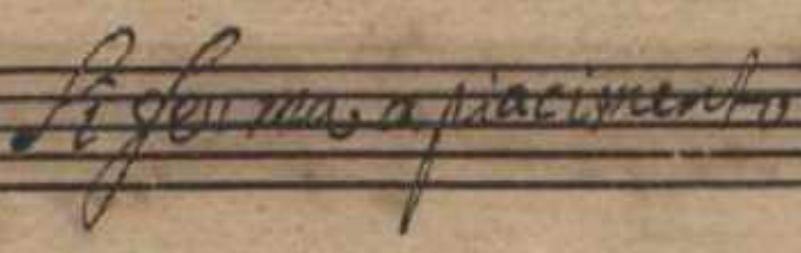
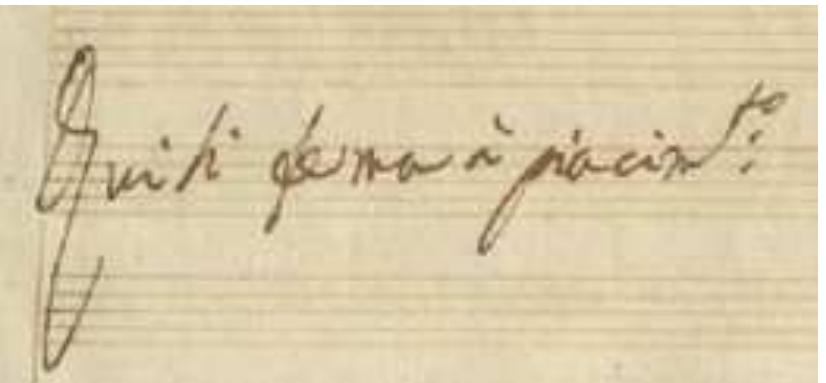
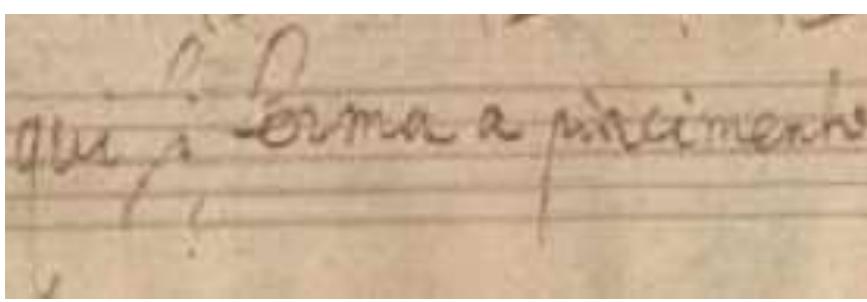
- Grattoni, Maurizio. "Qui si ferma 'a piacimento': Struttura e Funzione della Cadenza nei Concerti di Vivaldi." ("Here one pauses 'ad libitum': The Structure and Function of the Cadenza in Vivaldi's Concertos.") Nuovi Studi Vivaldiani: Edizione e Cronologia Critica delle Opere, 23 (1988): 479-492.
- Gregory M. The "'Other' Vivaldi Gloria: Discovering a Lesser-known." The Choral Journal, Vol. 51, No. 9 (April 2011), pp. 30-44
- Heller, Karl. Vivaldi, The Red Priest. Amadeus Press, USA, 1997
- Hiller, Johann Adam, Wöchentliche Nachrichten und Anmerkungen, die Musik betreffend, Volumen 1 Verlag der Zeitungs-Expedition, 1766
- Isacoff, Stuart. Vivaldi or Not Vivaldi -Is That the Question? The Sun, New York, 29 November, 2004
- Janice Stockigt, Musica senza nome dell'Autore: Anonymous Works listed in the Music Catalogue of the Dresden Hofkirche, 1765, «Studi vivaldiani», 7 (2007)
- Jean-Pierre Demoulin, Limites et faiblesses des supports matériels: importance du style et chronologie respective de couples d'oeuvres apparentées, in Nuovi studi vivaldiani: Edizione e cronologia critica delle opere, a cura di Antonio Fanna e Giovanni Morelli, Firenze, Olschki, 1988 (Studi di musica veneta. Quaderni vivaldiani 4, 1988).
- Jung, H. R. Die Dresdener Vivaldi-Manuskripte. Archiv fur Musikwissenschaft, 314- 318. 1955
- Kendall, Alan. Vivaldi London Chappel & Co., 1978
- Kolneder, Walter, Guía de Vivaldi, Alianza Editorial, Madrid, 1989
- Kolneder, Walter, Melodietypen bei Vivaldi, Amadeus Verlag, 1973
- Kolneder, Walter. Vivaldi, his life and work, University of California Press, 1970
- Köpp, Kai, Johann Georg Pisendel (1687-1755) und die Anfange der neuzeitlichen Orchesterleitung (Tutzing: Hans Schneider, 2005)
- Landmann, Ortrun. The Dresden Hofkapelle during the Lifetime of Johann Sebastian Bach, Early Music, Vol. 17, No. 1 (Feb., 1989), pp. 17-30
- Lockey, Nicholas Scott. The instrumental variation sets of Antonio Vivaldi: Old forms in new genres. (Thesis). B.M., Pacific Lutheran University, 2002
- Love, Harold, Attributing Authorship: An Introduction. Cambridge University Press, 2002
- Maunder, Richard. The Scoring of baroque concertos. Boydell Press, 2004
- McVeigh, Simon & Jehoash Hirshberg. The Italian Solo Concerto1700-1760, Rhetorical Strategies and Style History. Woodbridge,UK :The Boydell Press, 2004
- Newman, William S. The Sonatas of Albinoni and Vivaldi, Journal of the American Musicological Society, Vol. 5, No. 2 (Summer, 1952), pp. 99-113
- Nicholas Lockey, Second thoughts, embellishments and an orphaned fragment: Vivaldi's and Pisendel's contributions to the Dresden score of RV 340, «Studi vivaldiani», 10 (2010), pp. 125-142.
- Owens, Samantha; M. Reul, Barbara; Stockigt, Janice B. Music at German Courts, 1715-1760: Changing Artistic Priorities. Boydell Press, 2011
- Pincerle, Marc. Vivaldi. Norton & Company, New York, 1955
- Pincherle, Marc Antonio Vivaldi et la musique instrumentale Tome II: Inventaire thématique Paris, Librairie Floury, 1948
- Poppe, Gerhard (Ed.) Schranck No. II: das erhaltene Instrumentalmusikrepertoire der Dresdner Hofkapelle aus den ersten beiden Dritteln des 18. Jahrhunderts. Forum mitteldeutsche Barockmusik; Band 2. Ortus Musikverlag. 2012
- Pysh, Gregory. The 'Other' Vivaldi "Gloria": Discovering a Lesser-known Masterwork-A Comparative Analysis. Choral Journal. April 2011, Vol. 51 Issue 9, p.30 Quantz, Johann Joachim: Herrn Johann Joachim Quantzens Lebenslauf, von ihm selbst entworfen. Bd. 1, St. 3 (1755), S. 197-250 in Marpurg, Friedrich Wilhelm (ed.)
- Historisch-Kritische Beyträge zur Aufnahme der Musik. I. Band, Berlin 1754/55
- Randel, Don Michael. The Harvard dictionary of music, Harvard University Press, 2003
- Rinaldi, M. Catalogo numerico tematico delle composizioni di Antonio Vivaldi: con la definizione delle tonalità, l'indicazione dei movimenti e varie tabelle illustrative. Editrice Cultura Moderna. 1945
- Rinaldi, Mario Catalogo numerico tematico delle composizioni di Antonio Vivaldi Roma, Editrice Cultura moderna, 1945?
- Roche, E. Vivaldi vade mecum. Early Music, 29(1), 2001, pp. 123-125.
- Rudolf Jung, Hans. Die Dresdener Vivaldi-Manuskripte. Archiv für
- Ryom, Peter Antonio Vivaldi Thematisch-systematisches Verzeichnis seiner Werke (RV)
- Weisbaden, Breitkopf & Härtel, 2007, 633p. ISBN 978-3-7651-0372-8
- Ryom, Peter Répertoire des oeuvres instrumentales d'Antonio Vivaldi Copenhague, Engstrom & Sodring, 1986, 726p. ISBN 87-8709-119-4
- Sampsel, Laurie J. Music Research: A Handbook. Oxford University Press. 2008
- Sardelli, Federico Maria Aggiornamenti del catalogo vivaldiano«Studi vivaldiani», 11
- Sardelli, Federico Maria Aggiornamenti del catalogo vivaldiano«Studi vivaldiani», 12
- Sardelli, Federico Maria, Da RV Anh. 76 a RV 808: un nuovo concerto di Vivaldi, «Studi vivaldiani», 7 (2007)
- Sardelli, Federico Maria, Dall'esterno all'interno: criterî di autenticità e catalogazione di nuove fonti vivaldiane, «Studi vivaldiani», 8 (2008), pp. 93-109
- Sardelli, Federico Maria. Aggiornamenti del catalogo vivaldiano «Studi vivaldiani», 8
- Sardelli, Federico Maria. Aggiornamenti del catalogo vivaldiano, «Studi vivaldiani», 9
- Sardelli, Federico Maria. Aggiornamenti del catalogo vivaldiano, «Studi vivaldiani», 7
- Sardelli, Federico Maria. Aggiornamenti del catalogo vivaldiano, «Studi vivaldiani», 10
- Sardelli, Federico Maria. Aggiornamenti del Catalogo Vivaldiano, Studi Vivaldiani 12 - 2012, Instituto Italiano Antonio Vivaldi, 2012
- Sardelli, Federico Maria. Catalogo delle concordanze musicali vivaldiane, L. S. Olschki Editore, 2012
- Selfridge-Field, E. Antonio Vivaldi: Thematisch-systematisches Verzeichnis seiner Werke (RV) (review). Notes, 65(2), 2008 pp. 294-298.
- Selfridge-Field, Eleanor. Venetian Instrumental Music from Gabrieli to Vivaldi. Courier Corporation, 1994
- Sheldon, D. A. Johann Friedrich Fasch: Problems in Style Classification. Musical Quarterly, 1972, pp.92-116.
- Spitzer, John. Authorship and attribution in Western art music. Cornell University, 1983
- Stockigt, J. B., & Talbot, M. Two More New Vivaldi Finds in Dresden. Eighteenth Century Music, 3(01), 2006, pp. 35-61.
- Sumpter, J. M. The instrumental sonatas of Antonio Vivaldi: a style-critical analysis (Doctoral dissertation, University of North Carolina at Chapel Hill). 1950
- Talbot, Michael and Stockigt, Janice B. Two more new Vivaldi finds in Dresden. Eighteenth Century Music, 3, 2006. pp 35-61.
- Talbot, Michael Antonio Vivaldi: A Guide to Research New York, Garland Press, 1988, 197p. Collection: Garland Composer Resource Manuals # 12
- Talbot, Michael, A New Vivaldi Violin Sonata and Other Recent Finds, «Informazioni e Studi Vivaldiani», 20, 1999
- Talbot, Michael, Vivaldi, "Motezuma" and the opera seria: essays on a newly discovered work and its background, Brepols, 2008
- Talbot, Michael, Vivaldi, Laudate Pueri Dominum, Edizione Critica, Ricordi Milano, 1995
- Talbot, Michael. How Recitatives End and Arias Begin in the Solo Cantatas of Antonio Vivaldi. Journal of the Royal Musical Association, 126(2), 2001, pp. 169-192.
- Talbot, Michael. Italians at home and abroad. Early music, 35(4), 2007, pp. 659-661.
- Talbot, Michael. "Miscellany". Studi Vivaldiani 12, 2012
- Talbot, Michael. New approaches to Vivaldi. Early Music, 37(4), 2009, pp. 691-694.
- Talbot, Michael. Sonates à Pisendel (rv2, 29, 25, 6) by Vivaldi. The Musical Times, Vol. 124, No. 1684 (Jun., 1983), p. 366
- Talbot, Michael. The challenge of Vivaldi. Early Music, 36(3), 2008, pp. 490-493.
- Talbot, Michael. The Manchester Sonatas, Proceedings of the Royal Musical Association, Vol. 104 (1977 -1978), pp. 20-29
- Talbot, Michael. The Vivaldi Compendium. The Boydell Press, 2012
- Talbot, Michael. Varied Vivaldi. Early Music, 36(1), 2008, pp. 144-146.
- Talbot, Michael. Vivaldi and Rome: Observations and Hypotheses, Journal of the Royal Musical Association, Vol. 113, No. 1 (1988), pp. 28-46
- Talbot, Michael. Vivaldi in the Foundling Museum: Some discoveries in London. "Early Music performer" 28, 2011, pp 4-16
- Talbot, Michael. Vivaldi rediscovered and reinvented. Early Music, 40(3), 2012, pp. 532-535.
- Talbot, Michael. Vivaldi und Dresden. Wissenschaftliche Zeitschrift der Technischen Universität Dresden, 55(1-2), 2006. pp. 166-171.
- Talbot, Michael. Vivaldi, Antonio. Sonate RV 815 e 816. Critical edition, Ricordi Milano, 2012
- Talbot, Michael. Vivaldi. J.M. Dent, London, 1993
- Talbot, Michael. Vivaldi. The Musical Times, Vol. 121, No. 1645 (Mar., 1980), p. 161
- Talbot, Michael. "Vivaldi, Antonio." Grove Music Online. Oxford Music Online. Oxford University Press, accessed August 8, 2014 223
- Talbot, Michael. Antonio Vivaldi: a guide to research. Garland. 1988
- VV.AA. Nuove norme editoriali, a cura del Comitato Editoriale dell'Istituto Italiano Antonio Vivaldi, in «Studi vivaldiani» 9 (2009) pp. 91-103.
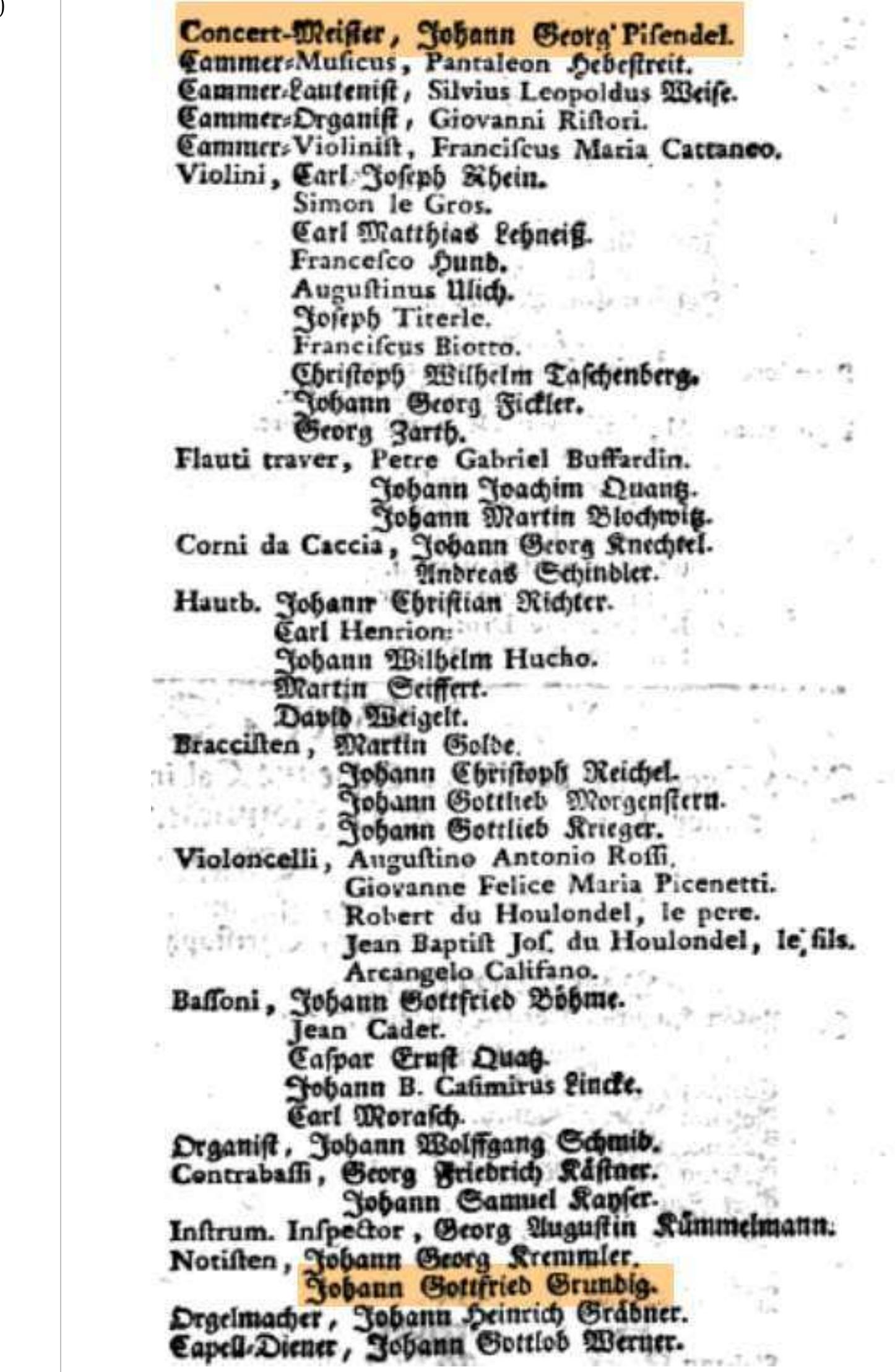
- Weidmann (Ed.) . Königl. Koln. Khurfürstl. und Sachsischer Hof und Staats Kalender, auf das Jahr 1735..., 1735
- White, Michael. The Vivaldi Hunters. The New York Times. 21, November, 2004
- Whitmore, Philip. Towards an Understanding of the Capriccio. Journal of the Royal Musical Association, Vol. 113, No. 1 (1988), pp. 47-56
- Woolley, A. Vivaldi highs and lows. Early Music, 39(1), 2011, pp. 131-134.
- Woolley, Andrew, An unknown flute concerto by Vivaldi in Scotland, «Studi vivaldiani», 10 (2010), pp. 3-38
- Zohn, Steven David. Music for a mixed taste: style, genre, and meaning in Telemann's instrumental works. Oxford University Press, USA, 2008. 223 http://www.oxfordmusiconline.com/subscriber/article/grove/music/40120pg7.
FAQs
AI
What new sources for Vivaldi concertos were discovered in Dresden?
The project uncovered new sources for concertos RV 206 and RV 241, along with an unknown concerto (Mus. 2-O-7b), enhancing Vivaldi's catalog.
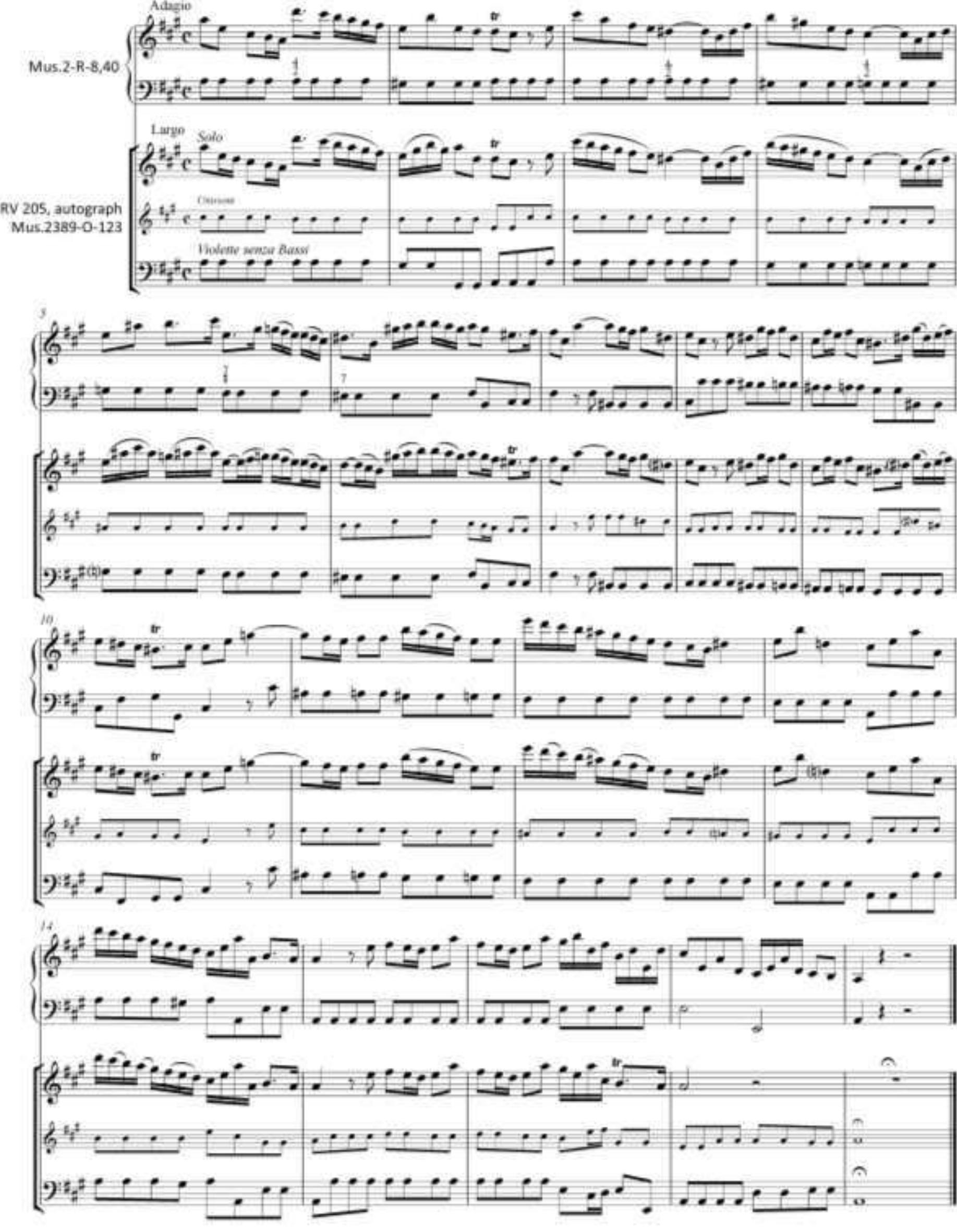
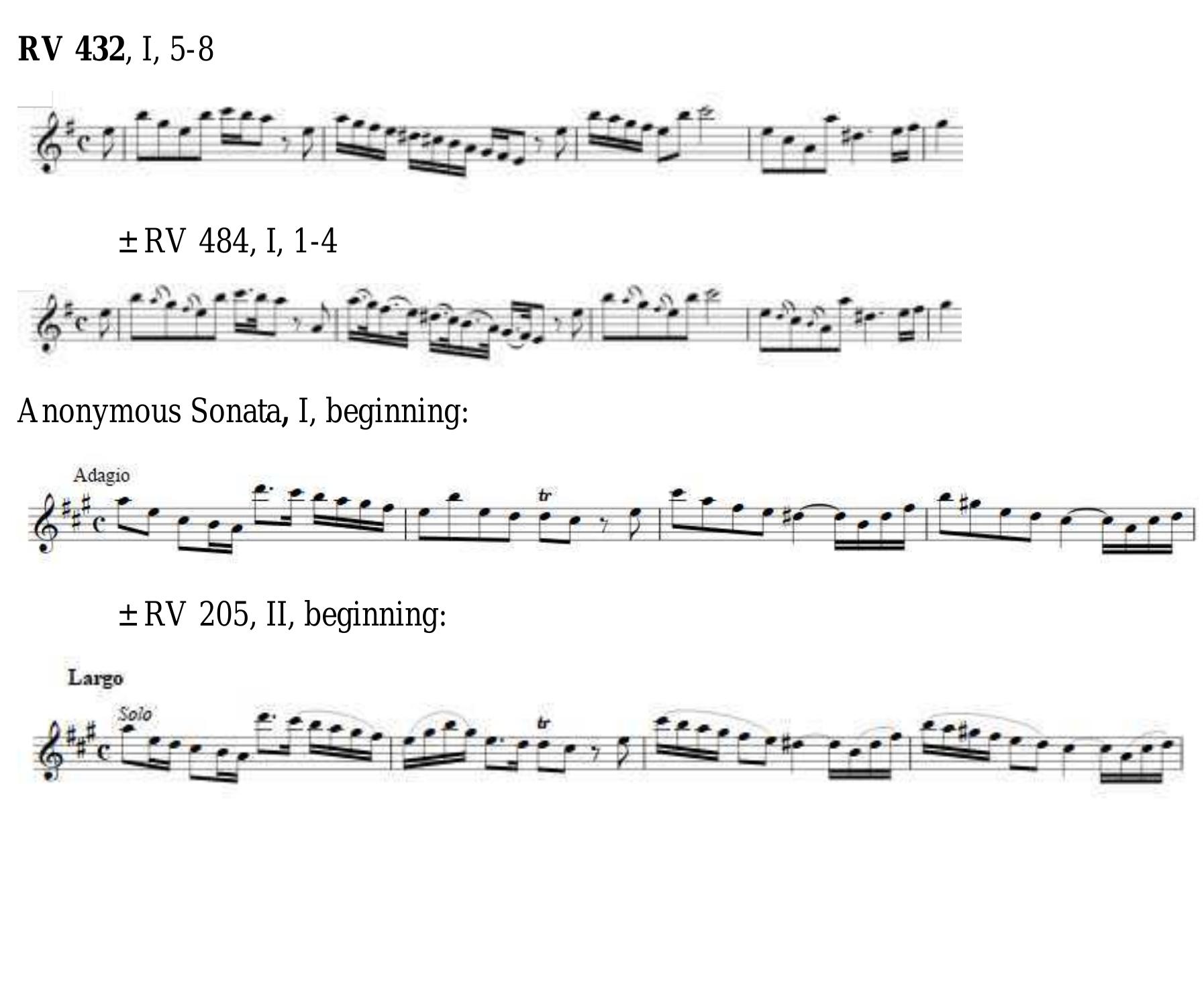
How does the anonymous sonata correspond to Vivaldi's RV 205?
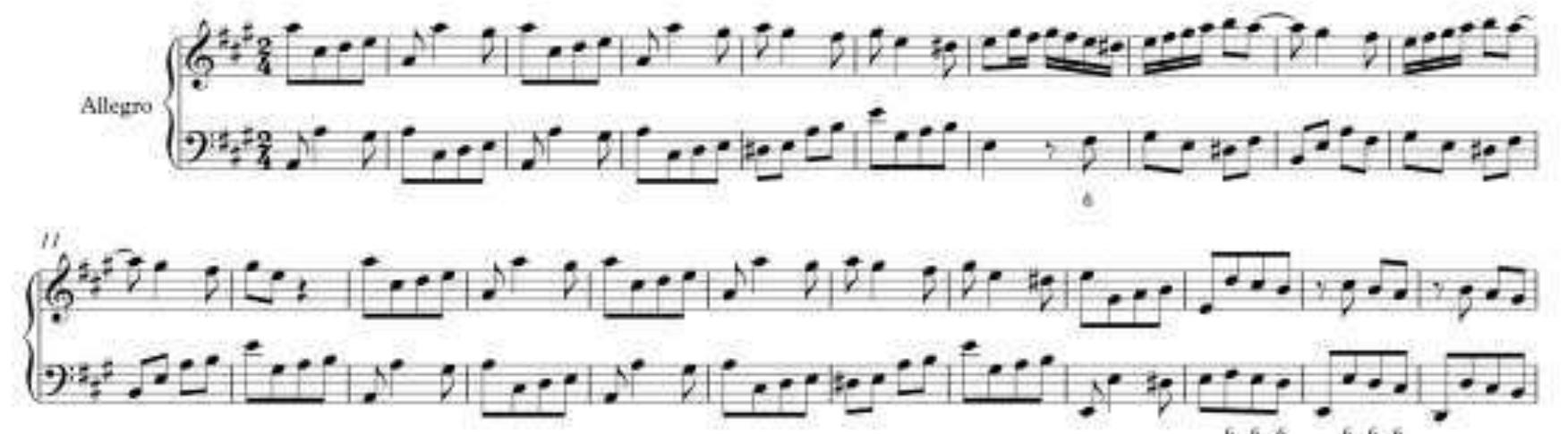
The anonymous sonata's first movement closely mirrors the second movement of RV 205, suggesting potential attribution to Vivaldi.
What criteria are used for authenticating Vivaldi's works?
Authentication relies on both external and internal features; Vivaldi's unique stylistic traits facilitate positive identification, often more than external characteristics.
In what ways did Pisendel influence Vivaldi's music in Dresden?
As a concertmaster, Pisendel collected numerous Vivaldi scores and likely shaped the orchestral performance style in Dresden, blending Italian influences.
What are the stylistic characteristics that define Vivaldi's compositions?
Vivaldi's works often exhibit modular composition, asymmetrical phrasing, distinct cadential patterns, and unique features like the acephalic reprise.
Javier Lupiáñez


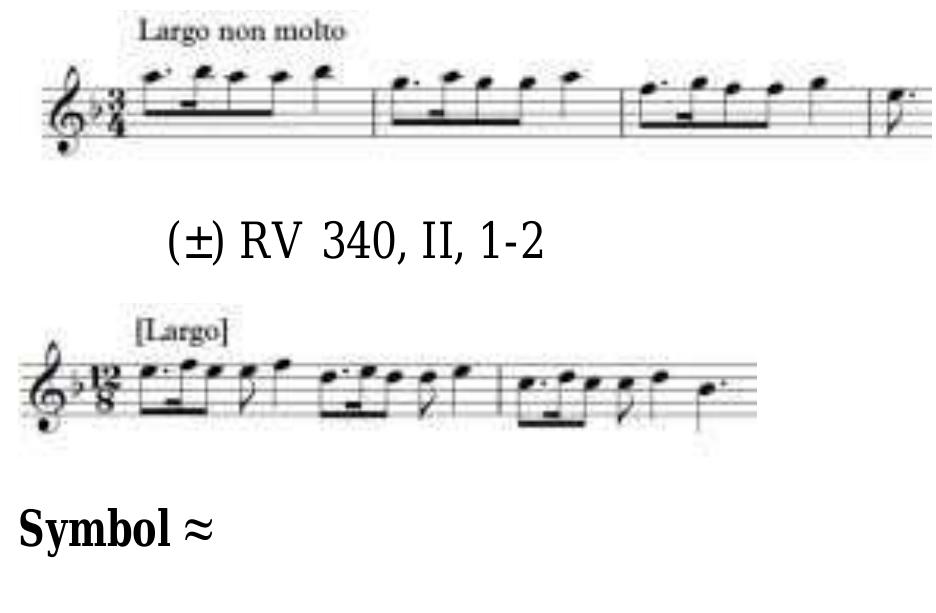
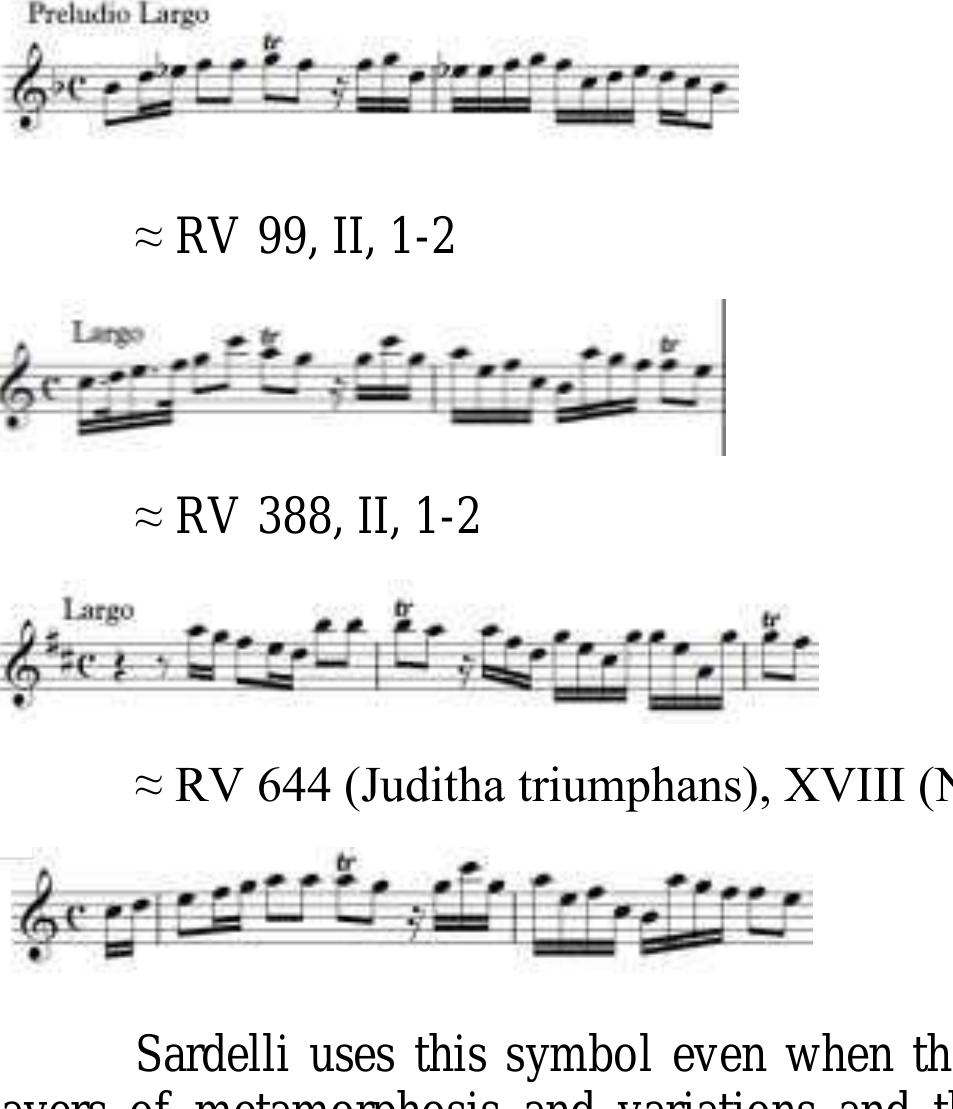
![33 “Due o pit’ porzioni di musica vegono considerate identiche anche se presentano in tonalita 0 modi diferente, purche restino inalterate le relazioni di grado de la linea melddica [...] 0 con variazione de articulazione [...] di instrumentazione [...] di ottava” Sardelli, Federico Maria. Catalogo delle concordanze musicali vivaldiane, L. S. Olschki Editore, 2012, p. CXKX VIII - CX XIX 54 The examples on the use of the symbols are all taken from Sardelli, Federico Maria. Catalogo delle concordanze musicali vivaldiane, L. S. Olschki Editore](https://figures.academia-assets.com/38789227/figure_007.jpg)
![Bellotto, Bernardo. View of Dresden from the Right Bank of the Elbe with the Augustus Bridge (1748) Vivaldi’s connection with Dresden began on 29 February 1712 when the visiting electoral prince, Friedrich August, was presented at the Pieta with “un libro di suonate” [a book of sonatas] of his composition. This travel was following by a longer sojourn in 1716 — 1717, spent principally in Venice, *! accompanied by violinist Pisendel. The music of Vivaldi will take a more important role in Dresden from autumr 717, when Pisendel returned from Italy. 4?](https://figures.academia-assets.com/38789227/figure_011.jpg)


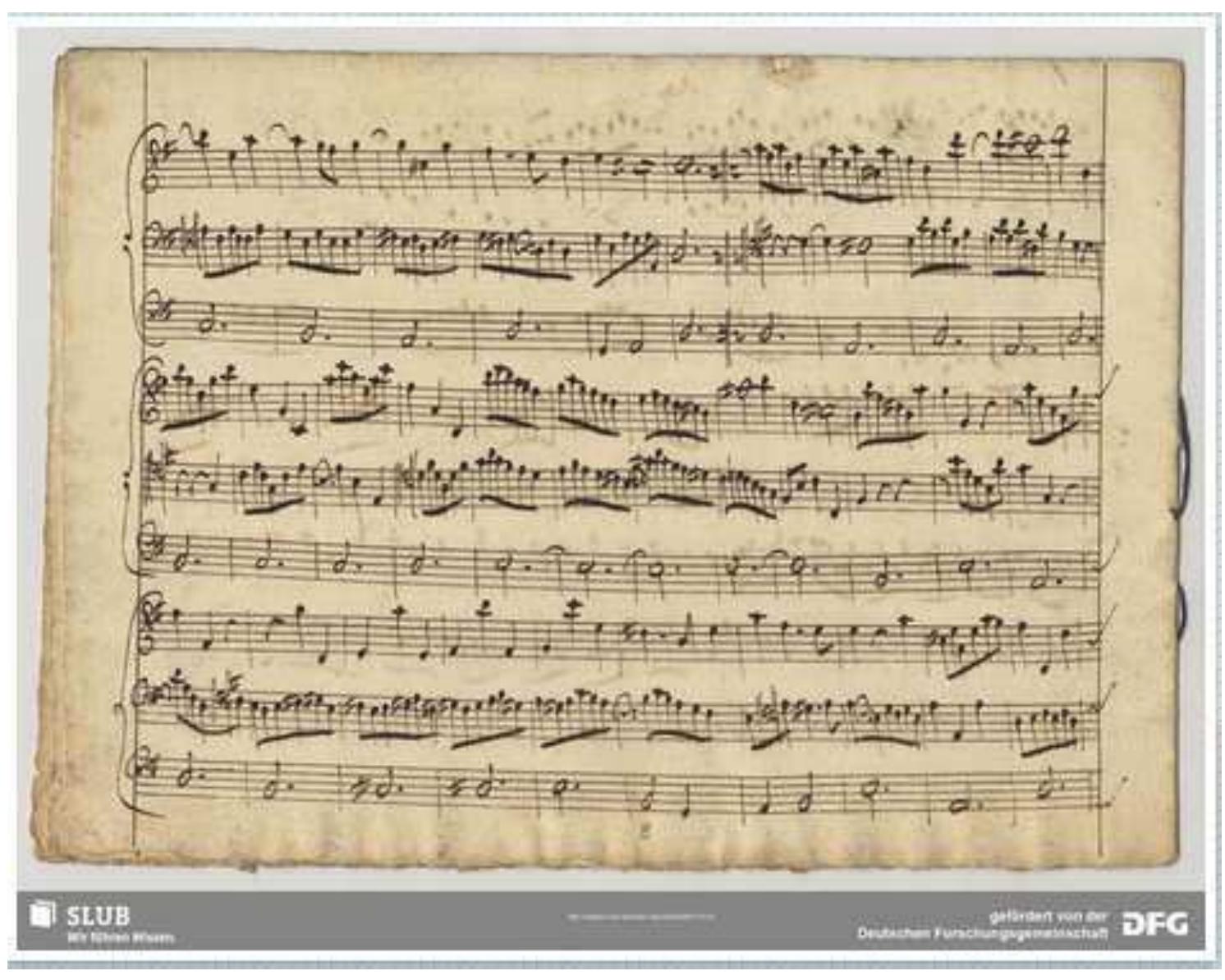
![Cover page from Torelli's trio sonata (D-D] Mus.2035-Q-3) A logical conclusion is that Pisendel copied these pieces during his period in Ansbach (from 1697 to 1712).!28](https://figures.academia-assets.com/38789227/figure_035.jpg)
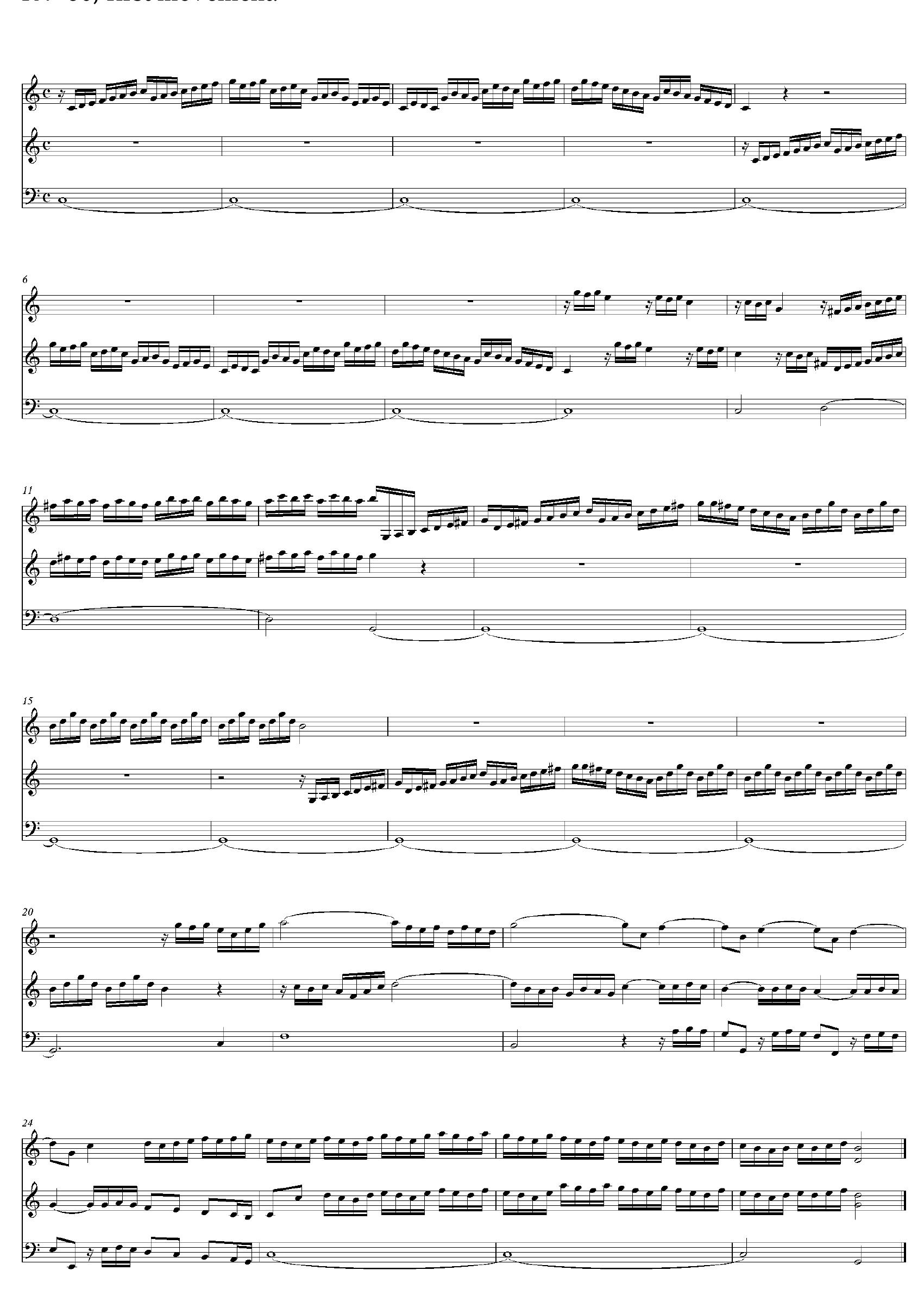


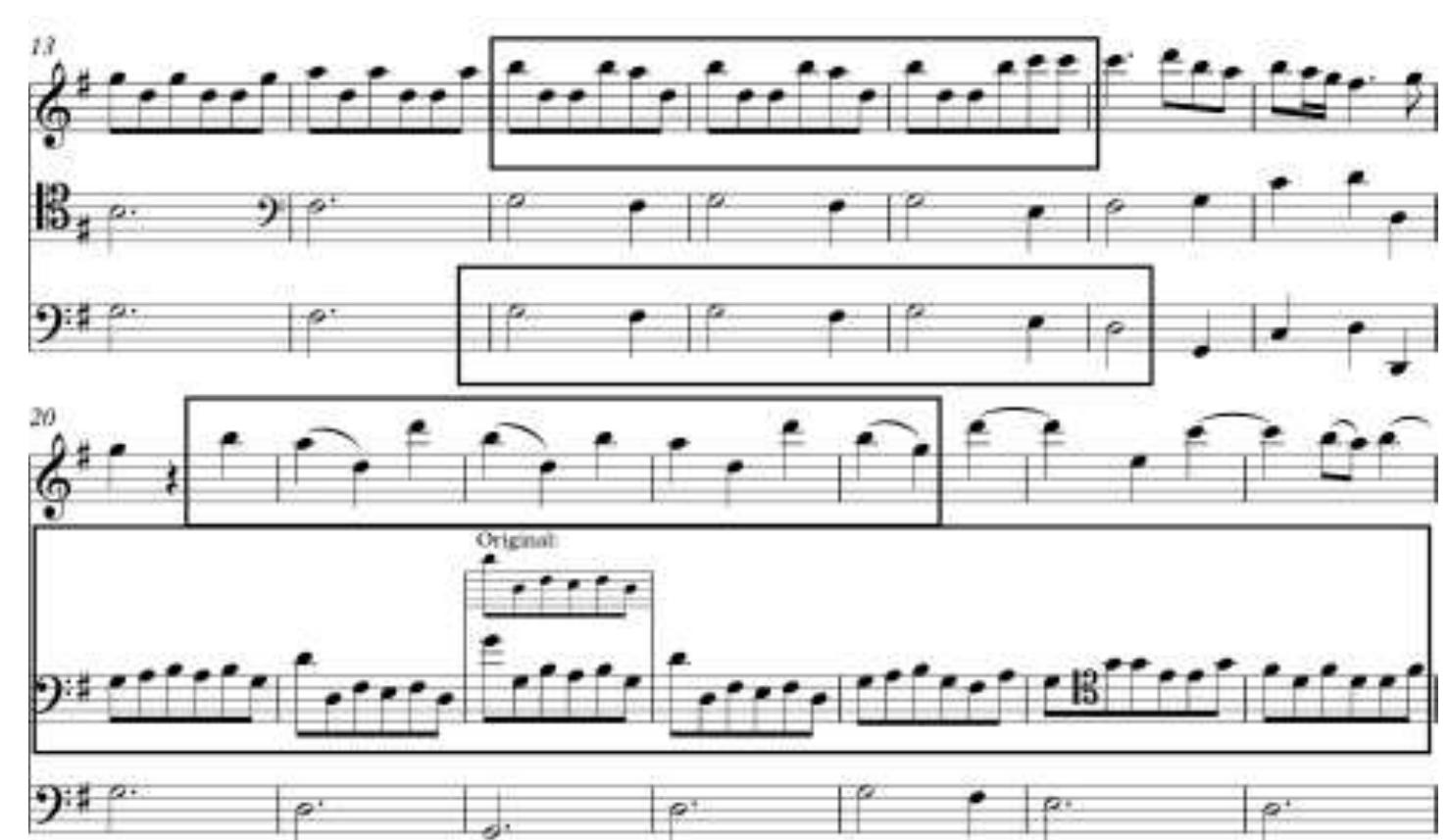
![This elaboration strongly points to Vivaldi as a very plausible author but the evidence must be taken carefully. It is very plausible that Vivaldi took the material from other composer. In the chapter “Vivaldi rielabora gli altri”,!*” [Vivaldi re-elaborates the others] Federico Maria Sardelli shows a large catalogue of example of Vivaldian works composed with material of other composers. Ruggieri, Lotti, Ziani, Bonporti, Westhoff, Bononcini, Marini are just some examples of composers that served as inspiration to Vivaldi. B section of both sonatas:](https://figures.academia-assets.com/38789227/figure_052.jpg)