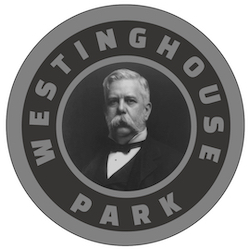
140th Anniversary of the discovery of natural gas

At Westinghouse Park, we say History Happens Here. Here’s one reason why.

In the spring of 1884, George Westinghouse hired a drilling team to see if there happened to be any natural gas beneath his estate, Solitude.

Early on the morning of May 22, the drilling team broke into a large pocket of gas at just over 1500 feet deep, releasing a roaring, uncontrollable gusher of gas and fluids that blew off the top of the drilling rig and spewed into the sky. At the time, there was no way to stopper gas wells, but within a week, Westinghouse figured how to staunch the flow.

Less than one month later, the Pittsburgh Common Council was already debating a proposal Westinghouse had submitted to pipe gas under city streets to nearby customers. Over the coming years, Westinghouse designed and patented dozens of devices to make the use of gas safe, effective, and financially viable.

So, in numerous ways, the natural gas industry began that day in what is now Westinghouse Park.

To read more on the subject, check out this article from Western Pennsylvania History Magazine.

Presentation at the East Liberty Valley Historical Society

by David Bear, May 1, 2024

In 1892, the same year Carnegie and Frick’s Pinkertons were battling steelworkers at the Homestead works, one Pittsburgh industrialist was planning a brighter future for all– by introducing safe, alternating current electric lighting to brilliant effect at the Chicago World’s Fair the following year. His company would be among the first to adopt better working conditions for employees, including a shorter work week. For those reasons and more, George Westinghouse deserves to be much better remembered in Pittsburgh and around the country, David Bear told an audience of 56 last night in Calvary Episcopal Church’s Parish Hall.

“He was a really progressive employer,” Dave said during the first part of his talk, which focused on the significance of Westinghouse’s pioneering achievements in rail safety, electricity and natural gas. The second part detailed what happened to his Point Breeze home (razed and buried), land (public park), personal papers (burned at his request) and furniture and household goods (scattered among his 79 descendants) after he and his wife Marguerite died in 1914.

The third part of Dave’s talk set forth what is now being done to interpret Westinghouse’s life and work and the landscape where so much of it was accomplished but so little evidence remains. Dave is the founding president of The Westinghouse Legacy, the new non-profit that plans to create a digital archive linking to documents, videos and other materials—a sort of one-stop reference shop for all things Westinghouse. It also will advocate for implementation of Westinghouse Park’s new master plan, for more extensive archaeology in the 10-acre park and for its designation as a city historic site. In 2021, it was determined eligible for listing on the National Register of Historic Places and also became a nationally recognized certified arboretum, with 10 trees dating to the time of the Westinghouse estate.

Also in recent years, the story of the Westinghouse-Edison, AC-DC rivalry has been featured in a film and musical, both called “The Current War,” and Westinghouse has been the subject of a new biography by William R. Huber. One thing not happening, Dave said, is transformation of Westinghouse engineer and general manager Emil Keller’s historic house near the park into a Westinghouse archive and academic research center, after the present owner decided against donating it to The Westinghouse Legacy and instead will restore it himself, a simpler and more expedient option for him. Keller was the engineer Westinghouse hired to illuminate the 1893 fair’s White City; the house he and his wife designed and completed in 1905 at the corner of Meade and North Murtland streets is still a private home and virtually unchanged from the Keller era. It was designated a city historic landmark in December. “We had ambitious plans but it’s going to take a lot of work” to restore, Dave said, adding that having a narrower mission “has taken a huge load off.”

Information: thewestinghouselegacy.org. ELVHS photos by E.J. Donnelly; story by Patricia Lowry

The Westinghouse Brand Endures

How design has helped the rebirth of a 100-year-old American brand

From the San Francisco Chronicle

By StoryStudio May 10, 2023 9:27 PM

(BPT) – When you think of the most important, influential companies in America, the first image that may pop into your head is their logo. This is common for long-lived brands spanning decades — or over a century — and even more so for well-designed, memorable logos that represent the company in a visually meaningful way. 

For example, when you hear the name “Westinghouse,” you probably imagine the distinctive brand logo designed by renowned graphic designer and art director Paul Rand (1914-1996) back in 1959. Throughout his illustrious career, Rand created numerous well-known logos for companies like IBM, UPS, ABC and NeXT.

Rand’s familiar logo is now undergoing a facelift thanks to acclaimed contemporary designer Paula Scher, who has reimagined the famous logo with a colorful approach that’s appealing to today’s consumers, while still paying homage to its original creator.

Brief history of an iconic American brand

George Westinghouse founded Westinghouse Electric in 1886, and through a partnership with Nikola Tesla and the development of the AC power system, defeated Thomas Edison’s DC power in the “war of the currents.” For the next century Westinghouse Electric achieved fascinating firsts in electrical innovation, including the first long-distance transmission of high-voltage AC power, the first commercial radio broadcast and the camera that captured the first steps on the moon during the Apollo 11 mission. Today, the Westinghouse logo can be found on products ranging from nuclear power plants and large industrial motors to televisions, light bulbs, generators and more.

The famous brand logo designed by Paul Rand is made from the letter “w” with three circles atop each peak and a bold line underneath. Not only is the design eye-catching and memorable, but it suggests the idea of electronic circuits connecting, representing the company’s foundation and continuing product line.

“The enduring legacy of this logo design is undeniable,” said Director of Brand Experience at Westinghouse Electric Corporation Kevin Drain. “And the longevity of this clear, clean, evocative image speaks to the power and passion behind Rand’s vision.”

Redesigning an iconic brand for the next generation

As the company planned to revitalize the brand, they sought one of the best designers in the country to help reimagine the logo for a modern audience.

Paula Scher was their top choice, as a highly influential graphic designer well known for her creative work for companies including Citibank, Tiffany’s, Microsoft, Adobe, Coca-Cola and the Walt Disney Company, just to name a few — plus venerable institutions such as the Museum of Modern Art, the Sundance Institute, the Metropolitan Opera and the New York Philharmonic. In 2001, Scher was awarded the profession’s highest honor by the American Institute of Graphic Arts, the AIGA Medal, to recognize her distinguished achievements in the field, and is one of the world’s most highly regarded designers today.

Using Paul Rand’s original Westinghouse brand manual as inspiration, Scher created a visually compelling redesign for the new look of Westinghouse. The design incorporated bright colors, larger typeface and the circle element to appeal to a younger audience while still honoring the company’s legacy of technological innovation. This new design system is a powerful tool in perpetuating the generational legacy of the brand.

“The evolution of this logo is proof that great design will always be great,” added Drain. “If you have a classic design like Rand’s logo, why not keep it — especially when it’s been created to stand the test of time. Scher has taken the original design and modernized it brilliantly, bringing it into the 21st century.”

Check out the new look for the logo design by visiting Westinghouse.com.