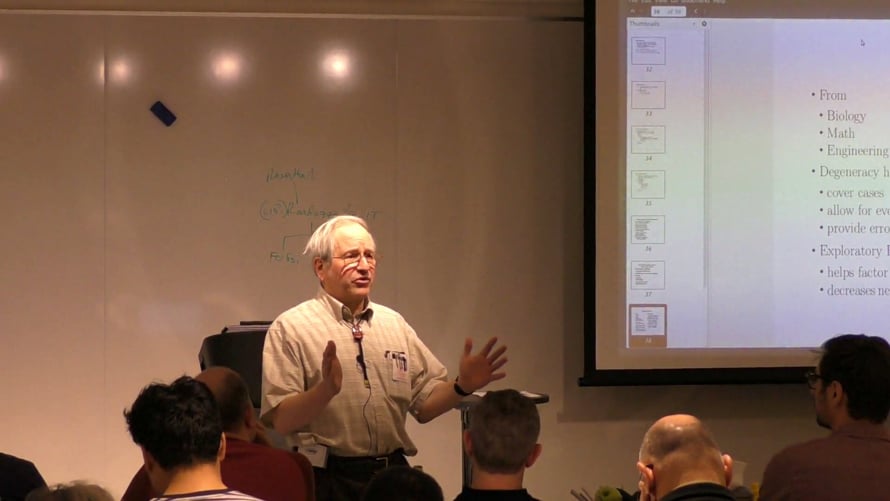
Gerald Jay Sussman on Flexible Systems, The Power of Generic Operations

Flexible Systems
The Power of Generic Operations
Abstract
Most systems we build work well for the application that they were designed for, but they are brittle in that adapting to even small changes in the problem requires large changes in the code. Can we optimize for flexibility, trading off other virtues like proofs of correctness or efficient execution? I think this is often the right path.
Indeed, Postel's Law, "Be conservative in what you do, be liberal in what you accept from others," is strong advice for enhancing robustness in open systems.
In the spring term I teach an advanced programming class, where the goal is to learn how to avoid programming oneself into a corner. One of the most powerful (and dangerous) techniques for enhancing flexibility is the use of extensible generic operations.
I will show where it is to our advantage to make systems with extensible generic operations, and how to control such systems.
Bio
Gerald Jay Sussman is the Panasonic Professor of Electrical Engineering at the Massachusetts Institute of Technology (MIT). He received his S.B. and Ph.D. degrees in mathematics from MIT in 1968 and 1973 respectively. He has been involved in artificial intelligence research at MIT since 1964. His research has centered on understanding the problem-solving strategies used by scientists and engineers, with the goals of automating parts of the process and formalizing it to provide more effective methods of science and engineering education. Sussman has also worked in computer languages, in computer architecture and in VLSI design.
Sussman is a coauthor (with Hal Abelson and Julie Sussman) of the introductory computer science textbook Structure and Interpretation of Computer Programs. It was used at MIT for several decades, and has been translated into several languages.
Sussman's contributions to artificial intelligence include problem solving by debugging almost-right plans, propagation of constraints applied to electrical circuit analysis and synthesis, dependency-based explanation and dependency-based backtracking, and various language structures for expressing problem-solving strategies. Sussman and his former student, Guy L. Steele Jr., invented the Scheme programming language in 1975.
Get started for free
24/7 customer support
Our customer support team is available to help 24/7. Enterprise members also receive dedicated account managers and a guaranteed uptime SLA.
© 2026 Vimeo.com, Inc. All rights reserved.
TermsPrivacyYour Privacy ChoicesU.S State PrivacyCopyrightCookies