
Home > Television > ITV
Fade-up Guildhall
22 September 2025 tbs.pm/82930


From ‘Fusion’, the staff magazine of Rediffusion London, issue 40, autumn 1965
Much has already been written about the 10th anniversary of Independent Television. Fusion [Rediffusion’s staff magazine] decided the best way to commemorate the event was to tell the story of opening night in particular, and the hectic events of those early days in general, through the words of some of the 273 members of the staff who were with the company on opening night – Thursday, September 22, 1955 – and who are still working for us.
First, however, the scene should be set. This is what the TV Times said in their first edition: ‘Gala Night! British Independent Television makes its bow this evening. First the cameras scan the face of London; then they fix upon historic Guildhall, where the inaugural ceremony lakes place.’
At 7.15 John Connell did the commentary as the guests arrived. At 7.30 there was the Hallé Orchestra and at 7.43 there were the inaugural speeches, including one by Dr the Rt. Hon. Charles Hill, M.P., then the Postmaster-General, now Lord Hill, chairman of the Independent Television Authority.
The programmes that first evening were shared with ATV and included our production of an excerpt from ‘Private Lives’ by Noel Coward with Kay Hammond and John Clements. After this came professional boxing and ‘News and Newsreel’ which presented ‘Outstanding events of recent days’.
Then there was ‘Gala Night at the Mayfair’ during which Leslie Mitchell introduced some of the guests. Meanwhile the staff had their own party at the old Granville Theatre which had been converted into a television studio.
The next day Associated-Rediffusion, as it was then, became the first Independent TV company to launch a full day of programmes. They started at 10.43a.m. with ‘Sixpenny Corner’. As the TV Times said, this was ‘A daily serial telling of the life, love and tribulation of young Bill and Sally Norton and their garage at Sixpenny Corner in rural Springwood’. It was written by Jonquil Antony and Hazel (‘Compact’) Adair. After this came ‘Hands about the House’ in which Elsa Court showed viewers how to make a frame with flowers. At 12.13 there was ‘Small Time’. Highlight of the evening viewing was ‘Take Your Pick’ at 8 p.m. and ‘Dragnet’ at 8.30. Later came ‘Confidentially’ with Reg Dixon and ‘Round the World with Orson Welles’. The epilogue was at 11 p.m.
Now here is the story of that opening night and hectic early days as told by the staff concerned. If it all appears to be a bit chaotic, then it has captured the right flavour.
Neil Bramson, head of presentation, then a programme officer with Cyril Francis: ‘It was my shaky voice in the master control at Television House which said “fade up Guildhall”. It was shaky from excitement and from the fact that at that afternoon’s rehearsal of the five OB’s to be used on opening night, only one had come up correctly.’ He also tells the story from those early days of a performance of ‘Hamlet’ which ended abruptly before the final scene. A very irate and very senior executive furiously rang up the control room. ‘What happened?’ he asked. ‘He died’ was the answer.
Cyril Francis, programme planning executive, recalls that the first commercial – for Gibbs S.R. ‘tingling fresh’ toothpaste at 8.52 – was miscued and a ‘6’ came up in the gate.
Courtesy of The Hall of Advertising
Ernest Hewitt, costume buyer/designer: ‘I spent the whole evening trying to sort out our accounts, which we had to do ourselves in those days. Sheila Jackson was working with me and we had a heck of a time trying to get things on people as best as we could’.
David West, foreman studio electrician: ‘There’s nothing you can print. Most of the electricians had come from the BBC and we are proud that 22 of us are still working for the company’.
Joan Kemp-Welch, programme director: ‘I directed the first live programme, the day after opening night. It was about how to make a frame with flowers and was from the Viking Studios. Teddy Shankster did the lighting and I had Geoff Rimmer’s camera crew. David Boisseau, who had trained all the directors, was there to watch’.
Percy Mole, back projectionist: ‘I was the projectionist at the Wembley pre-view theatre and I spent the day running stuff through for the editors’.
Vicki Miller, assistant to head of casting: ‘I went to the party for the staff at the Granville Theatre and saw the opening night programmes piped through. It was terribly exciting’.
Anstice Shaw, sales executive, who resigned at the end of August, was the only surviving member of the advertisement department: ‘There were four sales executives – I was the only woman – and we were invited to the Mayfair. I was terribly poor and didn’t have an evening dress. I blew everything and bought one. I popped out of the bath to see the first commercial before going to the Mayfair. After the party I got back to my flat in the early hours to find I had lost the key. I climbed over a wall and landed on my hands and knees in the back garden to get someone to let me in. That night I shall not forget’.
Olive O’Sweeny, Wembley day cleaner: ‘I was busy in the dressing rooms. I used to work for 20th Century and the company took me over with the furniture when they bought Wembley. I worked from 6 a.m. to 12.30 p.m. every day and still do’.
Bill Lee, senior lighting director: I can’t remember anything in particular but it is interesting that the lighting equipment we installed in Studios 1 and 9 was the forerunner of the equipment now in use in TV throughout the world. We pioneered the transition from film to television lighting. The tubular grid in Studio 1 was the first system conceived in this way and our switch-board was the forerunner of similar boards all over the world’.
Jim Runkel, supervisory engineer: ‘We telerecorded the opening ceremony. It was our first real crack at anything. I suppose it is all down in archives somewhere’.
Vic Gardiner, assistant to P.Prod.E.: ‘I was the senior cameraman then. I recall my first production was with Michael Westmore and was a promotion film for our children’s programmes. I also worked with Cyril Butcher on the Granville Melodramas (transmitted from the second week). We had had a training course at the Viking Studios – Don Gale and Geoff Rimmer were with me. About 50 cameramen were trained, most from the BBC’.

The Granville Theatre
Tony Oldfield, graphic designer: ‘I remember going to the Granville party but I can’t remember any more’.
Muriel Cole, head of casting: I was casting drama and children’s. We had around five hours of children’s programmes live each week. I remember thinking at the Granville party “how did I get into all this from the sanity of films?”. The whole of Television House was being torn apart. I might be talking to an agent and have to stop him while part of the sixth floor went down the chute outside my window’.
Stella Ashley, manager scripted series: ‘I was P.A. to Lloyd Williams. There was tremendous relief when everything worked. On the night, Lloyd commented “If the Post Office keep their switches in and their fingers out we shall be all right”. We were’.
Charlie Craft, an assistant manager: ‘As assistant cashier at Wembley I did all sorts of jobs. There was the chaos of the old film studio being divided into two and on the night we were flooded out by press people who wanted more phones than there were in the building’.
Liz Anderson, secretary publicity (she and Dick Dawson are the only ‘originals’ still in the department): ‘It was all quite mad. I was in the press office and had only been with the company a fortnight. Joan Parsley had ten bob stolen at the Granville party’.
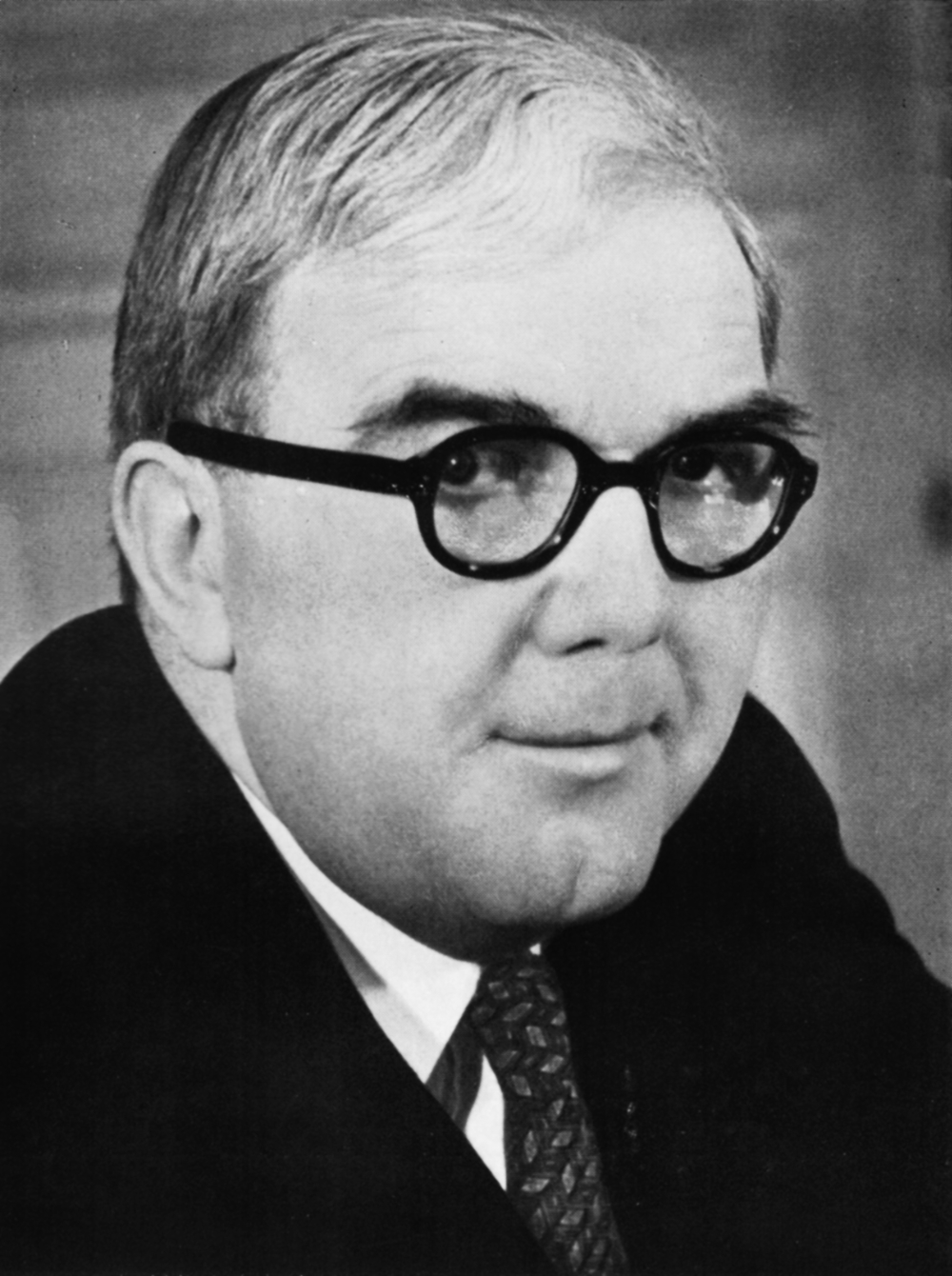
Dr Charles Hill MP, postmaster-general
Ted Vosper, assistant to A.G.M. (Staff): ‘The administration of remotes was my job at Wembley. We had no office; we just operated from a corner of the garage with old boxes and had to run to the front of the building if there was a phone call’.
Bob Lacy-Thompson, senior contracts officer: ‘I went to the Granville party. All the incidents had happened for us by then in getting out the contracts before opening night’.
Graham Bye, promotion executive: ‘There were shrieks at the Granville when the first commercials went out. Before that I had to write scripts for auditions for announcers. Muriel Young went to one audition by mistake instead of going to an audition for actresses. She got the job.’
Michael Tresadern, head of wages and salaries: ‘The lights used to fail quite frequently as they were pulling the place down. We just made out the wages by the light of hurricane lamps’.
Vic Cope, first projectionist: ‘A room on the third floor was used as the preview theatre. I remember Ray Dicks came to see the first Epilogue on the afternoon of the opening night. “That’s O.K.” he said, and I locked up the room. Halfway home on the bus I had the terrible thought that I had also locked up the Epilogue for that first night. Fortunately I was wrong’.
Alec Gunn, programme officer: ‘As a floor manager I worked on “Cavalcade of Sports”. Instead of sportsmen we rehearsed with Boy Scouts as substitutes’.
Joan Elman, head of programme clearance: ‘I sat at home watching the miracle come to life, natural breaks and all’.
Eric Martin, senior manager, features: ‘I was a weird animal called a cost planning assistant working with Peter Choat at Shepperton’.
Joan Taylor, senior accountancy assistant: ‘I was on holiday in Jersey’.

Programme for the first night, given to diners at the May Fair Hotel
Robert Everett, head of programme services: ‘As manager remotes I was at the Guildhall. During the afternoon I stood in front of a camera giving an interminable monologue while they played with the sound and picture at the other end. We got our first Proctor Dolly that afternoon but it didn’t fit the camera. So I was in my dinner jacket on my knees trying to drill a hole in it. Then I was aware of someone standing over me. It was the general manager, Capt. Brownrigg, who said without much conviction “I hope everything is all right”. It was – despite the fact that so many had forecast that we would never do it’.
Jack Elkins, charge hand plant attendant: ‘I was in the boiler room at Wembley. The first show we did down there was “Sixpenny Corner” in Studio 3 which is now used by telerecording’.
Joan Lamb, copy typist: ‘One mad rush, it was. But I shall always remember “Channel 9” coming up on the screen’.
Ronald Marriott, programme director: ‘I did the first advertising magazine with Margo Lovell, I think it was called “Design for Living”. At our rehearsal in a bare room without props there were about 30 advertisers and their side-kicks watching. One kept insisting that we did not mention the “brass knurled nuts” on his equipment’.
Mrs A. Darby, senior duplicator operator: ‘When the electricity in TV House was turned off we had to operate the duplicating machines by hand. We could hardly move by the end of the day’.
Gil Knight, film cameraman: ‘I filmed the first stuff screened – the background to a commentary about ITV. The opening shot entailed me going up a lift on scaffolding around Big Ben and panning round to the face of the clock. It needed careful timing’’
Beryl Wilkins, film editor: ‘With Amy Hawes I had the job of assembling the first reel of commercials and doing dummy runs before going on the air’.
Mrs D. S. Lochmuller, switchboard supervisor: ‘It was a bit of a madhouse that evening as we were still using the old Air Ministry switchboard. The inside of the building was still being done up. People kept changing offices. The only way we could get hold of them was to run out ourselves and find them’.
Daphne Shadwell, programme director: ‘As P. A. to women’s programmes I was made secretary in the opening night office looking after the arrangements and invitations to the Guildhall and Mayfair events. I was kept running around like a maniac. Still I was in good company. John (her husband John Hamilton) was on sound, Bimbi Harris was a vision mixer and Grahame Turner was a cameraman in those days. Now we are all programme directors and we have been joined by Robert Gray from lighting’.
Vic O’Brien, engineer-in-charge, TV House: ‘Fingers were crossed and tummy muscles were tightened in master control as we approached the launching of ITV. Our air-raid sirens wailed for silence among the builders, cues were said and we were on the Guildhall. It was a smooth, exciting progression from one programme to another all evening … apart from having to switch off all unnecessary lights in Television House due to overloading of our technical power supply. The drama was to follow’.
Your comment
Enter it below