Testing AI: What Actually Works for QA Teams in 2026
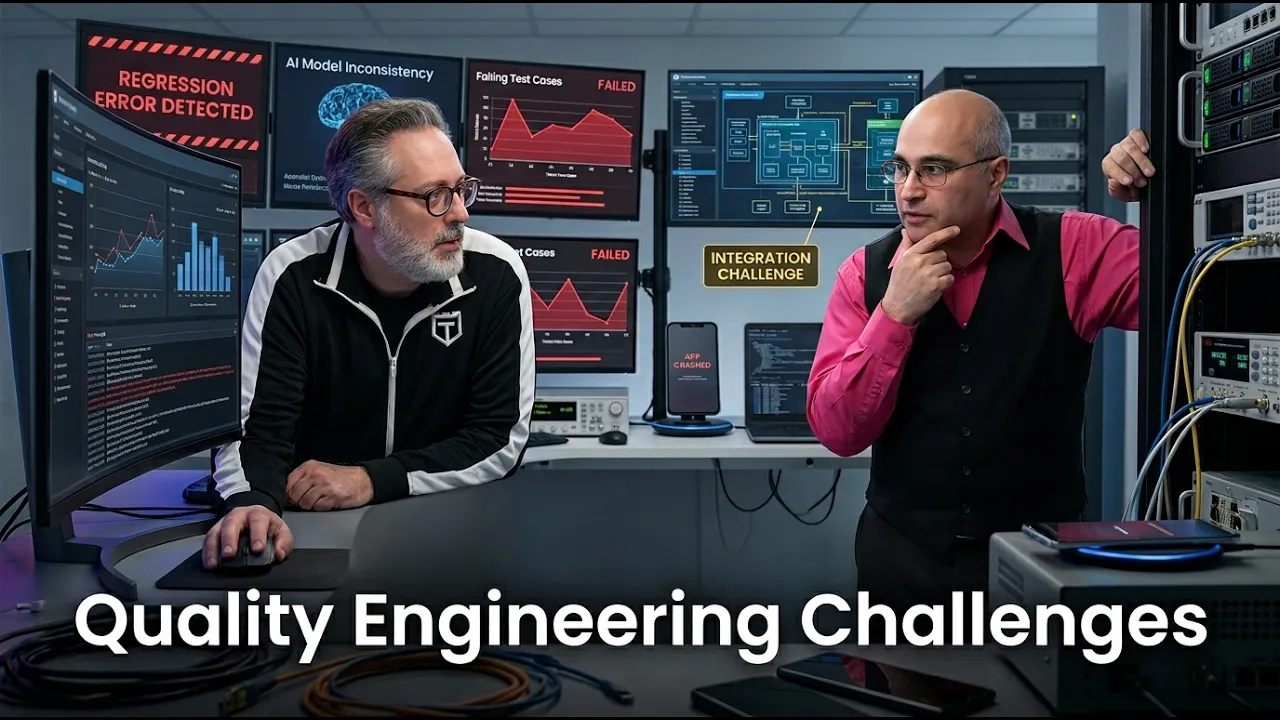
If you’ve spent any time testing AI-powered applications lately, you’ve probably hit this moment: you run the same test twice, with the exact same input, in the exact same environment and get two completely different outputs.
That’s not a bug.
That’s non-deterministic behavior.
And it breaks almost every assumption your current software testing process is built on.
As a long time tester this can be super frustrating — right?
I talked about this at length with Adam Sandman, founder of Inflectra and a 20-year veteran of software quality, on the TestGuild Automation Podcast.
“The stakes got higher, the volume got bigger, and potentially the quality has gotten lower. That raises the bar on the quality side of things.”
— Adam Sandman, Founder of Inflectra (TestGuild Automation Podcast Episode #580)
In this post I’m breaking down exactly what testing AI systems actually requires, why your existing test automation approach won’t cut it for generative AI features, and what a practical strategy looks like in 2026.
If you’re looking for a roundup of AI testing tools, I’ve got a separate guide for that check out my list of AI test automation tools here.
This post is about the methodology.
What Is Non-Deterministic Behavior in AI Systems?
With a traditional deterministic system, the rules are simple: same input + same environment = same output. Every time.
That’s the whole foundation of repeatable test automation.
Run your regression testing suite a hundred times, you get the same results a hundred times.
If something breaks, something changed and “what changed?” is your first debugging question.
AI systems specifically large language models, generative AI features, recommendation engines, and AI agents, break that rule completely by design.
A non-deterministic system can take the exact same input in the exact same environment and return a different answer every single time.
The probability distributions that make these systems useful are the same thing that makes them hard to test.
That means the classic “did the test pass or fail?” question doesn’t fully apply anymore.
“It isn’t a question of do we test this or do we test it completely — it’s what is the acceptable level of risk we’re willing to tolerate in this AI system for this use case.”
— Adam Sandman, Founder of Inflectra (TestGuild Automation Podcast Episode #580)
That’s a fundamentally different question than what most testers are used to asking.
And the manual testing approaches and automated testing scripts that work perfectly for your web app?
They’re the wrong tool for this job.
What Is the Difference Between Agentic AI and Generative AI — And Why Does It Matter for Testing?
Before getting into methodology, it’s worth clarifying what you’re actually testing, because the approach differs.
- Generative AI (LLMs, image generators, text summarizers) takes an input and generates a novel output. The output varies each time based on the model’s probability distributions. Testing generative AI is mostly about output quality, accuracy, and safety across a large sample of runs.
- Agentic AI goes further it takes actions, calls tools, makes decisions across multiple steps, and operates autonomously over time. Testing AI agents is harder because you’re not just evaluating a single output. You’re evaluating a chain of decisions, each of which can branch in unexpected directions. Failure modes compound.
Both are non-deterministic. Both require statistical testing approaches.
But agentic AI testing requires additional focus on: decision chain integrity, tool call accuracy, failure recovery, and security (how does the agent handle unexpected inputs designed to manipulate it?).
Why Traditional Testing Tools Won’t Work Here
Here’s an analogy Adam used that really clicked: trying to test a non-deterministic AI system with a traditional functional testing tool is like trying to do load testing by opening 20 browser tabs and clicking around manually.
You can do it. It won’t tell you anything useful.
Functional testing tools are built around determinism.
They expect a specific output for a specific input.
When your AI chatbot gives a slightly different phrasing of the correct answer on test run #47, your automated test fails, even though the system is working exactly as designed.
You end up with flaky tests that aren’t actually flaky, they’re just testing the wrong thing with the wrong tool.
The same problem applies to test case generation using traditional approaches.
When you’re writing test cases for a deterministic system, you’re specifying exact expected outputs.
For an AI system, you can’t do that.
Your test cases need to define criteria, not exact answers.
This is also why test maintenance overhead explodes when teams try to apply existing automation frameworks to AI features ,they keep rewriting expected outputs that were never wrong to begin with.
The Right Mental Model: Think Like a Performance Engineer
The most useful reframe for AI testing is this: think about it like performance testing, not functional testing.
When you do load testing, you’re not asking “did this exact request succeed?” You’re asking “how does this system perform across thousands of concurrent requests?”
You’re looking for statistical patterns like response times, error rates, throughput degradation under stress.
Non-deterministic AI testing works the same way.
You’re not running one test and expecting one answer.
You’re running thousands (or millions) of input permutations and analyzing the output distribution across your test data set.
Here’s what that looks like in practice:
Step 1: Define your quality dimensions. What actually matters for this AI feature? For a support chatbot, it might be: accuracy, tone, safety (no hate speech, no harmful advice), escalation behavior when a user is frustrated, and whether it stays on topic. These become your acceptance criteria — not exact outputs, but measurable dimensions.
Step 2: Build diverse test data. Your test coverage depends entirely on the breadth of inputs you throw at the system. Edge cases, adversarial inputs, unusual phrasing, off-topic requests, multi-language inputs. The more varied your test data, the more meaningful your results.
Step 3: Deploy agents at scale. Purpose-built tools for testing AI let you spin up large numbers of input agents that run your AI system through diverse test permutations automatically. Think of it as load testing but for output quality instead of response time.
Step 4: Collect statistical outputs. Instead of pass/fail per test case, you get distributions: “Out of 10,000 test runs, the chatbot gave a helpful answer 89% of the time, avoided harmful content 99.97% of the time, and escalated appropriately 76% of the time.”
Step 5: Make a risk-based decision. Is 89% accuracy acceptable for this use case? That’s not a testing question — it’s a business decision. Your job is to generate the data that makes that decision possible.
What Acceptance Criteria Should You Use for Non-Deterministic Systems?
This is where a lot of teams get stuck.
You can’t write acceptance criteria the normal way (“the system shall return X when given input Y”). So what do you write instead?
The answer is probabilistic acceptance criteria tied to your quality dimensions:
- “The system shall provide a factually accurate response at least 90% of the time across a test corpus of 1,000 representative user queries”
- “The system shall never generate content that violates our content policy across 10,000 adversarial test inputs”
- “The system shall correctly escalate to a human agent in at least 85% of simulated frustrated-customer scenarios”
These criteria are testable, measurable, and meaningful.
They’re also the kind of thing you can defend to a compliance team, an executive, or a regulator.
Adam made a sharp point about the stakes here. Five nines (99.999% reliability) might be acceptable for an e-commerce chatbot.
It’s probably not acceptable for an AI-assisted medical diagnostic tool or an air traffic control deconfliction system. The acceptance criteria need to match the risk profile of the system.
Decompose Your App: Not Everything Is Non-Deterministic
Here’s something that gets overlooked: most applications that include AI features aren’t entirely non-deterministic. A lot of teams throw out their entire test automation strategy when they add a generative AI component.
That’s the wrong call.
An AI chatbot still runs in a web interface. That interface has buttons, forms, navigation, and API calls that are completely deterministic.
Your login flow is deterministic. Your data layer is deterministic. Your payment processing is deterministic. Your regression testing suite still covers all of that perfectly well.
The key is decomposing your application into its deterministic and non-deterministic components , and applying the right testing approach to each.
As Adam put it: “The same way when you’re doing load testing, you might load test the REST API and you know the UI is going to scale fine. You don’t need to load test that. So it’s decomposing the app into the right bits, and testing in the right way.”
Here’s how that decomposition looks in practice:
| Component | Behavior | Testing Approach |
|---|---|---|
| UI / frontend | Deterministic | Standard UI automation (Playwright, Cypress, Selenium) |
| API layer | Deterministic | API testing, contract testing |
| Business logic | Deterministic | Unit tests, integration tests |
| Regression suite | Deterministic | Existing automated tests — keep running these |
| Generative AI feature | Non-deterministic | Statistical testing at scale, quality dimensions |
| AI agent decision chain | Non-deterministic | Multi-step scenario testing, failure chain analysis |
| AI output safety | Non-deterministic | Red teaming, adversarial input testing |
Don’t throw away your existing test suite. Add the right new layer on top of it.
What Metrics Actually Measure Stability in Non-Deterministic AI?
When you move from deterministic to probabilistic testing, your KPIs change. Here’s what to track:
- Accuracy rate: Across your test corpus, what percentage of AI outputs are correct or on-target? Define “correct” carefully per use case before you start testing.
- Safety compliance rate: For high-risk dimensions (harmful content, bias, hate speech, hallucination), what’s your failure rate? Track this separately from general accuracy — a 99% accurate but 0.1% dangerous system may not be shippable.
- Consistency score: For questions that have a single objectively correct answer, how often does the AI give it? This is different from accuracy — it measures variance, not just correctness.
- Escalation accuracy: If your AI is supposed to hand off frustrated users to human agents, is it doing that reliably?
- Boundary behavior rate : How does the system respond to adversarial inputs, off-topic requests, and unusual phrasing? This is your exploratory testing dimension for AI systems.
- Drift over time : AI model behavior can change as underlying models are updated, even if you didn’t change anything in your application. Continuous testing in production isn’t optional — it’s how you catch model drift before your users do.
None of these are pass/fail. They’re distributions.
Your job is to define acceptable ranges before you ship and monitor against those ranges after.
How to Debug Flaky Behavior in AI Systems
“Flaky tests” mean something different in AI testing than in traditional test automation.
In a Selenium or Playwright suite, a flaky test usually points to a timing issue, environment instability, or a brittle selector.
Fix the test, move on.
In AI testing, apparent flakiness is usually one of three things:
- Real non-determinism — The model is producing varied outputs as designed. This isn’t a bug. Stop treating it like one. If your test framework is marking valid AI responses as failures because they don’t exactly match an expected string, the problem is your test framework, not your system.
- Prompt sensitivity — Small changes in how a query is phrased produce dramatically different outputs. This is worth investigating. If your AI feature is highly sensitive to minor input variations, that’s a quality problem worth surfacing to the product team.
- Model drift — The underlying model behavior has changed. This is the sneaky one. You didn’t change your application, but a model update changed how it responds. Continuous testing in production with established baselines is the only way to catch this.
The debugging approach for AI is more like statistical analysis than traditional root cause analysis.
When did the distribution shift? Which quality dimensions are affected?
Is it consistent across input categories or isolated to a specific type of query?
How to Integrate Non-Deterministic Testing Into CI/CD Pipelines
This is a practical question teams ask a lot and there’s not a clean universal answer yet ,the tooling is still maturing.
But here’s a workable approach:
- Gate on safety, not perfection. Don’t block deployments because accuracy dropped from 91% to 89% ,that might be noise. Do block deployments if your safety compliance rate drops below your defined threshold, or if a new model version produces a statistically significant regression on your core quality dimensions.
- Run statistical tests, not single-run assertions. Your CI/CD pipeline needs to run enough test iterations to get a meaningful sample. The exact number depends on the variance of your system, but “run it once and check the output” is not a valid pipeline step for AI features.
- Separate your test execution tiers. Fast unit and integration tests for deterministic components can run on every commit. Statistical AI quality tests are more expensive and slower — run them on merges to main or on a scheduled basis, not on every PR.
- Version your test data. Your test corpus is as important as your test scripts. Version control it. When results shift, you need to know whether the model changed, the application changed, or the test data changed.
- Monitor in production. Treat production as a continuous testing environment. Sample real user interactions (with appropriate privacy controls), evaluate them against your quality dimensions, and alert on drift. This is your regression testing for AI in production.
The Requirements-Code-Test Gap Gets Worse With AI
The classic traceability problem in software testing has always been: requirements say A, the code does B, and the tests check C.
With AI systems, you add a fourth dimension, users experience D, and D varies every time.
This matters most in regulated industries. If you’re building software in healthcare (HIPAA, 21 CFR Part 11), financial services, insurance, or anything touching the EU AI Act, you need to be able to demonstrate that you tested against defined requirements and that the system met those requirements at a defined confidence level.
Test management tooling that ties your quality criteria to requirements and produces audit-ready reports isn’t just nice to have in these environments it’s a compliance requirement. The regulators will ask for it.
Adam’s point about the A/B/C/D gap also applies to AI-assisted development. If your team is using AI coding assistants to write code faster, who’s checking that the generated code actually matches the requirements? And who’s updating the test cases when the AI writes code that implements requirements in an unexpected way?
This is a new source of requirements drift that testing teams need to have a plan for.
Where to Start If Your Team Is Already Overwhelmed
Honestly most QA teams I talk to are already stretched thin!
Adding a whole new testing practice for AI on top of everything else sounds like a lot.
Here’s what Adam recommended, and it’s the right call: don’t start with the hardest thing. Start with the thing that’s going to give your team time back.
If you’ve got brittle test scripts eating hours every week in test maintenance, start there.
Find an AI-assisted test automation tool that helps with self-healing , tools that can automatically update locators and test steps when the UI changes. Reduce your manual effort on maintenance.
Get a few hours back per week.
Then use that breathing room to start exploring statistical testing for your AI features.
The teams that struggle are the ones who try to rebuild everything at once.
The teams that win start with one pain point, prove value, and build from there.
Even in a large organization with compliance requirements, you can pilot statistical AI testing on a single low-risk feature before rolling it out broadly.
If you’re an individual tester wanting to learn the craft: install VS Code or Cursor, pick up Playwright, and start tinkering with MCP integrations.
The best way to understand AI testing is to build small things, break them, and see what happens.
Everyone is learning this right now.
That’s not a weakness, it’s just where the industry is.
Tools to Look At for Testing AI in 2026
I’m not going to give you a definitive ranked list, this space is moving too fast.
But here are the categories worth knowing:
- Statistical AI testing platforms — Purpose-built for testing non-deterministic systems at scale with quality dimension scoring. Inflectra’s SureWire is one in this space. The category is still early but it’s where the serious tooling is heading.
- AI-assisted test automation — Tools that use AI to help generate test cases, maintain test scripts, and handle self-healing for your deterministic test layers. This is the most mature AI testing tool category right now.
- Red teaming and adversarial testing tools — Specifically designed to probe AI systems for safety issues, bias, harmful outputs, and unexpected behavior under adversarial inputs.
- Visual testing with AI — Tools that use AI-based visual comparison to detect UI regressions without brittle pixel-matching. More resilient to minor UI changes than traditional visual testing approaches.
- Continuous testing and monitoring platforms — Once AI systems are in production, you need ongoing quality measurement. Production AI monitoring is becoming its own discipline.
For a full rundown of specific tools in the AI test automation space, check out my AI test automation tools guide — I keep that updated with what’s actually worth your time.
Frequently Asked Questions About Testing AI Systems
What is the difference between testing a traditional AI system and testing a generative AI system?
Traditional AI systems (rule-based classifiers, predictive models with discrete outputs) are often closer to deterministic — given the same input, they return the same prediction. Generative AI systems (LLMs, image generators, creative tools) are fundamentally non-deterministic. Their outputs vary by design. Testing generative AI requires statistical approaches; testing traditional AI models is closer to standard software testing with some additional data validation layers.
Can AI testing tools completely replace manual testers or QA engineers?
No — and this framing misses what’s actually happening. AI Tools are eliminating the most repetitive, low-value parts of testing: maintaining flaky locators, writing boilerplate test cases for well-defined requirements, generating basic test data.
What they can’t replace is the judgment required to define what “good” looks like for an AI feature, design meaningful acceptance criteria, interpret statistical results, and make risk-based decisions.
The testers role evolves; it doesn’t disappear.
What are the biggest challenges of using AI in software testing?
The biggest ones I hear consistently:
(1) teams don’t know how to define acceptance criteria for non-deterministic outputs,
(2) existing test automation frameworks weren’t designed for probabilistic systems and produce meaningless results,
3) test coverage is hard to reason about when the input space is effectively infinite, and
(4) AI model behavior can drift after updates even when the application code hasn’t changed.
What skills will testers need going forward?
Statistical thinking is the biggest gap.
Understanding distributions, variance, and confidence intervals matters now in ways it didn’t when everything was pass/fail.
Beyond that: prompt engineering basics, understanding how LLMs work (enough to reason about failure modes), and the ability to translate quality metrics into business risk language for non-technical stakeholders.
Does testing AI eliminate the need for manual testing?
Not for AI-specific testing. Exploratory testing of AI systems, manually probing for unexpected behavior, testing edge cases that automated suites don’t cover, evaluating output quality in ways that are hard to quantify, remains valuable.
The human judgment required to recognize “this output is technically within spec but deeply weird” isn’t something you can automate away yet.
What tools and frameworks support AI software testing?
The honest answer is the tooling is still catching up to the problem. For deterministic layers of AI applications, standard frameworks (Playwright, Cypress, pytest, REST-assured) still apply. For non-deterministic AI features, purpose-built statistical testing platforms are emerging. For safety and red teaming, dedicated adversarial testing tools are available. See my AI testing tools guide for specifics.
How do you implement AI in your existing testing processes?
Start with the deterministic layers — use AI to help with test case generation, test maintenance, and self-healing for your existing automated tests. That’s the fastest win. Then layer in statistical testing for your AI-specific features. Don’t try to replace your entire testing process at once.
Key Takeaways
- Testing AI requires a fundamentally different approach than traditional software testing — statistical and probabilistic, not pass/fail
- Decompose your application: deterministic components still get standard automated testing; only AI features need the new approach
- Define probabilistic acceptance criteria before testing, tied to meaningful quality dimensions
- Think like a performance engineer: run tests at scale and analyze output distributions
- Flaky tests in AI systems are usually real non-determinism, prompt sensitivity, or model drift — not test infrastructure problems
- Integrate statistical AI testing into CI/CD by gating on safety thresholds, not perfection
- Start by using AI to reduce test maintenance drudgery, then layer in non-deterministic testing practices
- Continuous testing in production isn’t optional — model drift happens without warning

Joe Colantonio is the founder of TestGuild, an industry-leading platform for automation testing and software testing tools. With over 25 years of hands-on experience, he has worked with top enterprise companies, helped develop early test automation tools and frameworks, and runs the largest online automation testing conference, Automation Guild.
Joe is also the author of Automation Awesomeness: 260 Actionable Affirmations To Improve Your QA & Automation Testing Skills and the host of the TestGuild podcast, which he has released weekly since 2014, making it the longest-running podcast dedicated to automation testing. Over the years, he has interviewed top thought leaders in DevOps, AI-driven test automation, and software quality, shaping the conversation in the industry.
With a reach of over 400,000 across his YouTube channel, LinkedIn, email list, and other social channels, Joe’s insights impact thousands of testers and engineers worldwide.
He has worked with some of the top companies in software testing and automation, including Tricentis, Keysight, Applitools, and BrowserStack, as sponsors and partners, helping them connect with the right audience in the automation testing space.
Follow him on LinkedIn or check out more at TestGuild.com.
Related Posts

Bottom Line: Kobiton is the first real device testing platform I’ve seen that makes AI-powered mobile testing feel like it […]

Look, most of the AI testing tools I cover on the TestGuild Automation Podcast share two things in common: they’re […]

At least one in five people has some kind of impairment, so it’s important to have them in mind when […]

Last Updated: April 18, 2026 By Joe Colantonio — 25+ years in testing, 500+ podcast interviews with tool creators Full […]