
Máximo Rafael Colón
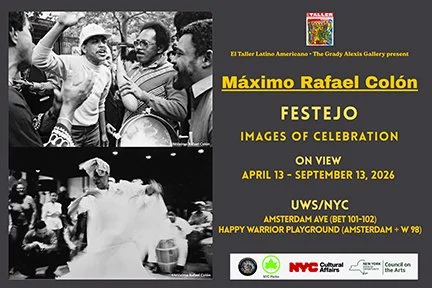
Festejo, a collection of 24 images by Máximo Rafael Colón, about celebration.
Join us + Máximo for exhibition walks and talks:
Sunday May 17 at 1pm - meet at 102nd Street and Amsterdam Avenue
Wednesday, May 27 at 7pm on Zoom - details to follow
On view from April 13, 2026 through September 13, 2026
Frederick Douglass Playground (on Amsterdam Avenue between 101-102 Street) and
Happy Warrior Playground (Amsterdam Avenue and West 98th Street).
This is a part of The Grady Alexis Gallery’s public art presentations that brings art outdoors for all to enjoy in environments of play.
Máximo Rafael Colón’s black-and-white photographs, from the 1970s through the early 2000s, are joyous depictions of community gatherings that include parades, dance, music, and cultural events. In them, we see New Yorkers use public spaces as avenues of expression. Colón takes us to the center of sound and movement at each event: from the Lower East Side, El Barrio and Upper West Side. These images make us feel a part of all the action and refer to New York City’s long history of festivity in its open streets, parks, playgrounds, and the corners of all of our neighborhoods; they recollect for us all the reasons to come together in happiness and peace.
Colón’s work exemplifies the best of our humanity in our need to be together, to celebrate culture and identity, and experience art and music. He reminds us that we are the best version of ourselves when we are part of something shared that reinforces our core values. And in this sharing, we are participating in unifying and simple, yet profound, moments that can offer transcendence from our daily concerns.
Born in Arecibo, Puerto Rico, Máximo Rafael Colón is a New York–based photographer who studied at the School of Visual Arts in New York City. Colón’s photography speaks to his concerns of social justice, activism, and cultural expression, which encapsulate a wide range of interests in music, the human condition, and making visible the people of our society who are often marginalized through discrimination and inequality. His primary medium is analog photography. Colón also creates assemblages in the found object tradition. His works have been exhibited in several venues throughout New York City and Puerto Rico and a number of his photographs form part of the Centro De Estudios Puertorriqueños archives at CUNY Hunter College and of the permanent collection at the National Portrait Gallery of the Smithsonian Institution in Washington, D.C.
Virtual Gallery Tour with comments by Máximo Rafael Colón

Máximo Rafael Colón - Tato Laviera, Fiesta de Loiza, Avenue C, 1975
Fiesta de Loíza, 1970s
“This is Tato Laviera, and this is 1975. And this is a festival that Tato and I worked on with
Ana Martha Morales, at The Center for Puerto Rican Arts…”
Máximo Rafael Colón, 2026

Máximo Rafael Colón - Fiesta de Loiza, Centro de Arte Puertorriqueño, E 11th Street, 1975

Máximo Rafael Colón - Fiesta de Loiza, El Barrio, Third Avenue , 1976
La Rumba, 1990
“The thing, with the music, with things like this, is that there's a lot of energy happening, there's a lot of spontaneity, and people are interacting with one another. And I just love that. Using a 35 millimeter lens just forces you to get close, to just to be in there and just try to capture the energy that's happening.”
Máximo Rafael Colón, 2026

Máximo Rafael Colón - La Rumba, Central Park, 1990

Máximo Rafael Colón - La Rumba, Central Park, 1990

Máximo Rafael Colón - Nellie and Sammy Tanco, Riverside Park Promenade, 1979
The Tanco Family, 1970s-2000s
“Nellie and Sammy, played and sang together… They were preserving their cultural heritage from Puerto Rico, from la plena, la bomba. Exquisite singers and musicians.
This is like a legacy: a legacy of their family, a legacy that they preserve.”
Máximo Rafael Colón, 2026

Máximo Rafael Colón - Los Pleneros de la 21, Caribbean Cultural Festival, West 62nd Street, 1984

Máximo Rafael Colón - Tanco Family, Caribbean Cultural Festival, 10th Avenue, 1985

Máximo Rafael Colón - Fiesta de Loiza, East 11th Street, 1975

Máximo Rafael Colón - Nellie Tanco y Los Pleneros de la 21 Hostos Community College, 2004
Central Park Bandshell, 1973
“All those musicians on that stage were very pivotal in our cultural development and preservation.”
Máximo Rafael Colón, 2026

Máximo Rafael Colón - Marcial Reyes, Central Park Bandshell ,1973

Máximo Rafael Colón - Sylvia del Vallard, Central Park Bandshell, 1973
Grupo Folklorico y Experimental, 1976
“One of the pictures that's in the exhibit is this photograph: Chocolate Armenteros, Nelson Gonzalez and Heny Alvarez.
This was an electrifying moment, and it was full of people. And this is the best shot that I could get, because the Grupo Folklorico was hot!”
Máximo Rafael Colón, 2026
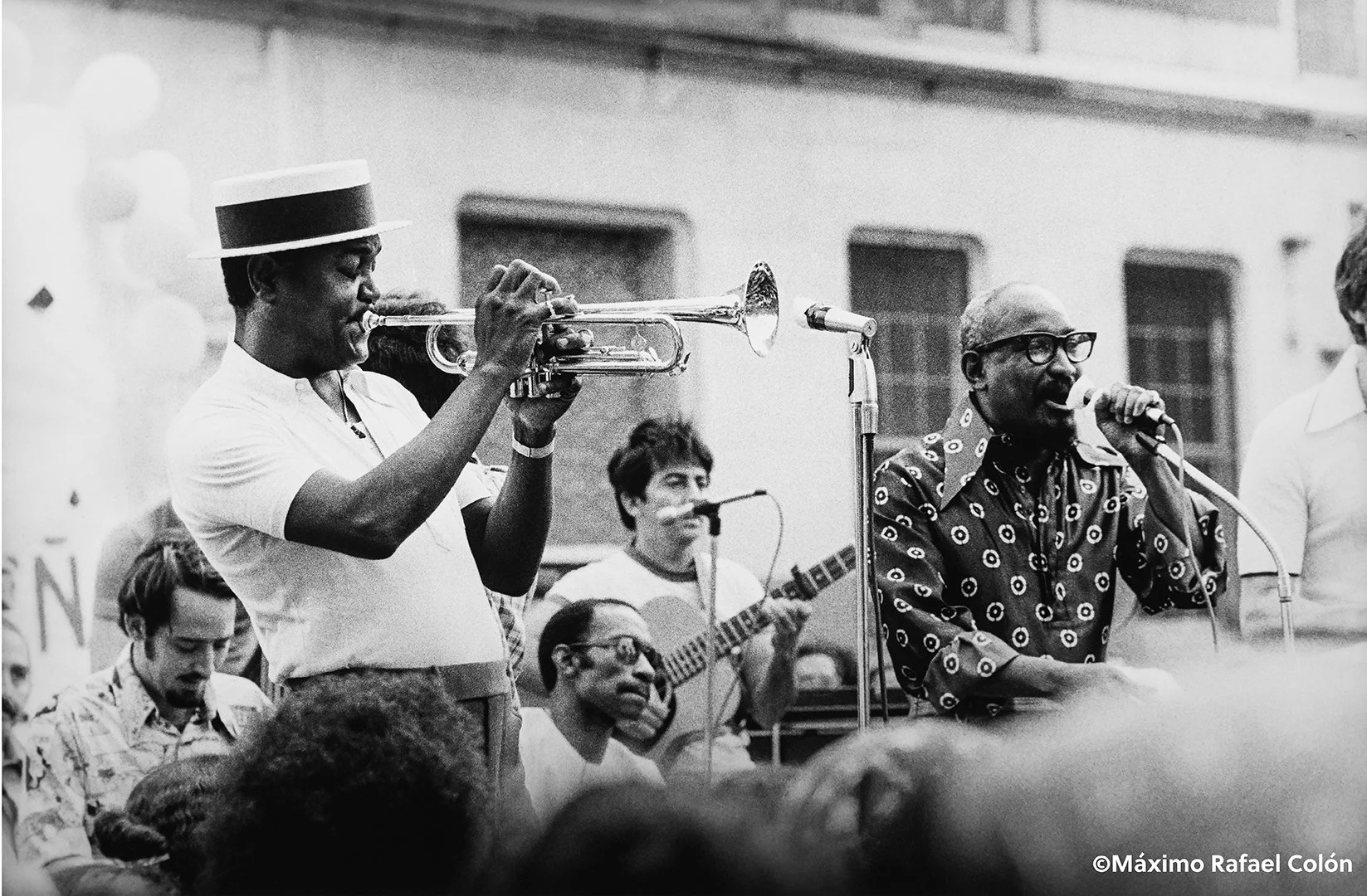
Máximo Rafael Colón - Grupo Folklorico y Experimental, 1976
Caribbean Cultural Festival, 1980’s
“I want to talk about a series of photographs that I’ve taken over the years, probably starting in ‘85. It's the carnival, the Caribbean Cultural Center’s, summer carnival. And it was a carnival - procession - representing the Caribbean: not only Puerto Rico, but the English-speaking Caribbean also.
It was all these different groups and, the most beautiful thing about the carnival was the procession. And that's where all the energy came together.”
Máximo Rafael Colón, 2026

Máximo Rafael Colón -
Roberto Borrel, Caribbean Cultural Festival, Lincoln Center, 1984
Máximo Rafael Colón -
Tanco Family, Caribbean Cultural Festival, 10th Avenue, 1985

Máximo Rafael Colón -
Caribbean Cultural Festival, Lincoln Center, 1984
Máximo Rafael Colón -
Los Pleneros de la 21, Caribbean Cultural Festival, West 62nd Street, 1984

Máximo Rafael Colón-
Caribbean Cultural Festival, 10th Avenue, 1985

Máximo Rafael Colón -
Caribbean Cultural Festival, 10th Avenue, 1985
Machito, 1978
“One of the other pictures that’s in the exhibit that I want to talk about is this photograph of Frank Grillo, also known as “Machito”, one of the Latin Kings, the Mambo Kings that they talk about in the history of New York City and music at the Palladium”
Máximo Rafael Colón, 2026

Máximo Rafael Colón - Machito, Goddard Riverside Music Series, West 94th Street,1978

Máximo Rafael Colón - Ismael Santiago, Commonwealth of Puerto Rico, 1984
Ismael Santiago, 1984
“One of the other photographs that’s in the exhibit is of Ismael Santiago and they call him “El mago de la sinfonía”, “the Magician of the Accordion”, and he was an island born Puerto Rican who migrated to New York but, also participated in creating the musical history of jíbaro music”
Máximo Rafael Colón, 2026
“These moments I cherish because it's a time when people put away their worries and concerns and just are expressing and enjoying being among the community, being among each other.”
Máximo Rafael Colón, 2026

Máximo Rafael Colón- Fiesta Folklorica, Central Park, 1974

Máximo Rafael Colón -
Amsterdam Avenue Festival, West 105th Street, 1982

Máximo Rafael Colón -
Fiesta de Loiza, 3rd Avenue, 1979
Máximo Rafael Colón -
Fiesta de Loiza, El Barrio, Third Avenue , 1976
Máximo Rafael Colón -
Tato Laviera, Fiesta de Loiza, Avenue C, 1975
This Grady Alexis Gallery exhibition is supported in partnership with the NYC Parks Department and the Columbus-Amsterdam BID, as well as through public funds from the New York City Department of Cultural Affairs, with the City Council. Additional funding comes from the Jacob and Ruth Epstein Foundation, the New York State Council on the Arts and individual donations.
We Thank You!
El Taller Latino Americano (aka The Latin American Workshop, Inc) is 501(c)(3) community-based institution in New York City.
Since 1979, El Taller has been an open space for expression and dialogue inspired by the belief that creativity dispels fear and mistrust among communities.