


Casting is such an elusive but important part of a sitcom’s ultimate success. Part of what makes the best ensemble sitcoms so popular is that there’s almost always at least one character who feels relatable to every viewer. The six friends in Friends are archetypes, and most people will identify with at least one of them.
Still, even Friends only feels worthy of an honorable mention when writing about the greatest American sitcom ensemble casts. With so many incredible American sitcoms, there are many factors to consider. Though ensembles from shows like Friends and Seinfeld seem like easy additions, too many of the actors were forever synonymous with their roles. The only notable exception is Seinfeld's Julia Louis-Dreyfus.
Another conventional choice that didn't make the cut for this list is The Office, for the same reason. Actors Jenna Fischer and Angela Kinsey are so intrinsically connected to their roles that, arguably, their next most notable project is an Office rewatch podcast. However, The Office gets bonus points for introducing Mindy Kaling, one of the most influential women in comedic television.
Compare this to the sitcoms that did make the cut, like Community or Parks and Recreation. These shows launched unknown casts into household names, and many of those actors used that momentum to keep working. In the end, the strongest ensemble sitcoms are the ones where casting pays dividends beyond the show itself, shaping careers, projects, and even the broader TV landscape.
The Golden Girls
Bea Arthur, Betty White, Rue McClanahan, & Estelle Getty

Every member of The Golden Girls cast brought a completely distinct comedic energy while still feeling inseparable from the group dynamic. Centering four women of a certain age navigating friendship, romance, financial struggles, loneliness, and aging with warmth and sharp humor, it was groundbreaking for network television in the 1980s.
Bea Arthur’s dry sarcasm, Betty White’s sweetly naïve optimism, Rue McClanahan’s flirtatious confidence, and Estelle Getty’s perfectly timed insults created a balance that rarely faltered across seven seasons of The Golden Girls. Remarkably, all four lead actresses won Emmy Awards for their performances, making the series one of only four sitcoms ever to achieve that distinction.
The chemistry was so enduring that three of the four stars continued the story sans Bea Arthur in a sequel series, The Golden Palace, after the original ended. Its legacy lives on and inspires contemporary shows like Grace and Frankie, which similarly explore older women’s lives and are driven by indelible chemistry.
Happy Endings
Eliza Coupe, Elisha Cuthbert, Zachary Knighton, Adam Pally, Damon Wayans Jr., & Casey Wilson

Happy Endings deserves far more recognition as one of the strongest sitcom ensembles of the 2010s. Happy Endings is an improvement on How I Met Your Mother’s friendship/romance formula, thriving on rapid-fire banter, absurd running jokes, and the sense that these characters had years of shared history before the pilot even began.
What made the cast special was how natural the chemistry felt right away, something many sitcoms struggle to develop even after several seasons together. The cast of Happy Endings all played off one another effortlessly, giving the show an easy hangout-comedy energy.
Even after the series ended, much of the cast appeared in some of television’s funniest, underrated comedies, including Future Man, Champaign ILL, and Black Monday. Happy Endings is one of the best canceled-too-soon sitcoms, and though its stars are funny in everything, they were never better than they were together.
Party Down
Adam Scott, Ken Marino, Lizzy Caplan, Ryan Hansen, Martin Starr, Jane Lynch, & Jennifer Coolidge

Party Down was one of the most underrated sitcoms of the 2000s. Looking back now, the lineup feels almost absurdly stacked: Adam Scott before Parks and Recreation turned him into a comedy staple, Martin Starr before Silicon Valley, and Jennifer Coolidge years before her career resurgence in The White Lotus.
Add in Lizzy Caplan, Ken Marino, Ryan Hansen, Megan Mullally, and Jane Lynch, and the result was an ensemble overflowing with sharp comedic instincts. The premise, following aspiring actors, writers, and comedians trapped working for a struggling catering company, also created endless opportunities for memorable guest stars in every episode.
Ironically, the cast’s success elsewhere ultimately hurt the show. External commitments, including Lynch joining Glee, contributed to its early cancellation, while the later revival never fully recreated the original chemistry. Rewatching the series today feels like spotting an entire generation of comedy performers right before they became television mainstays.
Living Single
Queen Latifah, Kim Coles, Kim Fields, Erika Alexander, T.C. Carson, & John Henton

Living Single featured one of the strongest sitcom ensembles, even if the series does not always receive the same level of recognition as some of its contemporaries today. Premiering a full year before Friends, the show perfected the "young adults navigating it all together" angle with a cast that felt effortlessly believable as a tight-knit social circle.
Queen Latifah anchored the cast of Living Single with charisma and confidence, and Kim Coles, Kim Fields, Erika Alexander, T.C. Carson, and John Henton each brought sharply defined comedic personalities that balanced one another perfectly. They played young, successful Black professionals, including an attorney, a stockbroker, and a business owner.
Living Single does not get the credit it deserves, and was a major hit with Black audiences during its original run. Its influence on the modern hangout sitcom feels undeniable, even if the show still rarely gets mentioned in the same conversations as Friends or Seinfeld.
Brooklyn Nine-Nine
Andy Samberg, Stephanie Beatriz, Terry Crews, Melissa Fumero, Joe Lo Truglio, Chelsea Peretti, & Andre Braugher

Brooklyn Nine-Nine succeeded partly because its casting was so smartly assembled from different corners of comedy and television. The show had a recognizable comedic anchor in Andy Samberg, while longtime scene-stealers like Joe Lo Truglio and Terry Crews brought years of underrated comic experience.
It also pulled from the stand-up comedy world with Chelsea Peretti. The ensemble also benefited enormously from Andre Braugher, who brilliantly repurposed the gravitas he built on Homicide: Life on the Street into one of television’s funniest deadpan performances. Just as importantly, the series cast actors who felt perfect for the roles rather than building characters around rigid demographic expectations.
Star Stephanie Beatriz once shared that she was surprised that the show’s two primary female detectives were Latinas (via BUILD Series), helping the characters in Brooklyn Nine-Nine feel naturally diverse instead of performatively checking boxes. Later seasons even incorporated Beatriz’s real-life experience as a bisexual woman into Rosa’s storyline, deepening the character without losing the show’s comedic balance. The result was a brilliant bench of characters who could be funny in endlessly different combinations.
Arrested Development
Jason Bateman, Portia di Rossi, Will Arnett, Michael Cera, Alia Shawkat, Tony Hale, David Cross, Jeffrey Tambor, & Jessica Walter

Arrested Development assembled one of television’s most unusual and effective comedy ensembles by combining veteran sitcom actors, respected character performers, alternative comedians, and largely unknown younger talent. Jason Bateman brought the steady straight-man energy of a former sitcom child star, and Portia de Rossi, Jeffrey Tambor, and Jessica Walter added polished, razor-sharp comic timing developed across decades of television work.
At the same time, David Cross arrived with major alternative comedy credibility from Mr. Show with Bob and David, while Will Arnett and Tony Hale used the series as breakout showcases. Michael Cera and Alia Shawkat were brilliantly cast child actors who continue to work in film and television.
What made the entire ensemble special was how perfectly these wildly different comedic styles fit together. Every actor committed fully to the show’s heightened absurdity without losing the sense that the Bluth family genuinely shared years of dysfunction and resentment. Few sitcom casts have ever balanced chaos, timing, and character specificity so effortlessly.
Taxi
Judd Hirsch, Jeff Conaway, Danny DeVito, Marilu Henner, Tony Danza, & Andy Kaufman
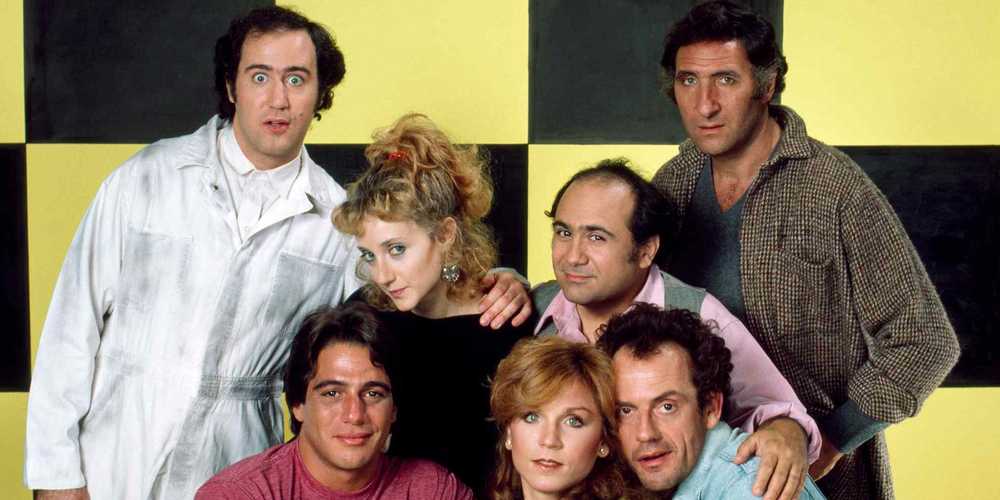
Taxi created one of the most influential sitcom ensembles ever by combining respected actors, stage performers, cult comedians, and complete newcomers into a cast that somehow felt perfectly unified. Judd Hirsch entered as the closest thing to an established dramatic lead, while Jeff Conaway had fresh recognition from Grease.
Danny DeVito and Tony Danza, meanwhile, were largely unknown to television audiences before the series transformed them into stars. Marilu Henner brought Broadway polish, while Andy Kaufman added an unpredictable anti-comedy twist that still feels unique decades later.
The Taxi cast's wildly different comedic energies balanced each other within the grounded world of exhausted New York cab drivers chasing impossible dreams. The show’s blend of emotional realism, eccentric character comedy, and fast ensemble interplay became enormously influential on later workplace sitcoms, with traces of Taxi visible in everything from Cheers to Scrubs.
Community
Joel McHale, Gillian Jacobs, Danny Pudi, Yvette Nicole Brown, Alison Brie, Donald Glover, Ken Jeong, & Chevy Chase

Chevy Chase provided the cast of Community with legacy star power and comedy pedigree, while the rest of the ensemble was relatively unknown, largely growing into their roles together. This reinforced the sense of a real, evolving study group rather than a pre-packaged sitcom cast.
Joel McHale had earned some recognition as a stand-up comedian and TV host, but Community turned him into a central figure in modern TV comedy. Alison Brie was largely unknown before the series and has since become a major presence in both mainstream and indie film and television.
Donald Glover is now an indelible figure in television, film, and music culture. Ken Jeong also used the show as a springboard into major film success, including The Hangover. The long-term success of Community’s cast shows how smart ensemble casting doesn’t just serve a single series; it feeds the broader comedy ecosystem for years afterward.
Cheers
Ted Danson, Shelley Long, Nicholas Colasanto, Rhea Perlman, & George Wendt

Cheers stands as one of the most iconic sitcom ensembles ever assembled, foundational to the modern workplace comedy. Set in a Boston bar where “everybody knows your name,” the series builds a perfectly balanced group dynamic.
Cheers was anchored by the will-they-won’t-they tension of Sam and Diane, a template that sitcoms have been chasing ever since. None of the core cast started as household names.
Instead, it elevated a generation of major talent, especially Ted Danson, who is still leading TV comedies today. The chemistry of the cast of Cheers, including Rhea Perlman and George Wendt, was strong enough that later additions to the show, such as Kelsey Grammer and Woody Harrelson, slotted in seamlessly, reinforcing rather than disrupting the already tightly balanced ensemble dynamic.
Parks And Recreation
Amy Poehler, Rashida Jones, Aziz Ansari, Nick Offerman, Aubrey Plaza, Chris Pratt, Adam Scott, Rob Lowe, Jim O’Heir, & Retta

Parks and Recreation is a rare example of a sitcom ensemble that didn’t arrive fully formed, but instead refined itself into greatness over time. The early seasons of Parks had potential, but the show truly locked in its identity by season 3, when it sharpened its tone and built out the ensemble with the additions of Adam Scott's Ben Wyatt and Rob Lowe's Chris Traeger.
From the beginning, there were clear building blocks. Aziz Ansari and Retta brought stand-up precision and rhythm, Nick Offerman gave Ron Swanson instant icon status, and the writers quickly recognized the breakout potential of Chris Pratt, whose character Andy was originally intended for only a short arc.
Even more striking is how its cast has shaped modern TV and film, with Poehler moving into producing (helping launch Broad City), Ansari creating personal work like Master of None, and actors like Plaza, Offerman, and Pratt becoming major cultural figures across indie film, prestige TV, and blockbuster franchises. This cements Parks and Recreation as one of the best sitcom ensemble casts ever assembled.