We have found
47045
results matching your criteria.
Please wait while we search...
4-carvomenthenol
4-carvomenthenol, also known as terpinen-4-ol, is a natural terpene alcohol used in flavors and fragrances with spicy, woody, and cooling characteristics.
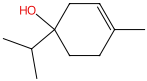
General Material Description
4-carvomenthenol, commonly known as terpinen-4-ol, is a naturally occurring monoterpene alcohol with the molecular formula C10H18O. It appears as a colorless to pale yellow liquid and exhibits characteristic woody, spicy, and menthol-like aroma traits. Terpinen-4-ol is a significant component in many essential oils and presents a range of sensory notes, including cooling and earthy aspects. This compound is listed in controlled vocabulary databases such as ChEBI. It is commonly sourced from the essential oils of various plants, including tea tree, marjoram, and eucalyptus.
Occurrence, Applicability & Uses
4-carvomenthenol is widely found in nature within numerous essential oils derived from plants such as tea tree (Melaleuca), marjoram, eucalyptus, oregano, and many spices. It occurs in varying concentrations, for example approximately 1.5% in cajuput oil and between trace to several percent in other botanical oils. The compound is employed primarily as a flavor and fragrance agent, contributing woody, spicy, herbal, and cooling notes in formulations. Its applicability is supported by standards such as FEMA (US), where it holds the number 2248. It serves as a replacer for cardamom and tarragon oils in flavoring and enhances aromatic profiles in both food and cosmetic products.
Physico-Chemical Properties Summary
4-carvomenthenol exhibits moderate volatility with a flash point around 79°C (175°F) and a logP value of approximately 3.26, indicating moderate lipophilicity suitable for fragrance and flavor applications. At 25°C, its density ranges between 0.928 and 0.934 g/mL. It shows slight water solubility, estimated at 386.6 mg/L, and good solubility in alcohols. Due to its physicochemical traits, it is stable when stored in cool, dry, and dark conditions within tightly sealed containers. The compound’s sensory efficacy is influenced by these properties, enabling substantive impact in formulations over extended periods of time.
FAQ
What is 4-carvomenthenol and how is it related to terpinen-4-ol?
4-carvomenthenol is a naturally occurring monoterpene alcohol. Terpinen-4-ol is a trivial and widely used synonym for the same chemical compound. Both names refer to a substance with the molecular formula C10H18O that possesses notable woody, spicy, and cooling aromatic properties. It is present in various essential oils and is used in flavor and fragrance formulations.
Where is 4-carvomenthenol found and what are its typical uses?
It occurs naturally in essential oils of plants such as tea tree, marjoram, eucalyptus, oregano, and several spice oils. Its concentration varies across these sources. 4-carvomenthenol is used as a flavoring agent to impart woody, spicy, and citrus-like notes and also serves as a fragrance ingredient with cooling and herbal characters. It can replace cardamom, tarragon, and thyme oils in formulations.
What regulations and safety considerations apply to 4-carvomenthenol?
4-carvomenthenol is recognized under FEMA (US) with the number 2248 and assessed by IFRA (Global) for safe usage levels, recommending maximum skin concentrations around 0.13% in fine fragrances and up to 5% in fragrance concentrates. It is classified as harmful if swallowed and irritating to eyes and skin per European safety data, thus requiring proper handling and protective measures. It is also listed by JECFA with specific food flavoring evaluations.
US / EU / FDA / JECFA / FEMA / Scholar / Patents
| Google Scholar | Start search |
| Google Books | Start search |
| Google Patents | Start search |
| Perfumer & Flavorists | Start search |
| EU Patents | Start search |
| PubMeb | Start search |
| NCBI | Start search |
Literature & References
| Leffingwell: | Chirality or Article |
| 4-methyl-1-propan-2-ylcyclohex-3-en-1-ol | |
| NIST Chemistry WebBook: | Search Inchi |
| Canada Domestic Sub. List: | 562-74-3 |
| Pubchem (cid): | 11230 |
| Pubchem (sid): | 134978014 |
| Flavornet: | 562-74-3 |
| Pherobase: | View |
Other Information
| (IUPAC): | Atomic Weights of the Elements 2011 (pdf) |
| Videos: | The Periodic Table of Videos |
| tgsc: | Atomic Weights use for this web site |
| (IUPAC): | Periodic Table of the Elements |
| FDA Substances Added to Food (formerly EAFUS): | View |
| CHEBI: | View |
| CHEMBL: | View |
| KEGG (GenomeNet): | C17073 |
| HMDB (The Human Metabolome Database): | HMDB35833 |
| FooDB: | FDB014601 |
| YMDB (Yeast Metabolome Database): | YMDB01790 |
| Export Tariff Code: | 2906.19.5000 |
| Typical G.C. | |
| VCF-Online: | VCF Volatile Compounds in Food |
| ChemSpider: | View |
| Wikipedia: | View |
| FAO: | 4-Carvomenthenol |
General Material Information
| Preferred name | 4-carvomenthenol |
| Trivial Name | Terpinen-4-ol |
| Short Description | 4-terpinenol |
| Formula | C10 H18 O |
| Category | Pure Compounds , Pure Compounds > Alcohols |
| CAS Number | 562-74-3 |
| Deleted CAS Number | 1336-05-6 |
| FEMA Number | 2248 |
| Flavis Number | 2.072 |
| ECHA Number | 209-235-5 |
| FDA UNII | L65MV77ZG6 |
| Nikkaji Number | J6.503J |
| Beilstein Number | 1906603 |
| MDL | MFCD00001562 |
| COE Number | 2229 |
| xLogP3-AA | 2.20 (est) |
| Bio Activity Summary | External link |
| NMR Predictor | External link |
| JECFA Food Flavoring | 439 4-carvomenthenol |
| FDA Patent | No longer provide for the use of these seven synthetic flavoring substances |
| FDA Mainterm | 562-74-3 ; 4-CARVOMENTHENOL |
| Synonyms |
|
Suppliers
PhysChem Properties
| Material listed in food chemical codex | Yes |
| Molecular weight | 154.2526550293 |
| Specific gravity | @ 25 °C |
| Pounds per Gallon | 7.722 to 7.772 |
| Refractive Index | 1.476 to 1.48 @ 20 °C |
| Boiling Point | 88 to 90°C @ 6 mm Hg |
| Vapor Pressure | 0.048 mmHg @ 25 °C |
| Flash Point TCC Value | 79.44 °C TCC |
| logP (o/w) | 3.26 |
| Shelf life | 24 months (or longer if stored properly.) |
| Storage notes | Store in cool, dry place in tightly sealed containers, protected from heat and light. |
| Solubility | |
| alcohol | Yes |
| water, 386.6 mg/L @ 25 °C (est) | Yes |
| water | No |
Organoleptic Properties
| Odor Type: Spicy | |
| peppery, woody, earthy, musty, sweet, mentholic, citrus, terpenic, spicy | |
| Odor strength | medium |
| Substantivity | 20 hour(s) at 100.00 % |
| Luebke, William tgsc, (1992) | At 100.00 %. pepper woody earth musty sweet |
| Mosciano, Gerard P&F 23, No. 4, 33, (1998) | At 5.00 %. Woody, ceding, mentholic, citrus terpy, spicy |
| Flavor Type: Cooling | |
| cooling, mentholic, woody, weedy, earthy, herbal, spicy, citrus, clove | |
| Luebke, William tgsc, (1992) | Cooling mentholic woody weedy earthy herbal spicy citrus |
| Mosciano, Gerard P&F 23, No. 4, 33, (1998) | At 25.00 ppm. Cooling, woody, earthy, clove spicy with a citrus undernote |
| General comment | Sweet citrus green tropical fruity |
| Useful in: mint, savory vegetable, savory spices, fruity citrus, fruity red, fruity yellow, fruity tropical, sweet others, alcoholics. | Earthy, musty, terpenic, lime, thyme |
Occurrences
| (data available) |
Applications
| Applications | flavor and fragrance agents |
Uses
| Odor uses | Apple, Apricot, Blackberry, Cardamom oil replacer, Cinnamon, Citrus, Coriander, Cranberry, Currant, Filbert, Honey, Hop, Huckleberry, Lime, Lotus, Mace, Mango, Marjoram, Nutmeg, Oregano, Passion fruit, Peach, Peanut, Spice, Tangerine, Tarragon oil replacer, Tea green tea, Thyme oil white replacer |
| Flavoring uses | Brandy apricot brandy, Brandy grape brandy, Carrot, Chocolate cocoa, Coriander, Gin, Marjoram, Pecan, Tarragon oil replacer, Tomato, Tropical |
| Cosmetic uses | Fragrance |
Safety Information
Safety information
| Preferred SDS: View | |
| European information : | |
| Most important hazard(s): | |
| Xn - Harmful. | |
| R 22 - Harmful if swallowed. R 36/37/38 - Irritating to eyes, respiratory system, and skin. S 02 - Keep out of the reach of children. S 26 - In case of contact with eyes, rinse immediately with plenty of water and seek medical advice. S 36/37/39 - Wear suitable clothing, gloves and eye/face protection. | |
| Hazards identification | |
| Classification of the substance or mixture | |
| GHS Classification in accordance with 29 CFR 1910 (OSHA HCS) | |
| None found. | |
| GHS Label elements, including precautionary statements | |
| Pictogram | |
| Hazard statement(s) | |
| None found. | |
| Precautionary statement(s) | |
| None found. | |
| Human Experience: | |
| 5 % solution: no irritation or sensitization. | |
| Oral/Parenteral Toxicity: | |
| oral-rat LD50 1300 mg/kg (Moreno, 1977v) oral-mouse LD50 1016 mg/kg Zhonghua Jiehe He Huxixi Jibing Zazhi. Chinese Journal of Tuberculosis and Respiratory Diseases. Vol. 4(4), Pg.203,1981. intraperitoneal-mouse LD50 250 mg/kg KIDNEY, URETER, AND BLADDER: URINE VOLUME INCREASED Cesko-Slovenska Farmacie. Vol. 8, Pg. 433, 1959. intramuscular-mouse LD50 780 mg/kg KIDNEY, URETER, AND BLADDER: URINE VOLUME INCREASED Cesko-Slovenska Farmacie. Vol. 8, Pg. 433, 1959. intramuscular-rat LD50 1500 mg/kg KIDNEY, URETER, AND BLADDER: URINE VOLUME INCREASED Cesko-Slovenska Farmacie. Vol. 8, Pg. 433, 1959. | |
| Dermal Toxicity: | |
| skin-rabbit LD50 > 2500 mg/kg Food and Chemical Toxicology. Vol. 20, Pg. 833, 1982 subcutaneous-mouse LD50 750 mg/kg KIDNEY, URETER, AND BLADDER: URINE VOLUME INCREASED Cesko-Slovenska Farmacie. Vol. 8, Pg. 433, 1959. | |
| Inhalation Toxicity: | |
| Not determined | |
Safety in use information
| Category: | |||
| flavor and fragrance agents | |||
| RIFM Fragrance Material Safety Assessment: Search | |||
| IFRA Code of Practice Notification of the 49th Amendment to the IFRA Code of Practice | |||
| maximum skin levels for fine fragrances: | |||
| 0.1300 % and are based on the assumption that the fragrance mixture is used at 20% in a consumer product (IFRA Use Level Survey).(IFRA, 2006) | |||
| Recommendation for 4-carvomenthenol usage levels up to: | |||
| 5.0000 % in the fragrance concentrate. | |||
| use level in formulae for use in cosmetics: | |||
| 0.0430 % | |||
| Dermal Systemic Exposure in Cosmetic Products: | |||
| 0.0011 mg/kg/day (IFRA, 2006) | |||
| Maximised Survey-derived Daily Intakes (MSDI-EU): | 150.00 (μg/capita/day) | ||
| Use levels for FEMA GRAS flavoring substances on which the FEMA Expert Panel based its judgments that the substances are generally recognized as safe (GRAS). | |||
| The Expert Panel also publishes separate extensive reviews of scientific information on all FEMA GRAS flavoring substances and can be found at FEMA Flavor Ingredient Library | |||
| publication number: 3 | |||
| Click here to view publication 3 | |||
| average usual ppm | average maximum ppm | ||
| baked goods: | - | 7.00000 | |
| beverages(nonalcoholic): | 1.00000 | 21.00000 | |
| beverages(alcoholic): | - | - | |
| breakfast cereal: | - | - | |
| cheese: | - | - | |
| chewing gum: | - | - | |
| condiments / relishes: | - | - | |
| confectionery froastings: | - | - | |
| egg products: | - | - | |
| fats / oils: | - | - | |
| fish products: | - | - | |
| frozen dairy: | 1.00000 | 84.00000 | |
| fruit ices: | 1.00000 | 84.00000 | |
| gelatins / puddings: | - | - | |
| granulated sugar: | - | - | |
| gravies: | - | - | |
| hard candy: | 7.00000 | 63.00000 | |
| imitation dairy: | - | - | |
| instant coffee / tea: | - | - | |
| jams / jellies: | - | - | |
| meat products: | - | - | |
| milk products: | - | - | |
| nut products: | - | - | |
| other grains: | - | - | |
| poultry: | - | - | |
| processed fruits: | - | - | |
| processed vegetables: | - | - | |
| reconstituted vegetables: | - | - | |
| seasonings / flavors: | - | - | |
| snack foods: | - | - | |
| soft candy: | - | - | |
| soups: | - | - | |
| sugar substitutes: | - | - | |
| sweet sauces: | - | - | |
Safety references
| European Food Safety Athority(EFSA):Flavor usage levels; Subacute, Subchronic, Chronic and Carcinogenicity Studies; Developmental / Reproductive Toxicity Studies; Genotoxicity Studies... |
| European Food Safety Authority (EFSA) reference(s): |
| Opinion of the Scientific Panel on food additives, flavourings, processing aids and materials in contact with food (AFC) related to Flavouring Group Evaluation 18 (FGE.18): Aliphatic, alicyclic and aromatic saturated and unsaturated tertiary alcohols, aromatic tertiary alcohols and their esters from chemical group 6 View page or View pdf |
| Flavouring Group Evaluation 18, Revision 1 (FGE. 18 Rev1)[1] : Aliphatic, alicyclic and aromatic saturated and unsaturated tertiary alcohols, aromatic tertiary alcohols and their esters from chemical groups 6 and 8 View page or View pdf |
| EPI System: View |
| ClinicalTrials.gov:search |
| Chemical Carcinogenesis Research Information System:Search |
| AIDS Citations:Search |
| Cancer Citations:Search |
| Toxicology Citations:Search |
| EPA Substance Registry Services (TSCA):562-74-3 |
| EPA ACToR:Toxicology Data |
| EPA Substance Registry Services (SRS):Registry |
| Laboratory Chemical Safety Summary :11230 |
| National Institute of Allergy and Infectious Diseases:Data |
| WGK Germany:2 |
| 4-methyl-1-propan-2-ylcyclohex-3-en-1-ol |
| Chemidplus:0000562743 |
| RTECS:OT0175110 for cas# 562-74-3 |
Jump to section