

ALL THE BEST COWBOYS HAVE DADDY ISSUES
Original Airdate: 12/8/2004
Written By: Javier Grillo-Marxuach
Directed By: Stephen Williams
Character: Jack
Day Sixteen
Some famous cowboys: Gene Autry, Roy Rogers, Wyatt Earp, Buffalo Bill, John Wayne, Will Rogers, The Lone Ranger and Tonto, Cool Hand Luke, Butch Cassidy, the Sundance Kid, and everything Clint Eastwood has ever made. And then of course there's the modern day incarnations of the cowboy, including Back to the Future III, Han Solo, and the entirety of the Firefly universe. American culture is especially permeated with images of the cowboy and his noble quest of ruggedness. But what is a cowboy? A peaceful herder of cows? A manly man's man capable of facing down the barrel of a gun without so much as breaking a sweat? Or a man on a quest, a knight errant, with a score to settle and guilt on his mind? That last one fits our hero perfectly.
As I've said before, Jack has somewhat of a hero complex. His need to do the 'right thing' at all times errs a little on the unhealthy side, but this is precisely what makes him such an effective leader. His need to save the Marshal, his guilt over not being able to save Joanna, and his guilt over what he did to Sawyer in order to get medicine for Shannon all pale in comparison to the guilt that he feels this week. The guilt he feels on Claire's behalf is different from the others because of his role in denying her the week before. Unwilling to believe something that he had no proof of, he turned to science and his own sense of reason for the answers. Both led him to the conclusion that Claire was suffering from hallucinations, and both led him to ignore the ever growing sense of danger that was beginning to haunt the group from within. As he tells Kate in the jungle, "I didn't believe her." He trusted his own reason and practicality over her very real, and justified, fear. And so, the fact that he may have prevented hers and Charlie's abduction is eating away at him. But it's more than that: his own sense of reason, his moral compass and the lens through which he views the world, has failed him, collapsed. Just as it did with his father.
Here's where the "daddy issues" come in. I've already established in my review of White Rabbit that Christian was simultaneously Jack's role-model and an incredibly destructive presence in Jack's life. Jack followed his father, whom he idolized blindly, into medicine and then watched as his father failed him. Maybe Christian was once a good man like Jack, worthy of being idolized by his son, or maybe it was simply the case that Jack grew up and is now finally able to see his father as a person instead of an idea. And what he sees isn't pleasant; it's heartbreaking. In his father's alcoholism, in his failures as a doctor and as a father, Jack doesn't just lose his father's love and respect, he loses a whole way of life, a system of codes and ethics, and ways of being that he's based his entire life upon. Jack is called in to surgery by a concerned nurse, and his heart breaks a little when he it then becomes his duty to clean up what he sees as his father's mess. His father has broken the rules, performed surgery under the influence, and Jack believes this is the reason the patient dies. Later, in Christian's office, Christian tells Jack of the sacrifices he's made, that people die in surgery all the time, and that if Jack turns him in, wrongly, he'll be betraying "the greater good." More importantly, he'll be betraying his father whose whole life is medicine. Even while Jack was growing up, Christian's career was more important than his son. It's hard to tell whether or not Christian believes what he's telling Jack, or whether he's just spinning a tale he knows will win him a get-out-of-jail free card. "It'll never happen again," Christian says. And Jack wants to believe him, he really does. But the guilt is on his hands now; he bears the sins of his father.
That's what it's all about, really, those "daddy issues": we all have something to prove against the sins of our fathers. And in Jack's case, the stakes are pretty high. At first Jack is willing to let his father's indiscretion slide by; the patient is dead, and turning his father in would ruin him. But the guilt keeps piling on: while Christian tells the review board, "By the time I was called in, the damage was irreversible," Jack just can't ignore it anymore. He's seen the husband of the woman who was killed: another stab in the gut. But the final blow comes in the review board when he learns that the patient was pregnant. Suddenly, he just can't take it anymore. He has to choose between protecting his father and doing the "right" thing. He can't take the blood on his hands for one more second, and he justly believes that preventing his father from practicing such destructive medicine is the right choice. So he speaks up, and in washing the dead woman's blood from his hands, he puts on his father's instead. In the office when Christian was pleading with Jack to sign the statement of release he told him, "They'll strip me of my license." And Jack looks at him, a mixture of sadness and something hard, something undefinable, says," Yes. Yes, they will." And in that moment, we know what he is going to do, even before he does. It may not be easy for him, but Jack isn't one to let the blood of innocents remain long on his hands.
It's interesting, then, to note that this episode opens with that very image: Jack, with blood on his hands. This time, it's Sayid's, but the parallel is clear. He didn't believe Claire when he had the chance, and now she and Charlie have been taken. This blood mirrors the blood on his hands in the middle of surgery, when he fails to save the pregnant woman. Claire, who is also pregnant, is now on his hands as well as that dead woman. He failed to save her, let his father mess up, let his father walk all over him his whole life, but now it's time to take control. And in the end, this cowboy on a mission, with anger and desperation in his heart, finds Charlie hanging from a noose, bloody and bruised. And he tries to save him, banging on his chest, and with each passing moment he's reminded even more strongly of every other person he failed to save. Unlike the woman at the beginning, whom his CPR failed to resuscitate, Charlie is saved by Jack's sheer force of will. "I'm not letting him do this," he pants desperately to Kate, "Not again." And we're not sure if he's talking about Ethan, or his father. But it doesn't really matter, no matter the situation, those daddy issues will be with him. He's a cowboy through and through.
It's fitting that Jack has Kate to accompany him in the search. "Just give me something real," he tells her. So she tells him about her father, how they would go hiking together. "Being in the woods was like his religion," she says. And while we know differently from future episodes, in this one it seems like Kate is the only cowboy with nothing to prove. Just the thrill of the chase, and the lure of adventure. The connection between nature, the woods, and religion is interesting, though. Kate's father sounds like Locke, with his all encompassing belief in the island, faith in the power of faith. Jack didn't believe Claire because it didn't make sense; he had no proof. Even after Claire and Charlie are taken, his first question is, "how can one man drag off two people, one of them pregnant?" How, not why, as Locke points out. This is the first indication of many to come that The Others are on the side of nature, also. It's the "why" that's important, Locke tells him. All he had was his trust in science, a science that was telling him Claire's fears were nothing more than hallucinations, a science which led him to choose it over the words of his own father. Was he right to do so?
In their own ways, everybody is a cowboy in this episode: Locke and Boone, Jack and Kate, Hurley with his "warrior" comment, Sayid and Sawyer in their grudge-match...but the most notable is Michael. "A lot of us," meaning Michael, "don't want to just sit here waiting for news." Even Walt wants in, saying that he could use Vincent to sniff for clues. The Walt and Michael situation is a perfect microcosm for what's happening in the episode as a whole. Here's Walt, with daddy-issues of his own, helpless to do anything but wait. And here's Michael, the only father on the island, with daddy-issues of his own. But unlike the rest who are fighting against the memories of their fathers and the burdens left behind, Michael is fighting to prevent those memories from taking hold, to prevent Walt from seeing him as nothing but a man who stood by and watched as other people saved the day. And it's Michael's bad luck that Locke humiliates him in front of Walt, and, adding insult to injury, Walt takes Locke's side. When Michael says he's "getting sick of being treated like a second class citizen" in comparison to Jack or Locke, what he's really telling us is that he's sick of not measuring up. So when Walt rubs it in, saying that Locke is a "warrior," that he can "hunt, he can track stuff, and he's the only one who brought knives, so if it were me, I'd listen to him." And Michael, idiotic, competitive Michael retorts, like a spoiled child fighting over a toy, "Well, I don't want you to." It's not about what's best for Walt, it's about Michael wanting Walt to see him as the perfect father, the perfect man. But with Locke standing in the way, providing for Walt in ways that Michael never has and never will be able to, he's threatened. And he should be, because it's becoming ever more clear that Walt is indeed special. Those weren't just lucky rolls when he was playing backgammon with Hurley, and in this game of good and evil, nature vs. nurture, and faith vs. science, Walt seems to be on the winning side.
Speaking of Locke, we know of his daddy-issues from future episodes (it seems like everyone has them on this show), but for now he is driven by something else. After he and Boone separate from Jack and Kate, It's almost like the island is leading him somewhere. "It's going to start raining in one minute," he tells Boone. And he's right. And of all the places they should end up, they drop a flashlight on a mysterious piece of metal in the ground, altering the course of the show forever.
Some quick, final thoughts. I absolutely loved Locke dismissing Michael's attempt to form a rescue party: "Good idea..." Ethan knowing more about tracking than Locke is a frightening thought. I don't think anybody was surprised at Kate's newfound tracking skills. The whole exchange between Boone and Locke hits just the right chord for me, talking about their jobs, etc. Locke gets Boone: the young man, itching to prove something. Once again, we are shown that Sawyer gets how things work on this island with his comment about Sayid and karma. Though we don't understand it now, Hurley telling Walt that he'll get his $20,000 isn't a joke; Hurley can afford it. I've said it before and I'll say it again: Ethan is one scary mother-frakker. Speaking of Ethan, it's interesting that he is the first Other that we encounter. It gives a really sinister vibe to the rest of them. Was he just "off" or are they all that violent at heart? We as viewers look at everything we see of The Others from now on through the lens of Ethan. The first time I saw this episode, I really thought that Charlie was going to die; that whole sequence is just painful to watch, those tears of Kate and Jack's extremely well-earned. Walt telling Sawyer that it's stupid to lie about your name was a very fitting moment; what else has Sawyer been doing his whole life but lying about his name? And, in a final note of irony, Kate telling Shannon, "If there's anyone on this island your brother's safe with, it's Locke," is very, very wrong. Because we all know what happens.
Questions Raised
1. Who are The Others?
2. Why did Ethan take Charlie and Claire? Did he just want Claire? If so, why is she important?
3. Why was Walt raised by a different father? Is there more to Walt than what he seems?
4. How did Ethan physically manage to subdue Claire and Charlie?
5. What mysterious metal object did Locke and Boone find in the jungle?
Questions Answered
1. Ethan only wanted Claire, not Charlie. He was the one attacking her in the night; it wasn't a dream.
Mythology
1. The Others!
Motifs/Themes
1. Guilt
2. Faith/Belief vs. Science
3. Blood--Literal and Physical
4. Savages vs. Civilization (Cowboys vs. Indians)
5. Weakness vs. Usefulness
Death Count
n/a
Sawyerisms
1. To Walt: "All righty, Tattoo, where do you think he came from?"
2. About Jack: "Dr. Do-Right doesn't trust me with his anti-biotics."
Character Connections
n/a
Songs
1. "All the Best Cowboys Have Daddy Issues," Senses Fail:
My fathers sins are out tonight(x2)
I haven't seen him in years(x2)
My mothers sins are out tonight(x2)
I haven't loved her in years(x2)
(Chorus)
(Let's hear a toast)Here's a toast for(for loneliness)loneliness
(Sometimes it just)Sometimes it just makes so much sense
(For every night)every night I(I drink alone)drink alone
(I'm happier)happier than I could have ever known
My family's sins are out tonight(x2)
My skin is on the run(x2)
My private sins are out tonight(x2)
My skin is on the run(x2)
I'm not waiting(x2)
(Chorus)
(Let's hear a toast) Here's a toast for (for loneliness) loneliness
(Sometimes it just) Sometimes it just makes so much sense
(For every night) Every night I (I drink alone) drink alone
(I'm happier)happier than I could have ever known
I'm not waiting(x2)
I'm betting dreams upon my paper wings
Because flying isn't just for kings
I take the stairs to the very top floor
I paid the super to leave open the door
A perfect sunset is sinking in the sky
I know my body is ready to fly
I start the countdown back wards from ten
When I reach one my family name will end
Falling down as windows pass I start to cry
And curse the day my parents laid
In a bed of hopelessness where love was made
Please mark my grave unknown
(Chorus)
(Let's hear a toast)Here's a toast for(for loneliness)loneliness
(Sometimes it just)Sometimes it just makes so much sense
(For every night)every night I(I drink alone)drink alone
(I'm happier)happier than I could have ever known
Here I lie
Here I lie
2. All the Best Cowboys Have Chinese Eyes, Pete Townshend. From the inside jacket of the album:
"A natural leader emerged...the most remarkable thing about him was his eyes...Somehow they arrived alive. Somehow they found the broken bottle trail without help. All stars, great and small, shine under God...All the best cowboys have Chinese eyes."

Creepy, creepy Locke. This shot, right before the opening sequence, gives the
entire rest of the episode its tone.
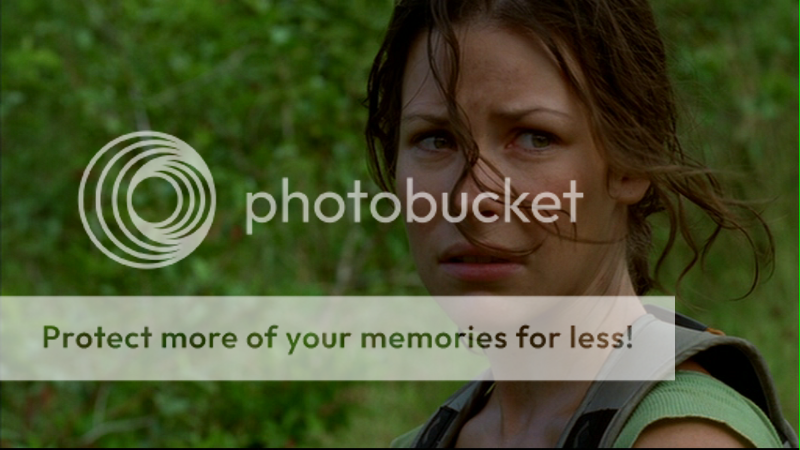
Kate, sensing something extra in Jack's heroics.

Hating what he's being asked to do--and doing it anyway. The guilt is written
all over his face.

Entering the jungle...

...and entering a shit-storm.

Ethan FREAKS ME OUT.

And now Jack is the one lying down: the victim, with blood on his face
instead of his hands.

God, this shot is scary. Scary, but beautiful.

Tears of joy...
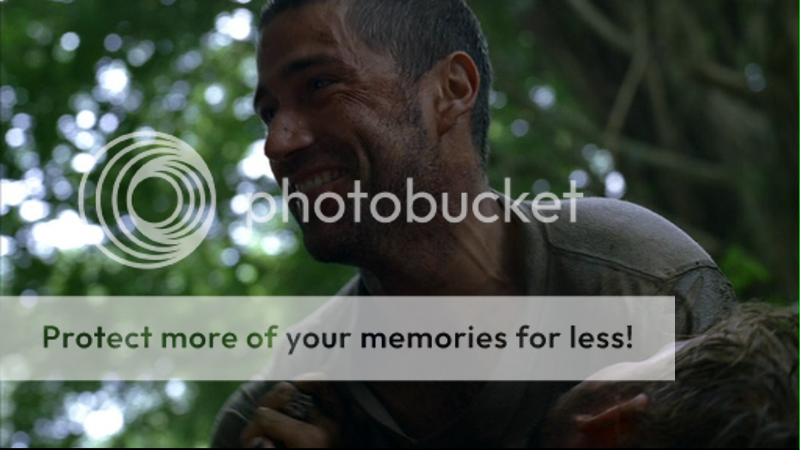
...and Jears of joy!!!
"This doesn't make any sense, how can one man drag off two people, one of them pregnant."
"The question isn't how, it's why." Jack and Locke: Man of Science, Man of Faith.
"So a tribe of evil natives planted a ringer in the camp to kidnap a pregnant girl and a reject from VH-1 Has-Beens. Yeah, fiendishly clever." Yes, Sawyer, that is exactly what happened.
"You're either a taxidermist or a hitman." Boone, with an amusing assessment of Locke.
"Well, well, well. I don't know if you Islams got a concept of karma, but I get the sense this island just served you up a heaping platter of cosmic payback." Sawyer, once again proving he's a lot smarter than people give him credit for.
"Back home, I'm known as something of a warrior, myself. " Hurley, with a somewhat puzzling comment.
"I know I have been hard on you...but that is how you make a soft metal into steel." Christian, lying his way to freedom.
"Maybe he was already on the island, before we were." Walt, saying what nobody else wants to believe.