
Red Hat will tout three key features in the 2.6 release of its Ansible Automation Platform (AAP) at the AutoCon 4 conference. These features are:
- An automation dashboard to help measure ROI
- The Lightspeed genAI intelligent assistant
- A self-service automation portal
Automation Dashboard
AAP 2.6 includes a new utility, called the automation dashboard, to help teams measure the Return on Investment (ROI) of their automation investments. Teams can use the dashboard to track how automation is delivering value vs. manual processes by tracking metrics such as job success rates and time saved on tasks. Reports can be shared with stakeholders directly in the dashboard, or exported as PDF or CSV files.
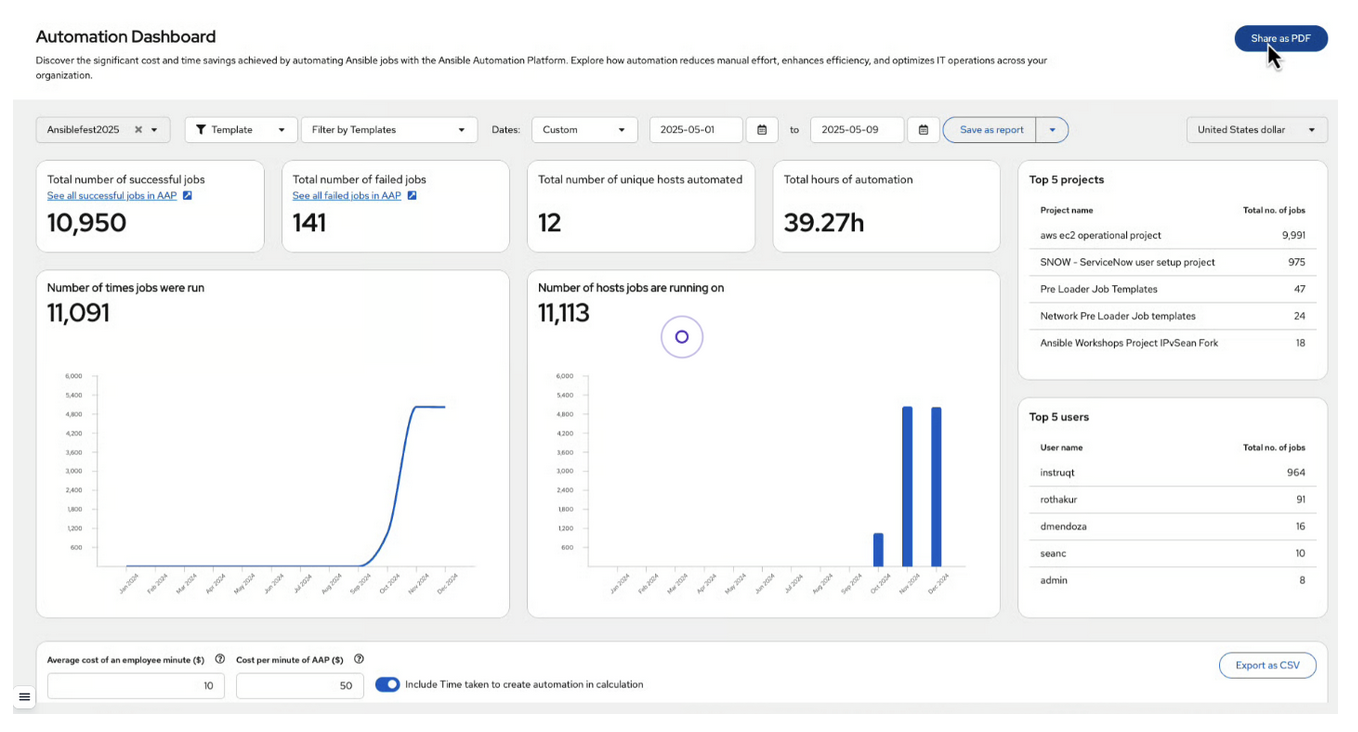
Automation Dashboard. Source: Red Hat
The dashboard is meant to help technical teams get business support for automation initiatives. In addition, having data on automation usage can help guide decision-making on where further automation efforts could have an impact.
Getting business backing for automation projects is often a significant hurdle. A dashboard with measurable ROI may help engineers demonstrate value more effectively with the business side of the organization.
Lightspeed Intelligent Assistant
The Lightspeed intelligent assistant is a genAI tool available within the AAP UI. The assistant is trained on Ansible documentation, so users can ask questions about the product in natural language. Ansible says the assistant can speed up onboarding, improve troubleshooting, and support day-to-day management of AAP. The assistant is not connected to the Internet, which should alleviate concerns about sensitive queries or information leaking outside the organization.
Self-Service Automation Portal
AAP 2.6 includes a new portal that aims to make it easier for organizations to offer automated service delivery to internal users. For example, a network team could use the portal to offer a catalog of automated network services, such as VLANs or subnets, that server or virtualization teams could order up with a few clicks.
Catalog builders can build in access permissions and guardrails to ensure that catalog items meet security and compliance requirements. Consumers get a guided, point-and-click mechanism to launch these pre-approved automations.
In addition to service delivery, AAP 2.6 includes new event-driven automation that can kick off workflows or playbooks in response to pre-defined events or conditions. Automated rulebooks use plug-ins to monitor events in repositories such as Kafka and Splunk. If a rulebook detects an event, it runs the requisite playbook. Multiple rulebooks can listen from the same event source.
Red Hat briefed the Packet Pushers about AAP 2.6 as part of Red Hat’s sponsorship package with AutoCon 4.
