MCode vs WHY Institute
WHY Institute and MCode both help people understand what drives them — but they answer that question differently, surface different data, and serve different purposes. One builds personal clarity. The other builds organizational performance.

Same question, different lenses
Both WHY Institute and MCode ask why — why you do what you do, why certain things compel you, and why some experiences feel deeply satisfying, and others don’t. But the lens each tool looks through is fundamentally different.
- WHY Institute looks at your life broadly, asking what singular force drives every decision you make, and distills that into one statement of core identity and purpose.
- MCode looks at specific moments of peak achievement and asks what motivated you in those experiences, building a ranked map of the conditions that produce your best work.
Same underlying question, yet one tool finds your individual purpose, and the other finds your performance fuel.


Motivation is more nuanced than a single why
WHY Institute’s WHY.os helps people identify a WHY statement that captures the core purpose driving their decisions — a clear, singular force that explains what they’re fundamentally compelled toward.
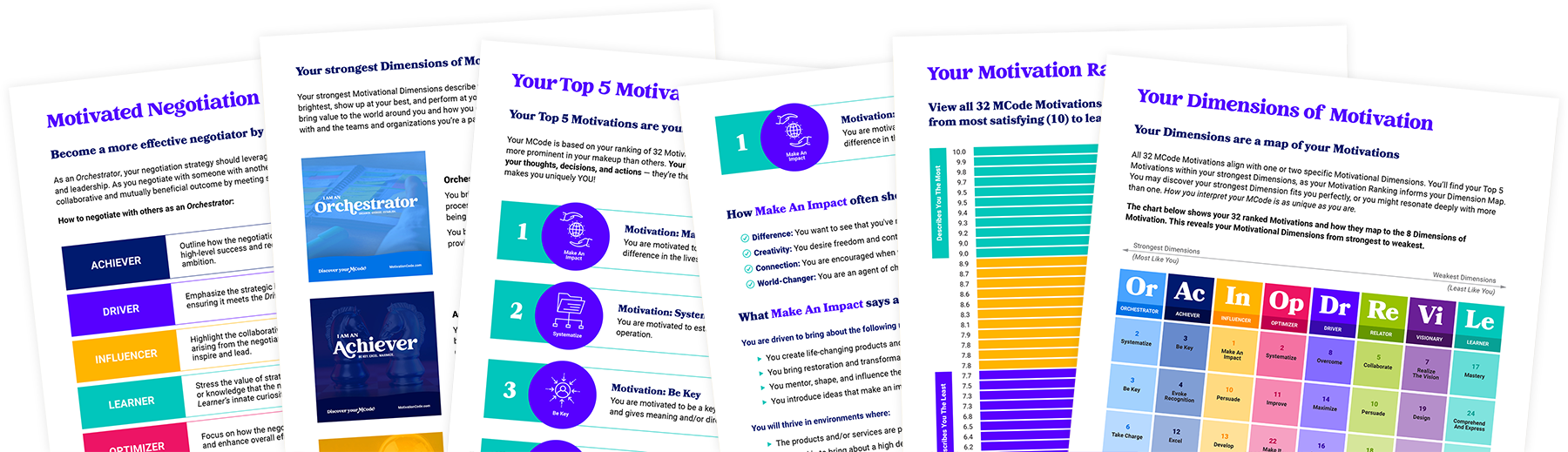
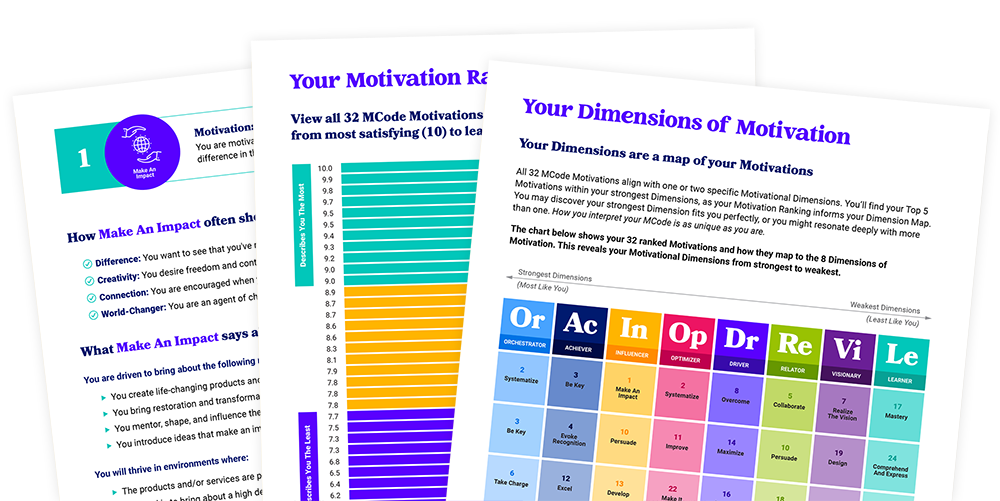
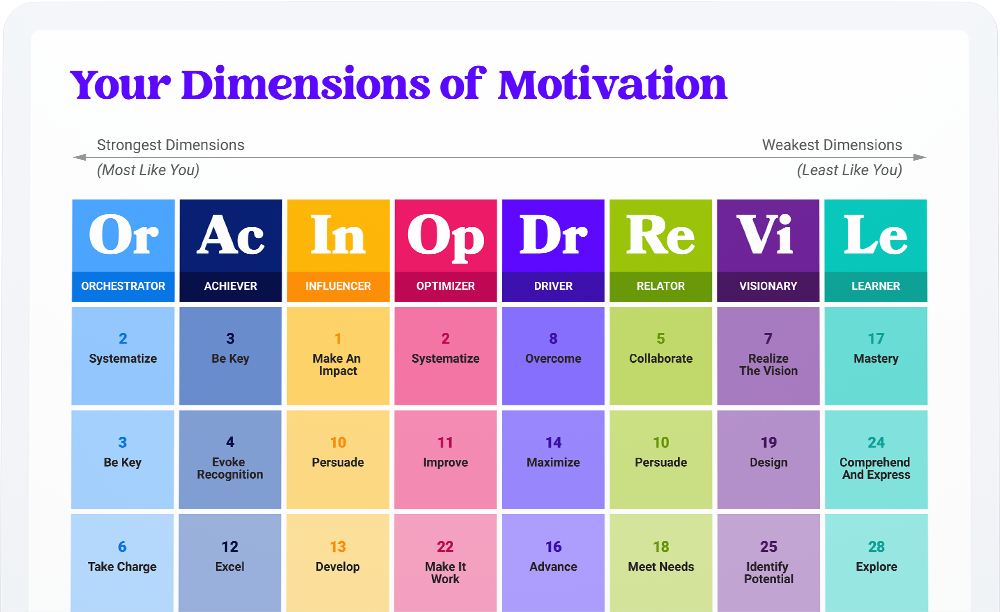
MCode surfaces a ranking of 32 Motivations across 8 Dimensions to reveal a person’s MCode and explain which specific types of work, responsibilities, and relationships energize and drain them, even when doing work they’re good at. That level of detail gives individuals a precise understanding of where they thrive, and gives managers the intelligence to structure each person’s work in ways that sustain high performance rather than deplete it.
Deeper insight, better people decisions
WHY Institute’s team offerings help individuals discover and share their WHY, improving how teammates understand and communicate with each other.
MCode takes individual motivational intelligence and extends it into the decisions organizations make every day — who to hire, whether a candidate will be energized by the role and work well with their manager, how to build teams with motivational balance, how to develop each person in ways that resonate, and how to identify disengagement before it becomes a resignation.
For organizations, the difference between the two tools is the difference between building shared understanding and building the intelligence infrastructure to act on it.

Algorithm vs. Narrative analysis
The WHY Discovery uses a logic-based algorithm that presents individuals with 10–15 branching questions drawn from a pool of 1,500–2,000 possibilities, with each answer narrowing the next question until a single core WHY is identified. The process is fast and designed to surface purpose through deductive reasoning.
MCode uses narrative analysis — individuals share four personal achievement stories and rate their satisfaction across specific elements of those experiences — to identify their recurring motivational patterns. Because results emerge from real lived experiences rather than responses to abstract questions, they reflect what has genuinely driven someone throughout their life, not what they believe drives them or what they think the right answer is.
Single type vs. Motivational profile
WHY Institute’s assessment assigns an individual one of nine WHY types: Contribute, Trust, Make Sense, Better Way, Right Way, Challenge, Mastery, Clarify, and Simplify. A singular result captures the core purpose driving every decision someone makes. The nine types are distinct and mutually exclusive. The full WHY.os expands on that single WHY type by adding how someone naturally brings their WHY to life, and what they offer the world at their best.
MCode surfaces a ranking of 32 Motivations mapped across 8 Motivational Dimensions: Achiever, Driver, Influencer, Learner, Optimizer, Orchestrator, Relator, and Visionary. It doesn’t assign a type — it reveals a full motivational profile that reflects the full complexity of what drives each individual.
Context shapes how MCode Motivations express themselves. The same person may lead with a different Dimension at work than at home. The Motivations that score lowest carry as much insight as those that score highest, because understanding what depletes someone’s engagement is just as important as understanding what fuels it. If MCode typed you, it would lose precisely the nuance that makes it impactful.
MCode vs WHY Institute Features Comparison
The MCode assessment and WHY Institute’s WHY Discovery are two assessment tools that take motivation seriously as a subject of study. Where they differ is in methodology, depth of output, and application, particularly for organizations trying to make better people decisions.
MCode
WHY Institute
Assessment framework
A ranking of 32 Motivations mapped across 8 Motivational Dimensions: Achiever, Driver, Influencer, Learner, Optimizer, Orchestrator, Relator, and Visionary. No two MCodes are the same.
Nine WHY types expressed as a single core WHY: Contribute, Trust, Make Sense, Better Way, Right Way, Challenge, Mastery, Clarify, and Simplify. The full WHY.os adds HOW and WHAT.
Assessment origins
Based on the System for Identifying Motivated Abilities (SIMA), developed by Art Miller in the 1950s to study the intrinsic motivations of high-performing individuals. Originally administered through in-depth interviews. Unified and expanded under the Motivation Code brand in 2022.
Developed by Dr. Gary Sanchez, a former dentist turned purpose and motivation thought leader. Built on decades of research into human motivation and purpose, evolving from a process that took months to administer into a logic-based algorithm that takes less than 10 minutes.
Assessment science
Grounded in decades of research on high performance, 60+ years of empirical science, integrating narrative psychology, behavioral psychology, and motivational research, and the analysis of more than 1.8 million achievement stories to identify the motivational patterns that drive fulfillment and high performance.
Built on a proprietary logic-based algorithm rather than a published empirical research base. WHY Institute does not publish peer-reviewed validity or reliability studies.
Assessment experience
Individuals share four achievement stories and answer questions about those experiences, rating satisfaction levels on a 1–10 scale.
Individuals answer 10–15 logic-based questions selected from a pool of 1,500–2,000 possibilities.
Time to complete
Approximately 30 minutes.
Approximately 5-10 minutes.
Assessment results
A ranking of all 32 Motivations and 8 Motivational Dimensions, a deep dive into the top three Dimensions, top 5 Motivations, and potential and blind spots. The Premium report adds Motivational Flow analysis, interactive work tools, and resources for communicating and applying insights.
A personalized WHY statement, a full WHY report, and access to a WHY dashboard. The full WHY.os adds HOW and WHAT, producing a three-part personal operating system with relationship and team compatibility insights.
Assessment application
Self-awareness, hiring and job fit, employee engagement, talent development, team building, retention, burnout prevention, leadership development, and ongoing performance management.
Personal clarity and direction, career alignment, communication and relationships, team mutual understanding, and business messaging and positioning for entrepreneurs and leaders.
Organizational tooling
A full ecosystem of organizational tools built on individual motivational profiles — including hiring and job fit analysis, team workshops, engagement monitoring, and an AI-powered platform for ongoing leadership decision-making. Every tool connects back to each individual’s MCode, making motivational intelligence actionable at every stage of the talent lifecycle.
Organizational offerings center on the individual assessment scaled to a team, supported by certified coach facilitation. Team and business workshops focus on internal alignment, communication, and external messaging.
Assessment challenges
Individuals may feel pressure to pick the stories that paint them in the best light. Some people have a hard time deciding which stories to share during the assessment process.
A single WHY type cannot account for the full complexity of human motivation. Results reflect purpose and identity rather than the specific motivational dynamics that drive performance.
MCode
WHY Insitute
Assessment framework
A ranking of 32 Motivations mapped across 8 Motivational Dimensions: Achiever, Driver, Influencer, Learner, Optimizer, Orchestrator, Relator, and Visionary. No two MCodes are the same.
Nine WHY types expressed as a single core WHY: Contribute, Trust, Make Sense, Better Way, Right Way, Challenge, Mastery, Clarify, and Simplify. The full WHY.os adds HOW and WHAT.
Assessment origins
Based on the System for Identifying Motivated Abilities (SIMA), developed by Art Miller in the 1950s to study the intrinsic motivations of high-performing individuals. Originally administered through in-depth interviews. Unified and expanded under the Motivation Code brand in 2022.
Developed by Dr. Gary Sanchez, a former dentist turned purpose and motivation thought leader. Built on decades of research into human motivation and purpose, evolving from a process that took months to administer into a logic-based algorithm that takes less than 10 minutes.
Assessment science
Grounded in decades of research on high performance, 60+ years of empirical science, integrating narrative psychology, behavioral psychology, and motivational research, and the analysis of more than 1.8 million achievement stories to identify the motivational patterns that drive fulfillment and high performance.
The WHY Discovery is built on a proprietary logic-based algorithm rather than a published empirical research base. WHY Institute does not publish peer-reviewed validity or reliability studies. Results are described as highly accurate and immediately applicable, supported by widespread use among coaches and individuals worldwide.
Assessment experience
Individuals share four achievement stories and answer questions about those experiences, rating satisfaction levels on a 1–10 scale.
Individuals answer 10–15 logic-based questions selected from a pool of 1,500–2,000 possibilities.
Time to complete
Approximately 30 minutes.
Approximately 5-10 minutes.
Assessment results
A ranking of all 32 Motivations and 8 Motivational Dimensions, a deep dive into the top three Dimensions, top 5 Motivations, and potential and blind spots. The Premium report adds Motivational Flow analysis, interactive work tools, and resources for communicating and applying insights.
A personalized WHY statement, a full WHY report, and access to a WHY dashboard. The full WHY.os adds HOW and WHAT, producing a three-part personal operating system with relationship and team compatibility insights.
Assessment application
Self-awareness, hiring and job fit, employee engagement, talent development, team building, retention, burnout prevention, leadership development, and ongoing performance management.
Personal clarity and direction, career alignment, communication and relationships, team mutual understanding, and business messaging and positioning for entrepreneurs and leaders.
Organizational tooling
A full ecosystem of organizational tools built on individual motivational profiles — including hiring and job fit analysis, team workshops, engagement monitoring, and an AI-powered platform for ongoing leadership decision-making. Every tool connects back to each individual’s MCode, making motivational intelligence actionable at every stage of the talent lifecycle.
Organizational offerings center on the individual assessment scaled to a team, supported by certified coach facilitation. Team and business workshops focus on internal alignment, communication, and external messaging.
Assessment challenges
Individuals may feel pressure to pick the stories that paint them in the best light. Some people have a hard time deciding which stories to share during the assessment process.
A single WHY type cannot account for the full complexity of human motivation. Results reflect purpose and identity rather than the specific motivational dynamics that drive performance.

Is MCode a WHY Institute alternative?
Maybe… Maybe not!
Of all the assessment tools available, WHY Institute sits closest to MCode in intent — both take the question of human motivation seriously, and both produce practical insights that feel personal, accurate, and immediately meaningful.
For individuals, both assessment reports provide clarity on what you are uniquely purposed for. Knowing your MCode, however, also tells you what kind of fuel keeps you fulfilled and performing at your best in any role.
For organizations, the two tools are built for different outcomes.
- WHY Institute builds shared understanding and improves how teams communicate.
- MCode builds self-awareness and team cohesion, while providing the motivational intelligence organizations need to make people decisions that affect hiring, leadership, performance, engagement, development, and retention.
The question isn’t which assessment tool to choose — it’s which problem you’re trying to solve.

“Discovering my MCode was eye-opening. In the past, I’ve struggled to maintain motivation when projects become routine. The Achiever in me loves to create, accomplish, and move on. Now that I know and understand my MCode, I can proactively take steps to adjust my workflow and project management to ensure my motivation doesn’t dip when I need it the most.“

Carly Voinski
Director of Digital Media & Strategic Partnerships, Carey Nieuwhof Communications
Experience the MCode difference
The MCode assessment uses personal stories, lived experiences, and satisfaction levels to uncover the Motivations that move you, explain why you do what you do, and ensure every MCode report is accurate, relevant, and actionable.
No arbitrary personality typing.
No sticking you in a predefined box.
No answering subjective questions.
No settling for sort-of-accurate results.
Get deeply personal insights that can be immediately applied to support you at your best, experiencing work at its best, and life at its best.