Monday assorted links
Who is losing out in marriage market competition?
Over the past half-century, U.S. four-year colleges have shifted from enrolling mostly men to enrolling mostly women, while the economic position of non-college men has weakened markedly. We examine how these changes correspond with the evolving structure of marriage markets across cohorts and places. As college men have become increasingly scarce, college women have maintained stable marriage rates by marrying high-earning non-college men. This shift—combined with the broader economic decline of non-college men—has sharply reduced the pool of economically stable partners available to non-college women: the share of non-college men who earn above the national median and are not married to college women has fallen by more than 50%. Cross-area evidence shows that education gaps in marriage are smaller where non-college men face lower rates of joblessness and incarceration. Taken together, the evidence suggests that deteriorating outcomes for men have primarily undermined the marriage prospects of non-college women.
That is from a new NBER working paper by
What else is special about southeastern Michigan? (from my email)
Thanks for swinging by Southeastern Michigan. He are two things other things that this area continues to produce and export at scale that don’t get as much notice:
* Mortgages – The two largest residential mortgage lenders are located in Detroit: United Wholesale Mortgage ($164B of mortgage originations for 2025) and Rocket Mortgages ($113B). It’s a fragmented industry, but to give you a sense of their comparative scale, Chase is #3 lender @ $66B in originations. Detroit continues to be the home of financial services for many Americans’ largest purchase.
* Food – Michigan, not NY or Italy, is responsible for the scaling of pizza. Domino’s, Little Caesar’s, and Jet’s were all founded in Southeastern Michigan. Domino’s is the largest pizza company in the world, and in many global markets, Domino’s defines “pizza.” For instance, Domino’s market share of pizza in the UK is over 50%. So, the UK has adopted Michigan’s, not Italy’s, understanding of pizza.
One narrative for Michigan should be that it has continued to shape global culture, through scaled production of mortgages and pizza. It doesn’t get more American than cars + mortgages + pizza, does it?
That is from Jeff Withington.
Why I am skeptical on the relationship between smart phones and fertility

That is from Alex Nowrasteh. And for some country by country graphs:

Here is that link. There might be some connection to smart phones, but it just does not seem that strong? Perhaps the phones give a fillip and a modest acceleration to an already in place trend? And are Kenya’s phones really all that “smart,” even today?
Sunday assorted links
1. University of Vermont enrollments expected to fall fifteen percent this year.
2, New NSF initiative, which seems set to bypass universities?
3. Are firms migrating from the US to Europe, or vice versa?
4. Soft tissue star injuries in the NBA are getting worse.
5. NY high school has 21 valedictorians all with A+ averages.
Dwarkesh in the Datacenter
Dwarkesh tours one of Jane Street’s datacenters. It’s extraordinary how much compute goes into finance. (I once predicted that the finance AIs would be the first to become conscious, since they have the most compute.) More generally, however, this is a peek inside the remarkable economics, technology and physics of a datacenter. Did you know the electrical signal in a copper wire can travel faster than light in fiber…and that matters! Amazing.
“Is the scientific enterprise too risk-averse?”
I participated in an Open to Debate debate at Johns Hopkins not too long ago, argued yes, and my side saw a twelve-point shift in our favor. Here are some links:
Links to the full debate:
-
YouTube: https://youtu.be/AuPz09dpLSc
Also to be broadcast over NPR.
South Korea facts of the day
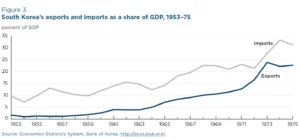
When I was young, the South Korean model was generally lumped in with places like Taiwan, Singapore and Hong Kong as a case of “export-led growth”. Even in the early 1970s, South Korea was still poorer than the North. There was no consensus that East Asia would do better than Latin America (or indeed that America would do better than the Soviet Union.)
I hate the term “export-led growth”, as on its face it would seem to imply that South Korea got rich by running trade surpluses. But exactly the opposite is true. During the three and a half decades of near double-digit growth (roughly 1963-97), Korea ran almost nonstop trade deficits, apart from a few years in the 1980s. This graph is from an excellent Doug Irwin paper that discusses the Korean reforms of 1964-65…
Here is more from Scott Sumner.
Revealing Life Preferences Through LLMs
Here is some Weberian verstehen (or is it?), but from unexpected quarters:
Large Language Models (LLMs) are trained on a prodigious corpus of human writing and may reveal human preferences over characteristics of life courses, such as income, longevity, and working conditions. We present OpenAI’s GPT-5.4 and a broadly representative sample of Americans with pairs of life stories and ask them to choose the life they would prefer for themselves. A person’s choice is better predicted by the LLM’s choice than by another person’s choice over the same stories, and LLM valuations of several life attributes are similar to those derived from human responses. Our results suggest that LLM responses offer a scalable and cost-effective complement to existing methods for studying human preferences.
That is from a new NBER working paper by
Saturday assorted links
Ned Phelps, RIP
Here is a brief appreciation from Olivier Blanchard, link now corrected.
Hayek in Jacobin
Here’s something I never expected to write: Jacobin, the magazine of the DSA-aligned left, has a good article on central planning. In an interview, Vivek Chibber lays out essentially the Mises–Hayek–Kornai critique of central planning. Information problems, incentive problems and the consequent failures are laid bare. Moreover, Chibber refuses to lay the blame at the feet of Stalin, poverty, or the Russians. Nor does he wave hopefully at supercomputers and AI, as is fashionable today on the planning-curious left:
The dilemma is this. There is a problem of information. Supercomputers will in fact help process information better. But if the information coming in is junk, and if that junk is built into the system because of the incentives that operators have in workplaces to lie, you will not have a planning system that can be put on its feet through the advent of computers or artificial intelligence or anything like that. I don’t see any reason to think that that strategic misalignment of incentives is simply there because of Russian backwardness or poverty.
Even the pedestrian is shocking coming from Jacobin:
Normally in capitalism, what do managers do? They want to make profits. The way to make a profit is by trying to sell, at the lowest price possible, the best-quality good that you can.
A vivid conclusion:
Melissa Naschek: What do you think leftists should learn from the failure of fully planned economies?
Vivek Chibber: What they should learn is that the burden of proof is on us, on the Left, if we want to continue with this slogan of replacing the market with the plan. The burden of proof is on us to show that it can work. You might say that along with this ought to come a kind of humility about facts and about the world.…it would be criminally negligent to ignore the experience of decades upon decades of planning and say to yourself, “Well, that wasn’t what my vision of socialism is, so I’m going to ignore it.” Because if you do that, I can guarantee 100 percent you will end up repeating many of the mistakes and falling into the same dilemmas that the planners did.
I could offer critiques. Stalin was not an impediment to central planning but a consequence of it. And to warn that ignoring the experience of central planning risks repeating “the same dilemmas that the planners did” is a bloodless way to describe dictatorship, famine, and mass murder. But that would be churlish. Let me end instead by saying that I agree with this:
If we’re actually serious about changing the world, people on the Left … should be the most remorseless and the most merciless when it comes to facts.
Replace “people on the Left” with “we” and the line is exactly right.
Detroit notes
It remains one of America’s most interesting cities, and now it is seeing a continuing comeback. Downtown remains mostly empty of foot traffic, but I was stunned to see new office buildings and signs of budding prosperity. It did not feel abandoned or hopeless.
Detroit Institute of Art is one of America’s best art museums, showing impeccable taste, though it is notable how much the picture donations simply disappear after some point in time. This is a temple for those are skeptical about modern art, as you will not find it reprensented much here. The American art, the Rembrandt Visitation, the Poussin Holy Family, the Breughel, and the huge Diego Rivera murals are all to die for. The average quality of painting is high as well.
Baobab Fare, not too far from the museum, is a good Burundian (!) restaurant in town.
I was lucky enough to visit the General Motors research and development complex in Cranbrook, mostly designed by Eero Saarinen, due to the ingenuity of Dan Wang (it is mostly not open to the public). Around 20,000 people work there, and it remains a temple of modernist architecture, perhaps anachronistic in effect but beautiful nonetheless. I had not realized how strong the colors were, as that does not come through in the photos.
The Saarinen (papa Saarinen!) house in the Cranbrook Art Museum is perhaps the best Art Deco design I have seen. The museum itself has excellent architecture, sculptures, and gardens, rather than being much of an art museum proper.
Here are good NYT photos of that part of the joy ride.
Overall a trip to the Detroit area is one of the very best American visits you can do, highly recommended, automobile required of course that is why they call it the Motor City.
Weapons, Wealth, and the Fates of Societies
Why do weapons sustain durable peace in some societies but provoke perpetual violence in others? We develop a theory in which the value of human life and the frequency of violence are jointly determined by weapons technology and economic conditions. Lethal weapons deter conflict but raise mortality, taxing the future returns to investing in one’s livelihood. When those returns are high, deterrence dominates and peace and investment reinforce each other. When those returns are low, the mortality tax dominates, agents divest from the future, the value of life falls, and violence deepens, a trap that deadlier weapons worsen. Whether weapons pacify or destabilize depends on the interaction between their offensive characteristics and the baseline prosperity of the society they enter. The theory illuminates four historical episodes: how Medieval Iceland (930–1262) sustained stateless order without a sovereign; why Tokugawa Japan (1603–1868) contained firearms within an institutional order that sustained two centuries of peace and growth; why firearms traded into West Africa and among Native American nations (17th–18th century) produced escalating violence and persistent underdevelopment rather than deterrence; and why the Comanche of the southern plains (c.~1750–1850) rose to regional dominance on horse and gun complementarities and then collapsed as sustained raiding into northern Mexico hollowed out the prosperity base on which their own order depended. The model also refines the logic of nuclear deterrence and generates testable predictions about urban gun violence in high-poverty neighborhoods.
That is from a new paper by Samuel Lee, Ilari Passivirta, and Alexander Zentefis, via the excellent Kevin Lewis.
What I’ve been reading
1. Mikhail Fishman, The Successor: Boris Nemtsov, Vladimir Putin, and the Decline of Modern Russia. One of the best books to read on how Russia moved from “had some democratic elements in place” to autocracy, on a step-by-step basis. The story is told using the career of Boris Nemtsov, who was assassinated in 2014, as a lens. The author has biases of his own, but they do not detract from what is valuable here.
2. Siri Hustvedt. Ghost Stories: A Memoir. About her history with her now-deceased husband Paul Auster, and how she dealt with his death. Moving and insightful, recommended.
3. Thomas Mann, Doctor Faustus, a new translation by Ritchie Robertson. An imperfect, problematic work, too caught up with its own Germanness, and lacking dramatic tension. Still, an important work and this new translation is much better than the old one.
Elsewhere, here is Beeple on AI and Monet, for the terminally online only.