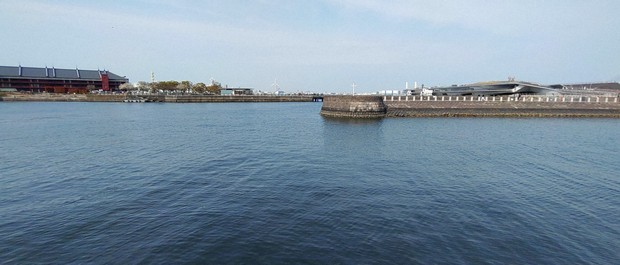
At the time of Isabella Bird's landing in Japan in May 1878, Yokohama was developing rapidly as the new gateway to the country. In the wake of the country's opening at the end of the Tokugawa period, Britain, the United States, France, Russia, the Netherlands, and other nations had established a presence there. Having passed through the customs house, Bird's first call was at the British Legation.
Let us dive further into the opening chapter of her travel narrative "Unbeaten Tracks in Japan." It is rich in the keen and inquisitive observations of a traveler encountering an unfamiliar country for the first time.
ORIENTAL HOTEL, YOKOHAMA, May 21.
The first thing that impressed me on landing was that there were no loafers, and that all the small, ugly, kindly-looking, shrivelled, bandy-legged, round-shouldered, concave-chested, poor-looking beings in the streets had some affairs of their own to mind. At the top of the landing-steps there was a portable restaurant, a neat and most compact thing, with charcoal stove, cooking and eating utensils complete; but it looked as if it were made by and for dolls, and the mannikin who kept it was not five feet high. At the custom-house we were attended to by minute officials in blue uniforms of European pattern and leather boots; very civil creatures, who opened and examined our trunks carefully, and strapped them up again, contrasting pleasingly with the insolent and rapacious officials who perform the same duties at New York.
Outside were about fifty of the now well-known jin-ri-ki-shas, and the air was full of a buzz produced by the rapid reiteration of this uncouth word by fifty tongues. This conveyance, as you know, is a feature of Japan, growing in importance every day. It was only invented seven years ago, and already there are nearly 23,000 in one city, and men can make so much more by drawing them than by almost any kind of skilled labour, that thousands of fine young men desert agricultural pursuits and flock into the towns to make draught-animals of themselves, though it is said that the average duration of a man's life after he takes to running is only five years, and that the runners fall victims in large numbers to aggravated forms of heart and lung disease. Over tolerably level ground a good runner can trot forty miles a day, at a rate of about four miles an hour. They are registered and taxed at 8s. a year for one carrying two persons, and 4s. for one which carries one only, and there is a regular tariff for time and distance.
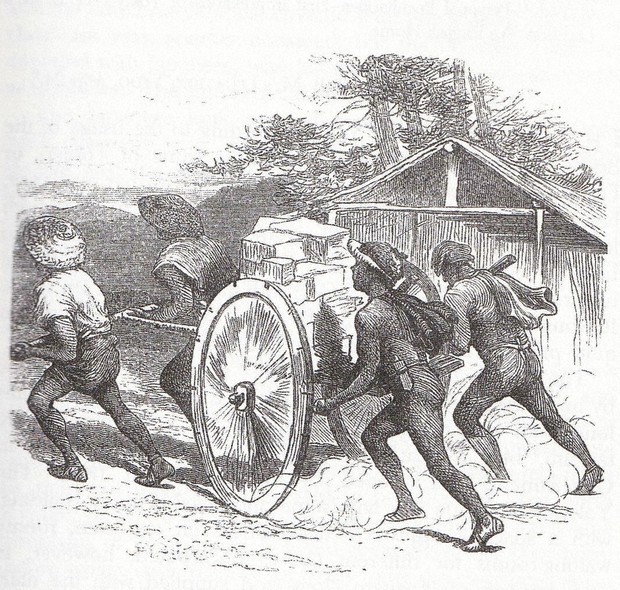
The kuruma, or jin-ri-ki-sha, consists of a light perambulator body, an adjustable hood of oiled paper, a velvet or cloth lining and cushion, a well for parcels under the seat, two high slim wheels, and a pair of shafts connected by a bar at the ends. The body is usually lacquered and decorated according to its owner's taste. Some show little except polished brass, others are altogether inlaid with shells known as Venus's ear, and others are gaudily painted with contorted dragons, or groups of peonies, hydrangeas, chrysanthemums, and mythical personages. They cost from £2 upwards. The shafts rest on the ground at a steep incline as you get in -- it must require much practice to enable one to mount with ease or dignity -- the runner lifts them up, gets into them, gives the body a good tilt backwards, and goes off at a smart trot. They are drawn by one, two, or three men, according to the speed desired by the occupants.
When rain comes on, the man puts up the hood, and ties you and it closely up in a covering of oiled paper, in which you are invisible. At night, whether running or standing still, they carry prettily-painted circular paper lanterns 18 inches long. It is most comical to see stout, florid, solid-looking merchants, missionaries, male and female, fashionably-dressed ladies, armed with card cases, Chinese compradores, and Japanese peasant men and women flying along Main Street, which is like the decent respectable High Street of a dozen forgotten country towns in England, in happy unconsciousness of the ludicrousness of their appearance; racing, chasing, crossing each other, their lean, polite, pleasant runners in their great hats shaped like inverted bowls, their incomprehensible blue tights, and their short blue over-shirts with badges or characters in white upon them, tearing along, their yellow faces streaming with perspiration, laughing, shouting, and avoiding collisions by a mere shave.
The passage gives a vivid sense of the lives of ordinary people in Yokohama, who, though poor, continued to live with resilience in this newly emerging town. Bird's comparison of the customs officials' demeanor with that of their counterparts in New York, in particular, reflects the perspective of a seasoned traveler who had seen many parts of the world.
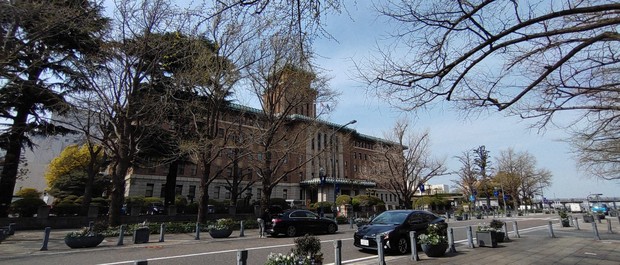
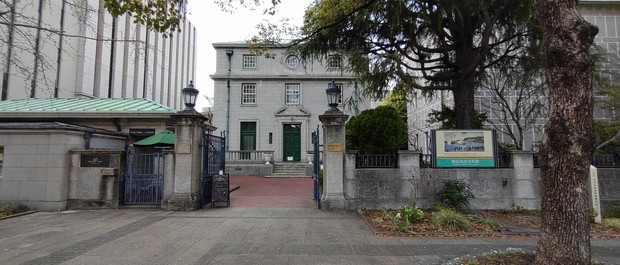
The customs house was located on what is now part of the Kanagawa Prefectural Government complex, with the Consulate situated close by. The second British Consulate building survives today as the former main building of the Yokohama Archives of History, where valuable materials conveying the atmosphere of the period are on display. It is a place well worth visiting for those seeking to picture Yokohama as it was at that time.
Bird's illustrations include scenes of street stalls and or rickshaws, among other subjects, and they more than adequately supplement her written descriptions. Of these, the rickshaw -- developed in 1870 (the third year of the Meiji era) by the inventor Yosuke Izumi and others -- proved to be an invaluable new means of transport, replacing the traditional carrying palanquin. In Yokohama, by 1875, even designated parking areas for rickshaws had been established, and illustrated records showing pullers waiting for customers have been preserved at the Yokohama Archives of History. It is likely that Bird herself rode in one such vehicle.
After a visit to the Consulate I entered a kuruma and, with two ladies in two more, was bowled along at a furious pace by a laughing little mannikin down Main Street -- a narrow, solid, well- paved street with well-made side walks, kerb-stones, and gutters, with iron lamp-posts, gas-lamps, and foreign shops all along its length -- to this quiet hotel recommended by Sir Wyville Thomson, which offers a refuge from the nasal twang of my fellow-voyagers, who have all gone to the caravanserais on the Bund. The host is a Frenchman, but he relies on a Chinaman; the servants are Japanese "boys" in Japanese clothes; and there is a Japanese "groom of the chambers" in faultless English costume, who perfectly appals me by the elaborate politeness of his manner.
Almost as soon as I arrived I was obliged to go in search of Mr. Fraser's office in the settlement; I say search, for there are no names on the streets; where there are numbers they have no sequence, and I met no Europeans on foot to help me in my difficulty. Yokohama does not improve on further acquaintance. It has a dead-alive look. It has irregularity without picturesqueness, and the grey sky, grey sea, grey houses, and grey roofs, look harmoniously dull.
No foreign money except the Mexican dollar passes in Japan, and Mr. Fraser's compradore soon metamorphosed my English gold into Japanese satsu or paper money, a bundle of yen nearly at par just now with the dollar, packets of 50, 20, and 10 sen notes, and some rouleaux of very neat copper coins. The initiated recognise the different denominations of paper money at a glance by their differing colours and sizes, but at present they are a distracting mystery to me. The notes are pieces of stiff paper with Chinese characters at the corners, near which, with exceptionally good eyes or a magnifying glass, one can discern an English word denoting the value. They are very neatly executed, and are ornamented with the chrysanthemum crest of the Mikado and the interlaced dragons of the Empire.
I long to get away into real Japan. Mr. Wilkinson, H.B.M.'s acting consul, called yesterday, and was extremely kind. He thinks that my plan for travelling in the interior is rather too ambitious, but that it is perfectly safe for a lady to travel alone, and agrees with everybody else in thinking that legions of fleas and the miserable horses are the great drawbacks of Japanese travelling.
As is still the case today, one of the first tasks on arriving in a foreign country was to exchange one's money into the local currency. Firms such as Fraser & Co., located in Yokohama, handled foreign-exchange business at the time.
In 1871, the Meiji government promulgated the New Currency Act, abolishing traditional units such as the "ryo" and "bu" and introducing the yen as the new standard unit of currency. A decimal system was also adopted. The following year, regulations governing national banks -- effectively creating a central banking framework -- were issued, and the circulation of convertible banknotes exchangeable for gold began.
By the year before Bird's arrival, 1877, Japan's first domestically produced Western-style paper currency, the national bank notes (new issues), had only just been put into circulation. The unusual banknotes that passed through her hands were, in other words, products of a monetary system still in its infancy. Their designs were the work of the Italian engraver Edoardo Chiossone, often regarded as the father of modern Japanese banknote design.
The Oriental Hotel, where Bird first stayed, stood close to what is now Yokohama's Chinatown. Opened in 1872 by a Frenchman named Bonnat, it was a Western-style hotel situated on a quiet street at night. She remained there for about three days, using the time to prepare for the long journey that lay ahead.
What, then, was her purpose in coming to Japan? Various conjectures are possible, but in the end, it is best summed up by her own simple words:
"I long to get away into real Japan."
Equally revealing is the reaction of Mr. Wilkinson, who described her plans as "rather too ambitious." He also assured her that "it is perfectly safe for a lady to travel alone" -- but was it truly so?
Incidentally, an issue of the Tokyo Nichi Nichi Shimbun, the predecessor of the Mainichi Shimbun, published on May 20 -- the very day Bird arrived -- carried an article on an incident a short time earlier in which a sailor on a British warship committed an act of violence against a Japanese woman.
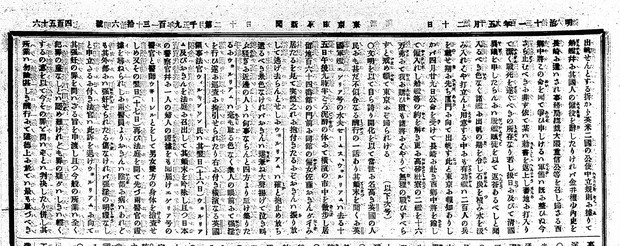
It can hardly be said, therefore, that the situation was ever truly "perfectly safe."
(By Tadahiko Mori, The Mainichi Staff Writer)
This Part 2 of an ongoing series. The next part will be published on June 6. All excerpts are taken from "Unbeaten Tracks in Japan" by Isabella L. Bird. Research cooperation provided by Professor Emeritus Kiyonori Kanasaka, Kyoto University.