Log in

Overview

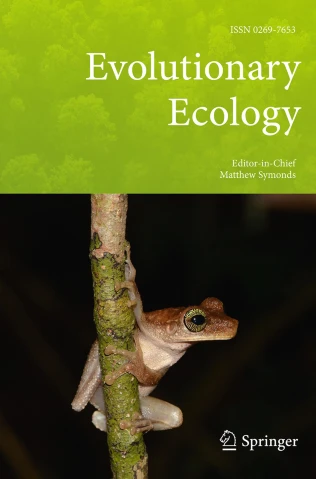
Evolutionary Ecology is a concept-oriented journal of biological research at the interface of ecology and evolution. We publish papers that therefore integrate both fields of research: research that seeks to explain the ecology of organisms in the context of evolution, or patterns of evolution as explained by ecological processes. 

The journal publishes original research and discussion concerning the evolutionary ecology of organisms. These may include papers addressing evolutionary aspects of population ecology, organismal interactions and coevolution, behaviour, life histories, communication, morphology, host-parasite interactions and disease ecology, as well as ecological aspects of genetic processes. The objective is to promote the conceptual, theoretical and empirical development of ecology and evolutionary biology; the scope extends to any organism or system.

In addition to Original Research articles, we publish Review articles that survey recent developments in the field of evolutionary ecology; Perspectives articles which present new points of view and novel hypotheses; and Comments on articles recently published in Evolutionary Ecology or elsewhere. We also welcome Natural History Notes, which aim to present new observations of organismal biology in the wild that may provide inspiration for future research, and Methods papers, which present or review new theoretical, practical or analytical methods used in evolutionary ecology.

Students & Early Career Researchers: We particularly encourage, and offer incentives for, submission of Reviews, Ideas & Perspectives, and Methods papers by students and early-career researchers (defined as being within one year of award of a PhD degree)–please see Students & Early Career Researchers.

We publish 6 types of papers:

1. Original Research articles, which present the results of empirical or theoretical research testing current ideas in evolutionary ecology;

2. Review articles, which survey recent developments in the field of evolutionary ecology;

3. Perspectives articles, which present new points of view and/or novel hypotheses;

4. Methods papers, to present or review new theoretical, practical or analytical methods used in evolutionary ecology;

5. Natural History Notes, which present new observations of organismal biology in the wild that may provide inspiration for future evolutionary ecology research;

6. Comments on articles recently published in Evolutionary Ecology or elsewhere.
 

Evolutionary Ecology:

Editor-in-Chief
  • Matthew R. E. Symonds PhD

Journal metrics

Journal Impact Factor
2.1 (2024)
5-year Journal Impact Factor
1.9 (2024)
Submission to first decision (median)
6 days
Downloads
259.1k (2025)

Calls for papers

Latest articles

Journal updates

  • Dispersal in small organisms

    LATEST SPECIAL ISSUE | Volume 39, Issue 6, December 2025
    Issue editors: Frank Stearns, Aurélie Coulon
    In 1975, Daniel Otis Wolfenbarger published Factors Affecting Dispersal Distances of Small Organisms, a book presenting the organic and inorganic factors affecting dispersal in small-sized species or propagules (e.g., insects, seeds, pollen, fungi, bacteria). Although reviews were generally positive, Dr. Ronald J. Prokopy lamented some omissions particularly with regard to analysis and synthesis of the massive amount of data compiled (Prokopy 1976). In his review, Dr. Prokopy mentioned that Wolfenbarger was hinting at a follow-up volume. This volume was never written, and this special issue will revisit the theme on the 50th anniversary of the original publication.

    UN SDG 15 (Life on Land)

Journal information

Electronic ISSN
1573-8477
Print ISSN
0269-7653
Abstracted and indexed in
  1. AGRICOLA
  2. ANVUR
  3. Astrophysics Data System (ADS)
  4. BFI List
  5. BIOSIS
  6. Baidu
  7. Biological Abstracts
  8. CAB Abstracts
  9. CLOCKSS
  10. CNKI
  11. CNPIEC
  12. Chinese Academy of Medical Science (CAMS)
  13. Current Contents/Agriculture, Biology & Environmental Sciences
  14. Dimensions
  15. EBSCO
  16. EMBiology
  17. Engineering Village – GEOBASE
  18. Google Scholar
  19. Japanese Science and Technology Agency (JST)
  20. Meta
  21. Naver
  22. OCLC WorldCat Discovery Service
  23. Ovid Discovery
  24. Portico
  25. ProQuest
  26. SCImago
  27. SCOPUS
  28. Science Citation Index Expanded (SCIE)
  29. TD Net Discovery Service
  30. Wanfang
  31. Zoological Record
  32. eLibrary.ru
© Springer Nature Switzerland AG

Journal navigation