


US scientists make air-powered muscles that help robots lift 100x their weight
The flexible design allows robots to squeeze through tight spaces and debris.

Scientists in the US have developed a new type of air-powered artificial muscles that allow robots lift up to 100 times their own weight, without relying on bulky motors and external power systems.
Led by Eric Weissman, a PhD student at Arizona State University (ASU), the study explores bio-inspired robotic muscles designed to push robots beyond the limits of conventional motor-driven systems.
The artificial muscles would allow robots to run in extreme conditions, including boiling water and abrasive environments. They could also help the robots move past obstacles that slow down most machines and still lift up to 100 times their own weight.
“Essentially, we developed a novel artificial muscle that mimics real muscles,” Weissman said. “While bio-inspired muscles previously existed, we have made them more versatile, more lightweight and more powerful.”
Muscle-like robot power
Most modern quadruped robots rely on motors, which make them heavy, rigid and limited in mobility. But the novel helical anisotropically reinforced polymer (HARP) actuators mimic natural muscle contraction and expansion. They are flexible, lightweight and nearly silent.
“These muscles look like little tubes that are coiled like cavatappi, which is a hollow, ridged, corkscrew-shaped pasta,” Weissman said, adding that it only takes a small amount of air to cause the muscles to expand and contract.
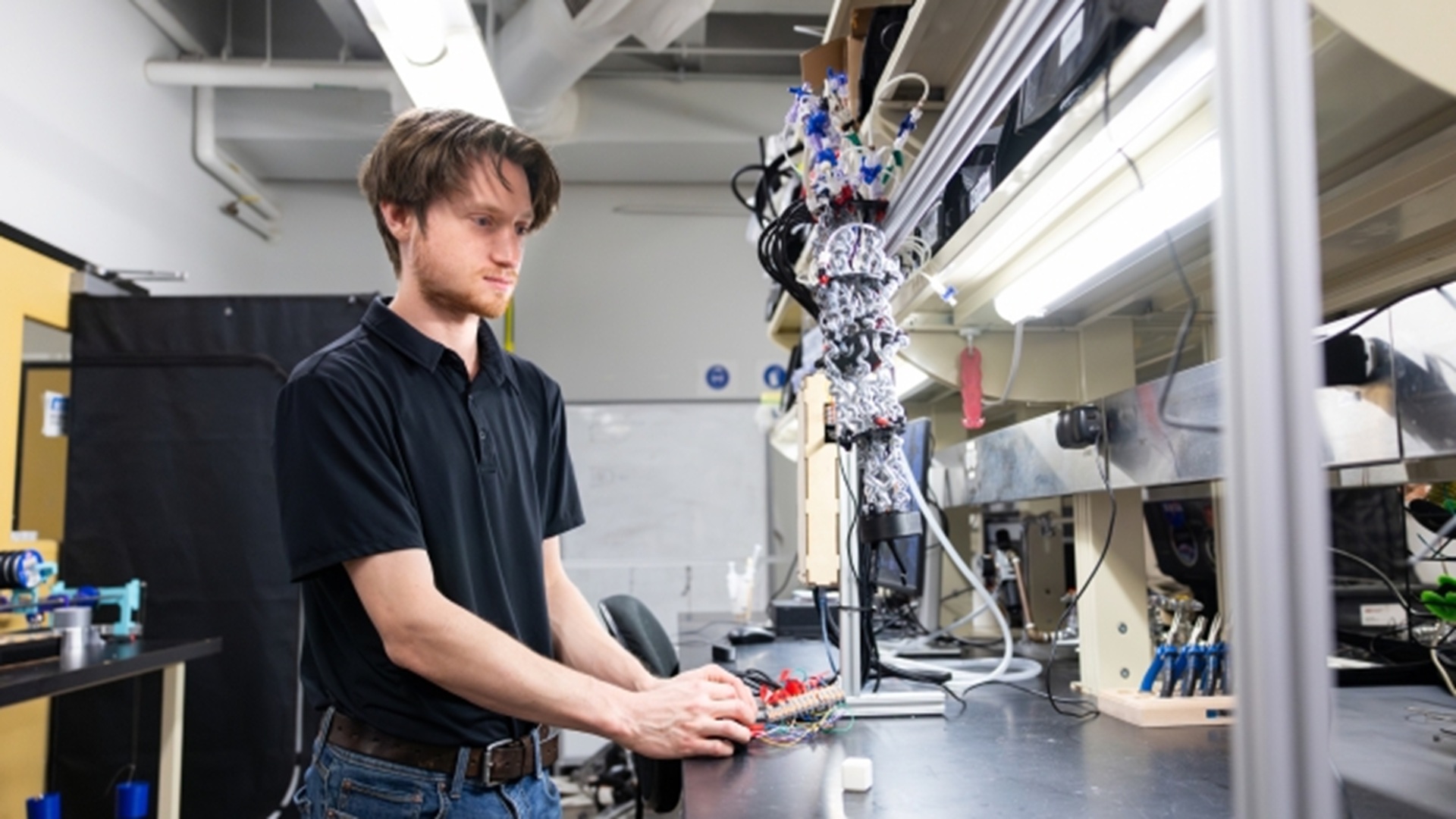
Credit: Samantha Chow/ASU
“Because of their versatility and adaptability, we were able to reduce that pressure requirement significantly, which enabled us to make a robot that could walk independently without any external power supply, carrying everything it needs on itself,” he added.
Still, the team’s work goes beyond designing bioinspired muscles for individual, specific tasks. Instead, it offers a broad framework that enables to tailor the new technology for a range of lower-cost applications.
“In disaster response, soft robots will move through debris or collapsed buildings to search for survivors,” Weissman said, adding that their flexibility allows them to fit into confined spaces without adding damage. “At home, they could safely help older adults with daily activities, like reaching for items on shelves and assisting with simple chores,” he continued.
Lighter, stronger robots
HARP actuators can withstand extreme heat, which is why, according to the team, they can be used across industrial rinsing, marine exploration, as well as sample collection near thermal vents.
What’s more, their flexibility, rotation, and grasping ability also make them well suited for agriculture and industrial applications. The team has filed a provisional patent through ASU’s Skysong Innovations and received an NVIDIA Academic Grant to support the work.
The lab has developed a bionic robotic arm inspired by an elephant’s trunk. It can reach over, under, and around obstacles with ease. Its soft, flexible design makes it ideal for delicate industrial tasks and close human interaction.

Credit: Samantha Chow/ASU
Meanwhile, the team has also built a wearable back support device that combines soft materials with adjustable assistance. It helps reduce strain during heavy lifting while remaining lightweight and comfortable.
Jiefeng Sun, PhD, an assistant professor at ASU, and co-author of the study, noted the muscles could be used across agriculture, industry, healthcare, home tasks and even future space missions.
“By using space-grade materials, we can provide mobility, agility and ease of motion in devices designed both for astronauts and the robots they bring with them to space,” he concluded in a press release.
The study has been published in the journal Proceedings of the National Academy of Sciences (PNAS).
Recommended Articles

Get the latest in engineering, tech, space & science - delivered daily to your inbox.
0COMMENT
Based in Skopje, North Macedonia. Her work has appeared in Daily Mail, Mirror, Daily Star, Yahoo, NationalWorld, Newsweek, Press Gazette and others. She covers stories on batteries, wind energy, sustainable shipping and new discoveries. When she's not chasing the next big science story, she's traveling, exploring new cultures, or enjoying good food with even better wine.
- 1Chinese scientists build handheld cancer detector with 94.9% accuracy in trials
- 2How solar panels on a van pumped out 120% of their rated power in one day
- 3US Navy to test 100,000 ton aircraft carrier as floating nuclear power station
- 4China's new humanoid robot joins officers to handle street management tasks
- 5Most advanced memory ever produced in US could boost defense, industrial systems


