


Design Self-Study Matbi's Practical HW Accelerator Design Using FPGA (From LED Control to Fully Connected Layer Accelerator Design)
With Seolgye Dokhak Matbi! Let's build fundamental knowledge of FPGA and gain experience in HW accelerator design.

Reviews from Early Learners
5.0
5.0
john3451
Having only experienced Verilog design and verification in testbenches, I needed an environment where I could verify on actual HW. I knew Vivado provided even the bitstream generation function to upload to an FPGA, but I felt overwhelmed by how to use the features, and even from the moment I tried to purchase a board, I felt a lot of helplessness. To take Mabbi-nim's lecture, I selected a board, and by listening to the provided lecture, I was able to personally experience what HW design through FPGA is like, and what constraints exist in actual, non-ideal HW (such as the process for meeting Timing via STA). Now that I've completed the lecture (it took quite a long time as I was juggling it with undergraduate classes...), I plan to thoroughly review each part, building both my HW design capabilities and SW capabilities to use Vitis. At the undergraduate level, it's difficult to use Synopsys or Cadence Tool, but since my school offered a lecture providing Frontend Tool, after trying them all, I found that aside from DFT, Vivado can practically cover almost everything. Therefore, I believe it would be very beneficial for those aspiring to ASIC design to take this course as well. Thank you for providing such a great lecture. As soon as I complete the XUP labs, I will return for Verilog Season 2 to gain a deeper understanding of AMBA AXI.
5.0
sunny75
2024/08/31/Sat 15:40 I listened to the lecture well. When using a computer, I had many questions such as what is a CPU? What is H/W? How do you make H/W? After listening to the lecture, I understood a lot. I am not a H/W developer. I am aiming for S/W development. I am currently a complete beginner in S/W. T.T So, I am listening to many lectures on inflearn. I have registered for 3 of Design Self-study's lectures. I am hesitating because the AXI4 lecture has a set period of attendance. Since I am not in the H/W field, I think I can attend the lecture right away and watch it a year later. I saw the announcement of a new lecture on YouTube. If you make a new lecture, if the period of attendance is "unlimited", I think I will register for the lecture right away. This is my opinion. For those who are aiming for H/W design, it seems like it would be a good idea to decide on a good course period (if there is a gap period, those who applied will be able to attend all of the courses within that period). I learned a lot from today's really good lecture. Thank you. Have a nice day. ^^;;
5.0
송순규
This is a course that deserves 5 points. It seems to teach well so that you can approach it more familiarly by doing real designs that are not taught in school. I am still in the learning stage for employment, but I think that the experience of applying the projects learned here and putting them on the board is the most important specification for me. Although it is difficult, I will try to understand it by continuing to look at it and run to the end.
What you will gain after the course
Verilog HDL
FPGA Accelerator Design
Basic knowledge of non-memory semiconductor design
Essential lectures for non-memory design engineers!
Build your FPGA knowledge and HW accelerator design experience.
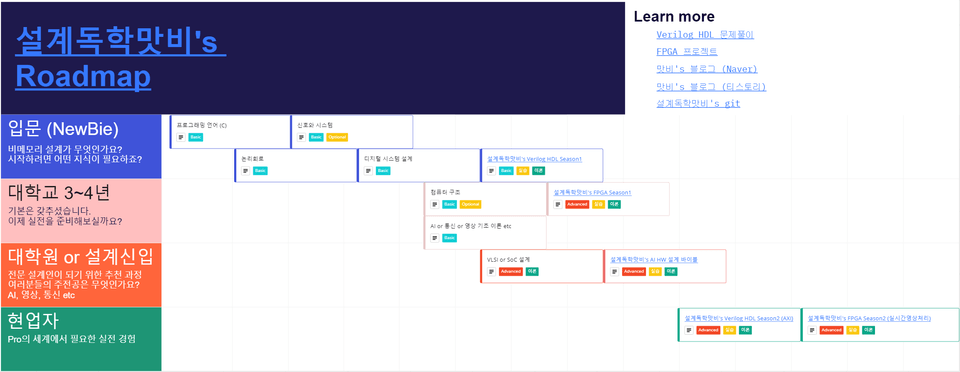
Check out the Matbi Universe Roadmap for those of you dreaming of becoming a non-memory design expert.
(Click the image to go to the detailed roadmap page.)
Hello!
I am Matbi from Design Self-Study.
Velilog HDL Season1 is the second lecture following the first!

Practical Verilog HDL Season 1 (From Clock to Internal Memory)
Basic knowledge and experience in non-memory semiconductor design
If you have not completed the prerequisite course, please hold off on applying for this course for a moment.
Please make sure to read the required document below, and if you agree with it, please apply for the course.
Prepared students should watch this.
Assuming you have agreed to the contents of the required reading,
I will deliver only the Facts.
Self-taught Design Matbi's FPGA Season 1 Required Reading (Click)
(As of 21/12/30) 730 Likes, 2 Dislikes, 47,386 Views.
* This video is currently set to private on YouTube and is only available through Inflearn.
We must learn FPGA.
The FPGA market is steadily growing.
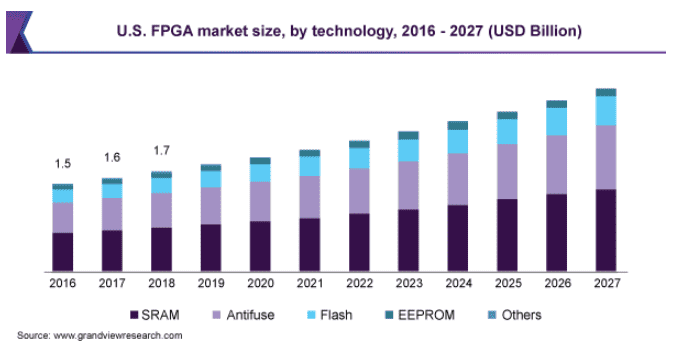
Learning the FPGAs demanded by the market will also increase your value.
Even now, you can receive a salary in the top 1% of the industry, but there is an opportunity to earn an even higher salary.
In this course, we use Xilinx FPGAs.
We must learn Xilinx FPGAs.
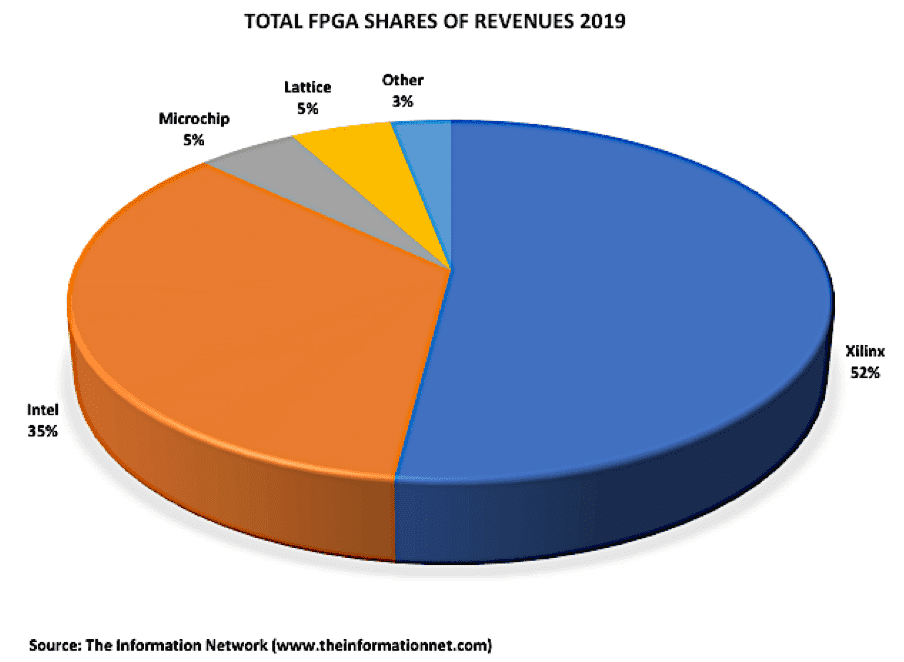
The FPGA market shares of Xilinx (AMD) vs. Altera (Intel) speak for themselves.
The following image is a statistical graph from 2019, and this gap is widening even further.
- It currently holds the number one market share, and I expect Xilinx to maintain its top position for at least the next 10 years.
- Every company I have worked for uses Xilinx FPGAs.
This course uses Zybo Z7 and Arty Z7.
(Click! Please be sure to refer to the link)
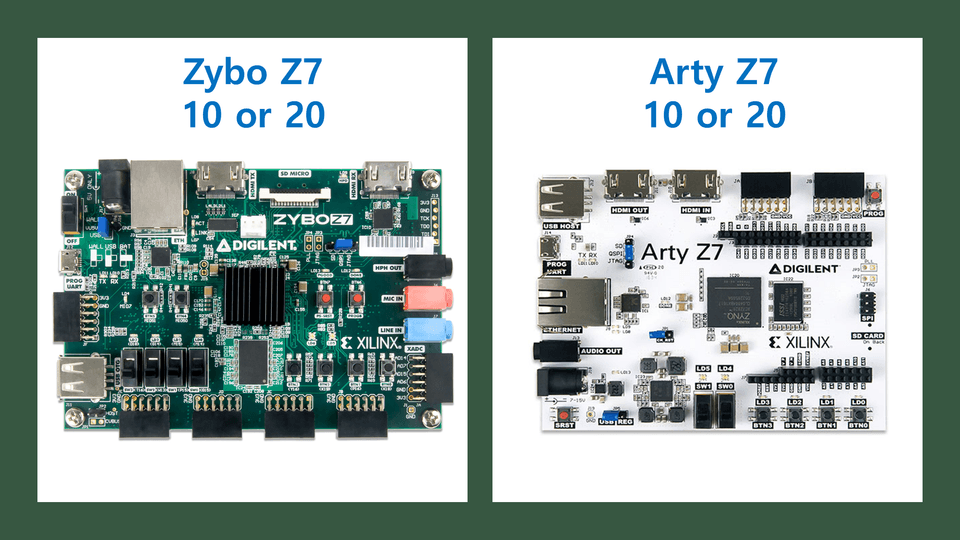
The reasons for choosing Zybo/Arty Z7 for FPGA beginners are as follows.
- You can experience using both Arm (PS) and PL. → You can understand the internal FPGA system.
- This is a board verified by Xilinx. → It is not a board made by an individual. It is reliable.
- There are many users. → Get help from engineers around the world.
- There are numerous examples. → You will be able to study even more after completing this course.
- There is HDMI in/out for video processing. → There is no reason to purchase an additional camera.
If you complete this course
First, you will be ready to use any FPGA board.
There are well over 1,000 different types of Xilinx FPGA products.
However, if you take this course, you will build the fundamental knowledge to use any Xilinx FPGA.
I first started with the Zybo board, and now I use the Alveo Card, Xilinx's flagship FPGA product for servers, and AWS's f1 instance. FPGAs are being used not only in the embedded market but also in the server market.
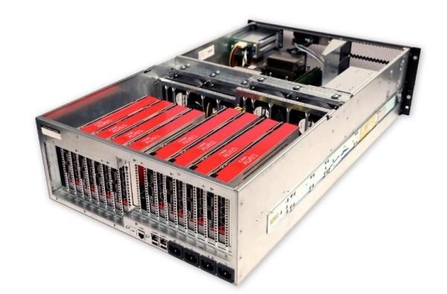
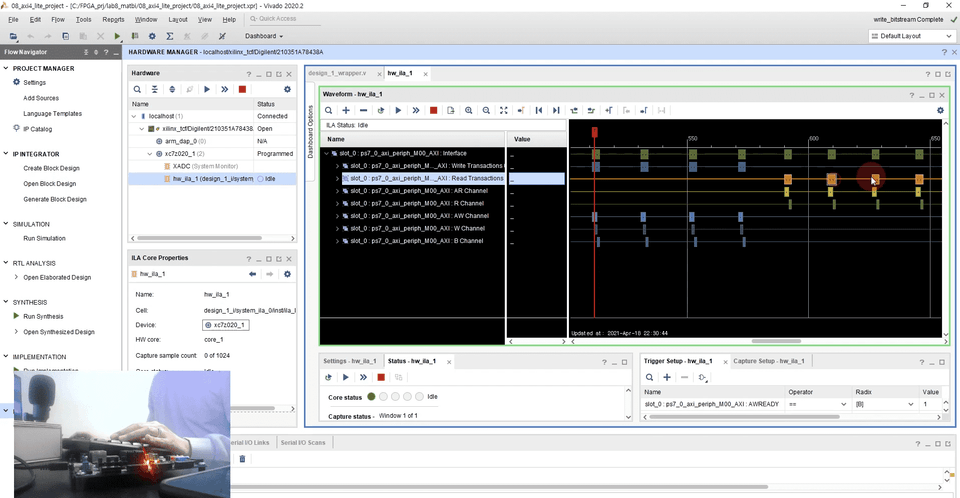
Second, you can understand HW accelerator design using Verilog HDL and FPGA.
You will be able to design the core you wish to accelerate.
FPGA is a chip specifically created for HW acceleration.
This includes the process of designing and verifying the core you want to accelerate.
See you in the industry 🖐
Thank you sincerely for reading.
If you have read this far, even if you do not take my course,
I am confident that you will become an excellent design engineer.
The choice is yours.
I look forward to meeting you in the field.
Thank you. Best regards, Matbi.
🎁 We are giving out discount coupons to members of the Design Self-Study Community! 🥰
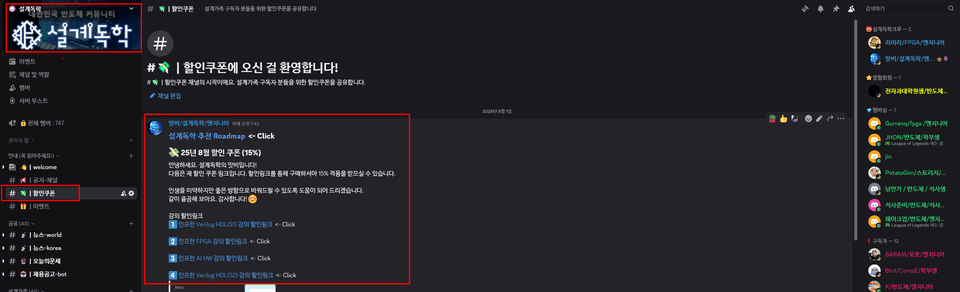
Join the Design Self-Study community and receive a discount coupon.. Join Link (Click)
Recommended for
these people
Who is this course right for?
Someone with knowledge at the level of a 3rd or 4th-year electronics engineering student
Those who wish to work in the non-memory design field + current engineers!
Those who want to try designing something other than a digital clock or a vending machine.
Those who want to learn practical FPGA
Need to know before starting?
Verilog HDL Season 1 Completed (Continuing from here.)

4,335
Learners
377
Reviews
1,316
Answers
5.0
Rating
5
Courses
Hello. I am Matbi from Design Self-Study.
Current) I am designing HW IPs at a Global Top5 Fabless company.
I am creating "real-world semiconductor design lectures" that have never existed before and will be helpful in your professional career.
Design Self-Study Roadmap and improve your skills together.
I am running the Design Self-Study Community to communicate with all of you.
(Join the community and receive a 15% discount coupon.)
Let's enjoy studying and grow together!
Curriculum
All
30 lectures ∙ (9hr 29min)
Course Materials: