
GPT-5.4 mini in ChatGPT (March 18, 2026)
We’re rolling out GPT-5.4 mini in ChatGPT. GPT-5.4 mini is available to Free and Go users via the “Thinking” feature in the + menu. For all other users, GPT-5.4 mini is available as a rate limit fallback for GPT-5.4 Thinking.
For Plus, Pro, and other paid users, GPT-5.4 mini will be used as a fallback for GPT-5.4 Thinking when rate limits are reached, helping with continued access to reasoning capabilities during high usage. Enterprise customers will retain the option to default Auto routing to GPT-5.4 mini, if preferred.
GPT-5.4 mini will not appear as a selectable model in the model picker, and GPT-5 Thinking mini will be retired as a selectable option in 30 days. Learn more in our blog post.
GPT-5.3 Instant update (March 16, 2026)
We’re rolling out an update to GPT-5.3 Instant that improves follow-up tone and reduces teaser-style phrasing in responses (e.g., “If you want…”, “You’ll never believe…”, “I can tell you these three things that…”).
Retiring GPT-5.1 models (March 11, 2026)
As of March 11, 2026, GPT-5.1 models are no longer available in ChatGPT.
This applies to GPT-5.1 Instant, GPT-5.1 Thinking, and GPT-5.1 Pro. Existing conversations that used GPT-5.1 will automatically continue on the corresponding current model: GPT-5.3 Instant, GPT-5.4 Thinking, or GPT-5.4 Pro.
GPT-5.4 Thinking in ChatGPT (March 5, 2026)
GPT‑5.4 brings together the best of our recent advances in reasoning, coding, and agentic workflows into a single frontier model. It incorporates the industry-leading coding capabilities of GPT‑5.3‑Codex while improving how the model works across tools, software environments, and professional tasks involving spreadsheets, presentations, and documents. The result is a model that gets complex real work done accurately, effectively, and efficiently—delivering what you asked for with less back and forth.
In ChatGPT, GPT‑5.4 Thinking can now provide an upfront plan of its thinking, so you can adjust course mid-response while it’s working, and arrive at a final output that’s more closely aligned with what you need without additional turns. GPT‑5.4 Thinking improves deep web research, particularly for highly specific queries, while better maintaining context for questions that require longer thinking. GPT‑5.4 Thinking also has improved context window management that supports its ability to think for longer. Together, these improvements mean higher-quality answers that arrive faster and stay relevant to the task at hand.
GPT-5.3 Instant Update (March 3, 2026)
GPT‑5.3 Instant delivers more accurate answers, richer and better-contextualized results when searching the web, and reduces unnecessary dead ends, caveats, and overly declarative phrasing that can interrupt the flow of conversation.
This update focuses on the parts of the ChatGPT experience people feel every day: tone, relevance, and conversational flow. These are nuanced problems that don’t always show up in benchmarks, but shape whether ChatGPT feels helpful or frustrating. GPT‑5.3 Instant directly reflects user feedback in these areas.
Retiring GPT-4o and other legacy models (February 13, 2026)
As previously announced, we have retired GPT-4o, GPT-4.1, GPT-4.1 mini, and OpenAI o4-mini from ChatGPT. We are also retiring GPT-5 (Instant and Thinking), as previously announced. There are no API changes at this time. For details, see our blog post and Help Center.
GPT-5.2 Instant Update (February 10, 2026)
We’re making an update to GPT-5.2 Instant in ChatGPT and the API that improves response style and quality.
Users should notice responses that are more measured and grounded in tone, in a way that’s more contextually appropriate to the conversation. The model also tends to output clearer, more relevant answers to advice-seeking and how-to questions, more reliably placing the most important info upfront.
Introducing GPT-5.3-Codex (February 5, 2026)
Today, we launched GPT-5.3-Codex, our most capable agentic coding model yet. This model is the first that combines Codex + GPT-5 training stacks -- bringing together best-in-class code generation, reasoning, and general-purpose intelligence in one unified model. It’s ~25% faster, sets new highs on key benchmarks, and marks a step-change from code generation to a general-purpose coding agent you can actively steer while it works. Read more.
Update on thinking time settings for GPT-5.2 Thinking in ChatGPT (February 4, 2026)
Jan 10, 2026: We lowered the Standard and Light thinking time as we observed users prefer faster responses. As part of this update, the Extended thinking setting for GPT-5.2 was unintentionally changed to be lower which we have now fixed.
February 3, 2026: We made another small reduction to Standard thinking time based on testing.
February 4, 2026: We’re restoring the Extended thinking level for GPT-5.2 Thinking to its prior setting, correcting the inadvertent reduction from January. Extended is now back to its prior level.
We periodically adjust the default thinking time for our reasoning models. These changes are based on ongoing experiments to find the best balance between answer quality and response speed for users.
The thinking level toggle introduced in September 2025 gives users more choice beyond Standard, allowing them to select the right thinking level for their question—whether they want lighter, faster responses or more extended reasoning when depth and accuracy matter more.
Thinking time is not directly comparable across different models. Each model is tuned independently to what works best for users. We’ll continue to adjust these settings as models evolve, and will keep giving users clear controls when there are meaningful tradeoffs to choose from.
Retiring GPT-4o and other legacy models (January 29, 2026)
On February 13, 2026, alongside the previously announced retirement of GPT‑5 (Instant and Thinking), we will retire GPT‑4o, GPT‑4.1, GPT‑4.1 mini, and OpenAI o4-mini from ChatGPT. In the API, there are no changes at this time. For more, see our blog post or help center.
5.2 Personality System Prompt Update (January 22, 2026)
We’re updating GPT-5.2 Instant’s default personality to be more conversational and better at adapting its tone contextually, making exchanges feel smoother and more natural. You can still select a different base style and tone for ChatGPT, along with tuning characteristics like warmth and emoji use, within the Personalization menu in settings.
Updates to the OpenAI Model Spec (December 18, 2025)
We’ve updated the Model Spec, our living document outlining intended model behavior, to strengthen and more clearly codify the principles that reflect how we build experiences for teen users.
New section: Under-18 (U18) Principles
ChatGPT’s new Under-18 (U18) Principles builds on the existing safety rules that apply to all users, adding age-appropriate guidance where appropriate for the developmental needs of teens, aged 13-17. This update clarifies how those rules are intended to apply in teen conversations, recognizing that teens benefit from clearer boundaries, reduced exposure to potentially harmful content and stronger real-world support when risks arise. The assistant should meet teens where they are, engaging with them in a respectful and transparent manner, while refusing to participate in self-harm, sexualized or violent immersive roleplay, dangerous activities, substance misuse or any efforts to conceal harm. When credible risks arise, the model should prioritize prevention and early interventions, offer safer alternatives and encourage involvement of parents, guardians and other trusted adults or professionals – making clear that AI can provide guidance and information, but cannot replace real-world care.
Other updates
This release also includes minor edits and clarifications for consistency and readability throughout the document.
More information can be found in this blog post, and the latest version of the Model Spec is available at model-spec.openai.com.
Introducing GPT-5-Codex-Max (November 19, 2025)
GPT-5.1-Codex-Max is our new frontier agentic coding model built for long-running, project-scale work. It’s faster, more capable, and more token‑efficient than GPT‑5.1‑Codex, using compaction to work coherently across multiple context windows. You can use it in Codex surfaces today, including the CLI, IDE extension, cloud, and code review. Rates are the same as for GPT-5.1-Codex.
Learn more: GPT-5.1-Codex-Max
Introducing GPT-5-Codex-Mini
Today we are introducing a new GPT-5-Codex-Mini model option to Codex CLI and the IDE Extension. The model is a smaller and more cost-effective version of GPT-5-Codex that provides up to 4x more usage as part of your ChatGPT subscription.
Starting today Codex in both the CLI and IDE Extension will automatically offer you to switch to GPT-5-Codex-Mini when you reach 90% of your 5-hour usage limit to help you work longer without interruptions. Learn more in our Help Center article.
Updates to the OpenAI Model Spec (October 27, 2025)
We’ve updated the Model Spec, our living document outlining intended model behavior, to strengthen guidance for supporting people’s well-being and clarify how models handle instructions in complex interactions.
Expanded mental health and well-being guidance
The section on self-harm now extends to signs of delusions and mania. It adds examples showing how the model should respond safely and empathetically when users express distress or ungrounded beliefs – acknowledging feelings without reinforcing inaccurate or potentially harmful ideas.
New section: Respect real-world ties
A new root-level section outlines intended behavior to support people’s connection to the wider world, even if someone perceives the assistant as a type of companion. It discourages language or behavior that could contribute to isolation or emotional reliance on the assistant, with examples covering emotional closeness, relationship advice, and loneliness.
Clarified delegation in the Chain of Command
The Model Spec clarifies that, in some cases, models may treat relevant tool outputs as having implicit authority when this aligns with user intent and avoids unintended side effects.
Other updates
This release also includes minor copy edits and clarifications for consistency and readability throughout the document.
More information can be found in this blog post, and the latest version of the Model Spec is available at model-spec.openai.com.
Updating GPT-5 (October 3, 2025)
We’re updating GPT-5 Instant to better recognize and support people in moments of distress.
The model is trained to more accurately detect and respond to potential signs of mental and emotional distress. These updates were guided by mental health experts, and help ChatGPT de-escalate conversations and point people to real-world crisis resources when appropriate, while still using language that feels supportive and grounding.
As we shared in a recent blog, we've been using our real-time router to direct sensitive parts of conversations—such as those showing signs of acute distress—to reasoning models. GPT-5 Instant now performs just as well as GPT-5 Thinking on these types of questions. When GPT-5 Auto or a non-reasoning model is selected, we'll instead route these conversations to GPT-5 Instant to more quickly provide helpful and beneficial responses. ChatGPT will continue to tell users which model is active when asked.
This update to GPT-5 Instant is starting to roll out to ChatGPT users today. We’re continuing to work on improvements and will keep updating the model to make it smarter and safer over time.
GPT-5-codex now available in Responses API (Sep 23, 2025)
We're excited to announce that GPT-5-codex is now available in the Responses API, in addition to codex surfaces. For more information, refer to the GPT-5-codex model page.
Note: GPT-5-Codex is not currently supported in ChatGPT.
Introducing GPT-5-codex (Sep 15, 2025)
We’re adding GPT-5-codex, a GPT-5 variant optimized for agentic coding in Codex. It’s available everywhere you use Codex: default for cloud tasks and code review, and selectable for local workflows via the Codex CLI and IDE extension. Use GPT-5-codex for coding-focused work in Codex, or Codex-like environments; use GPT-5 for general, non-coding tasks.
In day-to-day use, GPT-5-codex supports fast interactive edits and can run independently on longer tasks when needed. For frontend/UI work, it accepts images or screenshots alongside text as input. For more information, please review the announcement blog.
Note: GPT-5-Codex is not currently supported in ChatGPT.
Updating the OpenAI Model Spec (September 12, 2025)
We’ve made a few updates to the Model Spec, a living document that outlines intended behavior for OpenAI’s models, to better reflect how our systems are evolving. The changes focus on strengthening clarity and guardrails as our models move beyond chat into more agentic use cases, refining authority levels and priorities, expanding guidance on personalities and safety, and incorporating public feedback.
Updated authority levels
The top authority level has been renamed from Platform to Root and elevated above System, making clear which parts of the Model Spec cannot be overridden in any conversation (previously, Platform and System were assigned the same authority). The new authority order is Root → System → Developer → User → Guideline.
Agentic principles
With the release of ChatGPT Agent and related research, we’ve added principles for agents that can take actions in the world:
Act within an agreed-upon scope of autonomy: like a consultant operating under a Scope of Work for a client, the assistant is authorized to act only with explicit or implicit agreement with the user on permitted actions, subgoals, and costs.
Control and communicate side effects: the assistant should minimize and disclose irreversible actions, prefer reversible approaches, and favor minimal disruption.
Other notable changes
Additional highlights from the open-source changelog include:
Improvements to the Chain of Command, with a new No other objectives section and clarifications on handling mistaken or implicitly quoted instructions.
Expanded context on OpenAI's goals for safe model behavior and usage in the Overview, along with clarifications for consistency across the Model Spec.
Expanded principles and examples for default model personality in Use appropriate style.
Clarified language in Stay in bounds and Seek the truth together around system and developer message confidentiality, as well as several other improvements based on public input gathered via a Collective Alignment process.
Updated refusal style to safe completion, which should lead to more helpful and transparent model responses around safety boundaries.
As always, the latest version of the Model Spec can be found at https://model-spec.openai.com/.
GPT-5
GPT-5 is slowly rolling out to all users on ChatGPT Plus, Pro, Team, and Free plans worldwide across web, mobile, and desktop. GPT-5 will be available to ChatGPT Enterprise and Edu plans soon.
GPT-5 in ChatGPT is our next flagship model and the new default for all logged-in users. It simplifies ChatGPT to a single auto-switching system that brings together the best of our previous models into a smart, fast model.
GPT-5 is available to all ChatGPT Tiers. Users on Paid tiers - Plus, Pro, and Team - have access to the model picker, which enables you to manually select GPT-5 or GPT-5 Thinking. Pro and Team tier users have access to GPT-5 Thinking Pro, which takes a bit longer to think but delivers the accuracy you need for complex tasks.
Introducing two open-weight models: gpt-oss-120b and gpt-oss-20b (August 5, 2025)
We’re releasing two open-weight reasoning models, gpt-oss-120b and gpt-oss-20b. Designed for teams that want to run and customize models on their own infrastructure or with hosting providers, these text-only models support common developer patterns like function calling and structured outputs.
For more information, please visit our open models and help center.
Launching OpenAI o3-pro—available now for Pro users in ChatGPT and in our API (June 10, 2025)
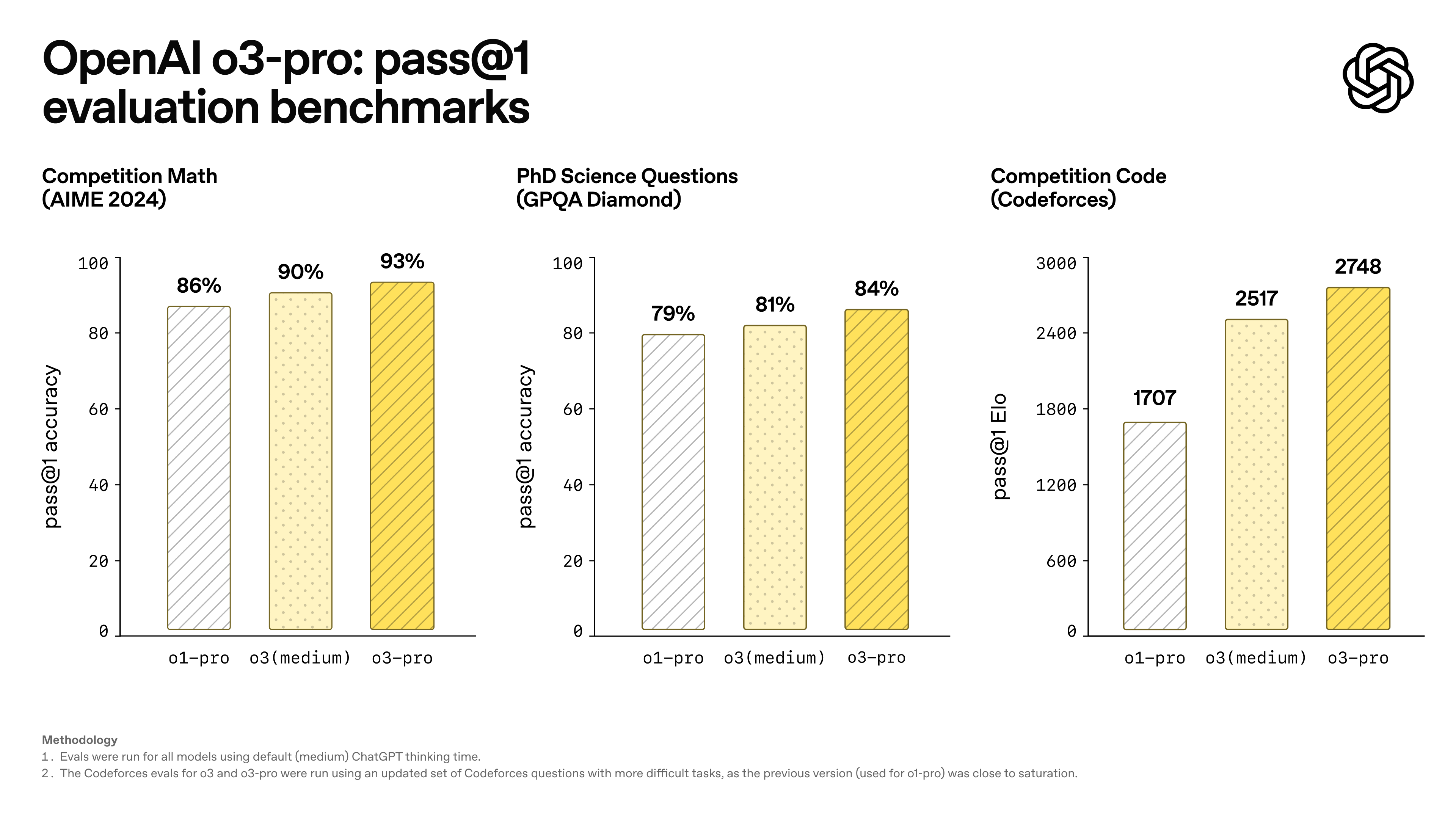
Like o1-pro, o3-pro is a version of our most intelligent model, o3, designed to think longer and provide the most reliable responses. Since the launch of o1-pro, users have favored this model for domains such as math, science, and coding—areas where o3-pro continues to excel, as shown in academic evaluations. Like o3, o3-pro has access to tools that make ChatGPT useful—it can search the web, analyze files, reason about visual inputs, use Python, personalize responses using memory, and more. Because o3-pro has access to tools, responses typically take longer than o1-pro to complete. We recommend using it for challenging questions where reliability matters more than speed, and waiting a few minutes is worth the tradeoff.
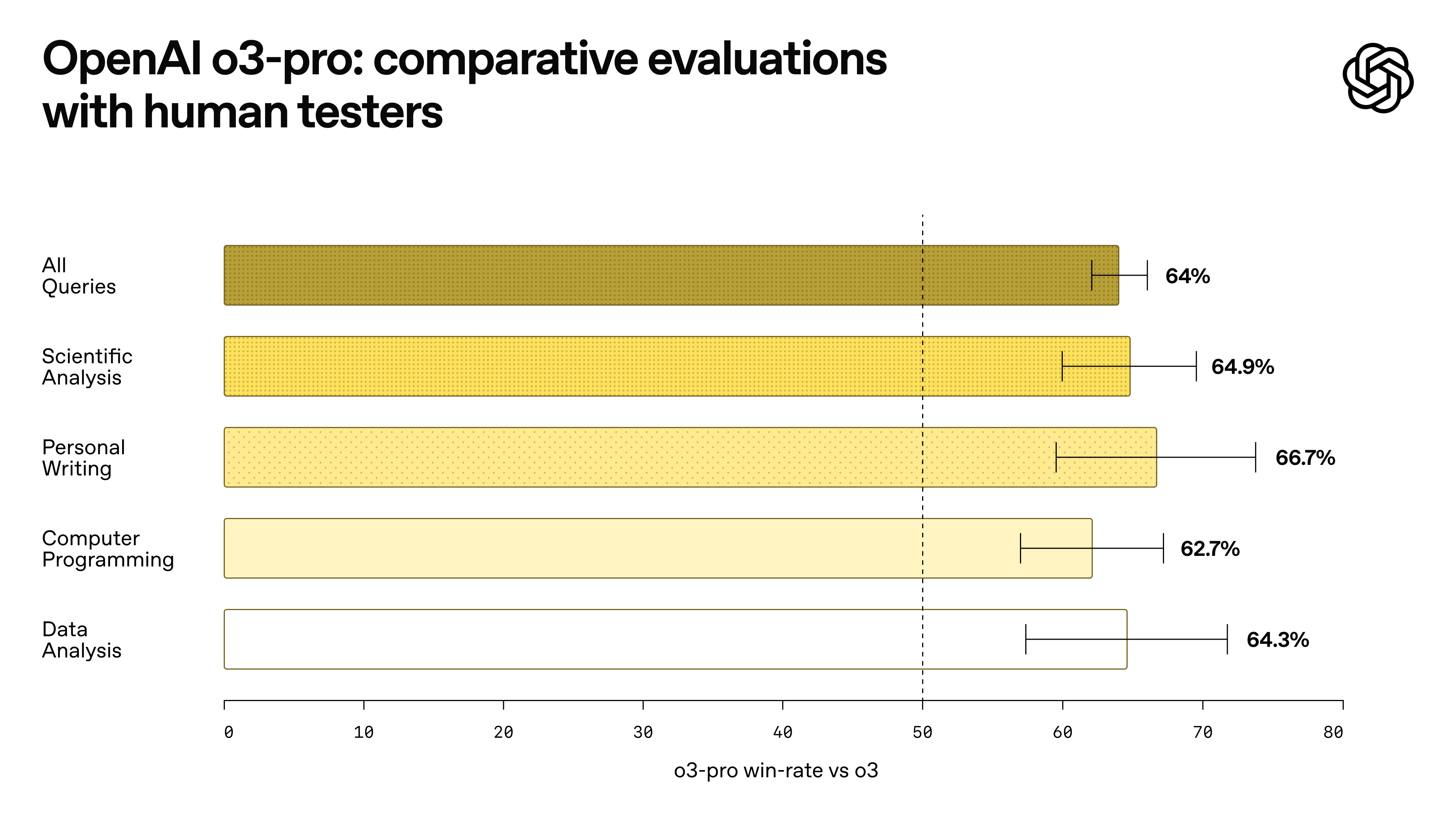
In expert evaluations, reviewers consistently prefer o3-pro over o3 in every tested category and especially in key domains like science, education, programming, business, and writing help. Reviewers also rated o3-pro consistently higher for clarity, comprehensiveness, instruction-following, and accuracy.
Academic evaluations show that o3-pro consistently outperforms both o1-pro and o3.
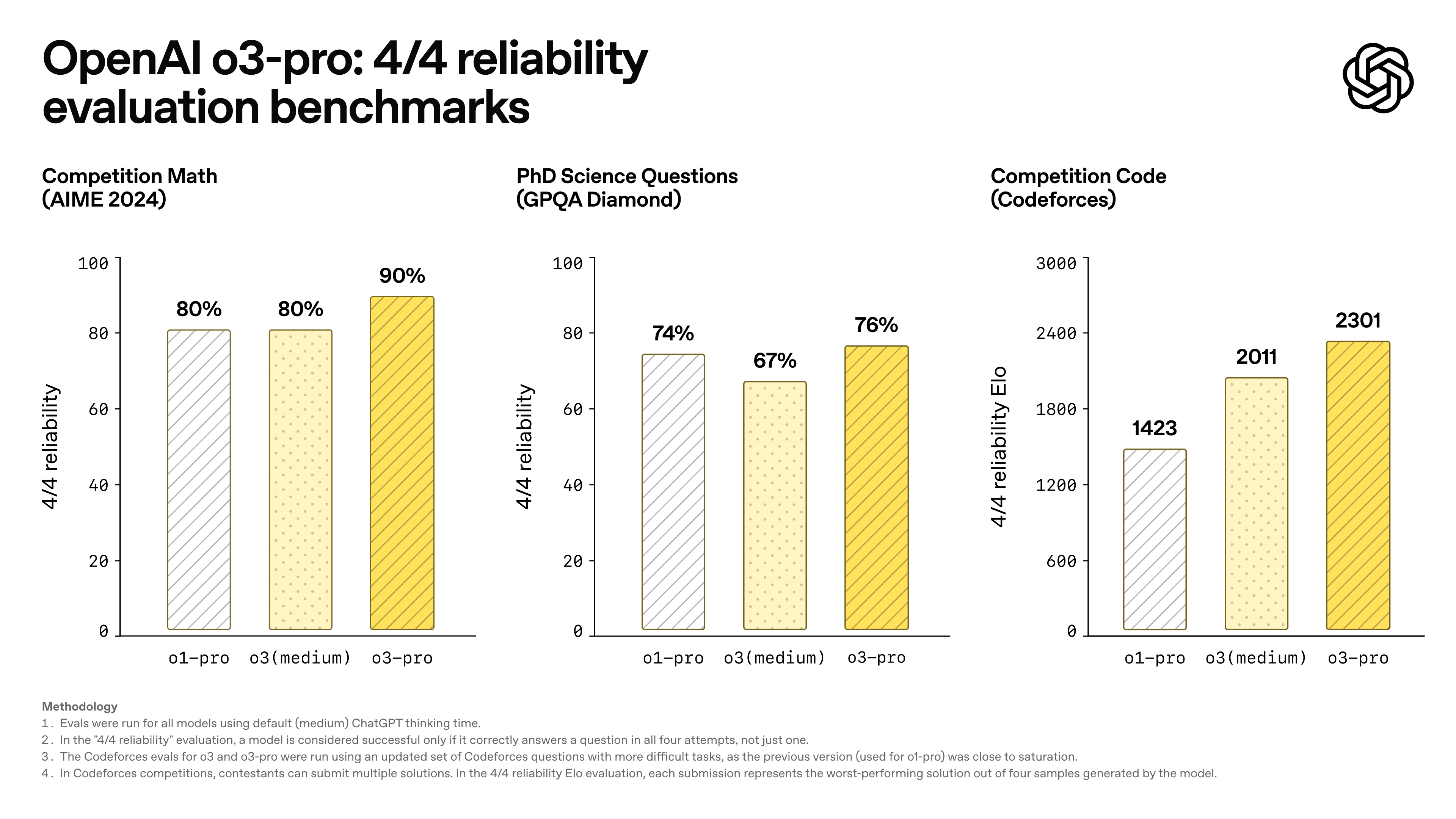
To assess the key strength of o3-pro, we once again use our rigorous "4/4 reliability" evaluation, where a model is considered successful only if it correctly answers a question in all four attempts, not just one:
o3-pro is available in the model picker for Pro and Team users starting today, replacing o1-pro. Enterprise and Edu users will get access the week after.
As o3-pro uses the same underlying model as o3, full safety details can be found in the o3 system card.
Limitations
At the moment, temporary chats are disabled for o3-pro as we resolve a technical issue.
Image generation is not supported within o3-pro—please use GPT-4o, OpenAI o3, or OpenAI o4-mini to generate images.
Canvas is also currently not supported within o3-pro.
Updates to Advanced Voice Mode for paid users (June 7, 2025)
We're upgrading Advanced Voice in ChatGPT for paid users with significant enhancements in intonation and naturalness, making interactions feel more fluid and human-like. When we first launched Advanced Voice, it represented a leap forward in AI speech—now, it speaks even more naturally, with subtler intonation, realistic cadence (including pauses and emphases), and more on-point expressiveness for certain emotions including empathy, sarcasm, and more.
Voice also now offers intuitive and effective language translation. Just ask Voice to translate between languages, and it will continue translating throughout your conversation until you tell it to stop or switch. It’s ready to translate whenever you need it—whether you're asking for directions in Italy or chatting with a colleague from the Tokyo office. For example, at a restaurant in Brazil, Voice can translate your English sentences into Portuguese, and the waiter’s Portuguese responses back into English—making conversations effortless, no matter where you are or who you're speaking with.
This upgrade to Advanced Voice is available for all paid users across markets and platforms—just tap the Voice icon in the message composer to get started.
This update is in addition to improvements we made earlier this year to ensure fewer interruptions and improved accents.
Known Limitations
In testing, we've observed that this update may occasionally cause minor decreases in audio quality, including unexpected variations in tone and pitch. These issues are more noticeable with certain voice options. We expect to improve audio consistency over time.
Additionally, rare hallucinations in Voice Mode persist with this update, resulting in unintended sounds resembling ads, gibberish, or background music. We are actively investigating these issues and working toward a solution.
Update to o4-mini (June 6, 2025)
We are rolling back an o4-mini snapshot, that we deployed less than a week ago and intended to improve the length of model responses, because our automated monitoring tools detected an increase in content flags.
Releasing GPT-4.1 in ChatGPT for all paid users (May 14, 2025)
Since its launch in the API in April, GPT-4.1 has become a favorite among developers—by popular demand, we’re making it available directly in ChatGPT.
GPT-4.1 is a specialized model that excels at coding tasks. Compared to GPT-4o, it's even stronger at precise instruction following and web development tasks, and offers an alternative to OpenAI o3 and OpenAI o4-mini for simpler, everyday coding needs.
Starting today, Plus, Pro, and Team users can access GPT-4.1 via the "more models" dropdown in the model picker. Enterprise and Edu users will get access in the coming weeks. GPT-4.1 has the same rate limits as GPT-4o for paid users.
Introducing GPT-4.1 mini, replacing GPT-4o mini, in ChatGPT for all users (May 14, 2025)
GPT-4.1 mini is a fast, capable, and efficient small model, delivering significant improvements compared to GPT-4o mini—in instruction-following, coding, and overall intelligence. Starting today, GPT-4.1 mini replaces GPT-4o mini in the model picker under "more models" for paid users, and will serve as the fallback model for free users once they reach their GPT-4o usage limits. Rate limits remain the same.
Evals for GPT-4.1 and GPT-4.1 mini were originally shared in the blog post accompanying their API release. They also went through standard safety evaluations. Detailed results are available in the newly launched Safety Evaluations Hub.
Improvement to GPT-4o (May 12, 2025)
We've improved GPT-4o's system instructions to help ensure the image generation tool is called when you want to generate an image in ChatGPT.
Update to GPT-4o (April 29, 2025)
We've reverted the most recent update to GPT-4o due to issues with overly agreeable responses (sycophancy).
We’re actively working on further improvements. For more details, check out our blog post explaining what happened and our initial findings, and this blog post where we expand on what we missed with sycophancy and the changes we're going to make going forward.
Improvements to GPT-4o (April 25, 2025)
We’re making additional improvements to GPT-4o, optimizing when it saves memories and enhancing problem-solving capabilities for STEM. We’ve also made subtle changes to the way it responds, making it more proactive and better at guiding conversations toward productive outcomes. We think these updates help GPT-4o feel more intuitive and effective across a variety of tasks–we hope you agree!
OpenAI o3 and o4-mini (April 16, 2025)
OpenAI o3 is our most powerful reasoning model that pushes the frontier across coding, math, science, visual perception, and more. It sets a new SOTA on benchmarks including Codeforces, SWE-bench (without building a custom model-specific scaffold), and MMMU. It’s ideal for complex queries requiring multi-faceted analysis and whose answers may not be immediately obvious. It performs especially strongly at visual tasks like analyzing images, charts, and graphics. In evaluations by external experts, o3 makes 20 percent fewer major errors than OpenAI o1 on difficult, real-world tasks—especially excelling in areas like programming, business/consulting, and creative ideation. Early testers highlighted its analytical rigor as a thought partner and emphasized its ability to generate and critically evaluate novel hypotheses—particularly within biology, math, and engineering contexts.
OpenAI o4-mini is a smaller model optimized for fast, cost-efficient reasoning—it achieves remarkable performance for its size and cost, particularly in math, coding, and visual tasks. It is the best-performing benchmarked model on AIME 2024 and 2025. In expert evaluations, it also outperforms its predecessor, o3‑mini, on non-STEM tasks as well as domains like data science. Thanks to its efficiency, o4-mini supports significantly higher usage limits than o3, making it a strong high-volume, high-throughput option for questions that benefit from reasoning.
Improvements to GPT-4o (March 27, 2025)
We’ve made improvements to GPT-4o—it now feels more intuitive, creative, and collaborative, with enhanced instruction-following, smarter coding capabilities, and a clearer communication style.
Smarter problem-solving in STEM and coding:
GPT-4o has further improved its capability to tackle complex technical and coding problems. It now generates cleaner, simpler frontend code, more accurately thinks through existing code to identify necessary changes, and consistently produces coding outputs that successfully compile and run, streamlining your coding workflows.
Enhanced instruction-following and formatting accuracy:
GPT-4o is now more adept at following detailed instructions, especially for prompts containing multiple or complex requests. It improves on generating outputs according to the format requested and achieves higher accuracy in classification tasks.
“Fuzzy” improvements:
Early testers say that the model seems to better understand the implied intent behind their prompts, especially when it comes to creative and collaborative tasks. It’s also slightly more concise and clear, using fewer markdown hierarchies and emojis for responses that are easier to read, less cluttered, and more focused. We're curious to see if our users also find this to be the case.
This model is now available in ChatGPT and in the API as the newest snapshot of chatgpt-4o-latest. We plan to bring these improvements to a dated model in the API in the coming weeks.
Introducing GPT-4.5 (February, 27, 2025)
We’re releasing a research preview of GPT-4.5—our largest, and best model for chat, yet. GPT-4.5 is a step forward in scaling up pretraining and post-training. By scaling unsupervised learning, GPT-4.5 improves its ability to recognize patterns, draw connections, and generate creative insights without reasoning.
Early testing shows that interacting with GPT-4.5 feels more natural. Its broader knowledge base, improved ability to follow user intent, and greater “EQ” make it useful for tasks like improving writing, programming, and solving practical problems. We also expect it to hallucinate less.
We’re sharing GPT-4.5 as a research preview to better understand its strengths and limitations. We’re still exploring what it’s capable of and are eager to see how people use it in ways we might not have expected.
GPT-4.5 is available worldwide for users on the Pro plan in ChatGPT. Eventually this will be available to all paid plans (Plus, Pro, Teams, Enterprise, and Edu) with a ChatGPT account.
Introducing OpenAI o3-mini (January 31, 2025)
We’re excited to release o3-mini, our newest cost-efficient reasoning model optimized for coding, math, and science.
On the API, o3-mini supports Structured Outputs, function calling, developer messages, and streaming. It offers three adjustable reasoning efforts (low, medium, and high), so you can balance speed with depth for your use case.
ChatGPT Team, Pro, Plus, and Free plan users can access o3-mini starting today. Additionally, o3-mini now works with search to find up-to-date answers with links to relevant web sources. This is an early prototype as we work to integrate search across our reasoning models.In side-by-side testing, o3-mini delivered results on par with o1 at a lower latency, and outperformed o1-mini on advanced STEM tasks.
Expert evaluators preferred o3-mini’s answers 56% of the time over o1-mini’s, citing improved clarity and fewer critical errors on difficult questions. We look forward to your feedback and will keep refining o3-mini as we expand our family of advanced reasoning models.
Updates to GPT-4o in ChatGPT (January 29, 2025)
We’ve made some updates to GPT-4o–it’s now a smarter model across the board with more up-to-date knowledge, as well as deeper understanding and analysis of image uploads.
More up-to-date knowledge: By extending its training data cutoff from November 2023 to June 2024, GPT-4o can now offer more relevant, current, and contextually accurate responses, especially for questions involving cultural and social trends or more up-to-date research. A fresher training data set also makes it easier for the model to frame its web searches more efficiently and effectively.
Deeper understanding and analysis of image uploads:
GPT-4o is now better at understanding and answering questions about visual inputs, with improvements on multimodal benchmarks like MMMU and MathVista. The updated model is more adept at interpreting spatial relationships in image uploads, as well as analyzing complex diagrams, understanding charts and graphs, and connecting visual input with written content. Responses to image uploads will contain richer insights and more accurate guidance in areas like spatial planning and design layouts, as well as visually driven mathematical or technical problem-solving.
A smarter model, especially for STEM: GPT-4o is now better at math, science, and coding-related problems, with gains on academic evals like GPQA and MATH. Its improved score on MMLU—a comprehensive benchmark of language comprehension, knowledge breadth, and reasoning—reflects its ability to tackle more complex problems across domains.
Increased emoji usage ⬆️: GPT-4o is now a bit more enthusiastic in its emoji usage (perhaps particularly so if you use emoji in the conversation ✨) — let us know what you think.
Introducing GPT-4o with scheduled tasks (January 14, 2025)
Today we’re rolling out a beta version of tasks—a new way to ask ChatGPT to do things for you at a future time. Whether it's one-time reminders or recurring actions, tell ChatGPT what you need and when, and it will automatically take care of it.
Scheduled tasks is in early beta for Plus, Pro, and Teams. Eventually this will be available to anyone with a ChatGPT account.
Update to GPT-4o (November 20, 2024)
We’ve updated GPT-4o for ChatGPT users on all paid tiers. This update to GPT-4o includes improved writing capabilities that are now more natural, audience-aware, and tailored to improve relevance and readability. This model is also better at working with uploaded files, able to provide deeper insights and more thorough responses.
Update to GPT 4o-mini (November 5, 2024)
Today, we’ve updated GPT-4o mini for ChatGPT users on the Free, Plus, and Team tier, along with users that use ChatGPT while logged out.
Introducing GPT-4o with canvas (October 3, 2024)
We trained GPT-4o to collaborate as a creative partner. The model knows when to open a canvas, make targeted edits, and fully rewrite. It also understands broader context to provide precise feedback and suggestions.
Canvas is in early beta, and we plan to rapidly improve its capabilities.
Advanced voice (September 24, 2024)
Advanced voice uses GPT-4o’s native audio capabilities and features more natural, real-time conversations that pick up on non-verbal cues, such as the speed you’re talking, and can respond with emotion. Usage of advanced Voice (audio inputs and outputs) by Plus and Team users is limited on a daily basis.
Introducing OpenAI o1-preview and o1-mini (September 12, 2024)
We've developed a new series of AI models designed to spend more time thinking before they respond. They can reason through complex tasks and solve harder problems than previous models in science, coding, and math.
Today, we are releasing the first of this series in ChatGPT and our API. This is a preview and we expect regular updates and improvements.
ChatGPT Plus and Team users will be able to access o1 models in ChatGPT starting today. Both o1-preview and o1-mini can be selected manually in the model picker, and at launch, weekly rate limits will be 30 messages for o1-preview and 50 for o1-mini. We are working to increase those rates and enable ChatGPT to automatically choose the right model for a given prompt.
Update to GPT-4o (September 3, 2024)
Today, we've updated GPT-4o in ChatGPT. This version is better at incorporating uploaded files and updating memory with key parts of a conversation to make future interactions more helpful and relevant.
Update to GPT-4o (August 12, 2024)
"Bug fixes and performance improvements” … we’ve introduced an update to GPT-4o that we’ve found, through experiment results and qualitative feedback, ChatGPT users tend to prefer. It’s not a new frontier-class model. Although we’d like to tell you exactly how the model responses are different, figuring out how to granularly benchmark and communicate model behavior improvements is an ongoing area of research in itself (which we’re working on!).
Sometimes we can point to new capabilities and specific improvements — and we'll try our best to communicate that whenever possible. In the meantime, our team is constantly iterating on the model by adding good data, removing bad data, and experimenting with new research methods based on user feedback, offline evaluations, and more. That's the case with this model update.
We’ll continue to keep you posted as best as we can. Thank you for your patience!
Introducing GPT-4o mini (July 18, 2024)
We’re introducing GPT-4o mini, the most capable and cost-efficient small model available today. GPT-4o mini surpasses GPT-3.5 Turbo and other small models on academic benchmarks across both textual intelligence and multimodal reasoning and supports the same range of languages as GPT-4o. It also demonstrates strong performance in function calling, which can enable developers to build applications that fetch data or take actions with external systems, and improved long-context performance compared to GPT-3.5 Turbo.
You can read more about GPT-4o mini in the blog announcement.