Carbon capture, one of the most controversial climate solutions, could soon become a centerpiece of U.S. climate policy.
The Environmental Protection Agency is expected to finally unveil its proposal to cut emissions from power plants next week. In the lead up to the announcement,
The New York Times reported that the agency is planning to set greenhouse gas emission limits for new and existing power plants based on the reductions that could be achieved by installing equipment to catch emissions from plant smokestacks before they enter the atmosphere.
The funny thing is, whether you see promise in carbon capture or deem it a boondoggle, this is probably the most aggressive approach the EPA can take for power plants. It could even speed up the transition to renewable energy. And for that reason, it’s going to put both proponents and critics of the technology in a weird position, scrambling the usual battle lines on the subject.
Due to the Supreme Court’s ruling in last year’s
West Virginia vs. EPA case, the agency’s legal avenues for reducing emissions from the power sector are limited. It can’t force utilities to shut down their fossil fuel power plants and switch to renewables. Instead, it must stick to reductions that can be achieved “within the fenceline” of a power plant.
That leaves a few options. The agency could base its rule on improvements to power plant efficiency. It could look to the potential for coal plants to co-fire with gas or for gas plants to burn hydrogen. But neither would reduce emissions as much as a rule based on carbon capture, Lissa Lynch, a senior attorney at the Natural Resources Defense Council told me in an email. And the Inflation Reduction Act, which contained huge tax credits for carbon capture, makes it possible for the agency to argue that carbon capture is an economically feasible solution, as my colleague Robinson Meyer has reported.
Here’s the twist: That doesn’t mean that every plant would have to install carbon capture. States would have the authority to create their own implementation plans to comply with the standard, and a range of options for how to do it. They might choose to shut down some power plants and replace them with renewables, or operate plants less frequently. But since renewables are so cheap, shifting to solar, wind, and batteries may be the more common response than investing in carbon capture.
The research firm Rhodium Group recently
modeled the potential emission reductions from carbon capture-based power plant rule, taking into account new tax credits from the Inflation Reduction Act, and found that only about 20 gigawatts’ worth of coal and gas plants would end up installing carbon capture by 2035. By comparison, some 700 gigawatts of coal and gas plants operate today.
The established rhetoric
Over the past few years, under increased pressure from investors to show what they are doing about climate change, the oil and gas industry has ramped up its advocacy for carbon capture. Many fossil fuel producers and electric utilities now have net-zero plans that rely heavily on the technology. In 2021, ExxonMobil
announced plans to work with 15 other companies to develop a $100 billion carbon capture hub in Houston. DTE, a Michigan utility that owns power plants in California, may have even engineered an entire dark money campaign to convince California regulators to make carbon capture part of the state’s climate plan.
In the American Petroleum Institute’s 2021
Climate Action Framework, the lobbying group said one of its goals was to “Fast-track the Commercial Deployment of Carbon Capture, Utilization and Storage,” and wrote that it “supports federal policies to achieve the ‘at-scale phase’ of CCUS commercial deployment.” (CCUS stands for carbon capture, utilization, and storage.)
On social media, API paints carbon capture as a present-day solution. “Advancements in carbon capture technology from the brightest minds in the energy industry are slashing emissions and creating a cleaner future,” it recently tweeted.
At the same time, large swaths of the environmental community have joined together to oppose the technology. In July 2021, more than 500 organizations signed on to a
letter to U.S. leaders in Washington arguing that carbon capture is not a climate solution. “Simply put, technological carbon capture is a dangerous distraction,” the groups wrote. “We don’t need to fix fossil fuels, we need to ditch them.” Many, many environmental groups have published treatises on why carbon capture is unproven, too expensive, harms communities, and prolongs dependence on fossil fuels.
A shift in tone
But as the new power plant regulations loom, proponents of carbon capture have started to temper their enthusiasm, citing some of those same concerns.
In comments submitted to the EPA in March, the American Petroleum Institute’s vice president of natural gas markets, Dustin Meyer, only mentions the technology as an afterthought, underscoring that it isn’t viable yet. After a long section highlighting the benefits of switching from coal to natural gas for power generation, he writes, “In the future ... new technologies like CCUS can offer additional opportunities to reduce emissions.” The American Petroleum Institute declined to comment for this story.
Southern Company, which owns gas and electric utilities across six states, submitted extensive comments to the EPA arguing that carbon capture was “many years away.” The company manages and operates the National Carbon Capture Center, where it conducts research on the technology. Its
climate plan suggests that some 21% of its electricity generation will come from natural gas plants with carbon capture by 2050. And it’s in the process of conducting an engineering study to install the technology on one of its natural gas plants in Alabama.
But carbon capture isn’t ready for commercial deployment, Southern writes, using an example that’s often cited by critics of the technology — Petra Nova. Petra Nova is a carbon capture project at a coal-fired power plant in Texas that was mothballed in 2020 when it lost buyers for the captured carbon. While it operated, it experienced frequent outages and failed to capture the amount of carbon it was designed to. Its failure, Southern writes, illustrates that more research is needed to reduce the cost of carbon capture and improve reliability and performance, “which are critical when facilities are required to meet regulatory emission limits.”
Meanwhile, some of the loudest proponents of carbon capture in the upcoming EPA regulations have been environmental groups like the Natural Resources Defense Council, Evergreen Action, and the Clean Air Task Force. This isn’t exactly surprising. These groups, in particular, have historically been supportive of carbon capture technology.
“Industry has been touting the promise of carbon capture and storage for decades,” Lynch of the Natural Resources Defense Council
told me. “It hasn’t been widely deployed on power plants because there currently aren’t any federal restrictions on the amount of carbon pollution that power plants can emit.”
Jay Duffy, litigation director at Clean Air Task Force, said the industry’s claims are unfounded. He cited
studies by the Department of Energy’s National Energy Technology Laboratory which show that carbon capture is economical, when considering the new tax credits in the Inflation Reduction Act. There are already 13 vendors offering the technology for gas-fired power plants, he said.
Moving forward, some of carbon capture’s biggest critics might find that they need to support a carbon capture-based standard. The Center for Biological Diversity submitted comments to the EPA criticizing the technology, but did not suggest an alternative basis for the rule. When I asked Jason Rylander, legal director for the organization’s Climate Law Institute, whether they would support a standard based on carbon capture, he didn’t say no.
“The big problem is that the existing fossil fuel fleet is essentially uncontrolled for climate pollution in the middle of a climate crisis,” he
told me. “That has to stop.”
Rylander couldn’t say where his organization would come down on the rule without seeing it, but he said that if it was based on carbon capture, there would have to be “extremely strong guardrails to ensure the safety and performance of the equipment.” But he also acknowledged that the EPA’s increasingly tough regulatory environment for power plants, along with tax incentives for clean energy in the Inflation Reduction Act, could mean that very little carbon capture would ultimately get built.
“It may very well be that the majority of plants meet these standards by other means.”










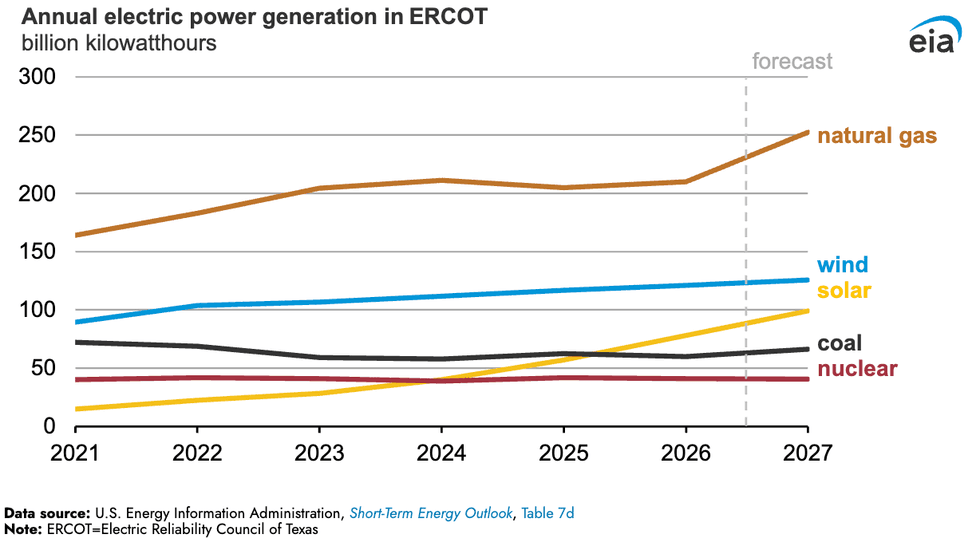 Solar is now the third-largest electricity source in Texas.EIA