
The HamSCI Personal Space Weather Station (PSWS)

Overview
The Personal Space Weather Station (PSWS) is a multi-instrument, ground-based system designed to observe space weather effects, both as a single-point measurement and as a part of a larger, distributed network. The PSWS elements are designed to be relatively low cost (between 100 and 1000 US dollars), easily constructed and deployed by science professionals, educational institutions and citizen scientists. HamSCI and its partners are constantly expanding the network, improving the PSWS data collection hardware and software, and growing the network infrastructure for data storage, retrieval and analysis. The project is led by the The University of Scranton, in collaboration with numerous universities, research institutions and funding partners (see their logos at the bottom of this page).
The PSWS is fundamentally a data collection system (visit the PSWS data server). As with any scientific endeavor, data is crucial to HamSCI's efforts, allowing researchers to analyze and interpret information in order to draw meaningful conclusions and make informed decisions on future research. HamSCI highly encourages all readers to explore the information here and consider building and deploying one or more PSWS components, contributing data to the research efforts. Questions are welcomed at HamSCI's general email address.
Getting Involved
HamSCI welcomes all those interested in space weather and its effects on the Earth's ionosphere. HamSCI members consist of citizen scientists, educators, university researchers, and professional space scientists - a broad spectrum of interests, educational experiences and practical backgrounds. Visit our About and Get Involved pages to learn more about our motivation, scientific focus, and resources such as Google Groups and regular telecons on related subjects.
HamSCI is continually creating and updating the PSWS documentation. Ideally, it should be complete enough that a person with moderate hardware, software and integration skills can build and operate their own PSWS components. The HamSCI community (1500+ members) is available to support your efforts.
Update, July, 2026: HamSCI has received grant monies for deploying PSWS components at little or no cost to volunteers willing to host one or more of the components described here. Depending on which component is hosted, the host may be expected to erect a simple antenna, bury a magenetometer sensor, and, in all cases, provide an Internet connection. Requirements are spelled out, in some detail, on each PSWS component web page. Visit Searching for Instrument Sites and Hosts to learn more about this program, including site requirements and how to apply.
Looking to build a Grape PSWS? The PSWS concept was born from the success of the Grape low-IF, single frequency Doppler receiver. The original Grape 1 was followed by Grape 1 DRF, then Grape 2 models. Most were deployed around the time of the 2023 and 2024 North American solar eclipses. Many of those units are still in service, providing valuable data on a daily basis. Unfortunately, due to component obsolescence issues, those Grape models can no longer be built. (The original Grape contributors are recognized here.)
Components
The Personal Space Weather Station is a modular system, with each module being developed by a different team. Visit the links or see the photos below to learn about the modules. Some can be assembled and programmed in a home workshop, while others consist mainly of commercially available components. All require some degree of 'systems integration' to assure the components are connected/programmed properly, and sending data to aggregation servers via the Internet. HamSCI strives to provide information and instructions for all modules - generally via our GitHub pages.
The most basic PSWS would consist of just a single module - a HamSCI HF Receiver, Ground Magnetometer or VLF Whistler Catcher. More ambitious PSWS hosts may wish to install and operate multiple instruments - allowing observed phenomena to be tracked across different aspects of the geospace environment.
- HamSCI Personal Space Weather Station HF Receiver (HFRx)
- HamSCI Ground Magnetometer (GMag)
- HamSCI VLF Whistler Catcher (VLF-WC)
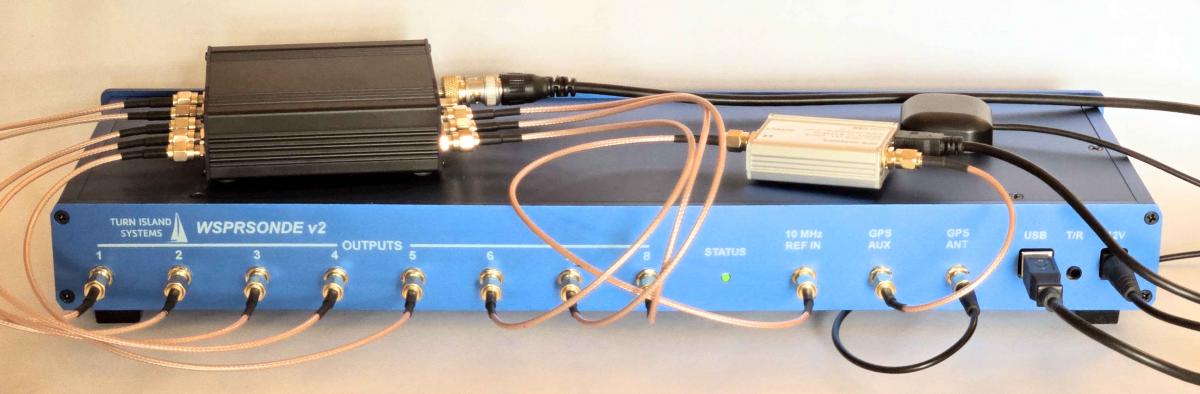
- Turn Island Systems WSPRsonde 8-band WSPR/FST4W transmitter (WS8)
Images
 |
|
|
HamSCI Personal Space Weather Station HF Receiver (HFRx) |
|
 |
 |
|
HamSCI/TAPR Ground Magnetometer (GMag) |
HamSCI VLF Whistler Catcher (VLF-WC) |
 |
|
|
Turn Island Systems WSPRSonde (WS8) |
|
Research Questions
The PSWS project is motivated by questions from both from the science and amateur radio communities:
Science Questions
- How does the ionosphere respond to inputs from space and from the neutral atmosphere?
- How does the ionosphere couple with the neutral atmosphere and with space?
- What are the sources of medium and large scale traveling ionospheric disturbances?
- What are the causes of Sporadic E?
Amateur Radio Questions
- How do disturbances such as solar flares, geomagnetic storms, and traveling ionospheric disturbances affect radio wave propagation?
- How does ionospheric science help amateur radio operators improve communications?
- How can I make measurements in my own backyard that will help improve my amateur radio operations?
Further Information
Most terms and topics relevant to the PSWS can be explored via the Search Page here on the HamSCI website. (The search function can be a bit buggy - if you receive an error message, reload and try again.) A few suggested links:
- The science behind the GRAPE HF Receiver/Doppler monitor
- A comprehensive poster explaining how HF Doppler observations made with a network of low cost HamSCI Personal Space Weather Stations can be used to detect ionospheric phenomena
- An Atlas of HamSCI’s PSWS Doppler Spectrograms - How to graphically interpret the Doppler Shift data generated by the HFRx and Grape receivers.
- WSPRDaemon: A site dedicated to scientific applications of the WSPR (Weak Signal Propagation Reporter) and FST4W digital modes
- Commentary on the value of ground magnetometer networks and their application to space physics, AGU (American Geophysical Union) Earth and Space Sciences
- What is possible with a VLF Observatory? The W2NAF-KC3EEY VLF Observatory: Building Exciting New Developments from a Solid Foundation
- HamSCI Glossary
