Windmill Desk Lamp Is Beautifully Soothing

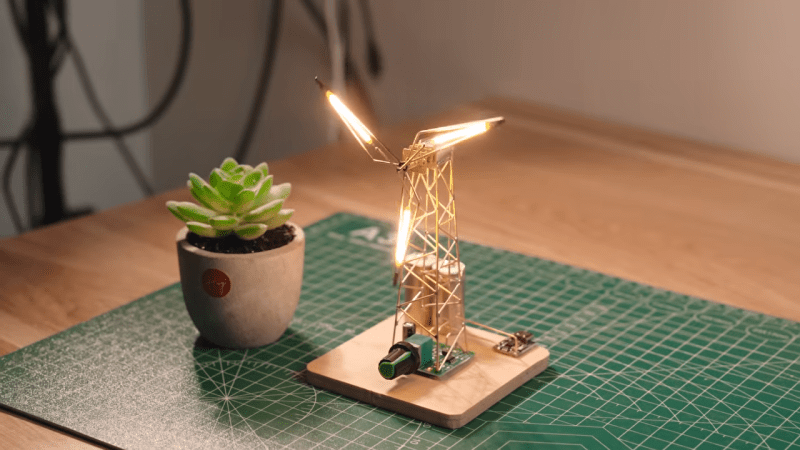
Typically, lamps provide a stationary source of light to illuminate a given area and help us see what we’re doing. However, they can also be a little more artistic and eye-catching, like this windmill lamp from [Huy Vector].

It’s somewhat of a charming desk toy, constructed out of copper wire soldered into the form of a traditional windmill. At its base, lives a simple motor speed controller, while up top, a brushed DC gearmotor is responsible for turning the blades. As you might imagine, it’s a little tricky to get power to flow to the LED filaments installed on those blades while they happen to be rotating. That’s where the build gets tricky, using the output shaft of the motor’s gear drive and a custom slip ring to pass power to the LEDs. That power comes courtesy of a pair of 16340 lithium-ion cells, which can be juiced up with the aid of a USB-C charger board.

It’s an elegant build, and rather charming to watch in motion to boot. We love a good lamp build here at Hackaday, particularly when they’re aesthetically beautiful.

Continue reading “Windmill Desk Lamp Is Beautifully Soothing”
Using The Wind And Magnets To Make Heat

On the face of it, harnessing wind power to heat your house seems easy. In fact some of you might be doing it already, assuming you’ve got a wind farm somewhere on your local grid and you have an electric heat pump or — shudder — resistive heaters. But what if you want to skip the middleman and draw heat directly from the wind? In that case, wind-powered induction heating might be just what you need.

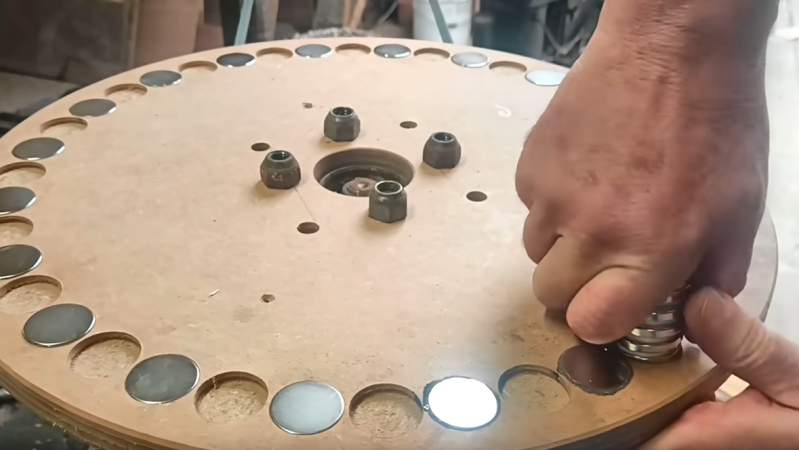
Granted, [Tim] from the Way Out West Blog is a long way from heating his home with a windmill. Last we checked, he didn’t even have a windmill built yet; this project is still very much in the experimental phase. But it pays to think ahead, and with goals of simplicity and affordability in mind, [Tim] built a prototype mechanical induction heater. His design is conceptually similar to an induction cooktop, where alternating magnetic fields create eddy currents that heat metal cookware. But rather than using alternating currents through large inductors, [Tim] put 40 neodymium magnets with alternating polarity around the circumference of a large MDF disk. When driven by a drill press via some of the sketchiest pullies we’ve seen, the magnets create a rapidly flipping magnetic field. To test this setup, [Tim] used a scrap of copper pipe with a bit of water inside. Holding it over the magnets as they whiz by rapidly heats the water; when driven at 1,000 rpm, the water boiled in about 90 seconds. Check it out in the video below.

It’s a proof of concept only, of course, but this experiment shows that a spinning disc of magnets can create heat directly. Optimizing this should prove interesting. One thing we’d suggest is switching from a disc to a cylinder with magnets placed in a Halbach array to direct as much of the magnetic field into the interior as possible, with coils of copper tubing placed there.
Continue reading “Using The Wind And Magnets To Make Heat”

Bad Experiences With A Cheap Wind Turbine

If you’ve got a property with some outdoor space and plenty of wind, you might consider throwing up a windmill to generate some electricity. Indeed, [The Broject List] did just that. Only, his experience was a negative one, having purchased a cheap windmill online. He’s warning off others from suffering the same way by explaining what was so bad about the product he bought.

The windmill in question was described as a “VEVOR Windturbine”, which set him back around 100 euros, and claimed to be capable of producing 600 watts at 12 volts. He starts by showing how similar turbines pop up for sale all over the Internet, with wildly inflated specs that have no relation to reality. Some sellers even charge over 500 euros for the same basic device.

He then demonstrates the turbine operating at wind speeds of approximately 50 km/h. The output is dismal, a finding also shared by a number of other YouTube channels out there. Examining the construction of the wind turbine’s actual generator, he determines that it’s nowhere near capable of generating 600 watts. He notes the poorly-manufactured rotor and aluminium coils as particular disappointments. He concludes it could maybe generate 5 watts at most.

Sadly, it’s easy to fall into this trap when buying online. That’s where it pays to do your research before laying down your hard-earned cash. Continue reading “Bad Experiences With A Cheap Wind Turbine”

Virginia To Get Large-Scale Wind Farm

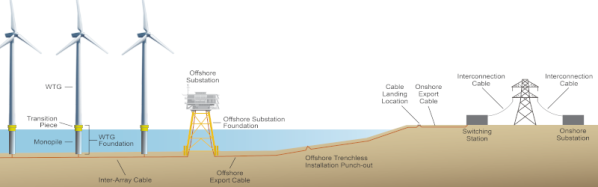
If you go about 27 miles off the coast of Virginia, you’ll find two windmills jutting up out of the sea. Two windmills aren’t particularly interesting until you realize that these two are on the edge of a 2,100-acre lease that Dominion Energy is placing in Federal water. According to the company, those two will be joined by 176 more windmills on a nearly 113,000-acre adjacent lease. The project has been in the planning and pilot phase for a while, but it was recently given the green light by the US government. You can see a promotional video about the project below. There’s also a video of the first monopiles — the mounts for the windmills — arriving in the area.

The project will eventually have three offshore substations that feed the power to the state military reservation and, from there, to Naval Air Station Oceania, where it feeds the commercial power grid. The final project will power 660,000 homes.

Continue reading “Virginia To Get Large-Scale Wind Farm”

Books You Should Read: The Boy Who Harnessed The Wind

For many of us, our passion for electronics and science originated with curiosity about some device, a computer, radio, or even a car. The subject of this book has just such an origin. However, how many of us made this discovery and pursued this path during times of hunger or outright famine?

That’s the remarkable story of William Kamkwamba that’s told in the book, The Boy Who Harnessed the Wind. Remarkable because it culminates with his building a windmill (more correctly called a wind turbine) that powered lights in his family’s house all by the young age of fifteen. As you’ll see, it’s also the story of an unyielding thirst for knowledge in the face of famine and doubt by others.

Continue reading “Books You Should Read: The Boy Who Harnessed The Wind”

Making Music With The Wind

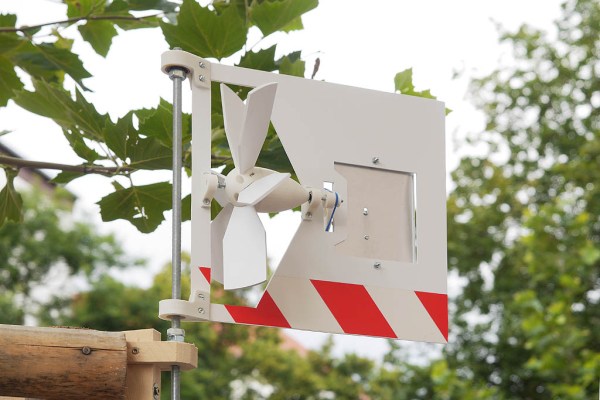
[Niklas Roy] built a windmill-powered music box for his backyard, and it was so awesome all the neighbors wanted to take a picture of it. Someone even liked it so much that he stole [Niklas]’s windmill in the middle of the night. (We kind of don’t blame them, it’s a gorgeously clean build.)

In the past few weeks [Niklas] has been mass-producing 20 windmills for the KIKK Festival 2017 to be held in November in Namur, Belgium. The windmills will operate in a cluster, and all play “Für Elise” when the wind blows. However, each one is driven independently and so the music is asynchronous. Since he was building a bunch anyway, he built a replacement windmill for his backyard, and documented how to do it.

Continue reading “Making Music With The Wind”

bike wheel wind turbine

Juice-Spewing Wind Turbine Bootstrapped From Bike Parts

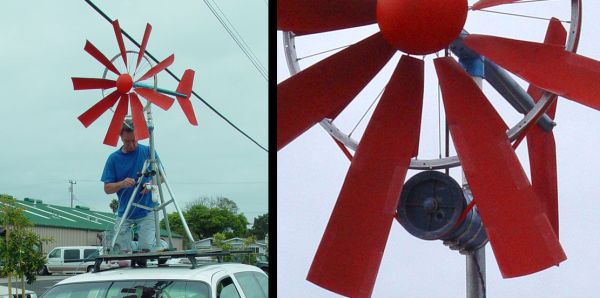
Wind Turbines are great, they let us humans harness the energy of the wind. Wind is free and that is good, but spending a ton of money on a wind turbine setup begins to make the idea less appealing. [Ted] has spent many years building low cost wind turbines and this one is not only simple but can be made from mostly found parts.

It’s easy to identify the main rotor hub and blade frame which are made from an old bicycle wheel. The blades are standard aluminum flashing normally used in home construction and are attached directly to the spokes of the bike wheel. Mounted below the bike rim is a permanent magnet motor that acts as a generator. A belt couples the motor to the main rotor and uses the tire-less rim as a pulley.

[Ted] has strapped this beast to the roof of his car to measure how it performs. At 12 mph, he’s getting between 18-20 volts at 2 amps. Not too bad! Bikes and bike parts are cheap (or free) and there is no surprise that they have been used in wind turbine projects before, like this one that hangs from a kite.