Old FM Radio Upcycled Into Classy Bluetooth Speaker

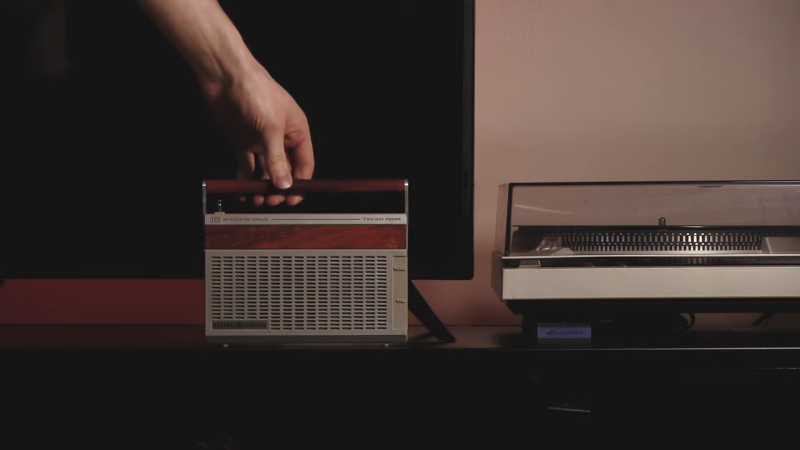
[Distracted by Design] loves gear from the 1980s, though some of it isn’t as useful as it used to be. He happened across a cheap old FM radio with a great look, but wanted to repurpose it into something more modern. Thus, he set about turning this cheap piece of old electronics into a stylish Bluetooth speaker.

All of the original electronics were stripped out, while the original speaker was kept since it neatly fit the case. Electronically, the build relies on a Bluetooth module harvested from an existing speaker. 3D-printed bracketry was used to fasten it neatly into place inside the radio housing, with the buttons neatly presented where the original radio had its tone and volume controls. Power is via an internal lithium-ion battery, charged over USB-C thanks to an off-the-shelf charging module.

Where the build really shines, though, is the detailing. The original cheap plastic handle was replaced with a CNC-machined wooden piece, bolted on with machined aluminium side plates. Similarly, the original clear plastic tuning window was replaced with another tasteful piece of wood that dropped perfectly into place. At the back, the charge port is nicely integrated. Where the radio formerly had a removable door for the power cable storage, it now has a machined aluminium plate hosting the USB-C charge port. Little 3D-printed button actuators were also used to integrate the Bluetooth module’s controls into the case.

It’s a very stylish build, overall. Perhaps the one area it’s a let down is in the sound quality. The ancient speaker simply doesn’t sound great compared to modern Bluetooth speakers and their finely-tuned, bassy audio. However, this isn’t necessarily a bad thing—sometimes it’s nice to have an audio source with a limited frequency response. It can be nice for use in an area where you may want to be able to easily speak over the music.

If you want to build a Bluetooth speaker of your own, you might like to whip up an open-source design from scratch. Video after the break.

Continue reading “Old FM Radio Upcycled Into Classy Bluetooth Speaker”
Lessons Learned After Trying MeshCore For Off-grid Text Messaging

[Michael Lynch] recently decided to delve into the world of off-grid, decentralized communications with MeshCore, because being able to communicate wirelessly with others in a way that does not depend on traditional communication infrastructure is pretty compelling. After getting his hands on a variety of hardware and trying things out, he wrote up his thoughts from the perspective of a hardware-curious software developer.

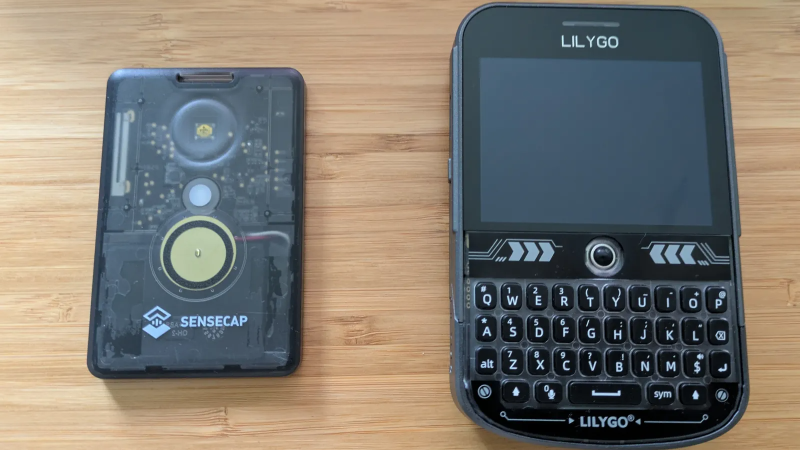
He ends up testing a variety of things: MeshCore firmware installed on a Heltec V3 board (used via an app over Bluetooth), a similar standalone device with antenna and battery built in (SenseCAP T-1000e, left in the header image), and a Lilygo T-Deck+ (right in the header image above). These all use MeshCore, which is built on and reportedly compatible with Meshtastic, a framework we have featured in the past.

Continue reading “Lessons Learned After Trying MeshCore For Off-grid Text Messaging”

Building A Low-Cost Satellite Tracker

Looking up at the sky just after sunset or just before sunrise will reveal a fairly staggering amount of satellites orbiting overhead, from tiny cubesats to the International Space Station. Of course these satellites are always around, and even though you’ll need specific conditions to view them with the naked eye, with the right radio antenna and only a few dollars in electronics you can see exactly which ones are flying by at any time.

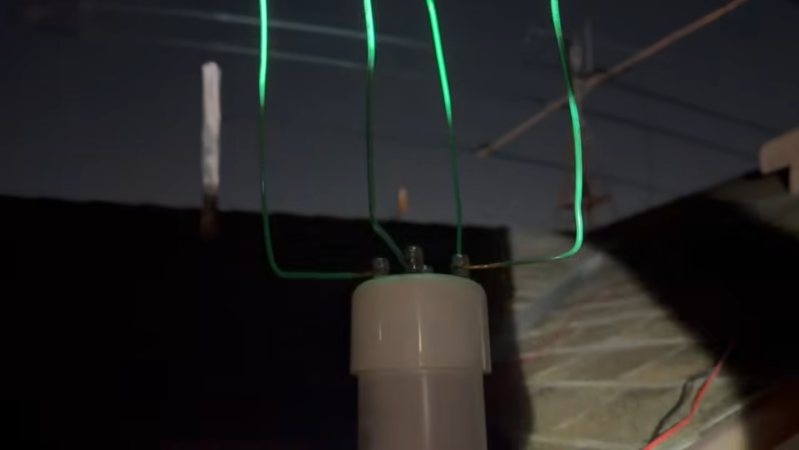
[Josh] aka [Ham Radio Crash Course] is demonstrating this build on his channel and showing every step needed to get something like this working. The first part is finding the correct LoRa module, which will be the bulk of the cost of this project. Unlike those used for most Meshtastic nodes, this one needs to be built for the 433 MHz band. The software running on this module is from TinyGS, which we have featured here before, and which allows a quick and easy setup to listen in to these types of satellites. This build goes much further into detail on building the antenna, though, and also covers some other ancillary tasks like mounting it somewhere outdoors.

With all of that out of the way, though, the setup is able to track hundreds of satellites on very little hardware, as well as display information about each of them. We’d always favor a build that lets us gather data like this directly over using something like a satellite tracking app, although those do have their place. And of course, with slightly more compute and a more directed antenna there is all kinds of other data beaming down that we can listen in on as well, although that’s not always the intent.

Continue reading “Building A Low-Cost Satellite Tracker”

Cheap VHF Antenna? Can Do!

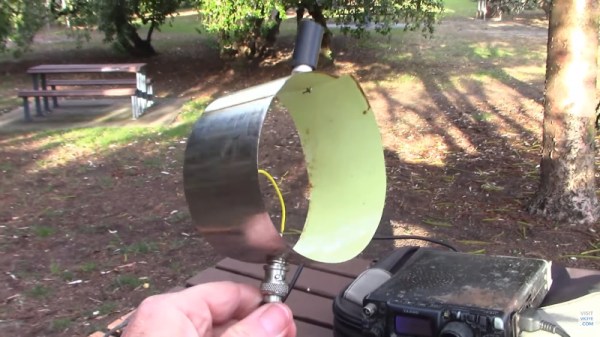
The magnetic loop antenna is a familiar sight in radio amateur circles as a means to pack a high performance HF antenna into a small space. It takes the form of a large single-turn coil made into a tuned circuit with a variable capacitor, and it provides the benefits of good directionality and narrow bandwidth at the cost of some scary RF voltages and the need for constant retuning. As [VK3YE] shows us though, magnetic loops are not limited to HF — he’s made a compact VHF magnetic loop using a tin can.

It’s a pretty simple design; a section from the can it cut out and made into a C shape, with a small variable capacitor at the gap. The feed comes in at the bottom, with the feed point about 20 % of the way round the loop for matching. The bandwidth is about 100 MHz starting from the bottom of the FM broadcast band, and he shows us it receiving broadcast, Airband, and 2 meter signals. It can be used for transmitting too and we see it on 2 meter WSPR, but we would have to wonder whether the voltages induced by higher power levels might be a little much for that small capacitor.

He’s at pains to point out that there are many better VHF antennas as this one has no gain to speak of, but we can see a place for it. It’s tiny, if you’re prepared to fiddle with the tuning its high Q gets rid of interference, and its strong side null means it can also reduce unwanted signals on the same frequency. We rather like it, and we hope you will too after watching the video below.

Continue reading “Cheap VHF Antenna? Can Do!”

Radio Apocalypse: Survivable Low-Frequency Communication System

In the global game of nuclear brinksmanship, secrets are the coin of the realm. This was especially true during the Cold War, when each side fielded armies of spies to ferret out what the other guy was up to, what their capabilities were, and how they planned to put them into action should the time come. Vast amounts of blood and treasure were expended, and as distasteful as the whole thing may be, at least it kept armageddon at bay.

But secrets sometimes work at cross-purposes to one’s goals, especially when one of those goals is deterrence. The whole idea behind mutually assured destruction, or MAD, was the certain knowledge that swift retaliation would follow any attempt at a nuclear first strike. That meant each side had to have confidence in the deadliness of the other’s capabilities, not only in terms of their warheads and their delivery platforms, but also in the systems that controlled and directed their use. One tiny gap in the systems used to transmit launch orders could spell the difference between atomic annihilation and at least the semblance of peace.

During the height of the Cold War, the aptly named Survivable Low-Frequency Communication System was a key part of the United States’ nuclear deterrence. Along with GWEN, HFGCS, and ERCS, SLFCS was part of the alphabet soup of radio systems designed to make sure the bombs got dropped, one way or another.

Continue reading “Radio Apocalypse: Survivable Low-Frequency Communication System”

The Singing Dentures Of Manchester And Other Places

Any radio amateur will tell you about the spectre of TVI, of their transmissions being inadvertently demodulated by the smallest of non-linearity in the neighbouring antenna systems, and spewing forth from the speakers of all and sundry. It’s very much a thing that the most unlikely of circuits can function as radio receivers, but… teeth? [Ringway Manchester] investigates tales of musical dental work.

Going through a series of news reports over the decades, including one of Lucille Ball uncovering a hidden Japanese spy transmitter, it’s something all experts who have looked at the issue have concluded there is little evidence for. It was also investigated by Mythbusters. But it’s an alluring tale, so is it entirely fabricated? What we can say is that teeth are sensitive to sound, not in themselves, but because the jaw provides a good path bringing vibrations to the region of the ear. And it’s certainly possible that the active chemical environment surrounding a metal filling in a patient’s mouth could give rise to electrical non-linearities. But could a human body in an ordinary RF environment act as a good enough antenna to provide enough energy for something to happen? We have our doubts.

It’s a perennial story (even in fiction), though, and we’re guessing that proof will come over the coming decades. If the tales of dental music and DJs continue after AM (or Long Wave in Europe) transmissions have been turned off, then it’s likely they’re more in the mind than in the mouth. If not, then we might have missed a radio phenomenon. The video is below the break.

Continue reading “The Singing Dentures Of Manchester And Other Places”

Smart Bulbs Are Turning Into Motion Sensors

If you’ve got an existing smart home rig, motion sensors can be a useful addition to your setup. You can use them for all kinds of things, from turning on lights when you enter a room, to shutting off HVAC systems when an area is unoccupied. Typically, you’d add dedicated motion sensors to your smart home to achieve this. But what if your existing smart light bulbs could act as the motion sensors instead?

Continue reading “Smart Bulbs Are Turning Into Motion Sensors”