DIY Light Panels Work With Home Assistant

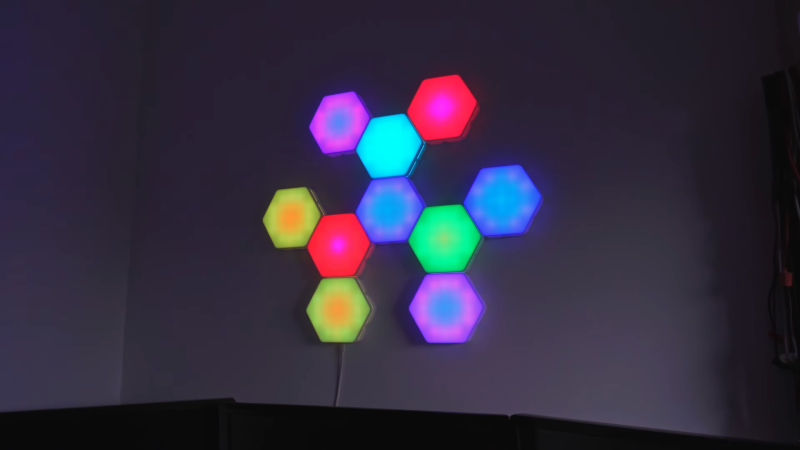
There are a few major companies out there building colorful LED panels you can stick on your wall for aesthetic purposes. Most commercial options are pretty expensive, and come with certain limitations in how they can be controlled. [Smart Solutions For Home] has whipped up a flexible DIY design for decorating your walls with light that is altogether more customizable.

In this case, the DIY light panels ape the hexagonal design made popular by brands like Nanoleaf. In this case, each hexagon panel runs an ESP32 microcontroller, which controls a series of WS2812 addressable LEDs. This allows each panel to glow whatever color you like, and they’re arranged in an XY grid to enable you to light individual panels with a range of different geometric effects. The benefit of having a full microcontroller on each panel is that they can act quite independently—each one able to be used as a smart light, an notification display, or even as a physical button, all integrated with Home Assistant.

If you’re a fan of DIY smart home products, these might be right up your alley. They’re supremely flexible and customizable, and can do a lot of things that commercial versions can’t easily replicate. Just don’t ignore the fact that they require a considerable amount of assembly, what with the custom PCBs, 3D printed enclosures, and front diffusers to deal with. That’s just the way the LED wall crumbles.

We’ve seen other similar builds before, too. Why? The simple fact is that a lot of people want cool glowy panels on their wall without having to pay through the nose for them.

Continue reading “DIY Light Panels Work With Home Assistant”
A Flexible Light Inspired By IKEA

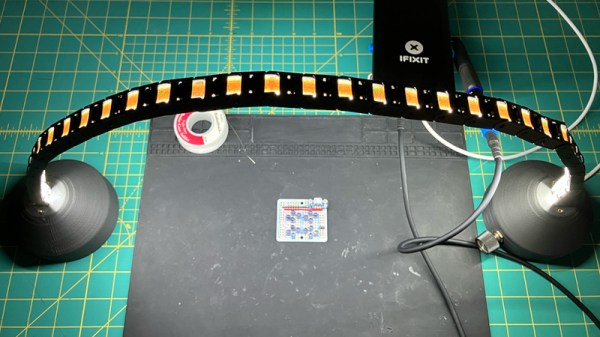
The IKEA SMÅSNÖRE is a flexible silicone rod with an embedded LED strip, attached at each end to a base. It’s eye-catching enough, and it has the useful property of providing a diffuse light from multiple angles that makes it a promising candidate for a work lamp. That’s enough for [Daniel James] to create his own lamp on a similar vein.

The electronics of his lamp are straightforward enough: a 12 volt LED strip whose brightness is controlled by a Pi Pico in response to a potentiometer as a brightness control. It’s not quite stiff enough to form the arch itself, so he’s created a 3D printed chain that forms the structure of the lamp. Similar to a bicycle chain in the way it’s constructed, it has individual links that slot together and pivot. The electronics are in the printed base at one end.

We like this lamp a lot, for the light it gives on the bench and for the ingenuity of the printed chain. We might even make one for ourselves.

One-Way Data Extraction For Logging On Airgapped Systems

If you want to protect a system from being hacked, a great way to do that is with an airgap. This term specifically refers to keeping a system off any sort of network or external connection — there is literally air in between it and other systems. Of course, this can be limiting if you want to monitor or export logs from such systems. [Nelop Systems] decided to whip up a simple workaround for this issue, creating a bespoke one-way data extraction method.

The concept is demonstrated with a pair of Raspberry Pi computers. One is hooked up to critical industrial control systems, and is airgapped to protect it against outside intruders. It’s fitted with an optocoupler, with a UART hooked up to the LED side of the device. The other side of the optocoupler is hooked up to another Raspberry Pi, which is itself on a network and handles monitoring and logging duties.

This method creates a reliable one-way transmission method from the airgapped machine to the outside world, without allowing data to flow in the other direction. Indeed, there is no direct electrical connection at all, since the data is passing through the optocoupler, which provides isolation between the two computers. Security aficionados will argue that the machine is no longer really airgapped because there is some connection between it and the outside world. Regardless, it would be hard to gain any sort of access through the one-way optocoupler connection. If you can conceive of a way that would work, drop it down in the comments.

Optocouplers are very useful things; we’ve seen them used and abused for all sorts of different applications. If you’ve found some nifty use for these simple parts, be sure to drop us a line!

2025 Component Abuse Challenge: Light An LED With Nothing

Should you spend some time around the less scientifically informed parts of the internet, it’s easy to find “Free power” stories. Usually they’re some form of perpetual motion machine flying in the face of the laws of conservation of energy, but that’s not to say that there is no free power.

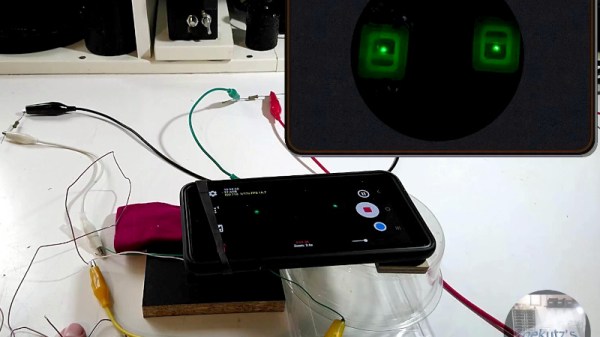
The power just has to come from somewhere, and if you’re not paying for it there’s the bonus. [joekutz] has just such a project, lighting up LEDs with no power source or other active electronics.

Of course, he’s not discovered perpetual motion. Rather, while an LED normally requires a bit of current to light up properly, it seems many will produce a tiny amount of light on almost nothing. Ambient electromagnetic fields are enough, and it’s this effect that’s under investigation. Using a phone camera and a magnifier as a light detector he’s able to observe the feeble glow as the device is exposed to ambient fields.

In effect this is using the LED as the very simplest form of radio receiver, a crystal set with no headphone and only the leads, some wires, and high value resistors as an antenna. The LED is after all a diode, and it can thus perform as a rectifier. We like the demonstration even if we can’t quite see an application for it.

While we’re no longer taking new entries for the 2025 Component Abuse Challenge, we’ve still got plenty of creative hacks from the competition to show off. We’re currently tabulating the votes, and will announce the winners of this particularly lively challenge soon.

2025 Component Abuse Challenge: Dawg Gone LED Tester

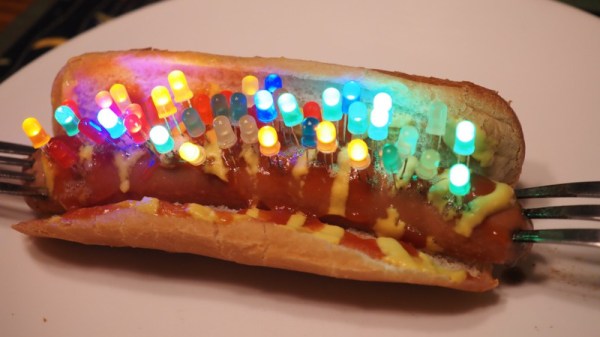
The Hackaday 2025 Component Abuse Challenge is all about abusing electronic components in the service of making them do things they were never intended to. It’s not the 2025 Food Abuse Challenge, so in the case of [Ian Dunn]’s hot dog pressed into service as an LED tester, we’ll take the ‘dawg to be a component in its own right. And by any measure, it’s being abused!

Cooking hot dogs by passing an electric current through them has a long and faintly hazardous history to it — we’re sure we’ve heard of domestic hot dog cooker appliances that are little more than the mains supply on a pin at each end of a hot dog shaped receptacle. This one takes the ‘dawg in a bun with condiments, no less, and sticks an ordinary table fork wired up to the grid in each end. The LED testing is the cherry on the cake, because he simply sticks a pile of LEDs by their pins into the tasty sausage. It forms a crude potential divider, so there’s about enough volts across the gap between pins to light it up nicely.

We like this project on so many levels, though we’re not sure what heavy metals would leach out of those LED pins into the meat. If it’s inspired you to do something similar you still have a few days in which to enter the contest, so break out your convenience food and a pile of parts, and start experimenting!

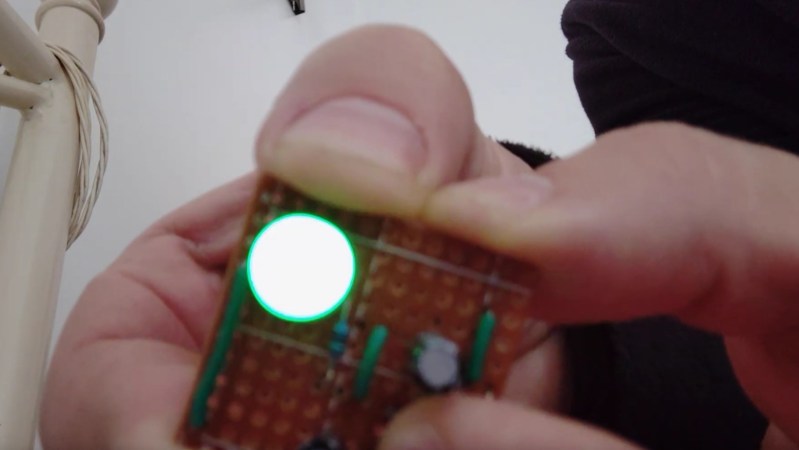
A hand holding the circuit in its active state

2025 Component Abuse Challenge: A Self-Charging LED Flasher By Burkhard Kainka

[Tito] entered a Self-Charging LED Flasher into the Component Abuse Challenge. It’s a simple re-build of a design by the unstoppable [Burkhard Kainka], and while [Tito] doesn’t explain its workings in detail, it’s a clever experiment in minimalism, and a bit of a head-scratcher at the same time.

You press a button and an LED flashes.  But there is no battery, so how does it work? Maybe the schematic to the right here will help. Or does it confound? Look at it yourself before reading on and see if you can figure out how it works.

Continue reading “2025 Component Abuse Challenge: A Self-Charging LED Flasher By Burkhard Kainka”

2025 Component Abuse Challenge: An LED As A Light Dependent Capacitor

The function of an LED is to emit light when the device is forward biased within its operating range, and it’s known by most people that an LED can also operate as a photodiode. Perhaps some readers are also aware that a reverse biased LED also has a significant capacitance, to the extent that they can be used in some RF circuits in the place of a varicap diode. But how do those two unintentional properties of an LED collide? As it turns out, an LED can also behave as a light dependent capacitor. [Bornach] has done just that, and created a light dependent sawtooth oscillator.

The idea is simple enough, there is a capacitance between the two sides of the depletion zone in a reverse biased diode, and since an LED is designed such that its junction is exposed to the external light, any photons which hit it will change the charge on the junction. Since the size of the depletion zone and thus the capacitance is dependent on the voltage and thus the charge, incoming light can thus change the capacitance.

The circuit is a straightforward enough sawtooth oscillator using an op-amp with a diode in its feedback loop, but where we might expect to find a capacitor to ground on the input, we find our reverse biased LED. The video below the break shows it in operation, and it certainly works. There’s an interesting point here in that and LED in this mode is suggested as an alternative to a cadmium sulphide LDR, and it’s certainly quicker responding. We feel duty bound to remind readers that using the LED as a photodiode instead is likely to be a bit simpler.

This project is part of the Hackaday Component Abuse Challenge, in which competitors take humble parts and push them into applications they were never intended for. You still have time to submit your own work, so give it a go!

Continue reading “2025 Component Abuse Challenge: An LED As A Light Dependent Capacitor”