A Heavily Modified Rivian Attempts The Cannonball Run

There are few things more American than driving a car really fast in a straight line. Occasionally, the cars will make a few left turns, but otherwise, this is the pinnacle of American motorsport. And there’s no longer, straighter line than that from New York to Los Angeles, a time trial of sorts called the Cannonball Run, where drivers compete (in an extra-legal fashion) to see who can drive the fastest between these two cities. Generally, the cars are heavily modified with huge fuel tanks and a large amount of electronics to alert the drivers to the presence of law enforcement, but until now, no one has tried this race with an EV specifically modified for this task.

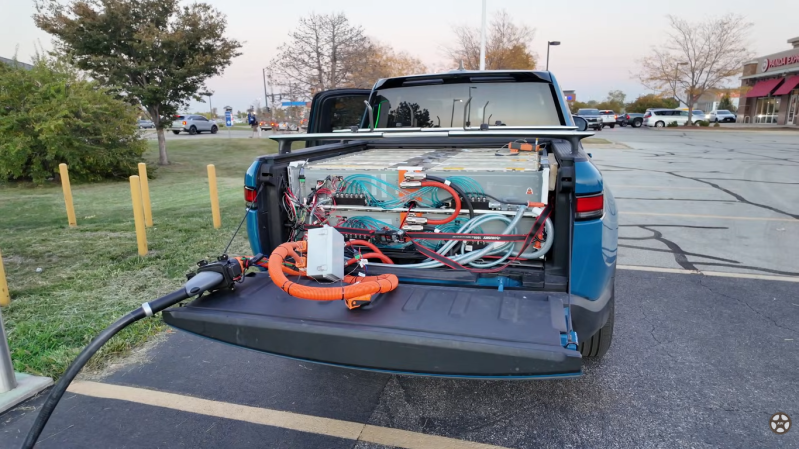
The vehicle used for this trial was a Rivian electric truck, chosen for a number of reasons. Primarily, [Ryan], the project’s mastermind, needed something that could hold a significant amount of extra batteries. The truck also runs software that makes it much more accepting of and capable of using an extra battery pack than other models. The extra batteries are also from Rivians that were scrapped after crash tests. The team disassembled two of these packs to cobble together a custom pack that fits in the bed of the truck (with the tonneau closed), which more than doubles the energy-carrying capacity of the truck.

Of course, for a time trial like this, an EV’s main weakness is going to come from charging times. [Ryan] and his team figured out a way to charge the truck’s main battery at one charging stall while charging the battery in the bed at a second stall, which combines for about a half megawatt of power consumption when it’s all working properly and minimizes charging time while maximizing energy intake. The other major factor for fast charging the battery in the bed was cooling, and rather than try to tie this system in with the truck’s, the team realized that using an ice water bath during the charge cycle would work well enough as long as there was a lead support vehicle ready to go at each charging stop with bags of ice on hand.

Although the weather and a few issues with the double-charging system stopped the team from completing this run, they hope to make a second attempt and finish it very soon. They should be able to smash the EV record, currently held by an unmodified Porsche, thanks to these modifications. In the meantime, though, there are plenty of other uses for EV batteries from wrecked vehicles that go beyond simple transportation.

Continue reading “A Heavily Modified Rivian Attempts The Cannonball Run”

Hackaday Links Column Banner

Hackaday Links: December 14, 2025

Fix stuff, earn big awards? Maybe, if this idea for repair bounties takes off. The group is dubbed the FULU Foundation, for “Freedom from Unethical Limitations on Users,” and was co-founded by right-to-repair activist Kevin O’Reilly and perennial Big Tech thorn-in-the-side Louis Rossman. The operating model works a bit like the bug bounty system, but in reverse: FULU posts cash bounties on consumer-hostile products, like refrigerators that DRM their water filters or bricked thermostats. The bounty starts at $10,000, but can increase based on donations from the public. FULU will match those donations up to $10,000, potentially making a very rich pot for the person or team that fixes the problem.

Continue reading “Hackaday Links: December 14, 2025”

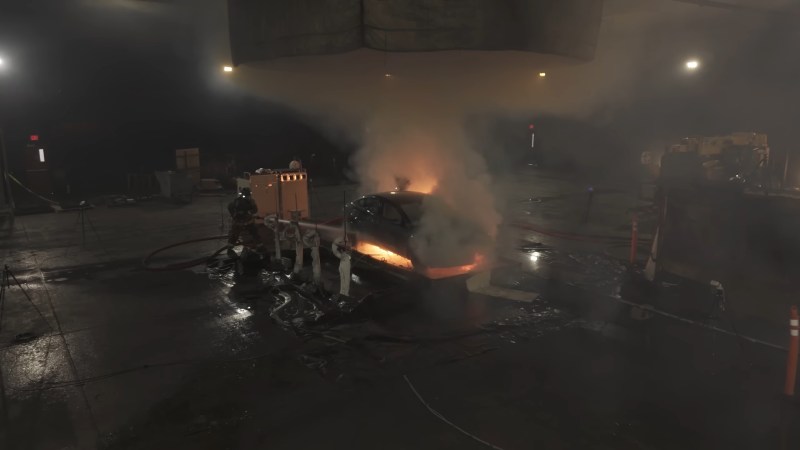
A dark warehouse contains a number of large blocky objects. A Tesla Model 3 sedan sits in the center with flames underneath and curling up the side away from the camera. A firefighter on the left side attempts to put out the fire with a fire hose.

UL Investigates The Best Way To Fight EV Fires

While electric vehicles (EVs) are generally less likely to catch fire than their internal combustion counterparts, it does still happen, and firefighters need to be ready. Accordingly, the UL Research Institute is working with reverse engineering experts Munro & Associates to characterize EV fires and find the best way to fight them.

There is currently some debate in the firefighting community over whether it’s better to try to put an EV battery fire out with water or to just let it burn. Research like this means the decision doesn’t have to fall on only anecdotal evidence. Anyone who’s worked in a lab will recognize the mix of exceedingly expensive equipment next to the borderline sketchy rigged up hacks on display, in this case the super nice thermal imagers and a “turkey burner on steroids.” The video goes through some discussion of the previous results with a Chevy Bolt, Hyundai Kona, Ford Mustang Mach E, and then we get to see them light up a Tesla Model 3. This is definitely one you shouldn’t try at home!

While the massive battery banks in modern EVs can pose unique challenges in the event of an accident, that doesn’t mean they can’t be repurposed to backup your own home.

Continue reading “UL Investigates The Best Way To Fight EV Fires”

Electric Vehicle Charging Heats Up

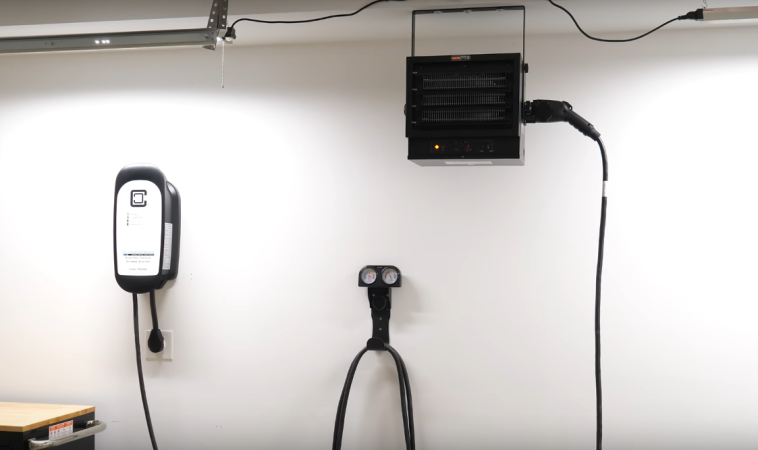
As the electric vehicle takeover slowly lumbers along, marginally increasing efficiencies for certain applications while entrenching car-centric urban design even further, there are some knock-on effects that are benefiting people and infrastructure beyond simple transportation. Vehicle-to-grid technology has applications for providing energy from the car back to the grid for things like power outages or grid leveling. But [Technology Connections] is taking this logic one step further. Since a large number of EV owners have charging stations built into their garages, he wondered if these charging stations could be used for other tasks and built an electric heater which can use one for power.

This project uses a level 2 charger, capable of delivering many kilowatts of power to an EV over fairly standard 240V home wiring with a smart controller in between that and the car. Compared to a level 1 charger which can only trickle charge a car on a standard 120V outlet (in the US) or a DC fast charger which can provide a truly tremendous amount of energy in a very short time, these are a happy middle ground. So, while it’s true a homeowner could simply wire up another 240V outlet for this type of space heater or other similar application, this project uses the existing infrastructure of the home to avoid redundancies like that.

Of course this isn’t exactly plug-and-play. Car chargers communicate with vehicles to negotiate power capabilities with each other, so any appliance wanting to use one as a bulk electric supply needs to be able to perform this negotiation. To get the full power available in this case all that’s needed is a resistor connected to one of the signal wires, but this won’t work for all cases and could overload smaller charging stations. For that a more complex signalling method is needed, but since this was more of a proof-of-concept we’ll still call it a success. For those wanting to DIY the charger itself, building one from the ground up is fairly straightforward as well.

Thanks to [Billy] for the tip!

Continue reading “Electric Vehicle Charging Heats Up”

Turning A Lada Into An EV With 50 Cordless Drills, Because Why Not?

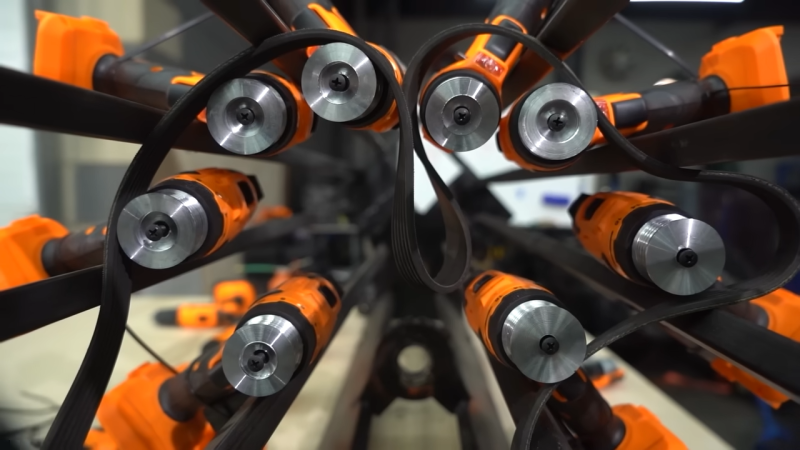
[Garage 54] is no stranger to vehicle-related projects of the “because why not?” variety, and their latest is using 50 cordless drills combined into a monstrous mega-motor to turn a gutted (and extended) Lada into an electric vehicle (EV).

Doing this leans on some of [Garage 54]’s earlier projects, such as replacing the aforementioned Lada’s engine block with a frame containing sixteen chainsaws. That means they don’t need to start completely from scratch, and have a frame design that can drop into the vehicle once the “engine” is constructed.

Fifty cordless drills won’t set any efficiency records for EV engines, but it’s got a certain style.

Here’s what’s in the new engine: each of the drills has its chuck replaced with an aluminum pulley, and belts connect each group of drills to an output shaft. Ideally, every drill motor would run at the same time and at exactly the same speed, but one works with what they have. [Garage 54] originally worked to synchronize the drills by interfacing to each drill’s motor control board, but eventually opted to simply bypass all controls and power each drill’s motor directly from the batteries. Initial tests are done by touching bare cable ends with a turned-away face and squinted eyes, but we expect “Just A Big Switch” to end up in the final assembly.

It looks wild and we can think of more than a few inefficiencies present in a system like this, but the output shaft does turn and torque is being transferred, so the next step is interfacing to the car’s factory gearbox.

If it powers the car in any meaningful way, that Lada might very well become the world’s most gloriously hacked-together EV. And hey, if the power output of the EV motor is disappointing, you can just make your own.

Continue reading “Turning A Lada Into An EV With 50 Cordless Drills, Because Why Not?”

Hackaday Links Column Banner

Hackaday Links: October 27, 2024

Problem solved? If the problem is supplying enough lithium to build batteries for all the electric vehicles that will be needed by 2030, then a new lithium deposit in Arkansas might be a resounding “Yes!” The discovery involves the Smackover Formation — and we’ll be honest here that half the reason we chose to feature this story was to be able to write “Smackover Formation” — which is a limestone aquifer covering a vast arc from the Rio Grande River in Texas through to the western tip of the Florida panhandle. Parts of the aquifer, including the bit that bulges up into southern Arkansas, bear a brine rich in lithium salts, far more so than any of the brines currently commercially exploited for lithium metal production elsewhere in the world. Given the measured concentration and estimated volume of brine in the formation, there could be between 5 million and 19 million tons of lithium in the formation; even at the lower end of the range, that’s enough to build nine times the number of EV batteries needed.

Continue reading “Hackaday Links: October 27, 2024”

Hackaday Links Column Banner

Hackaday Links: September 29, 2024

There was movement in the “AM Radio in Every Vehicle Act” last week, with the bill advancing out of the US House of Representatives Energy and Commerce Committee and heading to a full floor vote. For those not playing along at home, auto manufacturers have been making moves toward deleting AM radios from cars because they’re too sensitive to all the RF interference generated by modern vehicles. The trouble with that is that the government has spent a lot of effort on making AM broadcasters the centerpiece of a robust and survivable emergency communications system that reaches 90% of the US population.

The bill would require cars and trucks manufactured or sold in the US to be equipped to receive AM broadcasts without further fees or subscriptions, and seems to enjoy bipartisan support in both the House and the Senate. Critics of the bill will likely point out that while the AM broadcast system is a fantastic resource for emergency communications, if nobody is listening to it when an event happens, what’s the point? That’s fair, but short-sighted; emergency communications isn’t just about warning people that something is going to happen, but coordinating the response after the fact. We imagine Hurricane Helene’s path of devastation from Florida to Pennsylvania this week and the subsequent emergency response might bring that fact into focus a bit.

Continue reading “Hackaday Links: September 29, 2024”