For how crucial whales have been for humanity, from their harvest for meat and oil to their future use of saving the world from a space probe, humans knew very little about them until surprisingly recently. Most people, even in Herman Melville’s time, considered whales to be fish, and it wasn’t until humans went looking for submarines in the mid-1900s that we started to understand the complexities of their songs. And you don’t have to be a submarine pilot to listen now, either; all you need is something like these homemade hydraphones.
digital audio hacks747 Articles
How To Build Good Contact Mics
We’re most familiar with sound as vibrations that travel through the atmosphere around us. However, sound can also travel through objects, too! If you want to pick it up, you’d do well to start with a contact mic. Thankfully, [The Sound of Machines] has a great primer on how to build one yourself. Check out the video below.
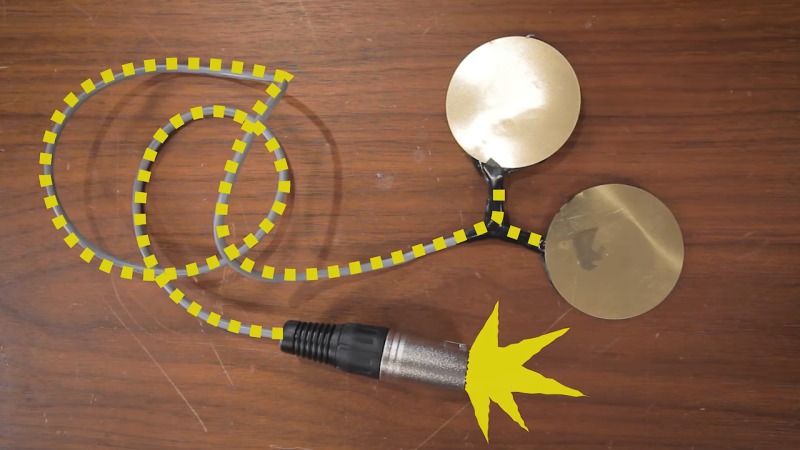
The key to the contact mic is the piezo disc. It’s an element that leverages the piezoelectric effect, converting physical vibration directly into an electrical signal. You can get them in various sizes; smaller ones fit into tight spaces, while larger ones perform better across a wider frequency range.
[The Sound of Machines] explains how to take these simple piezo discs and solder them up with connectors and shielded wire to make them into practical microphones you can use in the field. The video goes down to the bare basics, so even if you’re totally new to electronics, you should be able to follow along. It also covers how to switch up the design to use two piezo discs to deliver a balanced signal over an XLR connector, which can significantly reduce noise.
There’s even a quick exploration of creative techniques, such as building contact mics with things like bendable arms or suction cups to make them easier to mount wherever you need them. A follow-up explores the benefits of active amplification. The demos in the video are great, too. We hear the sound of contact mics immersed in boiling water, pressed up against cracking spaghetti, and even dunked in a pool. It’s all top stuff.
These contact mics are great for all kinds of stuff, from recording foley sounds to building reverb machines out of trash cans and lamps.
USB DAC Comes With Graphic EQ
[shiura] had a problem — they wanted a nice high-quality audio output for their computer, but they didn’t fancy any of the DACs that were readily available on the market. They specifically wanted one that was affordable, capable, and included a graphic equalizer so they could simply hook it up to a regular amplifier and dial in the perfect sound. When they couldn’t find such a device, they decided to build their own.
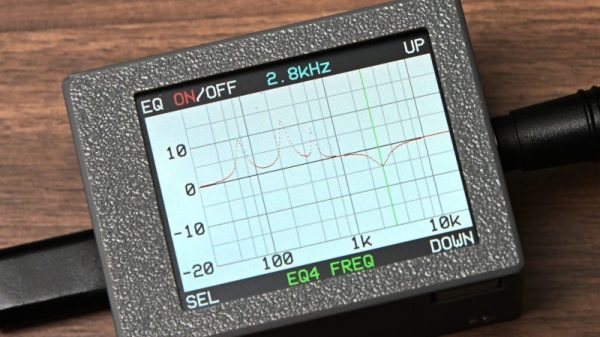
The build is based around a Raspberry Pi Pico, chosen for its feature set that makes it easy to configure as a USB audio device. It’s paired with a Waveshare Pico Audio module, which is based on the PCM5101A stereo DAC and slots neatly on top of the microcontroller board. An SPI-controlled LCD screen was also fitted in order to display the graphic equalizer interface that [shiura] whipped up. The project write-up explains the code required to implement the equalizer in detail. A four-channel equalizer was possible on the original Pi Pico (RP2040), while upgrading to a more powerful Pi Pico 2 (RP2350) allowed implementing eight channels in total.
If you’re looking to build a digital audio system with the ability to do some equalization to suit your listening room, this might be a project of interest to you. We’ve featured other projects in this realm before, too.
The AirPort Express Still Works In 2025 Thanks To Apple’s Ongoing Support
Apple was all-in on WiFi from the beginning, launching the AirPort line of products to much fanfare in 1999. In 2004, along came the AirPort Express—a fully-functional router the size of a laptop charger, that offered audio streaming to boot. As [schvabek] found out that while a lot of older Apple gear has long ago been deprecated, the AirPort Express is still very much supported and functional to this day!
Generally, you wouldn’t expect to plug in a 20-year-old Apple accessory and have it work with the company’s modern hardware. However, upon slotting the AirPort Express into a wall socket and starting the initialization process, [schvabek] noted that it was detected perfectly well by his post-2020 Macs. Only, there was a small problem—the configuration process would always stall out before completion.
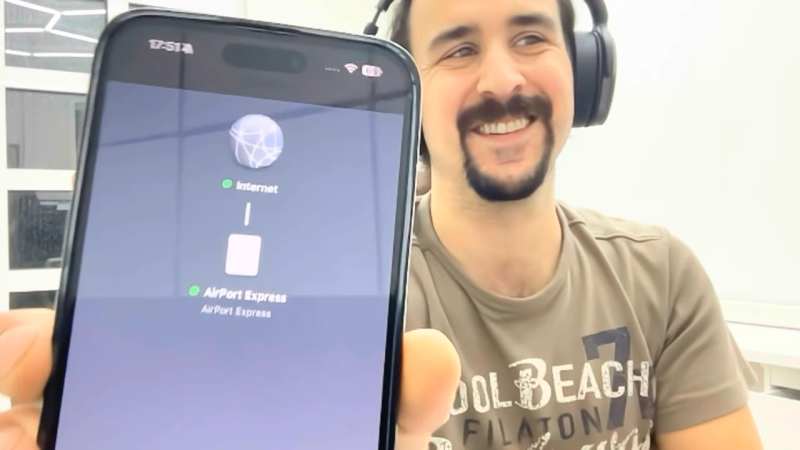
Thankfully, there was a simple remedy. [schvabek] found that he could connect to the AirPort Express with his classic white plastic MacBook and complete the process. From there, he was astonished that Apple’s servers let him pull down a firmware update for a device from 2004. After that upgrade, the AirPort Express was fully functional with all his modern Apple gear. He could readily stream audio from his iPhone and MacBooks with no compatibility issues whatsoever.
It’s nice to see Apple still supporting this ancient hardware to this day. It’s a nice contrast when companies like Sonos are more than happy to brick thousands of old devices just for the sake of progress. Continue reading “The AirPort Express Still Works In 2025 Thanks To Apple’s Ongoing Support”
The Simplest Ultrasound Sensor Module, Minus The Module
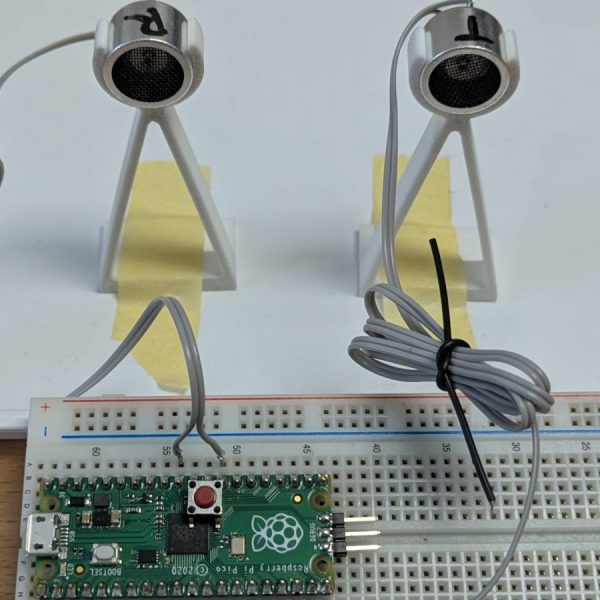
Just about every “getting started with microcontrollers” kit, Arduino or otherwise, includes an ultrasonic distance sensor module. Given the power of microcontrollers these days, it was only a matter of time before someone asked: “Could I do better without the module?” Well, [Martin Pittermann] asked, and his answer, at least with the Pi Pico, is a resounding “Yes”. A micro and a couple of transducers can offer a better view of the world.
The project isn’t really about removing the extra circuitry on the SR-HC0, since there really isn’t that much to start. [Martin] wanted to know just how far he could push ultrasound scanning technology using RADAR signal processing techniques. Instead of bat-like chirps, [Martin] is using something called Frequency-Modulated Continuous Wave, which comes from RADAR and is exactly what it sounds like. The transmitter emits a continuous carrier wave with a varying frequency modulation, and the received wave is compared to see when it must have been sent. That gives you the time of flight, and the usual math gives you a distance.
Continue reading “The Simplest Ultrasound Sensor Module, Minus The Module”
Know Audio: Lossy Compression Algorithms And Distortion
In previous episodes of this long-running series looking at the world of high-quality audio, at every point we’ve stayed in the real world of physical audio hardware. From the human ear to the loudspeaker, from the DAC to measuring distortion, this is all stuff that can happen on your bench or in your Hi-Fi rack.
We’re now going for the first time to diverge from the practical world of hardware into the theoretical world of mathematics, as we consider a very contentious topic in the world of audio. We live in a world in which it is now normal for audio to have some form of digital compression applied to it, some of which has an effect on what is played back through our speakers and headphones. When a compression algorithm changes what we hear, it’s distortion in audio terms, but how much is it distorted and how do we even measure that? It’s time to dive in and play with some audio files. Continue reading “Know Audio: Lossy Compression Algorithms And Distortion”
Live Coding Techno With Strudel
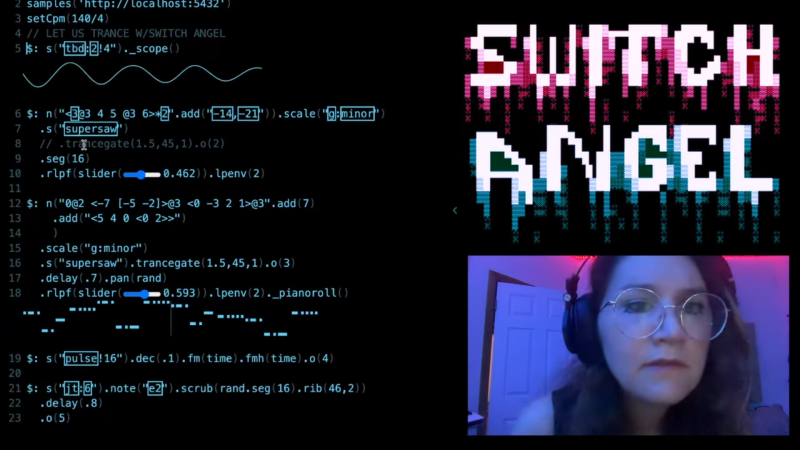
The super talented [Switch Angel] is an electronic music artist, with a few cool YouTube videos to show off their absolute nailing of how to live code with Strudel. For us mere mortals, Strudel is a JavaScript port of TidalCycles, which is an algorithmic music generator which supports live coding, i.e. the music that is passed down to the synthesizer changes on-the-fly as you manipulate the code. It’s magical to watch (and listen!) to how you can adapt and distort the music to your whims just by tweaking a few lines of code: no compilation steps, hardly any debugging and instant results.
The traditional view of music generators like this is to create lists of note/instrument pairs with appropriate modifiers. Each sound is specified in sequence — adding a sound extends the sequence a little. Strudel / Tidalcycles works a little differently and is based on the idea of repeating patterns over a fixed time. Adding an extra sound or breaking down one sound slot into multiple sounds squeezes all the remaining slots down, causing the whole pattern to repeat in the same period, with the sounds individually taking up less space. This simple change makes it really easy to add layer upon layer of interest within a sequence with a few extra characters, without recalculating everything else to fit. On top of this base, multiple effects can be layered—more than we can mention here—and all can be adjusted with pop-in sliders directly in the code.