
Welcome to FRIB
The Facility for Rare Isotope Beams (FRIB) at Michigan State University (MSU) is a world-class research and training center, hosting the most powerful rare-isotope accelerator. MSU operates FRIB as a user facility for the U.S. Department of Energy Office of Science (DOE-SC), with financial support from and furthering the mission of the DOE-SC Office of Nuclear Physics. FRIB is where researchers come together to make discoveries that change the world. They study the properties and fundamental interactions of rare isotopes and nuclear astrophysics and their impact on medicine, homeland security, and industry.
Research areas
FRIB advances nuclear science by improving our understanding of nuclei and their role in the universe, while also advancing accelerator systems.
Capabilities
In establishing and operating FRIB, capabilities were developed that transfer to other industries and applications.

User facilities
FRIB hosts the world’s most powerful heavy-ion accelerator and enables discoveries in rare isotopes, nuclear astrophysics, fundamental interactions, and societal applications like medicine, security, and industry.
Learn more about upcoming events taking place at FRIB.
Physics of Atomic Nuclei (PAN) is a free week-long program for U.S. high school students, exploring atomic nuclei's fundamentals and their connections to astrophysics and cosmology, inspiring future scientists.
During PAN, participants engage in hands-on activities led by FRIB faculty, staff, and students, exploring atomic nuclei and their connections to astrophysics. PAN is sponsored by FRIB, which is a user facility for the U.S. Department of Energy Office of Science (DOE-SC), supporting the mission of the DOE-SC Office of Nuclear Physics.
PAN offers:
- Insight into research at a top rare-isotope laboratory.
- Introductions to astrophysics, precision measurement, and nuclear science.
- Opportunities to conduct nuclear physics experiments.
- Networking with researchers on diverse scientific questions.
- Exploration of various career opportunities in science.
- Experience of college life.
- Free room and board provided on campus, if needed.
Education & training
FRIB at MSU is a world-class research and training center where students and researchers from all career stages and backgrounds come together to make discoveries that change the world.
External news and journal publications discussing FRIB.
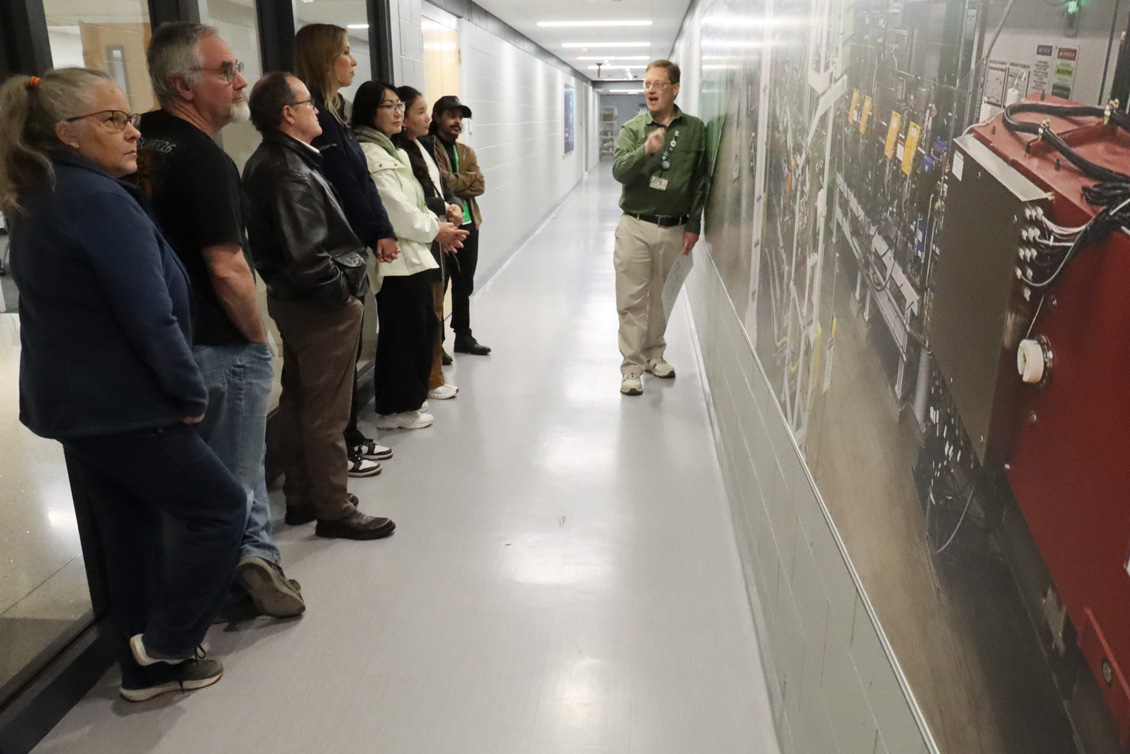
Michigan State University and Apple hosted the inaugural Apple Manufacturing Academy Spring Forum, bringing together industry leaders, researchers, and manufacturers to explore how artificial intelligence is reshaping manufacturing and supply-chain operations. The event included keynote sessions, poster presentations, and tours of facilities such as FRIB, where participants saw examples of advanced technology and operational innovation in practice.
Michigan State University's K500 Chip Testing Facility, inaugurated in February at FRIB, cost approximately $14 million to establish, with funding provided by the U.S. Department of Defense. The project repurposed the campus' K500 superconducting cyclotron, completed in 1982 for high-energy, heavy-ion research, including producing and accelerating ion beams to study nuclear structure, to now allow the facility to test semiconductors for space, defense and on-Earth applications.
Researchers have reported new experimental results addressing the origin of rare proton-rich isotopes heavier than iron, called p-nuclei. Led by Artemis Tsantiri, then-graduate student at FRIB and current postdoctoral fellow at the University of Regina in Canada, the study presents the first rare isotope beam measurement of proton capture on arsenic-73 to produce selenium-74, providing new constraints on how the lightest p-nucleus is formed and destroyed in the cosmos.

