
Welcome to FRIB
The Facility for Rare Isotope Beams (FRIB) at Michigan State University (MSU) is a world-class research and training center, hosting the most powerful rare-isotope accelerator. MSU operates FRIB as a user facility for the U.S. Department of Energy Office of Science (DOE-SC), with financial support from and furthering the mission of the DOE-SC Office of Nuclear Physics. FRIB is where researchers come together to make discoveries that change the world. They study the properties and fundamental interactions of rare isotopes and nuclear astrophysics and their impact on medicine, homeland security, and industry.
Research areas
FRIB advances nuclear science by improving our understanding of nuclei and their role in the universe, while also advancing accelerator systems.
Capabilities
In establishing and operating FRIB, capabilities were developed that transfer to other industries and applications.


User facilities
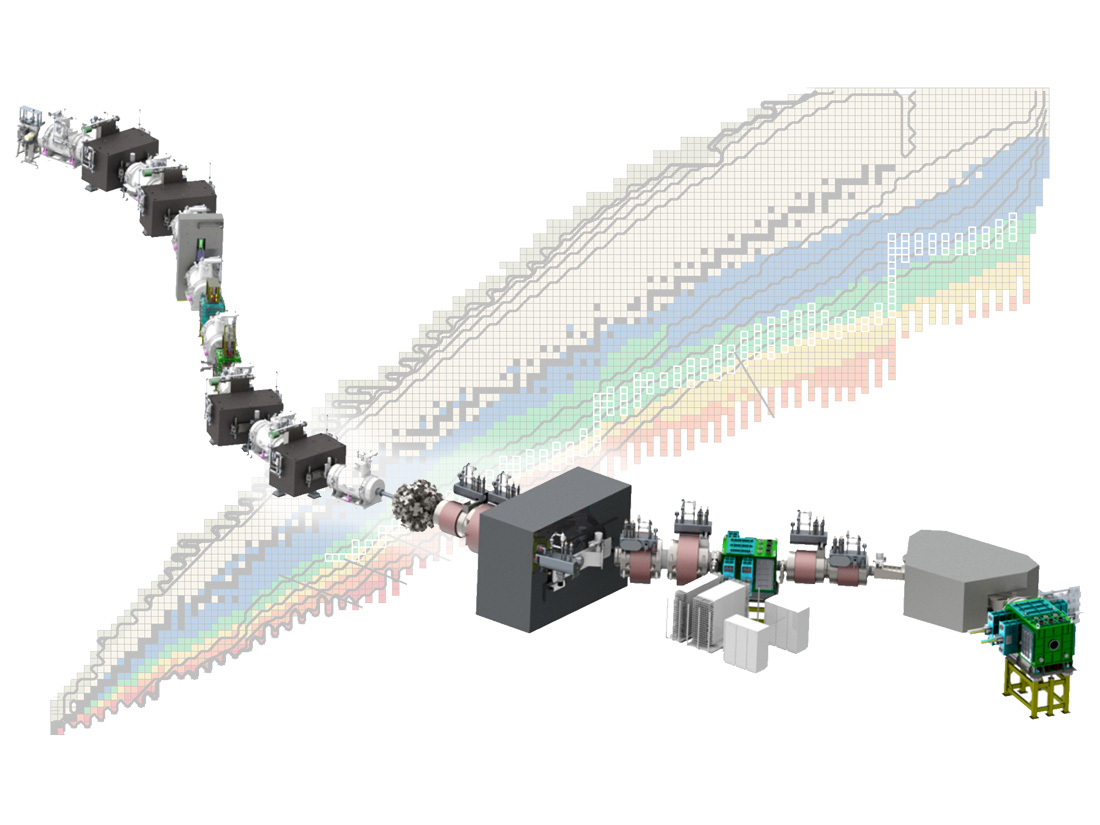
FRIB hosts the world’s most powerful heavy-ion accelerator and enables discoveries in rare isotopes, nuclear astrophysics, fundamental interactions, and societal applications like medicine, security, and industry.
Learn more about upcoming events taking place at FRIB.
Education & training
FRIB at MSU is a world-class research and training center where students and researchers from all career stages and backgrounds come together to make discoveries that change the world.
External news and journal publications discussing FRIB.
A research team at FRIB is the first ever to observe a beta-delayed neutron emission from fluorine-25, a rare, unstable nuclide. Using the FRIB Decay Station Initiator (FDSi), the team found contradictions in prior experimental findings. The results led to a new line of inquiry into how particles in exotic, unstable isotopes remain bound under extreme conditions.
One of the nation's premier research facilities located at Michigan State University is getting a multi-million dollar upgrade. Late last month, the U.S. Department of Energy Office of Science approved $49.7 million for MSU's Facility for Rare Isotope Beams.
A team of scientists, including researchers from FRIB, published an article in Nature Physics on how research on neutron-rich nuclei shows that in the so-called islands of inversion, they are deformed rather than spherical in their ground states.

