By Gear Experts
Table of Contents

Equipboard
Equipboard is the world's largest community of artists and their gear. Read our review process.
We are reader-supported. When you buy through links on our site, we may earn an affiliate commission. Learn more.
Difficulty Level: Novice
This guide is aimed at the beginner producer.
Genres & Style: Electronic music
While the concepts here apply to mixing any kind of music, some of the more specific tips are aimed towards electronic music with strong bass and drum components - house, EDM, drum & bass, dubstep.
Everyone starting out with music production has likely run into this problem: You get a killer idea for a track. You put in hours in the studio laying down your synths, loops, sample packs, and mess with the arrangement until you’re blue in the face. You bounce the track down, and play it back on your home or car stereo, ready to bask in the glow of your new masterpiece... only to realize it sounds completely dull and lifeless compared to professional recordings. Agh!!
Most amateur producers tend to think this is something that can be fixed by mastering (whether it’s you doing it, or paying an engineer to do it). It personally took me a long time to learn this, but the problem is almost always with the mixdown. If you’re planning on sending your track around to labels, I would argue a well-mixed track with no mastering will impress much more than a poorly-mixed track with Ozone slapped on the master channel.
On my way to getting my first few tracks signed to a label, several resources helped me tremendously along the way. I had a habit of writing the most helpful bits down in a doc, so I went through them, combined them with knowledge from some pro producers, and came up with a checklist of things to help your mix be as clear, loud, and punchy as possible.
This is not meant to be comprehensive, nor a masterclass. For that, there are tons of resources, and we even have a guide on the best books for mixing and mastering electronic music. These are simply quick tips I picked up that helped me at one point or another, and eventually led me to get a few tracks signed to a label, distributed on streaming platforms, and played in some DJ sets. Consider this your mixing cheat sheet ;-)
Your Mixing Checklist
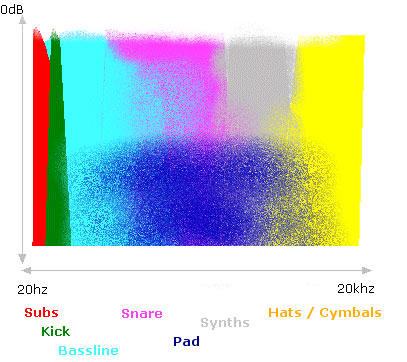
- Learn to visualize the track elements as a graph. Remember sounds are often wider “splotches” than what we think. Headroom is the vertical axis of the graph. If it sounds crowded, it’s because a certain range of frequencies is fighting for the space, thus maxing out headroom. The following graph is an example of a well balanced mix (visually speaking, of course):
- Kick drum should be in mono!
- Bass (sub-bass rather) in mono!
- Solo all layers of bass (e.g. your sub-bass and mid-bass), are they working together well? If not don’t be afraid to completely change your bass sounds.
- Solo just your kick and bass, are they working together well?
- Bass - roll off any super low frequencies (low cut the bass at 50-60Hz, most of the energy comes from the kick).
- Claps, snares - low cut everything under 400Hz (you usually don’t need it).
- For a snare to sound ideal: derive the "thunk" around 200-400Hz. A good "crack" around 2-3kHz, whereas general sparkle and crispness can be found all the way up to 7-8kHz
- Audio clips - make sure to use fades to prevent clipping/clicks.
- Does any percussion need sidechaining to make it groove better?
- Reverb & busses - Use EQ to control reverb. Can you cut reverb frequencies and still retain the desired effect?
Tips from Laidback Luke
- An average well edited and well arranged track is about 6 minutes, otherwise the arrangement might get boring.
- Don’t make breakdown too long! Try and have them as simple and effective as you can, example Bingo Players - Rattle.
- Make sure there is a compressor and limiter on your master output. If you bump the signal into the 0db boundary of your limiter your output should be professional loud.
- Stereo width - Bass should always be mono and everything mid should be nice and wide.
- Especially in all the midrange and highrange synth sounds, you don't need any bass EQ there. You can definitely take the EQ out up to 400Hz on all these sounds.
- Sample at least your kickdrums from an existing track. Just sample one from Nicky Romero or Avicii and use that. You can do that with claps, snares and hihats too. This will make your underlying beats sound professional in an instant.
- Keep kickdrums and basslines mono. It's no use having them in stereo. They will take up too much overall volume and take away from where the stereo image is really needed, in the mid elements like claps and synths.
- Your kickdrum is likely a bit too subby. Try and low cut the EQ on it up to 40Hz.
- Your bass might be too subby. Most of the time you always want the kickdrum to win from the bass in subbyness. Otherwise it will sound too muddy on a club system.
- You can likely lowcut your lead synth sounds up to 300kHz at least.
Fixing a Muddy Mix
I’ve not heard your mixdown, but unless you’re some kind of prodigy (or The Prodigy), chances are it’s muddy! Here are steps to fix it:
- Width: Too much mono energy will overload the compressor/limiter, especially if a lot of those sounds are stereo and don't necessarily need to be right in the center. Use the Width to help carve little bits of a space out to ultimately help give you a better sonic environment, especially at high volumes.
- Reverb: EQ reverb, keep it under control. Also try sidechaining it so it lets the kick punch through.
- EQ: What's happening in the 200-500Hz area? Lots of content in this range often results in mud. Mastering engineers cut in this range to get rid of muddiness.
- Clean up low mids of kick & bass: since mud occurs 200-500Hz, take a narrow Q and see what you can get away with cutting (especially for the bass) that still maintains the integrity of the sound, but lets the kick & bass “breathe” together. What you can get away with meaning it still sounds ok after you’ve cut a good bit of frequencies.
Troubleshooting
- Start with drum elements, solo each individually. See if any are too boomy.
- Listen to the drums as a whole, sometimes the sum tends to have “buildup of potential low mid energy”, so consider bussing them and EQing.
- Bring the instruments in one by one with the drums. Maybe two different instruments are competing for the same spot in the frequency spectrum (a super common problem when you’re starting out and synth-happy), which results in an even muddier sound. It is important to note that you should not just assume that the mud is being caused by a bass instrument. More often than not the muddiness is due to an accumulation of instruments. So that being said there could be a lot of sonic power from instruments in areas that are not really necessary for them to be in. This will cause unnecessary muddiness. Also, effects like reverbs and delays can cause muddiness in the mix so watch out for those.
- Filter/hi-pass (200Hz and above).
- Now if you have tried filtering and it doesn't quite cut it, you have to resort to some corrective EQ. Low end thickness is often caused by a bump in the 120Hz range, and a boomy mid-range character can be caused by too much 200-250Hz. So by cutting a little bit in those frequency areas you can clean up an instrument quite nicely. Set your EQ to a narrow Q and see if you can't sweep any of those annoying frequencies off the table.
- If you have gone back to every instrument and tried EQ'ing and filtering without avail there is one more solution. You can slap a stereo EQ over the master bus and clean up the boominess of the whole mix. But be careful, those boomy frequencies are also the ones that keep the mix thick. Cutting too much can result in a thin mix, so you have to be subtle in your master bus cutting.
GREAT VIDEO, START TO FINISH MIXING (kick & bass, clap, perc, synths, white noise). An oldie but still a goodie.
(note how in the video Sadowick scoops a bit of mids in addition to a flat out low cut)
I hope sharing this with you all was helpful, and helps you avoid agonizing time spent wondering why your music isn’t sounding as loud, clear, and punchy as your favorite artist's releases! Would love to hear your thoughts in the comments below.
About the authors
Giulio Chiarenza is the co-founder of Equipboard and a lifelong multi-instrumentalist with a deep passion for music gear. Born in Italy and raised in the U.S., he holds a Computer Science degree from The University of Texas at Austin and blends technical acumen with decades of hands-on experience across guitar, piano, drums, and electronic production. Early in his career, Giulio was signed to a San Francisco-based EDM label, releasing both remixes and original tracks. These days, he helps steer Equipboard’s vision while personally testing and reviewing gear. He's never too far from his go-to guitar: a vintage 1978 Fender Telecaster Custom. Read more
Comments
Sign Up or Log In to add comments

1064
Thank you very much! :D

1065
Great! BUT Laidback Luke's advice here is dangerous if you don't know what you are doing -
"Make sure there is a compressor and limiter on your master output. If you bump the signal into the 0db boundary of your limiter your output should be professional loud."
At his level, if you're cranking out tracks continuously, testing out new track ideas and have to finish them a few minutes before a show, have mastered all the tools and know exactly how a compressor and limiter are affecting your whole mix... then sure. But for beginners this can be a confusing way to do things and actually impede the learning process. Just my 2 cents.

40958
I was looking for something i wrote to link a buddy when I say this guide and gave it a skim... there's some useful info in here, but it's mostly situational advice and it encourages people to engage in the loudness war and have true peaks in their music that are way into digital clipping, -0.3 db in digital is a good place to stop and getting your mix really loud is becoming pointless now that the LUFS system is ine ffect and sites like spotify will just turn your shitty, overcomrpessed club banger or black metal opus down until it measure -14LUFS so instead of being the loudest song on the web it'll be a really un-dynamic quiet song when people try to stream it... I guess I need to rewrite this guide for EB. Ugh. I'll put it on my to-do list with that AC30 article I never seem to write.