The Brooklyn Bridge is celebrating its 143rd birthday on May 24, the day Gilded Age New Yorkers could finally walk across this wondrous span and celebrate the uniting of Brooklyn and Manhattan.
Over close to a century and a half, the Brooklyn Bridge has taken the honor of the city’s most painted and photographed structure. I’d bet it’s also one of the most popular subjects for artists all over the world.
The Brooklyn Bridge over peaceful waters, the bridge and its smoky harbors, the turbulent river and the sturdy bridge lighting the way, the Ashcan school bridge, the Abstract bridge—every artist sees and creates something different when they portray this steel, granite, and limestone beauty.
The various takes on the bridge really hit me when I came across the two paintings in this post. Though both were completed in the early 20th century with the Brooklyn Bridge as a focal point, they conjure very different emotions and insight.
The first is by Jonas Lie, entitled “Path of Gold” and completed in 1914. Lie, a Norway-born artist, gives us an Impressionist bridge as a gateway to good fortune, with tugs and other crafts all heading in the same direction without confusion.
“Lie painted this work from slightly above the boats heading upriver—a perspective that seems to include the viewer along the path to prosperity,” states the High Museum of Art in Atlanta, which has the painting in its collection.
A very different painting from 1931 is “The Bridge Pier” by Robert Ryland. Grainy and textured, Ryland’s Brooklyn Bridge is less a gateway to prosperity than a steel barrier to it.
“‘The Bridge Pier,’ in which a man in a white shirt seems to slump beneath the weight of the city,” wrote the New York Times in 2013, when both paintings were featured in an exhibition at the Hudson River Museum called “Industrial Sublime: Modernism and the Transformation of New York’s Rivers, 1900-1940.”
Lie’s Brooklyn Bridge celebrates its magnificence, showing the entire span, the industrious Brooklyn harbor, and the steel skyscrapers of business on the Manhattan side.
Meanwhile, Ryland’s Brooklyn Bridge disappears into the chaos and melancholy of the modern world, with a forgotten man wondering if there’s a place for him.
“Painted during the Great Depression, it looks up at the dark, hulking forms of the Brooklyn Bridge and Manhattan’s Municipal Building and sees oppression,” the Times wrote.
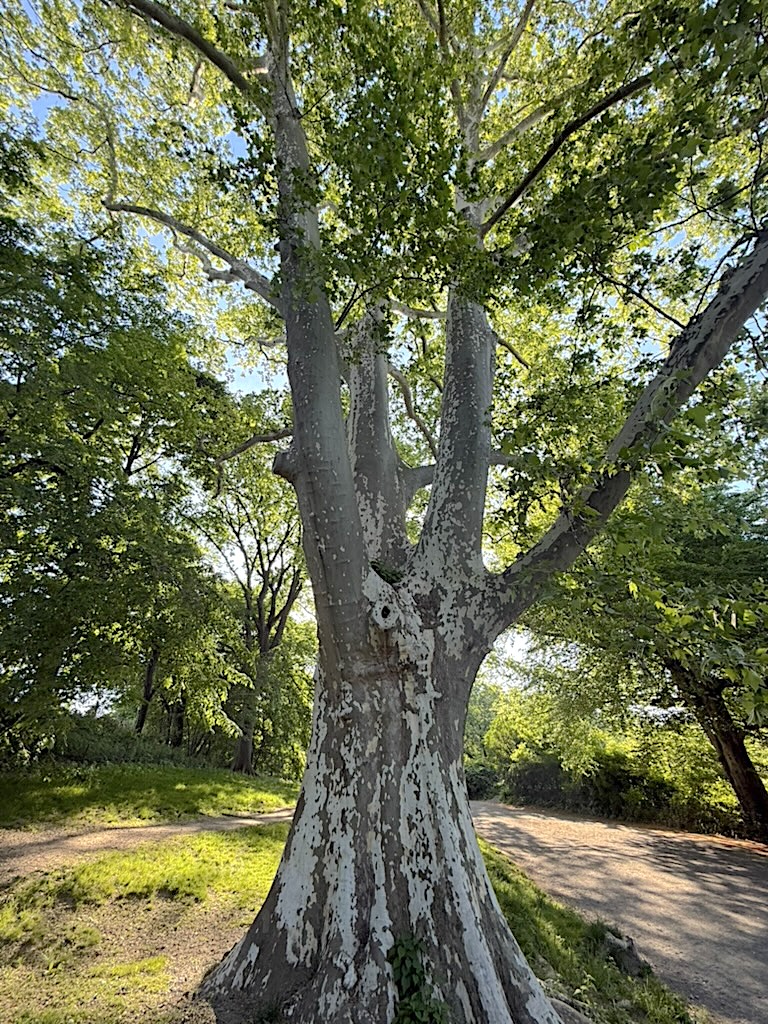
It’s an immense beauty rooted under grass and gravel that spreads its canopy of leaves across the northeastern end of the Central Park reservoir.
And this London Plane tree, mostly minding its business in this popular neck of the park, just might be the oldest tree in Central Park.
That’s according to NYC Parks, which notes the tree’s massive measurements: the diameter of its trunk is 65 inches, and it soars 95.94 feet into the sky.
So what makes this towering tree the oldest in the park? First, it helps to understand that as natural as Central Park seems, it’s almost entirely manmade.
The lake and pond were dug out, and the water has always been fed through underground pipes. As for the land the park is on, it was originally too swampy and rocky to support groves of trees or forests.
To transform the park according to co-designers Frederick Law Olmsted and Calvert Vaux’s Greensward plan, more than 500,000 trees, shrubs, and vines had to be planted during construction from 1858 to 1873, according to the Central Park Conservancy.
London Planes were a popular choice for the park, and this survivor might have been planted in 1862, the year the reservoir was dug, according to nature writer Dennis Burton via Untapped New York.
That makes it an impressive 164 years old, dating back to the Civil War. Of course, it’s not the oldest tree in New York City, nor is it the most striking.
And the London Plane in Central Park has some competition. One guide, Great Trees of New York, says that the Black Tupelo in the Ramble at 78th Street was planted in 1858. If so, it edges out the London Plane by four years!
Some New York City buildings become more than buildings—they transform into symbols.
Christodora House, a 16-story fortress completed in 1928 on Avenue B in the East Village, become a symbol of gentrification in the late 1980s—when a new owner converted the then-empty structure on the edge of Tomkins Square Park into condominiums.
Protestors sprang into action on the heels of the Tompkins Square Park riot in August 1988, chanting “die yuppie scum” in front of the building and smashing its brass-framed front doors.
The condos were an unexpected change in a neighborhood long defined by artists and immigrants living in tenement walkups and public housing. But Christodora House itself wasn’t the interloper many East Villagers assumed.
Its roots go back all the way to the 1890s, when the neighborhood was considered part of the Lower East Side, and various immigrant communities struggled to secure a foothold amid overcrowding, substandard housing, and deep poverty.
Christodora House’s story begins with a reformer named Christina MacColl (below). Born in 1864 into a Presbyterian family that put a high value on public service, she took a job after college at a city YWCA.
There she met another young woman, Sarah Carson, and the two joined forces to found a settlement house in Lower Manhattan, according to the VCU Libraries Social Welfare History Project.
What exactly is a settlement house? Replacing the religion-focused mission houses that ministered to the poor a generation earlier, settlement houses were private institutions set up in impoverished areas that offered education and healthcare to the local community.
Late 19th century New York City—with no reliable safety net of civic social services to help the needy—was becoming a city of settlement houses, largely founded by educated, service-oriented young women like MacColl and Carson.
And in 1897, MacColl rented a few basement rooms at 163 Avenue B in a walkup, named it the Young Women’s Settlement, and set out to “respond to the needs of young (mostly immigrant) women and girls who lived on the Lower East Side,” states christodora.org.
“MacColl saw firsthand that the reality of life in the slums had shattered many immigrants’ dreams of the good life in American and she declared that she hoped to keep these beleaguered, hardworking people from becoming embittered over what she called their ‘lost dreams,'” per the VCU Libraries.
A year later, the Young Women’s Settlement purchased for $23,000 a house down the block at 147 Avenue B.
Boys were now admitted, and the name was changed to Christodora, which means “gift of love.” Eventually, “house” was added to the name as well. (Below, kids undergo a weigh-in and dental exams)
“Christodora is intended for the amusement, instruction, and moral elevation” of “working girls,” as the New York Herald described them in an 1898 article. Those working girls were mostly school-age kids and teenagers who lived in the vicinity of Tompkins Square Park (above photo, about 1910).
Girls (the clientele seemed to be predominantly female early on) were divided into “clubs” based on age, and each club offered different opportunities.
Twenty volunteer teachers offered instruction in “millinery, dressmaking, plain sewing, stenography and typewriting, arithmetic and grammar, bookkeeping, English literature, physical culture, elocution, music, and cooking,” MacColl told the Herald. (Above, an adult English class in 1941)
Wealthy benefactors and fundraisers provided the support to keep the settlement going. Within a few years, a neighboring home for working girls and a separate gymnasium were established, and in 1909 a summer camp in New Jersey joined the offerings.
In 1922, Christodora House celebrated its 25th year. The New York Times penned a short tribute.
“It was a settlement before that word became popular, and ever since the old brownstone fronts on the once-aristocratic Avenue B were converted into classrooms, gymnasium, and apartments for the workers who live there, it has been a landmark in that densely populated section.”
“Miss C.I. MacCool, its founder, is still head worker, with a staff of helpers which has increased from year to year.”
MacCool died in 1939, but she lived long enough to see the new Christodora House—dubbed the “skyscraper settlement”—rise on the settlement’s former site in brick and limestone over Tompkins Square Park (above photo).
“The upper floors of the building provided inexpensive housing for male and female students,” states Christodora.org. “The principle was that the residents were to volunteer part of their time at the community center below.”
“The lower floors of the building were alive with activity ranging from health services to swimming, art and drama, and numerous clubs for music and poetry.” (Above, about 1940)
It would only exist as a settlement house for another 20 years. “Following World War II, the building fell into disrepair and eventually the city took it over,” states a 2005 article in The Villager.
Various community and political groups, including the Black Panthers, “continued to occupy the building through the 1960s, until water damage to the building’s electrical system caused it to be condemned around 1969.” (Above, in 1976)
Abandoned in the 1970s, it was sold by the city in 1986 for $3.5 million to developers, who renovated the settlement house into 85 apartments.
Community leaders and many residents resented the condo-ization of Christodora House, stating that it would have been better served as much-needed affordable housing.
That resentment boiled over during the 1988 Tompkins Square Park riots, as well in May 1991 during a rowdy night when demonstrators gathered in front of the building.
Since then, a host of semi-famous characters and full-on celebrities have resided there, including Iggy Pop—who acknowledges in his 1993 mini-documentary tour of the East Village that the fact that he lives in a “nice” building “gets up a lot of people’s tree.”
Thirty-five years later, with gentrification entrenched through much of the East Village, the space outside Christodora House is largely quiet and peaceful, with more activity from the dog run across the way then on the street.
Its century-old building (home to humans and a family of hawks in 2015, according to Village Preservation) continues to dominate the low-rise block.
But aside from its long-empty swimming pool, Christodora House doesn’t seem to contain any of the relics of its settlement-house start.
John Sloan was a Village resident and something of a voyeur in the early 1900s, discreetly watching from his window or walking nearby streets in search of scenes to commit to canvas.
He never lacked material, finding inspiration in the ordinary: a woman hanging laundry, men drinking in McSorley’s saloon, the elevated train snaking through Greenwich Village, a stone-faced nun passing a shuttered theater.
“One day the unexpected glimpse of a red stocking in the rain caught his eye,” wrote physician Thomas B. Cole. “Stepping briskly along a path, a woman carrying an umbrella picked up her skirt to protect it from a puddle.”
“Back in his studio, [Sloan] called the image to mind and painstakingly recreated the mood of Union Square on a blustery morning. . . . The eye-level perspective suggests that Sloan might have been following her on one of his long walks.”
“In the painting,” continued Cole, “the pavement is wet with reflections, new leaves billow in fluorescent green, a ring of red tulips blooms around a still fountain, and the archway of a barren tree catches a first glimpse of morning sun.”
You can see it from the Henry Hudson Parkway: the back of an ordinary seven-story tenement built on a primitive stone foundation that’s almost as tall as the tenement itself.
The foundation is made from the kind of uneven stones that form the walls of colonial-era houses. It’s built into the cliff, which is part of the natural topography of this stretch of Upper Manhattan.
But it seems a lot more primitive that the tenement on top of it. The tenement and its foundation look like a mismatch. Was that stone foundation part of much earlier structure?
One clue might have to do with the three small, slender windows that span the foundation. Perhaps this was the basement of an older building?
The circa-1927 tenement is officially at 80 Haven Avenue, a slender residential street that winds its way from Columbia Presbyterian Medical Center around 168th Street to 181st Street just before Castle Village.
Could that primitive stone foundation date back to the days of when the Paterno Castle lorded over Upper Manhattan, or one of the other great estates constructed here before urbanization in the early 20th century?
I’m sure the west-facing residents of 80 Haven Avenue enjoy fabulous Hudson River sunset views. But I’d be unnerved by the platform built around the ground floor and that steep drop into the dirt down the cliff below.
[Fourth photo: from Holdouts! via author Andrew Alpern]




 Ephemeral New York