testosterone

(redirected from Testosteron)
Also found in: Dictionary, Thesaurus, Medical.
Related to Testosteron: estrogen

testosterone

a potent steroid hormone secreted mainly by the testes. It can be extracted from the testes of animals or synthesized and used to treat androgen deficiency or promote anabolism. Formula: C19H28O2
Collins Discovery Encyclopedia, 1st edition © HarperCollins Publishers 2005

testosterone

[tes′täs·tə‚rōn]
(biochemistry)
C19H28O2 The principal androgenic hormone released by the human testis; may be synthesized from cholesterol and certain other sterols.
McGraw-Hill Dictionary of Scientific & Technical Terms, 6E, Copyright © 2003 by The McGraw-Hill Companies, Inc.
The following article is from The Great Soviet Encyclopedia (1979). It might be outdated or ideologically biased.

Testosterone


(also 17 β-hydroxyandrost-4-en-3-one), the principal male sex hormone; chemically, a steroid. Testosterone occurs as colorless crystals having a melting point of 155°C. It is sparingly soluble in water but soluble in organic solvents. (The substance was first obtained in 1935. Here, testosterone in crystalline form was isolated from bovine testis tissue, 100 kg of tissue yielding 10 mg of hormone.)

In humans and other higher vertebrates, testosterone is produced by the sex glands, mainly the testes, as well as by the adrenal glands, placenta, and liver. Intermediate products in the biosynthesis of testosterone include cholesterol and progesterone.
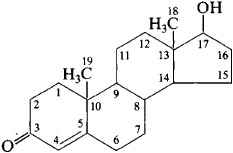
The normal level of testosterone in the blood of a man is 0.5–0.6 microgram per 100 milliliters; in a woman, the level is 0.12 microgram per 100 milliliters. A man produces approximately 15 mg of testosterone per day. Testosterone promotes the development of male sexual organs and of secondary sex characteristics. It affects the differentiation of sexual organs and bodily structures of vertebrates developing in the uterus. The concentration of testosterone in the blood probably serves as the factor determining masculinization in males and virilism in females. Other androgens are active only after their conversion into testosterone.

Testosterone is used in medicine in substitution therapy when there are insufficiencies in the functioning of sex glands in men. It is also used for climacteric disorders in women and for certain types of tumors. Intake of testosterone over prolonged periods blocks the secretion of gonadotrophic hormones and suppresses sexual activity. In the pharmaceutical industry, the hormone is obtained from sterols and steroid saponins. Highly active synthetic analogues of testosterone, such as testosterone propionate and methyltestosterone, are used in medical practice.

REFERENCES

Fieser, L., and M. Fieser. Steroidy. Moscow, 1964. (Translated from English.)
Heftmann, E. Biokhimiia steroidov. Moscow, 1972. (Translated from English.)

E. P. SEREBRIAKOV

The Great Soviet Encyclopedia, 3rd Edition (1970-1979). © 2010 The Gale Group, Inc. All rights reserved.
References in periodicals archive ?
GBH'nin ger cek belirteci olan biyoaktif testosteron duzeyinin yani sira toplam ve serbest testosteron da Parkinson hastalarinda daha dusuk bulunmustur ve semptomlarin siddeti a cisindan degerlendirildiginde Parkinson hastalarinin semptomlarinin daha siddetli oldugu ortaya konmustur.
Bu sendromda hormonal ye spermatoienik testikuler yetmezlige bagli infertilite, dusijk testosteron duzeyi, erektil disfonksiyon ve dusuk kemik mineral dansitesi gbrulur (14).
Iki tarafli inmemis testisleri ve mikropenisi (gerilmis penis boyu 1,5 cm, <10 persantil) olmasi nedeniyle bakilan luteinizan hormon (LH), folikul uyarici hormon (FSH), 17-hidroksiprogesteron (17-OH progesteron), dihidroepiandrosteron sulfat (DHEA-SO4), testosteron duzeyleri normal sinirlarda bulundu ve karyotip analizi 46 XY olarak degerlendirildi.
Temel degerlendirmeler sonrasinda hastalarin serum total testosteron. TSH, prolaktin ve LH duzeyleri olculdu.
Yapilan deneysel arastirmalar ve olgu ornekleri saldirgan davranislarda frontal lob, hipotalamus, limbik sistem ve beyin sapi gibi beyin yapilannm islevsellik sorunlannm; asetilkolin, GABA, norepinefrin, dopamin, serotonin gibi noromediatorlerin, kortizol ve testosteron gibi hormonal faktorlerin islevsel farkliliklannm rolu olabilecegi uzerinde durmaktadir (6-9).
Gecikmis puberte nedeniyle uroloji uzmani tarafindan degerlendirilen hastaya 1,5 yil sureyle testosteron 250 [micro]g aylik uygulanmisti.
Hastanin klinik ve endokrinolojik bulgulari Degerler Normal Aralik Testosteron (ng/mL) 2.82 1.75-7.81 Prolaktin (ng/mL) 12.5 2.64-13.13 FSH (mlU/mL) 3.09 1.27-19.26 LH (mlU/mL) 3.10 1.24-8.62 AFP (lU/mL) 1.53 0.5-5.5 beta-hCG (ng/mL) 0.6 0-0.7 LDH (U/L) 242 0-247 ACTH (pg/mL) 14.9 0-46 Spermiyogram Volum (mL) 3 [greater than or equal to]2 pH 7.6 7.2-7.8 Sperm sayisi ([10.sup.6]/mL) 0 [greater than or equal to]20 Sperm motilitesi (%) 0 [greater than or equal to]50 A+B (%) A:%0 B:%0 Pellet (-)
Dolayisiyla ogleden sonra ve aksam saatlerinde kandaki testosteron duzeyi azalmaktadir.
Nachweis von exogenem Testosteron [The detection of exogenous testosterone].