Introduction

.svg)
India, officially the Republic of India, is a country in South Asia. It is the seventh-largest country by area; the most populous country in the world and, since its independence in 1947, the world's most populous democracy. Bounded by the Indian Ocean on the south, the Arabian Sea on the southwest, and the Bay of Bengal on the southeast, it shares land borders with Pakistan to the west; China, Nepal and Bhutan to the north; Bangladesh and Myanmar to the east. In the Indian Ocean, India is near Sri Lanka and the Maldives. Its Andaman and Nicobar Islands share a maritime border with Myanmar, Thailand and Indonesia. (Full article...)

 Featured article –


The lion (Panthera leo) is a large cat of the genus Panthera, currently ranging only in Sub-Saharan Africa and India. It has a muscular, broad-chested body; a short, rounded head; round ears; and a dark, hairy tuft at the tip of its tail. It is sexually dimorphic; adult male lions are larger than females and have a prominent mane that extends from the head to the shoulders and chest.
The lion inhabits grasslands, savannahs, and shrublands. It is an apex and keystone predator, preying mostly on medium-sized and large hooved mammals. It is usually more diurnal than other wild cats, but when persecuted, it adapts to being active at night and at twilight. It is a social species, forming groups called prides. A lion pride consists of related females and cubs, and a few or one adult male who is unrelated to the females. Groups of female lions usually hunt together. Adult males often compete to keep or gain their membership in the pride. (Full article...)- The 44th Chess Olympiad (28 July – 10 August 2022) was a FIDE-organised international team chess event held in Chennai, the capital of Tamil Nadu, India. It consisted of two main tournaments—an Open event, enabling participation of players from all genders, and a Women's event, enabling participation of female players only—as well as several events to promote chess. The Olympiad was initially supposed to take place in Khanty-Mansiysk, Russia, the host of the Chess World Cup 2019, in August 2020, but it was later moved to Moscow. However, it was postponed due to the COVID-19 pandemic and then relocated to Chennai following Russia's invasion of Ukraine. This was the first Chess Olympiad to take place in India.
The total number of participants was 1,737: 937 in the Open and 800 in the Women's event. The number of registered teams was 188 from 186 nations in the Open section and 162 from 160 nations in the Women's section; being the host nation, India had three teams participating in each section. Both sections set team participation records. The main venue of the Chess Olympiad was the convention centre at the Four Points by Sheraton, while the opening and closing ceremonies were held at the Jawaharlal Nehru Stadium. The Chief Arbiter of the event was France's Laurent Freyd. (Full article...)
Hyderabad is the capital and largest city of the Indian state of Telangana. It occupies 650 km2 (250 sq mi) on the Deccan Plateau along the banks of the Musi River, in the northern part of South India. With an average altitude of 536 m (1,759 ft), much of Hyderabad is situated on hilly terrain around artificial lakes, including the Hussain Sagar lake, predating the city's founding, in the north of the city centre. According to the 2011 census of India, Hyderabad is the fourth-most populous city in India with a population of 6.9 million residents within the city limits, and has a population of 9.7 million residents in the metropolitan region, making it the sixth-most populous metropolitan area in India.
The Qutb Shahi dynasty's Muhammad Quli Qutb Shah established Hyderabad in 1591 to extend the capital beyond the fortified Golconda. In 1687, the city was annexed by the Mughals. In 1724, Asaf Jah I, the Mughal viceroy, declared his sovereignty and founded the Asaf Jahi dynasty, also known as the Nizams. Hyderabad served as the imperial capital of the Asaf Jahis from 1769 to 1948. As the capital of the princely state of Hyderabad, the city housed the British Residency and cantonment until Indian independence in 1947. Hyderabad was annexed by the Indian Union in 1948 and continued as a capital of Hyderabad State from 1948 to 1956. After the introduction of the States Reorganisation Act of 1956, Hyderabad was made the capital of the newly formed Andhra Pradesh. In 2014, Andhra Pradesh was split to form the state of Telangana, and Hyderabad became the joint capital of the two states until 2024. Since 1956, the city has housed the Rashtrapati Nilayam, the winter office of the president of India. (Full article...)
The Rani of Jhansi (Hindi: Jhānsi Ki Rāni; born Manikarnika Tambe; 1827–30, or 1835 – 18 June 1858), also known as Rani Lakshmibai, was one of the leading figures of the Indian Rebellion of 1857. The queen consort of the princely state of Jhansi from 1843 to 1853, she assumed its leadership after the outbreak of the conflict and fought several battles against the British. Her life and deeds are celebrated in modern India and she remains a potent symbol of Indian nationalism.
Born into a Marathi family in Varanasi, Manikarnika Tambe was married to the raja of Jhansi, Gangadhar Rao, at a young age, taking the name Rani Lakshmibai. The couple had one son but he died young, and so when Gangadhar Rao was on his deathbed in 1853, he adopted Damodar Rao, a young relative, to be his successor. The British East India Company, which by then had subjugated much of India, including Jhansi, refused to recognise this succession and annexed Jhansi under the Doctrine of Lapse, ignoring the Rani's vigorous protests to the Governor-General Lord Dalhousie. (Full article...)
Dimple Kapadia (born 8 June 1957) is an Indian actress predominantly appearing in Hindi films. Born and raised in Mumbai by wealthy parents, she aspired to become an actress from a young age and received her first opportunity through her father's efforts to launch her in the film industry. She was discovered at age 14 by the filmmaker Raj Kapoor, who cast her in the title role of his teen romance Bobby (1973), which opened to major commercial success and gained her wide public recognition. Shortly before the film's release in 1973, she married the actor Rajesh Khanna and quit acting. Their daughters, Twinkle and Rinke Khanna, both briefly worked as actresses in their youth. Kapadia returned to films in 1984, two years after her separation from Khanna. Her comeback film Saagar, which was released a year later, revived her career. Both Bobby and Saagar won her Filmfare Awards for Best Actress. Through her work over the next decade, she established herself as one of Hindi cinema's leading actresses.
While her initial roles often relied on her perceived beauty and sex appeal, Kapadia was keen to challenge herself and expand her range. She was among the first actresses who starred in women-centred Hindi action films but found greater favour with critics when she took on more dramatic roles in both mainstream and neorealist parallel cinema. Appearing in films ranging from marital dramas to literary adaptations, she played troubled women sometimes deemed reflective of her personal experience, and received acclaim for her performances in Kaash (1987), Drishti (1990), Lekin... (1991), and Rudaali (1993). For her role as a professional mourner in Rudaali, she won the National Film Award for Best Actress and a Filmfare Critics Award. She also had supporting roles in the crime dramas Prahaar (1991), Angaar (1992), Gardish (1993) and Krantiveer (1994), the latter securing her another Filmfare Award. (Full article...)
Sir Robert Eric Mortimer Wheeler (10 September 1890 – 22 July 1976) was a British archaeologist and officer in the British Army. Over the course of his career, he served as Director of both the National Museum of Wales and London Museum, Director-General of the Archaeological Survey of India, and the founder and Honorary Director of the Institute of Archaeology in London, in addition to writing twenty-four books on archaeological subjects.
Born in Glasgow to a middle-class family, Wheeler was raised largely in Yorkshire before moving to London in his teenage years. After studying classics at University College London (UCL), he began working professionally in archaeology, specialising in the Romano-British period. During World War I he volunteered for service in the Royal Artillery, being stationed on the Western Front, where he rose to the rank of major and was awarded the Military Cross. Returning to Britain, he obtained his doctorate from UCL before taking on a position at the National Museum of Wales, first as Keeper of Archaeology and then as Director, during which time he oversaw excavation at the Roman forts of Segontium, Y Gaer, and Isca Augusta with the aid of his first wife, Tessa Wheeler. Influenced by the archaeologist Augustus Pitt Rivers, Wheeler argued that excavation and the recording of stratigraphic context required an increasingly scientific and methodical approach, developing the "Wheeler method". In 1926, he was appointed Keeper of the London Museum; there, he oversaw a reorganisation of the collection, successfully lobbied for increased funding, and began lecturing at UCL. (Full article...)- Nil Battey Sannata (lit. 'Zero Divided by Zero Equals Nothing'; slang for "Good for Nothing"), released internationally as The New Classmate, is a 2015 Indian Hindi-language comedy drama film directed by Ashwiny Iyer Tiwari in her feature debut. Produced by Aanand L. Rai, Ajay Rai, and Alan McAlex under the banners of Colour Yellow Productions and JAR Pictures, the film was co-written by Iyer, Neeraj Singh, Pranjal Choudhary, and Nitesh Tiwari. Swara Bhaskar starred as Chanda Sahay, a high-school drop-out household maid and single mother of a sullen young girl named Apeksha, played by Riya Shukla. The film's theme is a person's right to dream and change their lives, irrespective of social status.
Released in India on 22 April 2016, Nil Battey Sannata was distributed by Eros International and garnered critical and audience acclaim. Reviewers praised most aspects of the production, especially its narrative and realism, and the performances of the cast, Bhaskar's in particular. At the 62nd Filmfare Awards, Iyer won the Filmfare Award for Best Debut Director, while Bhaskar and Shukla won the Screen Awards for Best Actress (Critics) and Best Child Artist respectively. The film did well at the box-office, collecting a total of around ₹69 million (US$720,000) during its entire theatrical run. The same year, the film was remade in Tamil as Amma Kanakku, with Iyer returning to direct. The following year, it was remade in Malayalam as Udaharanam Sujatha. (Full article...)
The tiger (Panthera tigris) is a large cat and a member of the genus Panthera native to Asia. It has a powerful, muscular body with a large head and paws, a long tail and orange fur with black, mostly vertical stripes. It is traditionally classified into nine recent subspecies, though some recognise only two subspecies, mainland Asian tigers and the island tigers of the Sunda Islands.
Throughout the tiger's range, it inhabits mainly forests, from coniferous and temperate broadleaf and mixed forests in the Russian Far East and Northeast China to tropical and subtropical moist broadleaf forests on the Indian subcontinent and Southeast Asia. The tiger is an apex predator and preys mainly on hooved mammals, which it takes by ambush. It lives a mostly solitary life and occupies home ranges, defending these from individuals of the same sex. The range of a male tiger overlaps with that of multiple females with whom he mates. Females give birth to usually two or three cubs that stay with their mother for about two years. When becoming independent, they leave their mother's home range and establish their own. (Full article...)
Hritik Rakesh Nagrath (born 10 January 1974), known professionally as Hrithik Roshan (Hindi: [ˈɾɪt̪ɪk ɾoːʃən]), is an Indian actor and producer who works in Hindi cinema. Referred as the millenial superstar, he has portrayed a variety of characters and is known for his dancing skills. One of the highest-paid actors in India, he has won many awards, including six Filmfare Awards, of which four were for Best Actor. Starting from 2012, he has appeared in Forbes India's Celebrity 100 several times based on his income and popularity.
Roshan has frequently collaborated with his father, Rakesh Roshan. He made brief appearances as a child actor in several films in the 1980s and later worked as an assistant director on four of his father's films. His first leading role was in the box-office success Kaho Naa... Pyaar Hai (2000), for which he received several awards. Performances in the 2000 terrorism drama Fiza and the 2001 ensemble family drama Kabhi Khushi Kabhie Gham consolidated his reputation but were followed by several poorly received films. (Full article...)
Margaret Ives Abbott (June 15, 1878 – June 10, 1955) was an American amateur golfer. She was the first American woman to win an Olympic event: the women's golf tournament at the 1900 Summer Olympics.
Born in Calcutta (now Kolkata), British Raj, in 1878, Abbott moved with her family to Chicago in 1884. She joined the Chicago Golf Club in Wheaton, Illinois, where she received coaching from Charles B. Macdonald and H. J. Whigham. In 1899, she traveled with her mother to Paris to study art. The following year, along with her mother, she signed up for a women's golf tournament without realizing that it was the second modern Olympics. Abbott won the tournament with a score of 47 strokes; her mother tied for seventh place. Abbott received a porcelain bowl as a prize. (Full article...)
Arthur Edward Jeune Collins (18 August 1885 – 11 November 1914) was an English cricketer and soldier. He held, for 116 years, the record of highest score in cricket: as a 13-year-old schoolboy, he scored 628 not out over four afternoons in June 1899. Collins's record-making innings drew a large crowd and increasing media interest; spectators at the Old Cliftonian match being played nearby were drawn away to watch the junior school house cricket match in which Collins was playing. Despite this achievement, Collins never played first-class cricket. Collins's 628 not out stood as the record score until January 2016 when an Indian boy, Pranav Dhanawade, scored 1009 in a single innings.
Collins joined the British Army in 1902 and studied at the Royal Military Academy, Woolwich, before becoming an officer in the Royal Engineers. He served in France during the First World War, where he was killed in action in 1914 during the First Battle of Ypres. Collins had been mentioned in despatches and also represented the Royal Military Academy at cricket and rugby union. (Full article...)
Rani Mukerji (Hindustani pronunciation: [raːni mʊkʰərdʒi]; born 21 March 1978) is an Indian actress who works in Hindi films. She is the recipient of multiple accolades, including a National Film Award and eight Filmfare Awards. Mukerji has featured in listings of the highest-paid actresses of the 2000s.
Born into the Mukherjee-Samarth family, Mukerji began acting as a teenager by starring in her father Ram Mukherjee's Bengali-language film Biyer Phool and in the social drama Raja Ki Aayegi Baaraat (both 1996). Mukerji had her first commercial success with the action film Ghulam and breakthrough with the romance Kuch Kuch Hota Hai (both 1998). Following a brief setback, the year 2002 marked a turning point for her when she was cast by Yash Raj Films as the star of the drama Saathiya. (Full article...)
The Indian roller (Coracias benghalensis) is a bird of the family Coraciidae. It is 30–34 cm (12–13 in) long with a wingspan of 65–74 cm (26–29 in) and weighs 166–176 g (5.9–6.2 oz). The face and throat are pinkish, the head and back are brown, with blue on the rump and contrasting light and dark blue on the wings and tail. The bright blue markings on the wing are prominent in flight. The sexes are similar in appearance. Two subspecies are recognised.
The Indian roller occurs widely from West Asia to the Indian subcontinent. Often found perched on roadside trees and wires, it is common in open grassland and scrub forest habitats, and has adapted well to human-modified landscapes. It mainly feeds on insects, especially beetles. The species is best known for the aerobatic displays of males during the breeding season. Adult males and females form pair bonds and raise the young together. The female lays 3–5 eggs in a cavity or crevice, which is lined with a thin mat of straw or feathers. The roller is the state bird of three Indian states. It is listed as a species of least concern on the IUCN Red List. (Full article...)
Kaikhosru Shapurji Sorabji (born Leon Dudley Sorabji; 14 August 1892 – 15 October 1988) was an English composer, music critic, pianist and writer. His music, written over a period of seventy years, ranges from sets of miniatures to works lasting several hours. One of the most prolific 20th-century composers, he is best known for his piano pieces, notably nocturnes such as Gulistān and Villa Tasca, and large-scale, technically intricate compositions, which include seven symphonies for piano solo, four toccatas, Sequentia cyclica and 100 Transcendental Studies. He felt alienated from English society by reason of his homosexuality and mixed ancestry, and had a lifelong tendency to seclusion.
Sorabji's mother was English and his father a Parsi businessman and industrialist from India, who set up a trust fund that freed his family from the need to work. Although Sorabji was a reluctant performer and not a virtuoso, he played some of his music publicly between 1920 and 1936. In the late 1930s, his attitude shifted and he imposed restrictions on performance of his works, which he lifted in 1976. His compositions received little exposure in those years and he remained in public view mainly through his writings, which include the books Around Music and Mi contra fa: The Immoralisings of a Machiavellian Musician. During this time, he also left London and eventually settled in the village of Corfe Castle, Dorset. Information on Sorabji's life, especially his later years, is scarce, with most of it coming from the letters he exchanged with his friends. (Full article...)- Eega (transl. The Fly) is a 2012 Indian Telugu-language fantasy action film written and directed by S. S. Rajamouli. The film was produced by Sai Korrapati under Vaaraahi Chalana Chitram. The film stars Nani, Samantha, and Sudeepa. M. M. Keeravani composed the songs and the background score, while K. K. Senthil Kumar was the director of photography. Janardhana Maharshi and Crazy Mohan wrote the dialogue for the Telugu and Tamil versions, respectively. It was filmed simultaneously in Tamil with the title Naan Ee (transl. I, the Fly).
The film follows a bedtime story narrated by a father to his daughter. Its protagonist, Nani, who is in love with his neighbour Bindu, is murdered by a wealthy industrialist named Sudeep, who is attracted to Bindu and considers Nani a rival. Nani reincarnates as a housefly and tries to avenge his death and protect Bindu from an obsessive Sudeep. (Full article...)
Elephants are the largest living land animals. Three living species are currently recognised: the African bush elephant (Loxodonta africana), the African forest elephant (L. cyclotis), and the Asian elephant (Elephas maximus). They are the only surviving members of the family Elephantidae and the order Proboscidea; extinct relatives include mammoths and mastodons. Distinctive features of elephants include a long proboscis called a trunk, tusks, large ear flaps, pillar-like legs, and tough but sensitive grey skin. The trunk is prehensile, bringing food and water to the mouth and grasping objects. Tusks, which are derived from the incisor teeth, serve both as weapons and as tools for moving objects and digging. The large ear flaps assist in maintaining a constant body temperature as well as in communication. African elephants have larger ears and concave backs, whereas Asian elephants have smaller ears and convex or level backs.
Elephants are scattered throughout sub-Saharan Africa, South Asia, and Southeast Asia and are found in different habitats, including savannahs, forests, deserts, and marshes. They are herbivorous, and they stay near water when it is accessible. They are considered to be keystone species, due to their impact on their environments. Elephants have a fission–fusion society, in which multiple family groups come together to socialise. Females (cows) tend to live in family groups, which can consist of one female with her calves or several related females with offspring. The leader of a female group, usually the oldest cow, is known as the matriarch. (Full article...)
Katrina Kaif (pronounced [kəˈʈriːna kɛːf]; born Katrina Rosemary Turcotte, 16 July 1983) is a British actress and businesswoman who works in Hindi-language films. One of India's highest-paid actresses, her accolades include four Screen Awards and four Zee Cine Awards, alongside three Filmfare Awards nominations. Although critical reception to her acting has varied, she is noted for her roles in action films and her dancing ability.
Born in British Hong Kong, Kaif lived in several countries before moving to London, where she spent three years. She received her first modelling assignment as a teenager and later pursued a career in fashion modelling. At a fashion show in London, Indian filmmaker Kaizad Gustad cast her in Boom (2003), which was a critical and commercial failure. While Kaif established a successful modelling career in India, she initially faced difficulty securing film roles due to her limited command of Hindi. After appearing in the Telugu film Malliswari (2004), Kaif achieved commercial success in Bollywood with the romantic comedies Maine Pyaar Kyun Kiya? (2005) and Namastey London (2007). Further success followed with a series of box-office hits, though she was criticised for her acting, repetitive roles, and preference for male-dominated films. (Full article...)
The Marwari, also known as the Malani is a rare breed of horse from the Marwar region of Rajasthan, in north-west India. It is closely related to the Kathiawari breed of the Kathiawar peninsula of Gujarat, with which it shares the distinctive inward-curving ears. Marwari horses are found in all equine colours, including piebald and skewbald. It is a hardy riding horse and may exhibit a natural ambling gait.
The Rathores, traditional rulers of the Marwar region of western India, were the first to breed the Marwari. Beginning in the 12th century, they espoused strict breeding that promoted purity and hardiness. Used throughout history as a cavalry horse by the people of the Marwar region, the Marwari was noted for its loyalty and bravery in battle. The breed deteriorated in the 1930s, when poor management practices resulted in a reduction of the breeding stock, but today has regained some of its popularity. The Marwari is used for light draught and agricultural work, as well as riding and packing. In 1995, a breed society was formed for the Marwari horse in India. The exportation of Marwari horses was banned for decades, but between 2000 and 2006, a small number of exports were allowed. Since 2008, visas allowing temporary travel of Marwari horses outside India have been available in small numbers. Though they are rare they are becoming more popular outside of India due to their unique looks. (Full article...)
The 2000 Sri Lanka cyclone (IMD designation: BOB 06 JTWC designation: 04B) was the strongest tropical cyclone to strike Sri Lanka since 1978. The fourth tropical storm and the second severe cyclonic storm of the 2000 North Indian Ocean cyclone season, it developed from an area of disturbed weather on December 25, 2000. It moved westward, and quickly strengthened under favorable conditions to reach top wind speeds of 75 mph (121 km/h). The cyclone hit eastern Sri Lanka at peak strength, then weakened slightly while crossing the island before making landfall over southern India on December 28. The storm degenerated into a remnant low later that day, before merging with another trough on the next day.
The storm was the first cyclone over Sri Lanka with winds of at least hurricane strength since a cyclone of 1978 hit the island in the 1978 season, as well as the first tropical storm to hit the island since 1992. The storm was also the first December tropical cyclone of hurricane intensity in the Bay of Bengal since 1996. It produced heavy rainfall and strong winds, damaging or destroying tens of thousands of houses and leaving up to 500,000 homeless. At least nine people died as a result of the cyclone. (Full article...)
Freida Selena Pinto (born 18 October 1984) is an Indian actress who has appeared mainly in American and British films. Born and raised in Mumbai, Maharashtra, she resolved at a young age to become an actress. As a student at St. Xavier's College, Mumbai she took part in amateur plays. After graduation, she briefly worked as a model and then as a television presenter.
Pinto rose to prominence with her film debut in the drama Slumdog Millionaire (2008), winning a SAG Award and earning a nomination for the BAFTA Award for Best Supporting Actress. She subsequently starred in Miral (2010), Trishna (2011), and Desert Dancer (2014). She also saw commercial success with the science fiction film Rise of the Planet of the Apes (2011), and the epic fantasy action film Immortals (2011). Pinto's other notable roles include You Will Meet a Tall Dark Stranger (2010), Love Sonia (2018), Hillbilly Elegy (2020), and Mr. Malcolm's List (2022). She also starred in the Showtime miniseries Guerrilla (2017), and had a recurring role in the Hulu series The Path (2018). (Full article...)
Kareena Kapoor Khan (pronounced [kəˈriːna kəˈpuːr xɑːn]; née Kapoor; born 21 September 1980) is an Indian actress. She has been known for her leading roles in Hindi cinema since 2000. Kapoor is the recipient of several awards, including six Filmfare Awards, and as of 2024, is one of Hindi cinema's highest-paid actresses.
Born into the Kapoor family, she is the daughter of actors Babita and Randhir Kapoor, and the younger sister of actress Karisma Kapoor. After making her acting debut in 2000 in Refugee, Kapoor established herself the following year with several roles, including in the top-grossing drama Kabhi Khushi Kabhie Gham. This was followed by a series of commercial failures and negative reviews for her repetitive roles. An against-type performance as a sex worker in the 2004 drama Chameli marked a turning point in her career. She earned critical recognition for her portrayal of a riot victim in the 2004 drama Dev and a character based on Desdemona in the 2006 crime film Omkara. Her performance as a loquacious woman in the romantic comedy Jab We Met (2007) earned her the Filmfare Award for Best Actress. (Full article...)- Lage Raho Munna Bhai (pronounced [ləˈɡeː rəˈɦoː mʊnːaːˈbʱaːi] ⓘ; translation: Keep Going, Munna Bhai) is a 2006 Indian Hindi-language satirical comedy drama film written, edited and directed by Rajkumar Hirani, who also co-wrote the screenplay with Abhijat Joshi, and produced by Vidhu Vinod Chopra under the banner Vinod Chopra Films. A sequel to Munna Bhai M.B.B.S. (2003), the film is the second installment of the Munna Bhai series. Sanjay Dutt and Arshad Warsi reprised their roles as the titular Munna Bhai and Circuit, respectively. New additions to the cast include Vidya Balan, Dilip Prabhavalkar and Dia Mirza, while several actors from the original, notably Jimmy Sheirgill and Boman Irani, appear in new roles.
In this film, the eponymous lead character, a crime boss in Mumbai, begins to see visions of Mahatma Gandhi. Through his interactions with Gandhi, he begins to practice what he refers to as "Gandhigiri" (a neologism for "Gandhism") to help ordinary people solve their problems. (Full article...) - Kahaani (IPA: [kəˈɦaːni]; transl. Story) is a 2012 Indian Hindi-language vigilante action thriller film co-written, co-produced, and directed by Sujoy Ghosh. It stars Vidya Balan as Vidya Bagchi, a pregnant woman looking for her missing husband in Kolkata during the festival of Durga Puja, assisted by Assist Sub-Inspector Satyoki "Rana" Sinha (Parambrata Chatterjee) and Inspector General A. Khan (Nawazuddin Siddiqui).
Made on a budget of ₹80 million (US$830,000), Kahaani was conceived and developed by Ghosh, who co-wrote the film with Advaita Kala. The crew often employed guerrilla-filmmaking techniques on Kolkata's streets to avoid attracting attention. Its creative portrayal of the city and its use of local crew and cast made it a notable film. Kahaani explores themes of feminism and motherhood in a male-dominated Indian society. The film also makes several allusions to Satyajit Ray's films, such as Charulata (1964), Aranyer Din Ratri (1970), and Joi Baba Felunath (1979). The film's musical score and soundtrack were composed by Clinton Cerejo and Vishal–Shekhar respectively, with cinematography handled by Setu and editing done by Namrata Rao. (Full article...)
Margaret Alice Murray (13 July 1863 – 13 November 1963) was a British Egyptologist, archaeologist, anthropologist, historian, and folklorist. The first woman to be appointed as a lecturer in archaeology in the United Kingdom, she worked at University College London (UCL) from 1898 to 1935. She was president of the Folklore Society from 1953 to 1955, and published widely.
Born to a wealthy middle-class English family in Calcutta, British India, Murray divided her youth between India, Britain, and Germany, training as both a nurse and a social worker. Moving to London, in 1894 she began studying Egyptology at UCL, developing a friendship with department head Flinders Petrie, who encouraged her early academic publications and appointed her junior lecturer in 1898. In 1902–1903, she took part in Petrie's excavations at Abydos, Egypt, there discovering the Osireion temple, and the following season investigated the Saqqara cemetery, both of which established her reputation in Egyptology. Supplementing her UCL wage by giving public classes and lectures at the British Museum and Manchester Museum, it was at the latter in 1908 that she led the unwrapping of Khnum-nakht, one of the mummies recovered from the Tomb of two Brothers – the first time that a woman had publicly unwrapped a mummy. Recognising that British Egyptomania reflected the existence of widespread public interest in Ancient Egypt, Murray wrote several books on Egyptology targeted at a general audience. (Full article...)
The 2003 Sri Lanka cyclone was a moderately powerful tropical cyclone that produced the worst flooding in Sri Lanka in 56 years. The first storm of the 2003 North Indian Ocean cyclone season, it developed over the Bay of Bengal on May 10. Favorable environmental conditions allowed the system to intensify steadily while moving northwestward. The storm reached peak maximum sustained winds of 140 km/h (85 mph) on May 13, making it a very severe cyclonic storm according to the India Meteorological Department (IMD), which is the official Regional Specialized Meteorological Center for the basin. The cyclone drifted north over the central Bay of Bengal, gradually weakening due to heightened wind shear. Turning eastward, the storm deteriorated to a deep depression on May 16 before it curved northeastward and re-intensified into a cyclonic storm. It came ashore in western Myanmar and dissipated over land the following day.
In the wake of prolonged precipitation during the first half of May, the cyclone produced torrential rains across southwest Sri Lanka while stationary in the central Bay of Bengal. The storm drew extensive moisture that coalesced in the mountainous portion of the island. A station at Ratnapura recorded 366.1 mm (14.41 in) of rainfall in 18 hours on May 17, including 99.8 mm (3.93 in) in one hour. In southwestern Sri Lanka, the rainfall caused flooding and landslides that destroyed 24,750 homes and damaged 32,426 others, displacing about 800,000 people. Overall damage totaled about $135 million (2003 USD), and there were 260 deaths. The cyclone also produced some rainfall in the Andaman and Nicobar Islands of India and along the country's eastern coast. The storm funneled moisture away from the mainland, which possibly contributed to a heat wave that killed 1,900 people, and dropped heavy rainfall in Myanmar. (Full article...)


.png)

_female_3_crop.jpg)
.jpg)
.jpg)

(2).jpg)

.jpg)


.jpg)
_(cropped).jpg)


Selected pictures
 Photograph credit: Vikramjit KakatiNohkalikai Falls is a 340-foot-tall (100 m) plunge waterfall located in the northeast Indian state of Meghalaya. It is the tallest plunge waterfall in India and is situated near Cherrapunji, one of the wettest places on Earth. Nohkalikai Falls are fed by the rainwater collected on the summit of a relatively small plateau. Below the falls is a plunge pool with water of an unusual shade of green.
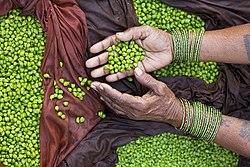 Photograph: Jorge RoyanAn Indian merchant holding green chickpeas (Cicer arietinum). One of the earliest cultivated legumes, chickpeas are ingredients in a number of dishes around the world. India is the largest producer of this nutrient-dense food, accounting for 64% of global production in 2016.
 Photograph: Muhammad Mahdi KarimBangles on display in Bangalore, India. These rigid bracelets are usually made from metal, wood, or plastic and are traditionally worn by women in India, Nepal, Pakistan, and Bangladesh. In India, it is a common tradition to see a new bride wearing glass bangles at her wedding and the honeymoon will end when the last bangle breaks.
 Photograph credit: Augustus BinuPomegranate juice is a beverage made from the fruit of the pomegranate. It is used in cooking both as a fresh juice and as a concentrated syrup. The fruit originated in the region extending from Iran to northern India and has been cultivated since ancient times. The fruit has a hard outer husk and a spongy mesocarp in which the seeds in their fleshy seedcoats are embedded. Pomegranate juice can be sweet or sour, but most fruits are moderate in taste. The juice has long been a popular drink in Europe and the Middle East, and is now widely distributed in the United States and Canada.
 Photo credit: Dan BradyPigments for sale at a market stall in Goa, India. Many pigments used in manufacturing and the visual arts are dry colourants, ground into a fine powder. This powder is then added to a vehicle or matrix, a relatively neutral or colorless material that acts as a binder, before it is applied. Unlike a dye, a pigment generally is insoluble.
 Photograph credit: Subhrajyoti SahaThe Buddha Park of Ravangla is situated near Ravangla in South Sikkim district of the Indian state of Sikkim. It was constructed between 2006 and 2013, and features a 130-foot-tall (40 m) statue of the Buddha, pictured here, as its main attraction. The statue was erected to mark the 2550th anniversary of the birth of Gautama Buddha, and was consecrated on 25 March 2013 by the 14th Dalai Lama.
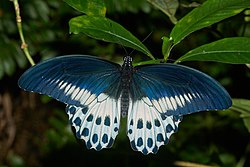 Photograph credit: Jeevan JosePapilio polymnestor, the blue Mormon, is a species of swallowtail butterfly found in southern India and Sri Lanka. It is a woodland species, often seen on forest paths and near streams. The larvae feed on trees in the family Rutaceae, such as citrus. Young larvae are green with white markings and position themselves on the upper surface of leaves, relying on their cryptic colouring, which resembles bird droppings, for protection. Older larvae seek less conspicuous locations, and have a unique habit of securing their balance by weaving silk on the substratum. This adult male P. polymnestor butterfly was photographed in the Indian state of Kerala.
 Coin design credit: East India Company and the Calcutta Mint; photographed by Andrew ShivaThe mohur is a gold coin that was formerly minted by several governments, including those of British India. It was usually equivalent in value to fifteen silver rupees. Gold mohurs issued by the British East India Company or the Crown are valuable collectors' items, and sell in auctions for high prices. The double mohur (minted between 1835 and 1918), with a value of thirty rupees, is the highest-denomination circulating coin ever issued in India. The 1835 two-mohur coin above was minted in the reign of King William IV, while the 1862 one-mohur coin below was minted in the reign of Queen Victoria; both are now part of the National Numismatic Collection at the National Museum of American History.
 Papilio demoleus matingPhotograph: JkadavoorA mating pair of Papilio demoleus, a common and widespread Swallowtail butterfly, photographed at Kadavoor, Kerala, India. After successful mating the female goes from plant to plant, laying a single egg at a time on top of a leaf, and flies off as soon as the egg is laid.
 Photograph credit: UnpetitproleXGangabal Lake is a high-altitude glacial lake situated at the foot of Harmukh, a mountain in the Himalayas in Jammu and Kashmir, India. The lake is called Gangabal, meaning 'place of Ganga' in the Kashmiri language, and is considered to be sacred in Hinduism as an abode of Shiva. The lake has been described as a place of pilgrimage in several ancient Hindu texts such as the Mahabharata, the Nilamata Purana and the Vishnu Smriti, and an annual Hindu pilgrimage to the lake starts from the nearby 8th-century Wangath temple complex. Kashmiri Hindus perform their ancestral rites at the lake and immerse the ashes of the dead into the lake after cremation. This photograph depicts a shrine dedicated to Shiva carved into a boulder at the shore of Gangabal Lake.
 Photograph: Muhammad Mahdi KarimAlstroemeria × hybrida, an Alstroemeria hybrid, at the Lal Bagh Botanical Gardens in Bangalore, India. The genus consists of some 120 species and is native to South America.
 A statue of the Hindu god Shiva as Nataraja, the Lord of Dance. In this form, Shiva performs his divine dance to destroy a weary universe and make preparations for the god Brahma to start the process of creation. A Telugu and Tamil concept, Shiva was first depicted as Nataraja in the famous Chola bronzes and sculptures of Chidambaram. The form is present in most Shiva temples in South India, and is the main deity in Chidambaram Temple, the foremost Shaivist temple.
 Photograph credit: Harshit Rautela; edited by UnpetitproleXKumaon is a revenue and administrative division in the Indian state of Uttarakhand. Historically known as Manaskhand and Kurmanchal, the Kumaon region has been ruled by several dynasties over the course of its history, most notably the Katyuri and the Chand. In 1790, the Kingdom of Kumaon was invaded and annexed by the Gorkhas, from whom it was conquered by the British East India Company in 1815, following which it became part of the Ceded and Conquered Provinces (which later became the United Provinces). After Indian independence in 1947, it remained part of the state of Uttar Pradesh until 2000, when the state of Uttarakhand was created as a result of the Uttarakhand movement. The people of Kumaon are known as Kumaonis and speak the Kumaoni language. This picture shows a panoramic view of the Kumaon Himalayas as seen from the hill station and town of Ranikhet, with mountains such as Trisul (7,120 m, 23,360 ft), Nanda Devi (7,817 m, 25,646 ft), Nanda Kot (6,861 m, 22,510 ft), Panchachuli (6,904 m, 22,651 ft), and other peaks prominently visible.
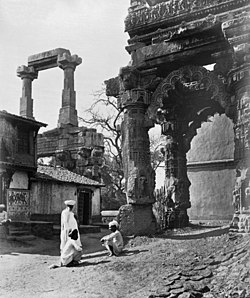 Photograph credit: Bourne & Shepherd; retouched by Yann ForgetThe Rudra Mahalaya Temple is an ancient temple complex at Siddhpur in the Patan district of Gujarat, India. The temple was completed in 1140 by Jayasimha Siddharaja, but in 1296, Alauddin Khalji sent an army under Ulugh Khan and Nusrat Khan, who dismantled the structure. In 1414 or 1415, the temple was further destroyed and the western part was converted into a congregational mosque by Muslim ruler Ahmad Shah I of the Muzaffarid dynasty. Apart from the mosque, the surviving fragments consist of two porches, a torana (ornamental gateway) and a few pillars.
 Photograph credit: Charles J. SharpThe southern plains gray langur (Semnopithecus dussumieri) is a species of Old World monkey native to the Indian subcontinent. It is about 62 cm (24 in) tall and lives in groups in various forest habitats, feeding mainly on leaves, fruit and flowers in the canopy, supplementing these with insects, gum, grasses, herbs and roots. The monkeys are considered sacred in India, and some are used by Hindu priests for religious purposes. They have adapted to living in close proximity to humans in urban settings; they are often fed by humans and accept cakes, millet, and other foods. The species is protected by law in India, but some are still persecuted for damaging crops, hunted for food and captured for pets.
This photograph of a female southern plains gray langur was taken in Kanha Tiger Reserve, in the Indian state of Madhya Pradesh. The park was created on 1 June 1955 and was designated a tiger reserve in 1973.


.jpg)


_female_head.jpg)
Featured list –

Sachin Tendulkar has scored more centuries in Test cricket than any other player.
Sachin Tendulkar played for India, widely acknowledged as one of the greatest batsmen of all time, he is the most prolific run-scorer in international cricket. Tendulkar has scored the highest number of centuries (100 or more runs) in Test matches and One Day International (ODI) matches organised by the International Cricket Council. His total of 51 centuries in Test matches is a world record for highest number of centuries by a batsman and his 49 centuries in ODI matches are the second highest number of centuries after Virat Kohli. He became the first and only cricketer to score 100 international centuries when he made 114 against Bangladesh in March 2012.
After making his Test debut in 1989, Tendulkar achieved his first century against England at Old Trafford, Manchester in 1990; he made 119 not out. In Test matches, Tendulkar has scored centuries against all the Test cricket playing nations, and is the second batsman to score 150 against each of them. He has scored a century in at least one cricket ground of all Test cricket playing nations, except Zimbabwe. In October 2010, Tendulkar went past Brian Lara's record of 19 scores of 150 or more by hitting his 20th against Australia in Bangalore. He made his highest score in 2004, when he made 248 not out against Bangladesh at the Bangabandhu National Stadium, Dhaka. Tendulkar has scored six double centuries and remained unbeaten on 15 occasions. His centuries have come in 30 different cricket grounds, with 27 of them being scored in venues outside India. Tendulkar has been dismissed nine times between scores of 90 and 99. (Full article...)- The National Film Award for Best Direction is an honour presented annually at India's National Film Awards ceremony by the National Film Development Corporation of India (NFDC), an organisation set up by the Indian Ministry of Information and Broadcasting. Since 1967, the award is given by a national panel appointed annually by the NFDC to a director for their work within Indian cinema. It is presented by the president of India at a ceremony held in New Delhi.
The winner is given a "Swarna Kamal" (Golden Lotus) certificate and a cash prize of ₹3,00,000. Including ties and repeat winners, the NFDC has presented a total of 53 Best Direction awards to 34 different directors. Although Indian cinema produces films in more than twenty languages, the performances of films that have won awards are of nine languages: Bengali (16 awards), Malayalam (14 awards), Hindi (11 awards), Tamil (4 awards), English, Kannada and Marathi (3 awards each), Assamese and Punjabi (1 each). (Full article...) 
Nani in 2018
Nani is an Indian actor, film producer and television presenter who works predominantly in Telugu films. Considered as one of the highest paid and leading actors of Telugu Cinema, He made his acting debut with Mohana Krishna Indraganti's 2008 comedy film Ashta Chamma, an Indian adaptation of Oscar Wilde's play The Importance of Being Earnest. After Ashta Chamma's commercial success, Nani played the lead roles in three Telugu films in the next two years: Ride (2009), Snehituda (2009) and Bheemili Kabaddi Jattu (2010). In 2011, Nani collaborated with B. V. Nandini Reddy on the romantic comedy film Ala Modalaindi which was profitable. The same year, he made his Tamil cinema debut with Anjana Ali Khan's Veppam, a crime drama set in the backdrop of North Chennai. The following year, Nani collaborated with S. S. Rajamouli and Gautham Vasudev Menon on the Telugu-Tamil bilingual Eega and the romance film Yeto Vellipoyindhi Manasu respectively. The former, which was about a murdered man reincarnating as a housefly and avenging his death, earned Nani an award in the Best Hero category at the 2013 Toronto After Dark Film Festival. He received the Nandi Award for Best Actor for his performance in Yeto Vellipoyindhi Manasu.
Nani ventured into film production in 2013 as a co-producer for the film D for Dopidi. He faced three box office failures in the upcoming years: Paisa (2013), Aaha Kalyanam (2014) and Janda Pai Kapiraju (2015). Nani termed it a "low phase" in his career and worked on the "planning of films and the timing of their release". He then played the lead role in Nag Ashwin's Yevade Subramanyam (2015), a film focusing on a businessperson's journey to the Himalayas seeking self exploration. Nani later starred in Maruthi's comedy film Bhale Bhale Magadivoy (2015), in which he played an absent minded scientist easily prone to distraction. It was the actor's first blockbuster success, and earned him the Critics Award for Best Actor – South at the 63rd Filmfare Awards South ceremony. With his subsequent releases, the profitable ventures Krishna Gaadi Veera Prema Gaadha (2016) and Gentleman (2016), he gained stardom in Telugu cinema. Nani later played the lead in the commercially successful Telugu films Majnu (2016), Nenu Local (2017), Middle Class Abbayi (2017), and Ninnu Kori (2017). In 2018, Nani featured as the host of the second season of the Telugu game show Bigg Boss. (Full article...)- The Pampa Award (or Pampa Prashasti) is a literary award in the Indian state of Karnataka. The award was established in 1987 by the government of Karnataka. It is the highest literary honor conferred by the Department of Kannada and Culture, Government of Karnataka State, and recognises works written in the Kannada language (1 of the 22 official languages of India).
The award is named after the first Kannada poet Adikavi Pampa. The award originally comprised a cash prize of ₹1 lakh (US$1,000), a shawl, a citation and a memento. The cash prize was increased to ₹3 lakh (US$3,100) in 2008. Prior to 1996, the awards were given for a best single work by a Kannada writer. Since then, the award has been given to writers for their lifetime contribution to the Kannada literature. The Pampa Prashasti is presented by the Chief Minister, during the Kadambotsava, a cultural festival held annually in Pampa's hometown of Banavasi in Uttara Kannada district. (Full article...)
The Dadasaheb Phalke Award is India's highest award in the field of cinema, given by the Government of India and presented annually at the National Film Awards. The recipient is honoured for their "outstanding contribution to the growth and development of Indian cinema" and is selected by a committee consisting of eminent personalities from the Indian film industry. The award comprises a Swarna Kamal (Golden Lotus) medallion, a shawl, and a cash prize of ₹1,000,000 (US$10,000).
Presented first in 1969, the award was introduced by the Government of India to commemorate Dadasaheb Phalke's contribution to Indian cinema. Phalke (1870–1944), who is popularly known as and often regarded as "the father of Indian cinema", was an Indian filmmaker who directed India's first full-length feature film, Raja Harishchandra (1913). (Full article...)- Aadukalam (transl. Arena) is a 2011 Indian Tamil-language drama film written and directed by Vetrimaaran and produced by S. Kathiresan. Vetrimaaran co-wrote the dialogues with Vikram Sugumaran. The film stars Dhanush and Taapsee Pannu with Kishore, V. I. S. Jayapalan, Naren, and Murugadoss playing supporting roles. The musical score was composed by G. V. Prakash Kumar while the cinematography and editing were respectively handled by Velraj and Kishore Te. The film's story revolves around Karuppu who is the understudy of an experienced cockfighter, Pettaikaran. When Karuppu wins in a cockfight against Pettaikaran's rival Rathnasamy, Pettaikaran, who is initially happy, becomes jealous of Karuppu's newfound popularity and plots his downfall.
Produced on a budget of ₹150-200 million, Aadukalam was released on 14 January 2011 and grossed ₹300 million according to a February 2011 report by The Economic Times. The film garnered awards and nominations in several categories, with particular praise for its direction, screenplay, Dhanush's performance, music, cinematography, and editing. The film has won 33 awards from 52 nominations. (Full article...) 
Vidya in 2023
Indian actress Vidya Balan made her acting debut in 1995 with the sitcom Hum Paanch, following which she made several unsuccessful attempts at a film career. Vidya then appeared in music videos for Euphoria, Pankaj Udhas, and Shubha Mudgal all directed by Pradeep Sarkar. She had her first film release with a leading role in Goutam Halder's Bengali film Bhalo Theko (2003). In 2005, she starred in Sarkar's Parineeta, an adaptation of Sarat Chandra Chattopadhyay's novel, which won her the Filmfare Award for Best Female Debut. Rajkumar Hirani's Lage Raho Munna Bhai (2006), a successful comedy sequel, saw her play a radio jockey opposite Sanjay Dutt.
Vidya played a variety of roles in 2007, including a woman suffering from multiple sclerosis in Mani Ratnam's drama Guru, a single mother in the comedy Heyy Babyy, and a dissociative identity disorder patient in the thriller Bhool Bhulaiyaa. All three films were commercially successful and established her as a leading lady. This was followed by two commercial failures in 2008. From 2009 to 2012, Vidya starred in five consecutive films that garnered her critical and commercial success. She played the mother of a child afflicted with progeria in Paa (2009), a seductive widow in Ishqiya (2010), and the real-life character of Sabrina Lal in No One Killed Jessica (2011). For portraying the actress Silk in the biopic The Dirty Picture, Vidya won the National Film Award for Best Actress. She next played a pregnant woman seeking revenge in the thriller Kahaani (2012), directed by Sujoy Ghosh. She was awarded the Filmfare Award for Best Actress for her roles in Paa, The Dirty Picture, and Kahaani, and the Filmfare Critics Award for Best Actress for Ishqiya. (Full article...)
The Chief Minister of Jharkhand is the chief executive of the Indian state of Jharkhand. In accordance with the Constitution of India, the governor is a state's de jure head, but de facto executive authority rests with the chief minister. Following elections to the Jharkhand Legislative Assembly, the state's governor usually invites the party (or coalition) with a majority of seats to form the government. The governor appoints the chief minister, whose council of ministers are collectively responsible to the assembly. Given the confidence of the assembly, the chief minister's term is for five years and is subject to no term limits.Chief Minister also serves as Leader of the House in the Legislative Assembly.
Seven people have served as the state's chief minister since Jharkhand's formation on 15 November 2000. Half of them, including the inaugural officeholder Babulal Marandi and Arjun Munda, represented the Bharatiya Janata Party (BJP). Hemant Soren, from the JMM, is the longest-serving chief minister. Three chief ministers, Shibu Soren, his son Hemant Soren, and Champai Soren, represented the Jharkhand Mukti Morcha (JMM). Shibu Soren's first term ended in just ten days, as he could not prove that he had the support of a majority of the house and was forced to resign. The state has also been governed by Madhu Koda, one of the few independents to become the chief minister of any state. In between their reigns, the state has also been under President's rule three times. Raghubar Das, of the BJP, was the first non-tribal and first chief minister to complete a full term in the state. Hemant Soren of the Jharkhand Mukti Morcha is the incumbent chief minister. (Full article...)- Velaiilla Pattadhari (transl. Unemployed graduate) is a 2014 Indian Tamil-language comedy drama film written and filmed by Velraj while also making his directorial debut. The film featured Dhanush, who produced the film under his production company Wunderbar Films, and Amala Paul in the lead roles. Saranya Ponvannan, Samuthirakani, Vivek, Surbhi and Amitash Pradhan played supporting roles. The film's story focuses on Raghuvaran (Dhanush), a civil engineering graduate who is unemployed for four years, and his search for a job. As soon as he finds employment, he faces competition from Arun Subramaniam (Amitash), the head of a rival engineering company, for a government project contract. The rest of the film shows how Raghuvaran overcomes the obstacles set by Arun. The soundtrack and score were composed by Anirudh Ravichander while the editing was handled by M. V. Rajesh Kumar.
Produced on a budget of ₹80 million, Velaiilla Pattadhari was released on 18 July 2014 and received positive reviews. It was commercially successful, grossing ₹530 million worldwide. The film won 19 awards from 31 nominations; its direction, performances of the cast members and music have received the most attention from award groups. (Full article...) 
Vidya Balan's performance in Kahaani garnered her several awards and nominations
Kahaani (transl. Story) is a 2012 Indian mystery thriller film directed and co-produced by Sujoy Ghosh. The film stars Vidya Balan as the protagonist, and features Parambrata Chatterjee, Nawazuddin Siddiqui, and Saswata Chatterjee in supporting roles. The film was edited by Namrata Rao, with the cinematography provided by Setu. Set in the city of Kolkata during the festivities of Durga Puja, Kahaani follows the life of a pregnant woman, Vidya Bagchi (Vidya Balan), in search of her husband, a man whose existence is denied by the people she encounters.
Made on a budget of ₹80 million (US$830,000), Kahaani was released on 9 March 2012 and grossed over ₹1.04 billion (US$11 million) worldwide after a 50-day theatrical run. The film garnered awards and nominations in several categories, with particular praise for its direction and the performance of the lead actress. As of 2014, the film has won 28 awards. (Full article...)
The Padma Bhushan is the third-highest civilian award of the Republic of India. Instituted on 2 January 1954, the award is given for "distinguished service of a high order", without distinction of race, occupation, position, or sex. The recipients receive a Sanad, a certificate signed by the President of India and a circular-shaped medallion with no monetary association. The recipients are announced every year on Republic Day (26 January) and registered in The Gazette of India—a publication used for official government notices and released weekly by the Department of Publication, under the Ministry of Urban Development. The conferral of the award is not considered official without its publication in the Gazette. The name of recipient, whose award have been revoked or restored, both of which require the authority of the President, is archived and they are required to surrender their medal when their name is struck from the register; none of the conferments of Padma Bhushan during 1980–1989 have been revoked or restored. The recommendations are received from all the state and the union territory governments, as well as from Ministries of the Government of India, the Bharat Ratna and the Padma Vibhushan awardees, the Institutes of Excellence, the Ministers, the Chief Ministers and the Governors of State, and the Members of Parliament including private individuals.
When instituted in 1954, the Padma Bhushan was classified as "Dusra Varg" (Class II) under the three-tier Padma Vibhushan awards, which were preceded by the Bharat Ratna in hierarchy. On 15 January 1955, the Padma Vibhushan was reclassified into three different awards as the Padma Vibhushan, the Padma Bhushan and the Padma Shri. The criteria included "distinguished service of a high order in any field including service rendered by Government servants", but excluded those working with the public sector undertakings with the exception of doctors and scientists. The 1954 statutes did not allow posthumous awards; this was subsequently modified in the January 1955 statute. The design was also changed to the form that is currently in use; it portrays a circular-shaped toned bronze medallion 1+3⁄4 inches (44 mm) in diameter and 1⁄8 inch (3.2 mm) thick. The centrally placed pattern made of outer lines of a square of 1+3⁄16 inches (30 mm) side is embossed with a knob carved within each of the outer angles of the pattern. A raised circular space of diameter 1+1⁄16 inches (27 mm) is placed at the centre of the decoration. A centrally located lotus flower is embossed on the obverse side of the medal and the text "Padma" is placed above and the text "Bhushan" is placed below the lotus written in Devanagari script. The State Emblem of India is displayed in the centre of the reverse side, together with the national motto of India, "Satyameva Jayate" (Truth alone triumphs) in Devanagari script, which is inscribed on the lower edge. The rim, the edges and all embossing on either side is of standard gold with the text "Padma Bhushan" of gold gilt. The medal is suspended by a pink riband 1+1⁄4 inches (32 mm) in width with a broad white stripe in the middle. It is ranked fifth in the order of precedence of wearing of medals and decorations of the Indian civilian and military awards. (Full article...)
Suriya is an Indian actor and film producer who works primarily in Tamil cinema. He made a commercially successful cinematic debut in Vasanth's Nerrukku Ner (1997). After few critical and commercial failures, Suriya collaborated with Vasanth again in Poovellam Kettuppar (1999), his first film with his future wife Jyothika.
In 2001, Suriya starred in Bala's Nandhaa as an ex-convict trying to find his place in society. The film was critically acclaimed and became a turning point in his career. His roles as a police officer in Gautham Vasudev Menon's Kaakha Kaakha (which became his first blockbuster) and a con artist in Bala's Pithamagan, established him as one of Tamil cinema's leading actors. Suriya's performances in both films were praised, winning him a Best Actor nomination for the former and the Best Supporting Actor for Pithamagan at the 51st Filmfare Awards South. The following year, he played dual roles—a hunchback and a college student—in Perazhagan. Suriya's performance was again praised, and he received his first Filmfare Best Actor award. He was also acclaimed for his performance as a student leader in Mani Ratnam's Aayutha Ezhuthu (2004). (Full article...)- Mani Ratnam is an Indian filmmaker who works predominantly in Tamil cinema. Regarded as one of the greatest Indian filmmakers, he is credited with redefining the "range and depth of Tamil cinema". As of 2025, he has directed 29 films, and produced over 15 under his production company Madras Talkies.
Mani Ratnam made his directorial debut, without formal training or education in filmmaking, with the Kannada film Pallavi Anu Pallavi (1983). The critically acclaimed film, which he also wrote, won him the Karnataka State Film Award for Best Screenplay. Then he entered Malayalam film industry with Unaroo, which was based on then prevailing trade union politics. His first Tamil film Pagal Nilavu (1985) was a commercial failure, but immediately followed Idaya Kovil (1985) found theatrical success. The following year, he made the romantic drama Mouna Ragam, which narrated the story of a young woman who is forced into an arranged marriage by her family. The critical and commercial success of the film established him as a leading filmmaker in Tamil cinema. His next release Nayakan, starring Kamal Haasan, was inspired by the life of the Bombay-based gangster Varadarajan Mudaliar. The film was submitted by India as its official entry for the 60th Academy Awards. Later in 2005, Nayakan was included in Time's "All-Time 100 Movies" list. Mani Ratnam followed this with the tragic romance Geethanjali (1989), which marked his Telugu cinema debut; the tragedy Anjali (1990), which narrated the story of an intellectually disabled child; and the crime drama Thalapathi (1991), loosely adapted from the Indian epic Mahabharata. In 1992, he made the romantic thriller Roja for Kavithalayaa Productions. The film was dubbed into many Indian languages, including Hindi, and its widespread success brought national recognition to Mani Ratnam. Three years later, he made Bombay (1995), which was based on the 1992–93 Bombay riots. Although controversial for its depiction of religious riots, the film met with wide critical acclaim and became commercially successful in India. (Full article...) 
Since Brabourne hosted its first international match in 1948, 35 Test centuries and 2 ODI centuries have been scored at the ground.
Brabourne Stadium is a cricket ground in Mumbai, India. It is the home of the Cricket Club of India and has played host to Ranji Trophy matches (including seventeen finals) and Indian Premier League matches, as well as being a Test, One Day International and Twenty20 International (T20) venue. It has a capacity of 20,000 spectators. The ground has hosted eighteen Test matches, the first in 1948 when India played the West Indies. It has also staged nine One Day International matches, the first of which was in 1989 when Australia lost to Pakistan by 66 runs. One T20 International has been played at the ground when India beat Australia by 7 wickets in 2007 (first T20 International to be played in India). Of the nine One Day Internationals played at the stadium, five matches (including the final) were staged during the ICC Champions Trophy in 2006.
The first Test century (100 or more runs in a single innings) scored at the ground was in 1948 by the West Indian Allan Rae in the first innings of the first Test match played at Brabourne Stadium. The first Indian to score a century at the Brabourne was Rusi Modi in the third innings of the same match. In total, 35 Test centuries have been scored at the ground in 18 Test matches. Virender Sehwag's 293, scored against Sri Lanka in 2009, is the highest Test innings achieved at the ground. The highest Test score by an overseas player is 194 by the West Indian Everton Weekes in 1948. Vijay Hazare has scored the most Test centuries at the ground with four. (Full article...)
Haider is a 2014 Indian crime-drama film directed by Vishal Bhardwaj, and produced by Bhardwaj and Siddharth Roy Kapur. The film stars Shahid Kapoor as the eponymous protagonist, and co-stars Tabu, Kay Kay Menon, Shraddha Kapoor, and Irrfan Khan. Bhardwaj wrote the dialogues for the film, and co-wrote the screenplay with Basharat Peer. Bhardwaj also composed the music and Gulzar wrote the lyrics. The film is a modern-day adaptation of William Shakespeare's tragedy Hamlet, and tells the story of Haider who searches for his missing father during the Kashmir conflict of 1995.
Produced on a budget of ₹240 million (US$2.5 million), Haider was released on 2 October 2014, and grossed ₹690 million (US$7.2 million) worldwide. The film garnered awards and nominations in several categories, with particular praise for its direction, performances of Shahid Kapoor and Tabu, music and production design. As of June 2015, the film has won 36 awards. (Full article...)- Neerja is a 2016 Indian Hindi-language biographical thriller film directed by Ram Madhvani and produced by Atul Kasbekar. The film stars Sonam Kapoor as Neerja Bhanot and features Shekhar Ravjiani, Shabana Azmi and Yogendra Tiku among others in supporting roles. The film's script and screenplay were penned by Saiwyn Quadras, the dialogue was written by Sanyuktha Chawla Sheikh, and the editing was handled by Monisha R Baldawa. Set in Karachi, the plot of Neerja centres on the Libyan-backed Abu Nidal Organization's hijacking of Pan Am Flight 73 in Karachi, Pakistan, on 5 September 1986. The film is shown from the point of view of the flight's head purser, Neerja Bhanot, who died saving passengers on the hijacked flight.
Made on a budget of ₹200 million (US$3.1 million), Neerja was released on 19 February 2016, and grossed ₹1.35 billion (US$14 million) worldwide. The film won 31 awards from 45 nominations; its direction and performances of the cast members have received the most attention from award groups. (Full article...) - Karisma Kapoor is an Indian actress widely known for her work in Hindi films. She made her acting debut in 1991 at the age of seventeen in the romance Prem Qaidi, which was a box office hit. She then appeared in successful ventures, drama Sapne Sajan Ke (1992), and action drama Jigar (1992). She had her first commercial success in a leading role in romantic action drama Anari (1993), which was a moderate success and was one of the highest-grossing Hindi films of 1993. Between 1993–1996 she featured in several highly successful films, including the comedy drama Raja Babu (1994), action drama Suhaag (1994), action comedy Andaz (1994), the comedies Coolie No. 1 (1995), Saajan Chale Sasural (1996), and Hero No. 1 (1997), and the action thriller Jeet (1996). The success of these films marked a turning point in her career, and established Kapoor as one of the leading actresses in Hindi cinema.
Kapoor's career prospects improved in 1996 when Dharmesh Darshan cast her in his romantic drama Raja Hindustani. With worldwide earnings of ₹763.4 million (US$8.0 million), it emerged as the highest-grossing film of the year and the fourth highest-grossing film in India of the 1990s. The film earned her praise from critics, and Kapoor won her first Filmfare Award for Best Actress. The following year, she received widespread recognition as well as the National Film Award and Filmfare Award for Best Supporting Actress for portraying a headstrong dancer in Dil To Pagal Hai, a musical romantic drama produced by Yash Raj Films. Subsequently, she played leading roles in several blockbuster films, including the comedies Biwi No.1 (1999), the ensemble family drama Hum Saath-Saath Hain (1999), and the romantic comedy Dulhan Hum Le Jayenge (2000). Her acclaimed performance of a disillusioned sister of Hrithik Roshan's character in the crime drama Fiza (2000) which earned her a second Best Actress award at Filmfare. The following year, she portrayed actress Zubeida Begum in the biographical drama Zubeidaa (2001), won her a Filmfare Award for Best Actress (Critics). In 2002, she portrayed a troubled daughter-in-law in the revenge-seeking war drama Shakti: The Power. (Full article...) 
Chopra in 2016
Priyanka Chopra is an Indian actress who has received several awards and nominations including two National Film Award, five Filmfare Awards, eight Producers Guild Film Awards, eight Screen Awards, six IIFA Awards, and two People's Choice Awards. In 2000, she participated in the Femina Miss India contest, where she finished second, winning the Femina Miss India World title. She then entered the Miss World pageant and was crowned Miss World 2000, becoming the fifth Indian to win the contest. Chopra made her Bollywood film debut with a supporting role in the 2003 spy thriller The Hero, which earned her the Stardust Award for Best Supporting Actress. The same year, her performance in the romantic musical Andaaz won her the Filmfare Award for Best Female Debut and a nomination for Best Supporting Actress at the same ceremony. For her portrayal of a seductress in the romantic thriller Aitraaz, Chopra won the Filmfare Award for Best Performance in a Negative Role and received her second nomination for Best Supporting Actress. The same year, she was nominated for the IIFA Award for Best Actress for the romantic comedy Mujhse Shaadi Karogi.
Chopra starred as a troubled model in the drama Fashion (2008), for which she won many Best Actress awards in India including the National Film Award for Best Actress and the Filmfare Award in the same category. In 2010, she received several Best Actress nominations for playing a feisty Marathi woman in the caper thriller Kaminey, winning her second consecutive Producers Guild Film Award for Best Actress in a Leading Role after Fashion. The same year, she was nominated for the Screen Award for Best Actress for playing twelve distinct roles in the social comedy film What's Your Raashee?. For her portrayal of a serial killer, in the 2011 neo-noir 7 Khoon Maaf, she won the Filmfare Award for Best Actress (Critics), in addition to a Best Actress nomination at the same ceremony. (Full article...)
Chhetri has scored 95 international goals for India
Sunil Chhetri is an Indian former professional footballer who represented the India national football team as a forward. He is the country's all-time top goalscorer and most-capped player. He has scored 95 goals in 157 official international appearances since his debut on 12 June 2005 against Pakistan.
On 9 December 2011, Chhetri netted twice in a match (also known as a brace) in India's 3–1 semi-final win over Maldives in the 2011 SAFF Championship to take his tally to 31, thus becoming his country's all-time leading goalscorer surpassing the 30 set by I. M. Vijayan.. With his 95 international goals, he is the fourth-highest international goalscorer behind Cristiano Ronaldo of Portugal, Lionel Messi of Argentina and Ali Daei of Iran. He is also the second highest goalscorer from Asia. On 21 June 2023, Chhetri scored a hat-trick for India in a 4–0 win over Pakistan to take his tally to 90 international goals, thus becoming the second-highest international goalscorer from Asia of all time. (Full article...)
The Chief Minister of Karnataka is the head of government of the Indian state of Karnataka. As per the Constitution of India, the governor of Karnataka is the state's de jure head, but de facto executive authority rests with the chief minister, a template applicable to all other Indian states. Following elections to the Karnataka Legislative Assembly, the governor usually invites the political party (or a coalition of political parties) with a majority of assembly seats to form the government in the state. The governor appoints the chief minister, whose council of ministers is collectively responsible to the assembly. Given that he/she has the confidence of the assembly, the chief minister's term is for five years, renewable, and is subject to no term limits. Usually, the chief minister also serves as leader of the house in the legislative assembly.
Historically, this office replaced that of the dewan of Mysore of the erstwhile Kingdom of Mysore with India's constitution into a republic. Since 1947, there have been a total of twenty-three chief ministers of Mysore (as the state was known before 1 November 1973) and Karnataka. A majority of them belonged to the Indian National Congress (INC) party, including the inaugural officeholder K. Chengalaraya Reddy. The current and the longest-serving chief minister is Siddaramaiah, who has held the office for over seven years. INC's Veerendra Patil had the largest gap between two terms (over eighteen years). B. D. Jatti, served as the country's fifth vice president, while H. D. Deve Gowda, went on to become the eleventh prime minister of India. B. S. Yediyurappa who was the first chief minister from the Bharatiya Janata Party (BJP), served as the chief minister of the state for four terms in 2007, 2008, 2018 and 2019, the only one to do so. S. R. Bommai served as the chief minister representing the Janata Parivar, whose son Basavaraj Bommai became chief minister representing the BJP in 2021 becoming the second father-son duo to serve office after Deve Gowda and HD Kumaraswamy. There have been six instances of president's rule in Karnataka, most recently from 2007 to 2008. (Full article...)
Khan in 2017
Indian actor Aamir Khan first appeared on screen at the age of eight in a minor role in his uncle Nasir Hussain's film Yaadon Ki Baaraat (1978). In 1983, he acted in and worked as an assistant director on Paranoia, a short film directed by Aditya Bhattacharya, following which he assisted Hussain on two of his directorial ventures—Manzil Manzil (1984) and Zabardast (1985). As an adult, Khan's first acting project was a brief role in the 1984 experimental social drama Holi.
Khan's first leading role came opposite Juhi Chawla in the highly successful tragic romance Qayamat Se Qayamat Tak (1988). His performance in the film and in the thriller Raakh (1989) earned him a National Film Award – Special Mention. He went on to establish himself with roles in several lucrative films of the 1990s, including the romantic drama Dil (1990), the comedy-drama Hum Hain Rahi Pyar Ke (1993), and the romance Raja Hindustani (1996). He also played against type in the Deepa Mehta-directed Canadian-Indian co-production Earth (1998). In 1999, Khan launched a production company, Aamir Khan Productions, whose first release Lagaan (2001) was nominated for the Academy Award for Best Foreign Language Film, and earned him the National Film Award for Best Popular Film. Also in 2001, he starred alongside Saif Ali Khan and Akshaye Khanna in the acclaimed coming-of-age drama Dil Chahta Hai. Lagaan and Dil Chahta Hai are cited in the media as defining films of Hindi cinema. After a three-year hiatus, Khan portrayed the eponymous lead in Mangal Pandey: The Rising (2005), a period film that underperformed at the box office, after which he played leading roles in two top-grossing films of 2006—Fanaa and Rang De Basanti. (Full article...)
Map showing the Indian Princely states during the rebellion of 1857
The Victoria Cross (VC) was introduced in Great Britain on 29 January 1856 by Queen Victoria to reward acts of valour during the Crimean War. For the Indian Mutiny (also known as India's First War of Independence, Revolt of 1857, or the Sepoy Mutiny) the VC was awarded to 182 members of the British Armed Forces, the Honourable East Indies Company (HEIC) and civilians under its command. The VC is the highest British honour and is awarded for valour "in the face of the enemy". Created in 1856 for the British Army and Royal Navy, eligibility was extended in 1857 to members of the HEIC and in 1858 to non-military personnel bearing arms as volunteers.
Queen Victoria created the tradition of the British monarch presenting the VC to the recipient, personally presenting 74 of the 111 awards for the Crimean War. Many VCs for the Indian Mutiny were sent to India for presentation and while there is documentation for 42 presentations, the information on 51 presentations which were likely presented in India is vague and it not known if the medal was personally presented or received by post. There were 18 Indian Mutiny VCs sent to next of kin where the award was posthumous, or the recipient died before presentation. The Queen personally presented 63 Indian Mutiny awards after the recipients returned to the UK. (Full article...)
The Padma Bhushan is the third-highest civilian award of the Republic of India. Instituted on 2 January 1954, the award is given for "distinguished service of a high order", without distinction of race, occupation, position, or sex. The recipients receive a Sanad, a certificate signed by the President of India and a circular-shaped medallion with no monetary association. The recipients are announced every year on Republic Day (26 January) and registered in The Gazette of India—a publication used for official government notices and released weekly by the Department of Publication, under the Ministry of Urban Development. The conferral of the award is not considered official without its publication in the Gazette. The name of recipient, whose award have been revoked or restored, both of which require the authority of the President, is archived and they are required to surrender their medal when their name is struck from the register; none of the conferments of Padma Bhushan during 1954–1959 have been revoked or restored. The recommendations are received from all the state and the union territory governments, as well as from Ministries of the Government of India, the Bharat Ratna and the Padma Vibhushan awardees, the Institutes of Excellence, the Ministers, the Chief Ministers and the Governors of State, and the Members of Parliament including private individuals.
When instituted in 1954, the Padma Bhushan was classified as "Dusra Varg" (Class II) under the three-tier Padma Vibhushan awards, which were preceded by the Bharat Ratna in hierarchy. The original specification of the award was a circle made of standard silver 1+3⁄8 inches (35 mm) in diameter, with rims on both the sides. A centrally located lotus flower was embossed on the obverse side of the medal and the text "Padma Vibhushan" written in Devanagari script was inscribed above the lotus along the upper edge of the medal. A floral wreath was embossed along the lower edge and a lotus wreath at the top along the upper edge. The State Emblem of India was placed in the centre of the reverse side with the text "Desh Seva" in Devanagari Script on the lower edge. The medal was suspended by a pink riband 1+1⁄4 inches (32 mm) in width divided into three equal segments by two white vertical lines. (Full article...)
The Padma Bhushan is the third-highest civilian award of the Republic of India. Instituted on 2 January 1954, the award is given for "distinguished service of a high order", without distinction of race, occupation, position, or sex. The recipients receive a Sanad, a certificate signed by the President of India and a circular-shaped medallion with no monetary association. The recipients are announced every year on Republic Day (26 January) and registered in The Gazette of India, a publication used for official government notices and released weekly by the Department of Publication, under the Ministry of Urban Development. The conferral of the award is not considered official without its publication in the Gazette. The names of recipients whose awards have been revoked or restored, both of which require the authority of the President, are archived, and recipients who are struck from the register are required to surrender their medals; none of the conferments of Padma Bhushan during 1990–1999 have been revoked or restored. The recommendations are received from all the state and the union territory governments, as well as from Ministries of the Government of India, the Bharat Ratna and the Padma Vibhushan awardees, the Institutes of Excellence, the Ministers, the Chief Ministers and the Governors of State, and the Members of Parliament including private individuals.
When instituted in 1954, the Padma Bhushan was classified as "Dusra Varg" (Class II) under the three-tier Padma Vibhushan awards, which were preceded by the Bharat Ratna in hierarchy. On 15 January 1955, the Padma Vibhushan was reclassified into three different awards as the Padma Vibhushan, the Padma Bhushan and the Padma Shri. The criteria included "distinguished service of a high order in any field including service rendered by Government servants", but excluded those working with the public sector undertakings with the exception of doctors and scientists. The 1954 statutes did not allow posthumous awards; this was subsequently modified in the January 1955 statute. The design was also changed to the form that is currently in use; it portrays a circular-shaped toned bronze medallion 1+3⁄4 inches (44 mm) in diameter and 1⁄8 inch (3.2 mm) thick. The centrally placed pattern made of outer lines of a square of 1+3⁄16 inches (30 mm) side is embossed with a knob carved within each of the outer angles of the pattern. A raised circular space of diameter 1+1⁄16 inches (27 mm) is placed at the centre of the decoration. A centrally located lotus flower is embossed on the obverse side of the medal and the text "Padma" is placed above and the text "Bhushan" is placed below the lotus written in Devanagari script. The State Emblem of India is displayed in the centre of the reverse side, together with the national motto of India, "Satyameva Jayate" (Truth alone triumphs) in Devanagari script, which is inscribed on the lower edge. The rim, the edges and all embossing on either side is of standard gold with the text "Padma Bhushan" of gold gilt. The medal is suspended by a pink riband 1+1⁄4 inches (32 mm) in width with a broad white stripe in the middle. It is ranked fifth in the order of precedence of wearing of medals and decorations of the Indian civilian and military awards. (Full article...)
Bowlers have taken thirteen five-wicket hauls in Tests and one fifer in One Day International matches played at Brabourne.
Brabourne Stadium is a cricket ground in Mumbai, India. It is the home of the Cricket Club of India and has played host to Ranji Trophy matches (including seventeen finals) and Indian Premier League matches, as well as being a Test, One Day International (ODI) and Twenty20 International (T20I) venue. It has a capacity of 20,000 spectators. The ground has hosted 18 Test matches, the first in 1948 when India played the West Indies. It has also staged nine ODI matches, the first of which was in 1989 when Australia lost to Pakistan by 66 runs. One T20I has been played at the ground when India beat Australia by seven wickets in 2007. This was also the first T20I to be played in India. Of the nine ODIs played at the stadium, five matches (including the final) were staged during the ICC Champions Trophy in 2006.
In cricket, a five-wicket haul (also known as a "five-for" or "fifer") refers to a bowler taking five or more wickets in a single innings. This is regarded as a notable achievement. The first bowler to take a five-wicket haul in a Test match at Brabourne Stadium was Prior Jones in 1949, for the West Indies against India. The first Indian to take a five-wicket haul in a Test at the Brabourne was Vinoo Mankad, who did so in a game against Pakistan in 1952. B. S. Chandrasekhar is the only bowler to have taken two five-wicket hauls in Test matches at the ground, doing so against the West Indies in 1966 and against England in 1973. Chandrasekhar is also the only bowler to have taken ten wickets in a match at Brabourne, he took eleven wickets against the West Indies in 1966. Twelve bowlers have taken thirteen five-wicket hauls at the ground. Sri Lankan bowler Farveez Maharoof's five wicket haul against the West Indies in 2006, is the only one achieved during an ODI. Khaleel Ahmed's three wickets for thirteen runs in an ODI versus West Indies in 2018 are the best figures by an Indian at the ground in the fifty over format. The best bowling figures in the only T20I staged at the ground featuring India and Australia in 2007 are Irfan Pathan's two wickets for thirty-four runs. (Full article...)


_(cropped).jpg)


.jpg)


 Good article –

- The 2025 Indian Premier League final was a Twenty20 (T20) cricket match played at the Narendra Modi Stadium in Ahmedabad, India, on 3 June 2025 to determine the winner of the 2025 Indian Premier League (IPL). It was originally scheduled to be played at Eden Gardens in Kolkata, on 25 May 2025 before being rescheduled.
It was played between Royal Challengers Bengaluru and Punjab Kings. Punjab won the toss and elected to field first; Bengaluru scored 190/9 in their innings. In the second innings, Punjab scored 184/7. Bengaluru won the match by 6 runs to win their maiden IPL trophy after 18 years. (Full article...) - Missamma is the soundtrack of the 1955 Indian Telugu-language film of the same name directed by L. V. Prasad. Composed by S. Rajeswara Rao, the soundtrack contains 11 songs with lyrics by Pingali. The film was written by Chakrapani, who co-produced it with B. Nagi Reddi for Vijaya Productions. N. T. Rama Rao and Savitri played the lead roles in the Telugu version, with Akkineni Nageswara Rao, Jamuna, S. V. Ranga Rao, Rushyendramani, Relangi and Ramana Reddy in supporting roles.
Until Bhanumathi was replaced by Savitri as the female lead, she was planned to provide vocals for her character in the film. After Bhanumathi left, P. Leela was chosen as Savitri's playback singer. Unlike their previous films, Vijaya Productions preferred A. M. Rajah over Ghantasala to sing for Rama Rao in the Telugu version. Chakrapani chose P. Susheela to sing the remaining two songs featuring Jamuna, and Venkata Ramaiah sang two uncredited songs. (Full article...) - Nadodi Mannan (transl. The Vagabond and the King) is a 1958 Indian Tamil-language action adventure film directed by M. G. Ramachandran in his debut as a filmmaker. He stars in dual roles alongside P. Bhanumathi, M. N. Rajam and B. Saroja Devi. P. S. Veerappa, M. N. Nambiar, M. G. Chakrapani, T. K. Balachandran and Chandrababu play supporting roles. The film revolves around a king being replaced by a look-alike after getting abducted on the eve of his coronation. The look-alike begins to implement social and economic reforms to uplift the poor which irks the kingdom's high priest, who has kidnapped the very person the look-alike resembles. The rest of the film shows how the look-alike saves the man he impersonates and defeats the high priest.
Made on a budget of ₹18 lakh, Ramachandran co-produced the film with Chakrapani and R. M. Veerappan under the banner of Em.Gee.Yar Pictures. C. Kuppusami, K. Srinivasan, and P. Neelakantan were in charge of the screenplay. Kannadasan and Ravindar undertook the responsibility of writing the dialogues. The cinematography was handled by G. K. Ramu while K. Perumal and C. P. Jambulingam did the editing. S. M. Subbaiah Naidu and N. S. Balakrishnan composed the film's soundtrack and score. Songs from the soundtrack like "Thoongathey Thambi Thoongathey", "Thadukkathey", "Summa Kedandha", and "Senthamizhe" became popular hits. (Full article...)
Mesrop Davtian Taghiadian or Taghiadiants (Armenian: Մեսրոպ Դաւթեան Թաղիադեան; 2 January 1803 – 10 June 1858) was a nineteenth-century Armenian writer, educator and journalist. He wrote prolifically in Classical Armenian and is regarded as one of the first Armenian authors of the Romantic movement, as well as one of the earliest modern Armenian fiction writers.
Taghiadian was born in Iranian-ruled Armenia, but lived most of his life away from his homeland. He was educated at the seminary of Etchmiadzin and traveled throughout Armenia with his teacher collecting folk songs and oral traditions. He attained the rank of deacon in the Armenian Church. Taghiadian emigrated to India to pursue further education. He graduated from Bishop's College in Calcutta (then ruled by the British East India Company, now modern Kolkata) in 1830 and published his first literary works during his time there. In 1831, Taghiadian left India and unsuccessfully attempted to establish a school of his own, first in New Julfa, Iran, then in Armenia. He worked as a teacher in Iran and married Tangkhatun Setian, the daughter of an Armenian merchant, who died in 1837. Taghiadian then lived briefly in Constantinople, where he narrowly escaped a plot against him by the Armenian Patriarch and again settled in Calcutta. In the 1840s and 1850s, he published an Armenian periodical, Azgaser, and ran an Armenian school for boys and girls. Having closed his periodical and school and frequently clashing with other members of the Armenian community of Calcutta, Taghiadian decided to return to Armenia. He fell ill and died on the way to Armenia in Shiraz, Iran in 1858. (Full article...)- Bajirao Mastani is a 2015 Indian Hindi-language epic historical romantic tragedy film directed by Sanjay Leela Bhansali, who co-produced it with Eros International and composed its soundtrack. The film stars Ranveer Singh, Deepika Padukone and Priyanka Chopra with Tanvi Azmi, Vaibhav Tatwawaadi, Milind Soman, Mahesh Manjrekar and Aditya Pancholi in supporting roles. Based on Nagnath S. Inamdar's Marathi novel Rau, Bajirao Mastani narrates the story of the Maratha Peshwa Bajirao I (1700–1740) and his second wife, Mastani.
Conceived as early as the 1990s, Bhansali announced the film in 2003 but production was delayed several times due to its changing cast. A passion project for Bhansali, Bajirao Mastani spent over a decade in development hell before being revived in 2014. Extensive research was done before moving into pre-production, which required the creation of twenty-two highly detailed sets, and numerous costumes and props to strengthen its opulence and high production value. Principal photography took place on sets constructed in Film City, with some portions being filmed on location. Visual effects and CGI were used in post-production to enhance a number of scenes. (Full article...)
Sivananda Yoga is a spiritual yoga system founded by Sivananda and Vishnudevananda; it includes the use of asanas (yoga postures) but is not limited to them as in systems of yoga as exercise. Vishnudevananda named this system, as well as the international Sivananda Yoga Vedanta Centres organisation responsible for propagating its teachings, after his guru, Sivananda.
Some other yoga organisations follow Sivananda's teachings, including the Divine Life Society (founded by Sivananda), Bihar School of Yoga, Integral Yoga (Satchidananda) and the Chinmaya Mission, but use different names for their yoga systems. Sivananda Yoga is the yoga system of the Sivananda Yoga Vedanta Centre organisation, and is based on Sivananda's teachings to synthesise the principles of the four paths of yoga (Yoga of Synthesis) along with the five points of yoga compiled by Vishnudevananda. The four classical paths of yoga consist of Karma Yoga, Bhakti Yoga, Raja Yoga and Jnana Yoga. These are: Proper Exercise (āsana), Proper Breathing (prāṇāyāma), Proper Relaxation (śavāsana), Proper Diet and Positive Thinking (vedānta) and Meditation (dhyāna). (Full article...)- The Prince of Wales riots occurred in Bombay (now also known as Mumbai), British India, between 17 and 20 November 1921 during the visit of Edward, Prince of Wales. The visit came during the non-cooperation movement protests for Indian self-rule, led by Mahatma Gandhi and the Indian National Congress. Gandhi had allied the mainly-Hindu Congress with the Muslim Khilafat Movement, who were concerned about the possibility that the British might depose the Ottoman Caliph. Gandhi called for his supporters to boycott the prince's visit and carry out a general strike (hartal).
The Prince was welcomed by members of the Parsi, Jewish and Anglo-Indian minorities. They were attacked by a Hindu and Muslim mob who also burnt shops, trams and cars. Parsi-owned liquor shops were a particular target. Anglo-Indian and Parsi mobs formed in response to the violence and attacked those they suspected of supporting the non-cooperation movement. Gandhi was shocked by the violence and declared he would undertake a hunger strike until peace was restored. The violence abated on 20 November, at least 58 lives having been lost. After the riots the British imprisoned thousands of non-cooperation movement supporters and Gandhi attempted to rebuild the movement with support from the minorities as well as the Hindu-Muslim majority. (Full article...)
Rāhula (born c. 534 BCE or 451 BCE) was the only son of Siddhārtha Gautama, commonly known as the Buddha, and his wife, princess Yaśodharā. He is mentioned in numerous Buddhist texts, from the early period onward. Accounts about Rāhula indicate a mutual impact between Prince Siddhārtha's life and the lives of his family members.
According to the Pāli tradition, Rāhula was born on the day of Prince Siddhārtha's renunciation, and was therefore named Rāhula, meaning a fetter on the path to enlightenment. (Full article...)
Takshaka steals earrings from Uttanaka. Illustrated by Asi in a folio of Razmnama.
Uttanka (Sanskrit: उत्तङ्क) is a rishi (sage) featured in Hindu literature. He is described to have resided in the Maru desert. The primary source of this account is found in the Hindu epic Mahabharata.
In the earliest version, Uttanka is described as the disciple of the sage Veda. In the second version, his guru is Gautama. In both legends, he is a learned sage who goes through many hurdles in procuring the earrings demanded by his guru's wife as the fee for the teacher (gurudakshina). (Full article...)
Gopal Mukund Huddar (17 June 1902 – c. 1981), also known as Balaji Huddar, was an Indian anti-colonial activist and anti-fascist soldier. A founding member of the Rashtriya Swayamsevak Sangh (RSS), a Hindutva paramilitary organisation, Huddar served as its first sarkaryavah (transl. General Secretary). Upon travelling to London to study journalism, exposure to left-wing and anti-fascist circles led him to volunteer for the International Brigades in the Spanish Civil War. Due to his shift towards communism and his calls for the RSS to engage in the Indian independence movement, the leadership of the organisation, particularly its sarsanghchalak (transl. Chief) K. B. Hedgewar, increasingly estranged themselves from him. (Full article...)- Ventilator is a 2016 Indian Marathi-language comedy drama film written and directed by Rajesh Mapuskar and produced by Priyanka Chopra. The film features an ensemble cast of more than 100 actors, including Ashutosh Gowariker, Jitendra Joshi, Sulbha Arya, and Sukanya Kulkarni. It tells the story of the Kamerkar family, whose oldest and most beloved member enters a coma and is put on a medical ventilator a few days before the Ganesh Chaturthi festival celebrations.
Mapuskar conceived the film after one of his family members was hospitalised and put on a ventilator; he started writing the script after noting the reaction of his family members, trying to treat the difficult situation with humour. On its completion, he approached several producers, who were sceptical and tried to discourage him from making it in Marathi. Later, Chopra accepted it to produce under her production company Purple Pebble Pictures. (Full article...) - Anniyan (/ənnɪjən/ transl. Stranger) is a 2005 Indian Tamil-language psychological action thriller film directed by Shankar and produced by V. Ravichandran. The film stars Vikram as a meek law-abiding lawyer who has dissociative identity disorder, and develops two other identities: a playboy fashion model, and a murderous vigilante seeking to eradicate corruption in India. The cast also includes Sadha, Prakash Raj, Vivek, Nedumudi Venu, and Nassar.
Shankar conceived the film in mid-2003 during the post-production period of his previous film Boys. He based the film on his own life experiences during his formative years when he was disturbed by what he saw around him and his eventual displeasure with the society. Pre-production for Anniyan began in November 2003 and principal photography in March 2004. The making of the film, which included numerous production delays, took 14 months. The film was shot at Hyderabad, Thanjavur, Viluppuram and Chennai. The song sequences were filmed in Mumbai, Malaysia, Amsterdam and Tenkasi. The film was notable for its recreation of the Tyagaraja Aradhana music festival and the extensive use of time slice photography in an action sequence. (Full article...)
Biryani is a mixed rice dish originating in South Asia, traditionally made with rice, meat (chicken, goat, beef), seafood (prawns or fish), or vegetables, and spices. It was present in Mughal-era India, though the precise date and place of origin are debated. It is thought to derive from a Persian rice dish, either pilau or birinj biryan. The dish makes use of slow-cooking as in Persian pilau, combined with Persian-style yoghurt-marinated meat and a spicy Indian style of cooking; it was likely developed in the Mughal court kitchens. It is also possible that biryani was brought to South India before the Mughal era, or that pilau was brought to India and biryani was developed from it before being adopted by the Mughals.
Biryani is one of the most popular dishes in South Asia and among the South Asian diaspora. The dish is often associated with the region's Muslim population in particular, but is nevertheless a mainstream culinary staple embraced by every demographic. Similar dishes are prepared in many other countries, often with local variations, and often brought there by South Asian diaspora populations. Biryani is the most-ordered dish on Indian online food ordering and delivery services, is used in weddings and celebrations throughout the region, and has been described as the most popular dish in India. (Full article...)- Kannum Kannum Kollaiyadithaal (transl. 'If eyes steal each other') is a 2020 Indian Tamil-language romantic heist comedy film written and directed by Desingh Periyasamy in his directorial debut. The film stars Dulquer Salmaan, Ritu Varma, Rakshan, and Niranjani Ahathian. Gautham Vasudev Menon and Uday Mahesh play supporting roles. Kannum Kannum Kollaiyadithaal marked the debuts of Rakshan and Nirinjani. The plot is centred on a pair of con artists who engage in various scams while juggling romantic relationships.
Development of the film began in 2017, when Salmaan showed interest in collaborating with Periyasamy. Principal photography took place in Goa and Delhi from 18 November 2017 to 24 July 2018. The film features a score composed by Masala Coffee and Harshavardhan Rameshwar. (Full article...)
Puri (also poori) is a type of deep-fried flatbread, with an unleavened wheat dough. Puri originated from the northern Indian subcontinent, where it is one of the most common flatbreads; it is a staple food in parts of the subcontinent. It resembles chapati but is deep-fried. Similar deep-fried breads from the region include bhatura, luchi, and kachori.
Puri is made of wheat flour, typically atta, which forms a dough with oil and water. This is rolled into circles that inflate while deep-frying. Due to the cooking method, puri is high in fat and calories. Puris are commonly served as a breakfast or snack, typically paired with other foods. It may be paired with savory foods, such as potato or chickpea curry, or with sweets. Variants of puri may use different types of flour or add puréed vegetables to the dough. Other variants are stuffed. Small, spherical puris are used for panipuri and sev puri, while flat puris are used for papri chaat and bhel puri; these dishes are classified as chaat. (Full article...)
Community health worker preparing a vaccine in Odisha, India
Women's health in India can be examined in terms of multiple indicators, which vary by geography, socioeconomic standing and culture. To adequately improve the health of women in India multiple dimensions of wellbeing must be analysed in relation to global health averages and also in comparison to men in India. Health is an important factor that contributes to human wellbeing and economic growth.
Currently, women in India face a multitude of health problems, which ultimately affect the aggregate economy's output. Addressing the gender, class or ethnic disparities that exist in healthcare and improving the health outcomes can contribute to economic gain through the creation of quality human capital and increased levels of savings and investment. (Full article...)
The Gateway of India is an arch-monument, completed in 1924, on the waterfront of Mumbai, Maharashtra, India. It was erected to commemorate the landing of King George V of the United Kingdom for his coronation as the Emperor of India in December 1911 at Strand Road near Wellington Fountain. He was the first British monarch to visit India.
The foundation stone was laid in March 1913 for a monument built in the Indo-Saracenic style, inspired by elements of 16th-century Gujarati architecture. The final design of the monument by architect George Wittet was sanctioned only in 1914, and construction was completed in 1924. The structure is a memorial arch made of basalt, which is 26 metres (85 feet) high, with an architectural resemblance to a triumphial arch as well as Gujarati architecture of the time. (Full article...)- Wonderwall Music is the debut solo studio album by the English musician George Harrison and the soundtrack to the 1968 film Wonderwall, directed by Joe Massot. Released in November 1968, it was the first solo album by a member of the Beatles, and the first album issued on the band's Apple record label. The tracks are mostly instrumental pieces, with some featuring non-English language vocals and one track with English lyrics, mostly short musical vignettes. Following his Indian-styled songs for the Beatles since 1966, he used the film score to further promote Indian classical music by introducing rock audiences to instruments that were relatively little-known in the West – including shehnai, sarod, tar shehnai, tanpura and santoor. The Indian pieces are contrasted by Western musical selections, in the psychedelic rock, experimental, country and ragtime styles.
Harrison recorded the album between November 1967 and February 1968, with sessions taking place in London and Bombay. One of his collaborators on the project was classical pianist and orchestral arranger John Barham, while other contributors include Indian classical musicians Aashish Khan, Shivkumar Sharma, Shankar Ghosh and Mahapurush Misra. The Western music features contributions from Tony Ashton and his band the Remo Four, as well as guest appearances by Eric Clapton and Ringo Starr. Harrison recorded many other pieces that appeared in Wonderwall but not on the soundtrack album, and the Beatles' 1968 B-side "The Inner Light" also originated from his time in Bombay. Although the Wonderwall project marked the end of Harrison's direct involvement with Indian music as a musician and songwriter, it inspired his later collaborations with Ravi Shankar, including the 1974 Music Festival from India. (Full article...) - Maitreyi (fl. 8th century BCE) was an Indian philosopher who lived during the later Vedic period in ancient India. She is mentioned in the Brihadaranyaka Upanishad as one of two wives of the Vedic sage Yajnavalkya. In the Hindu epic Mahabharata and the Gṛhyasūtras, however, Maitreyi is described as an Advaita philosopher who never married. In ancient Sanskrit literature, she is known as a brahmavadini (an expounder of the Veda).
Maitreyi appears in ancient Indian texts, such as in a dialogue where she explores the Hindu concept of Atman (soul or self) in a dialogue with Yajnavalkya in the Brihadaranyaka Upanishad. According to this dialogue, love is driven by a person's soul, and Maitreyi discusses the nature of Atman and Brahman and their unity, the core of Advaita philosophy. This Maitreyi-Yajnavalkya dialogue is the topic of Sureshvara's varttika, a commentary. (Full article...) - Moondram Pirai (transl. The third crescent) is a 1982 Indian Tamil-language romantic drama film written, directed and filmed by Balu Mahendra. The film stars Kamal Haasan and Sridevi, while Y. G. Mahendran, Silk Smitha and Poornam Viswanathan played supporting roles. It revolves around a school teacher who rescues a woman with retrograde amnesia, from a brothel, and protects her in his house located in Ketti. The rest of the film shows how the woman recovers her memory with the teacher's help.
Moondram Pirai is the first film produced by G. Thyagarajan and G. Saravanan's Sathya Jyothi Films. It was predominantly shot in Ooty and Ketti, with further shooting also taking place in Bangalore. The music for the film was composed by Ilaiyaraaja, with lyrics written by Kannadasan, Vairamuthu and Gangai Amaran. It also featured the last song written by Kannadasan to be recorded before his death in 1981. (Full article...)
Safdarjung's tomb is a sandstone and marble mausoleum in Delhi, India. It was built in 1754 in the late Mughal Empire style for Nawab Safdarjung. The monument has an ambience of spaciousness and an imposing presence with its domed and arched red, brown and white coloured structures. Safdarjung, Nawab of Awadh, was made prime minister of the Mughal Empire (Wazir ul-Mamlak-i-Hindustan) when Ahmed Shah Bahadur ascended the throne in 1748.
The tomb, within a garden, is in a late version of the style of earlier Mughal imperial tombs, most famously the Taj Mahal, with inside "eight paradises" (hasht bihisht) or eight rooms around the main chamber under the dome, and a garden divided into four parts outside. This was the first time someone outside the immediate imperial Mughal family built themselves such a tomb and garden complex, reflecting the greatly diminished powers of the emperors by this date. (Full article...)
Shri Mayureshwar Mandir or Shri Moreshwar Temple is a Hindu temple (mandir) dedicated to Ganesha, god of wisdom. It is located in Moragaon in Pune District, about 65 km away from Pune city in the Indian state of Maharashtra. The temple is the starting and ending point of a pilgrimage of eight revered Ganesha temples called Ashtavinayaka.
Moragon is the foremost centre of worship of the Ganapatya sect, which considers Ganesha as the Supreme Being. A Hindu legend relates the temple to killing of the demon Sindhura by Ganesha. The exact date of building of the temple is unknown, though the Ganapatya saint Moraya Gosavi is known to be associated with it. The temple flourished due to the patronage of the Peshwa rulers and descendants of Moraya Gosavi. (Full article...)- Iyarkai (pronunciation, transl. Nature) is a 2003 Indian Tamil-language romantic drama film directed by S. P. Jhananathan in his directorial debut. The film stars Shaam and Radhika. Arun Vijay—who at the time was known as Arun Kumar—makes a cameo appearance and Bollywood actor Seema Biswas plays a supporting role. Iyarkai marks the debuts of Radhika and Biswas in Tamil cinema.
Based on Fyodor Dostoevsky's short story "White Nights", the film revolves around a young woman who is unable to accept the love of a sailor because she is in love with a ship captain who was lost at sea. It was made on a budget of one crore (₹10,000,000). Vidyasagar composed the music for the film. (Full article...) - Nani Gentleman (or simply Gentleman) is a 2016 Indian Telugu-language romantic thriller film directed by Mohan Krishna Indraganti who wrote the film with R. David Nathan. Produced by Sivalenka Krishna Prasad's Sridevi Movies, Gentleman stars Nani in double role alongside Nivetha Thomas, Surbhi,Tanikella Bharani, Srinivas Avasarala and Vennela Kishore. The film narrates the story of two women, Aishwarya and Catherine, whose respective lovers, Jayaram and Gautham, are lookalikes. When Gautham dies in an accident, Catherine suspects Jai's role in it and spies on him, which reveals further truths about Jai and the people around him, including Gautham.
The film marked Prasad's return to film production after an eight-year hiatus. P. G. Vinda was the film's director of photography. Mani Sharma composed the soundtrack and score; Marthand K. Venkatesh edited the film. Principal photography commenced in November 2015 and lasted until April 2016. Except for a schedule in Kodaikanal, the majority of the film's portions were shot in and around Hyderabad. (Full article...)
Enhydriodon is an extinct genus of otters known from Africa and South Asia that lived from the late Miocene to the early Pleistocene. It contains nine confirmed species, two debated species, and at least a few other undescribed species from Africa. The genus name means "otter tooth" in Ancient Greek and is a reference to its dentition rather than to the Enhydra genus, which includes the modern sea otter and its two prehistoric relatives. Enhydriodon belongs to the tribe Enhydriodontini (which also contains Sivaonyx and Vishnuonyx) in the otter subfamily Lutrinae.
The exact sizes and lengths of Enhydriodon species are unknown given the lack of complete fossils of it and most related fossil lutrines. Indian subcontinental species are estimated to be of weights similar to that of the extant sea otter, but African species are estimated to be heavier than extant lutrines. In particular, several species such as E. kamuhangirei, E. dikikae, and E. omoensis were estimated to weigh over 100 kg (220 lb). Given these weight estimates, the three species likely reached sizes comparable to extant bears or lions, making them the largest known mustelids to exist, although a lack of complete specimens makes precise estimates impossible. (Full article...)
.JPG)


.JPG)
.jpg)


News
- 23 May 2026 – 2026 Ebola epidemic
- India issues a travel advisory to Uganda, Democratic Republic of the Congo, and South Sudan amidst the Ebola outbreak. (The Hindu)
- 21 May 2026 – 2026 Ebola epidemic
- Africa–India relations
- India and the African Union postpone the upcoming India–Africa Forum Summit, originally scheduled to be held in New Delhi between May 28 and 31, due to the Ebola outbreak in parts of Africa. (The Hindu)
- India, South Korea, and Thailand issue travel alerts for the Democratic Republic of the Congo (DRC) and Uganda, while South Korea plans to impose a level-4 travel ban for parts of the DRC, especially the Ituri Province, due to the Ebola outbreak in both countries. (Türkiye) (Yonhap)
- 18 May 2026 –
- At least 13 people are killed and more than 20 others are injured, most seriously, when a tempo carrying wedding guests collides with a container truck on the Mumbai-Ahmedabad Highway in Palghar district, Maharashtra, India. (CNN-News18)
Did you know...
- ... that Kanailal Sarkar, the opposition candidate for mayor of Calcutta in 1963, had been jailed during the 1930 protest movement against British rule in India?
- ... that a viral video by an Indian influencer resulted in the sugar content of Bournvita being cut by almost 15 percent?
- ... that optical physicist Franklin Dollar grew up on a Native American reservation without electricity or running water?
- ... that Indian field hockey player Sukhbir Singh Gill continued to play professionally after being diagnosed with a brain tumor in 2006?
- ... that Arthur Newnham was born in India, played first-class cricket in England, and served as a military attaché in Moscow?
- ... that because the Green Bay Packers were named after a canned meat company, PETA called on the team to change their name?
Topics related to India
Timeline of Indian history, Indus Valley Civilisation, Dholavira, Science and technology in ancient India, Meluhha, Aryan invasion theory, Out of India theory, Greek conquests in India, Indian maritime history, Maurya Empire, Ashoka, Shunga Empire, Hoysala Empire, Vijayanagara, Satavahana dynasty, Indo-Greek Kingdom, Indo-Scythians, Indo-Parthian Kingdom, Kushan Empire, Western Satraps, Gupta Empire, Chola dynasty, Pala Empire, Islamic incursions in India, Mughal Empire, Maratha Empire, British Raj, East India Company, Governor-General, Viceroy, War of Independence, 1857, Indian independence movement, Indian National Army, Azad Hind, Quit India Movement, Partition of India, History of Republic of India, Non-Aligned Movement, Sino-Indian War, Indo-Pakistani War of 1947–1948, Indo-Pakistani War of 1965, Indo-Pakistani War of 1971, Kargil War, 2001–02 India–Pakistan standoff, Military, Demographic
Law, Hindu law, Constitution, Political parties (Indian National Congress, Bharatiya Janata Party), Foreign relations, Elections, Political divisions, Reservation in India
Government agencies, Legislative branch (Lok Sabha, Rajya Sabha) Executive branch (President & Vice President, Prime Minister & Deputy Prime Minister, Cabinet Ministers, Cabinet Secretary, Election Commission, Foreign Minister; Law enforcement: CBI, CID, Intelligence: IB, RAW), Directorate General of Income Tax Investigation Judicial branch (Supreme Court), Armed Forces (Army, Navy, Air Force, Border Security Force, Coast Guard)
Himalayas, Western Ghats, Eastern Ghats, Indo-Gangetic Plain, Deccan Plateau, Thar Desert, Ganges, Rann of Kutch, Brahmaputra River, Northeast India; Mountains, Valleys, Islands, Rivers; States and union territories, Cities, Districts, Regions, Fauna, Flora
Rupee, Bombay Stock Exchange, National Stock Exchange, Standard of living, Companies, Reserve Bank of India, Energy policy (Solar, Wind, Nuclear), Tourism, Transport (Expressways, Rail transport, Auto rickshaw),
Languages, Standard of living, Religion
Music (Carnatic, Hindustani, Indi-pop), Dance, Languages, Literature, Architecture, Film & TV, Cuisine, Holidays, Folklore, Education, Media, Indian martial arts
Indian Council of Agricultural Research (ICAR), Indian Institute of Astrophysics, National Centre for Software Technology, AIIMS, IISc, IIT, NIT, BITS-Pilani, INRegistry, Indian numbering system, Indian Space Research Organisation, National Internet Exchange of India, ICRISAT, International Institute of Information Technology, Hyderabad
Indian English, Indian nationality law, Numbering system, Indian Space Research Organisation, Telecommunications, National Highways Development Project, Flag, Vehicle registration plates, Indian nationalism, Metrication in India
Categories

Related portals


.svg)
Religions in India


.svg)

Regions


_in_Amritsar,_India.jpg)
Cities


Other topics


Indian Subcontinent


Other countries


Wikipedias in Indian languages
- অসমীয়া (Assamese)
- বাংলা (Bengali)
- भोजपुरी (Bhojpuri)
- বিষ্ণুপ্রিয়া মণিপুরী (Bishnupriya Manipuri)
- गोंयची कोंकणी / Gõychi Konknni (Konkani)
- ગુજરાતી (Gujarati)
- हिन्दी (Hindi)
- ಕನ್ನಡ (Kannada)
- कॉशुर/كشميري (Kashmiri)
- मैथिली (Maithili)
- മലയാളം (Malayalam)
- मराठी (Marathi)
- नेपाली (Nepali)
- नेपाल भाषा
- (Newari)
- ଓଡ଼ିଆ (Odiya)
- ਪੰਜਾਬੀ (Punjabi)
- पालि (Pali)
- संस्कृत (Sanskrit)
- ᱥᱟᱱᱛᱟᱲᱤ (Santali)
- سنڌي (Sindhi)
- தமிழ் (Tamil)
- తెలుగు (Telugu)
- ತುಳು (Tulu)
- اردو (Urdu)
Associated Wikimedia
The following Wikimedia Foundation sister projects provide more on this subject:
-
 Commons
Free media repository -
 Wikidata
Free knowledge base -
 Wikiquote
Collection of quotations -
 Wikisource
Free-content library -
 Wikiversity
Free learning tools -
 Wikivoyage
Free travel guide -
 Wiktionary
Dictionary and thesaurus