
Mallinatha (Prakrit Mallinātha, Devanagari: मल्लिनाथ, Sanskrit: मल्लिनाथः, 'Lord of jasmine or seat') was the 19th tīrthaṅkara "ford-maker" of the present avasarpiṇī age in Jainism.
| Mallinatha | |
|---|---|
19th Tirthankara | |
 Idol of Mallinatha in female form at Keshavrai Patan, Rajasthan | |
| Venerated in | Jainism |
| Predecessor | Aranatha |
| Successor | Munisuvrata |
| Symbol | Kalasha[1] |
| Height | 25 dhanusha (75 meters) |
| Age | 56,000 |
| Color | Blue |
| Gender | Male (Digambara)
Female (Shvetambara) |
| Genealogy | |
| Born | |
| Died | |
| Parents |
|
| Dynasty | Somavaṁśa—Ikṣvākuvaṁśa |
In Jain history
edit

Jain texts indicate Mālliṇātha was born at Mithila into the Ikshvaku dynasty to King Kumbha and Queen Prajnavati.[citation needed] Their height is mentioned as 25 dhanusha.[2] Tīrthaṅkara Māllīnātha lived for over 56,000 years, out of which 54,800 years less six days, was with omniscience (Kevala Jnana).[3] They were said to have lived for 55,000 years by other authors.[2]
Mallinatha is believed to be a woman named Malli Devi by Shvetambara Jains while the Digambara sect believes all 24 tirthankara to be men including Māllīnātha. Digambara tradition believes a woman can reach to the 16th heaven and can attain liberation only being reborn as a man. Digambara tradition says Mallinatha was a son born in a royal family, and worships Mallinatha as a male.[4][5] However, the Shvetambara tradition of Jainism states that Māllīnātha was female with a name Mallivati.[6][7]
According to Jain beliefs, Mālliṇātha became a siddha, a liberated soul which has destroyed all of its karma.[8]
Mallinatha is said to have been born 1,000 crore less 6,584,000 years after their predecessor, Aranatha.[2] Their successor, Munisuvrata, is said to have been born 54 lakh years after them.[2]
Sectarian dispute on gender
editThe gender of Mallinatha constitutes one of the most fundamental theological divisions between the two major Jain sects.[9] The Śvētāmbara tradition firmly maintains that Mallinatha was a woman named Mallī.[10] According to Śvētāmbara texts, in a previous incarnation as a king named Mahabala, Mallinatha engaged in deceit (maya) by secretly outperforming friends in ascetic fasting.[11] This karmic deceit resulted in rebirth with female physiology (stri-veda), while the simultaneous accumulation of immense spiritual merit (tirthankara-nama-karma) resulted in the destiny of a tirthankara.[12] The Śvētāmbara sect heavily utilizes this narrative to assert that women are fully capable of attaining ultimate spiritual liberation (moksha).[13]
Conversely, the Digambara tradition vehemently rejects this narrative, asserting that Mallinatha was male.[14] Digambara theology dictates that complete non-attachment (aparigraha) requires absolute monastic nudity, a practice strictly prohibited for women in traditional Jain monastic codes.[15] Consequently, Digambara scholars argue that female biology and societal restrictions inherently prevent the attainment of the final stages of spiritual purity, making a female tirthankara an ontological impossibility.[16] Therefore, Digambara texts, universal histories, and iconography consistently depict Mallinatha as a male figure.[17]
Literature
edit- Jnatrdharmakathah gives the story of Lord Mallinath, which is said to be composed by Ganadhara Sudharmaswami.[citation needed]
- Mallinathapurana was written by Nagachandra in 1105 CE.[18]
Main temples
editMallinatha is highly venerated by both major Jain traditions, resulting in the construction of numerous historically and architecturally significant temple complexes across the Indian subcontinent.[19] In South India, the Mannargudi Mallinatha Swamy Jain Temple in Tamil Nadu stands as one of the most prominent historical shrines dedicated to this specific tirthankara.[20] Constructed during the era of the Chola Empire, this ancient temple features classic Dravidian architecture and serves as a crucial religious center for the regional Tamil Jain community.[20] Further west in Karnataka, the Chaturmukha Basadi in Karkala is a renowned late 16th-century stone monument.[21] Completed in 1586 CE, this symmetrical, four-faced temple prominently enshrines life-size idols of Mallinatha alongside the tirthankaras Aranatha and Munisuvrata, facing all four cardinal directions.[21][22]
In western India, the Shri Mallinath Jain Derasar located in Bhoyani, Gujarat, operates as a major regional pilgrimage center, particularly for the Śvētāmbara sect.[23] This temple complex houses a highly revered white marble idol of Mallinatha seated in the traditional lotus position (padmasana).[17] According to regional historical records, this primary deity was discovered submerged in a well during the mid-19th century, prompting the immediate construction of the surrounding temple infrastructure to accommodate visiting pilgrims.[17] Additionally, the ancient city of Mithila, traditionally identified in Jain universal history as Mallinatha's royal birthplace, remains a foundational point of sacred geography and a site of continuous devotional reverence.[24]
 Chaturmukha Basadi
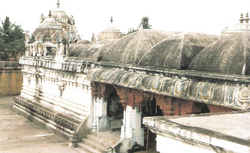 Mannargudi Mallinatha Swamy Temple
 Mallinath Temple, Kosbad


See also
edit
References
editCitations
edit- ↑ Tandon 2002, p. 45.
- 1 2 3 4 Finegan 1952, p. 190.
- ↑ Vijay K. Jain 2015, p. 203.
- ↑ Dundas 2002, p. 56.
- ↑ Umakant P. Shah 1987, pp. 159–160.
- ↑ Vallely 2002, p. 15.
- ↑ Vyas 1995, p. 19.
- ↑ Jaini 1998, p. 40n.
- ↑ Dundas 2002, p. 49.
- ↑ Jaini 2018, p. 1.
- ↑ Jaini 2018, p. 14.
- ↑ Dundas 2002, p. 50.
- ↑ Vallely 2002, p. 11.
- ↑ Jaini 2018, p. 3.
- ↑ Dundas 2002, p. 55.
- ↑ Jaini 2018, p. 32.
- 1 2 3 Umakant P. Shah 1987, p. 156.
- ↑ Ashton 1976, p. 20.
- ↑ Dundas 2002, p. 40.
- 1 2 Titze & Bruhn 1998, p. 122.
- 1 2 Michell 1990, p. 320.
- ↑ Sandhya, C D’Souza (19 November 2010), Chaturmukha Basadi: Four doors to divinity Last updated, Deccan Herald
- ↑ Cort 2001a, p. 145.
- ↑ Natubhai Shah 2004, p. 16.
Sources
edit- Dundas, Paul (2002) [1992], The Jains (Second ed.), London and New York: Routledge, ISBN 0-415-26605-X
- Cort, John E. (2001a), Jains in the World : Religious Values and Ideology in India, Oxford University Press, ISBN 978-0-19-513234-2
- Finegan, Jack (1952), The archeology of world religions, Princeton University Press
- Johnson, Helen M. (1931), Mallināthacaritra (Book 6.6 of the Trishashti Shalaka Purusha Caritra), Baroda Oriental Institute
- Jain, Vijay K. (2015), Acarya Samantabhadra's Svayambhustotra: Adoration of The Twenty-four Tirthankara, Vikalp Printers, ISBN 978-81-903639-7-6, archived from the original on 16 September 2015,
 This article incorporates text from this source, which is in the public domain.
 - Jaini, Padmanabh S. (1998) [1979], The Jaina Path of Purification, Delhi: Motilal Banarsidass, ISBN 81-208-1578-5
- Jaini, Padmanabh S. (2018) [1991], Gender and Salvation: Jaina Debates on the Spiritual Liberation of Women, University of California Press, ISBN 978-0-520-30296-9
- Michell, George (1990), The Penguin Guide to the Monuments of India, vol. 1, Penguin Books, ISBN 978-0140081442
- Shah, Natubhai (2004) [First published in 1998], Jainism: The World of Conquerors, vol. I, Motilal Banarsidass, ISBN 81-208-1938-1
- Shah, Umakant Premanand (1987), Jaina-rūpa-maṇḍana: Jaina iconography, Abhinav Publications, ISBN 81-7017-208-X
- Titze, Kurt; Bruhn, Klaus (1998), Jainism: A Pictorial Guide to the Religion of Non-Violence (2 ed.), Motilal Banarsidass, ISBN 978-81-208-1534-6
- Tukol, T. K. (1980), Compendium of Jainism, Dharwad: University of Karnataka
- Vallely, Anne (2002), Guardians of the Transcendent: An Ethnology of a Jain Ascetic Community, University of Toronto Press, ISBN 978-0-8020-8415-6
- Tandon, Om Prakash (2002) [1968], Jaina Shrines in India (1 ed.), New Delhi: Publications Division, Ministry of Information and Broadcasting, Government of India, ISBN 81-230-1013-3
- Vyas, Dr. R. T., ed. (1995), Studies in Jaina Art and Iconography and Allied Subjects, The Director, Oriental Institute, on behalf of the Registrar, M.S. University of Baroda, Vadodara, ISBN 81-7017-316-7
- Ashton, Martha Bush (1976), Yakshagana, Abhinav Publications, ISBN 9788170170471