
OpenAI chatbot solves 80-year-old math problem, drawing praise from experts
By Phong Ngo
An OpenAI chatbot has solved a decades-old geometry problem, earning praise from mathematicians for what they called a “clever” and “elegant” approach.
The company behind ChatGPT announced Wednesday that one of its experimental AI models had found a new solution to the long-standing "unit distance" problem, first posed by Hungarian mathematician Paul Erdős in 1946.
The unit distance problem asks how points can be arranged so the greatest possible number of pairs are exactly the same distance apart. Erdős proposed what many mathematicians believed was the best solution nearly 80 years ago, but nobody had managed to prove or disprove it, according to Scientific American.
That changed when OpenAI researchers Mehtaab Sawhney and Mark Sellke asked an experimental large language model whether Erdős’s conjecture was correct. The AI then produced a counterexample that surpassed the mathematician’s original construction.
"It feels like magic," Sawhney said. "It’s kind of an amazing experience to have a machine give back something which really resembles how I work."
 |
|
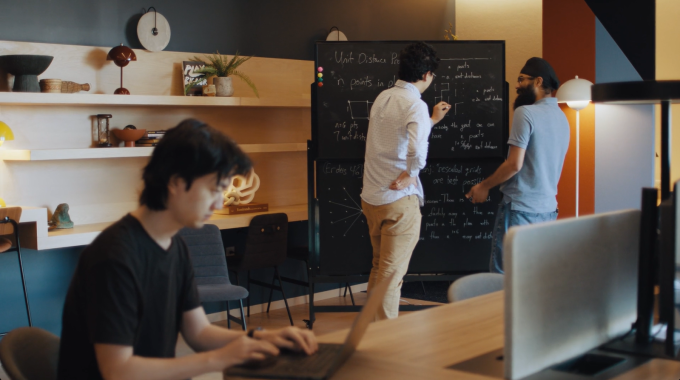
A team of researchers from OpenAI work on the "unit distance" problem. Photo courtesy of OpenAI |
Instead of using traditional grid-based arrangements, the AI created a more complex higher-dimensional structure before mapping it back into two dimensions. Researchers said the resulting pattern was too complicated to draw easily even for a small number of points.
Several mathematicians consulted by OpenAI said the result marked the first AI-generated proof that could likely qualify for publication in a top mathematics journal if produced solely by humans.
"No previous AI-generated proof has come close" to meeting that standard, British mathematician Timothy Gowers, winner of the 1998 Fields Medal, an award often referred to as the "Nobel Prize for math," wrote in commentary shared by OpenAI.
Experts reviewing the work said the result stood out not because the AI invented entirely new mathematics, but because it applied existing ideas in an unexpected way. Still, experts stressed that humans remained essential to validating and refining the result.
Mathematicians also noted that many researchers had spent decades trying to prove Erdős correct rather than searching for counterexamples, potentially limiting the field’s perspective.
"AIs have an edge," Jacob Tsimerman, a mathematician at the University of Toronto who previously worked on the problem without success, said. "They can play for longer and in more treacherous waters than mathematicians without getting overwhelmed."
OpenAI said the breakthrough could help AI systems tackle more complex scientific research by connecting ideas across disciplines and assisting experts in fields such as biology, physics and medicine.
However, Harvard University mathematician Melanie Matchett Wood warned that AI systems still struggle with academic norms, including properly crediting earlier research and ideas.
"Any mathematician who hasn’t been using the latest models should be surprised," Wood said. "It’s quite a different world than in December of last year."