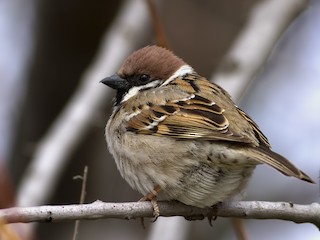
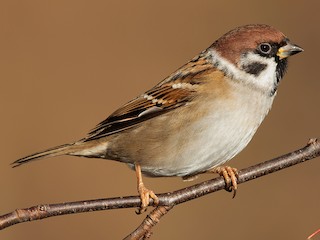
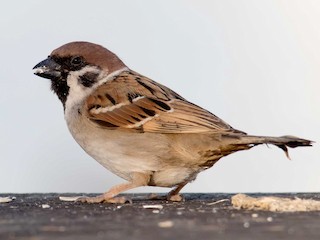
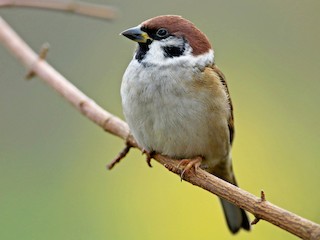
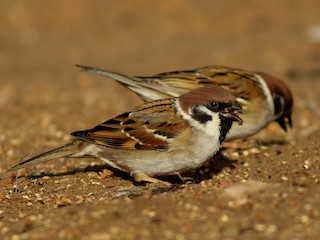
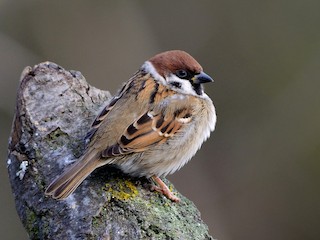
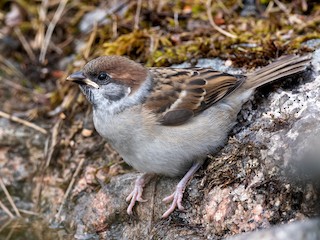

Eurasian Tree Sparrow Passer montanus Scientific name definitions
- LC Least Concern
- Names (62)
- Subspecies (9)
Sign in to see your badges
Species names in eBird-supported languages
| Language | Common name |
|---|---|
| Albanian | Harabeli i fushës |
| Arabic | عُصْفُورٌ شَجَرِيٌ أَوْرَاسِيٌ |
| Armenian | Դաշտային ճնճղուկ |
| Assamese | বনচিৰিকা |
| Asturian | Pardal de les lloses |
| Azerbaijani | Çöl sərçəsi |
| Bangla (India) | গেছো চড়াই |
| Basque | Landa-txolarrea |
| Bulgarian | Полско врабче |
| Catalan | pardal xarrec |
| Chinese | 麻雀 |
| Chinese (Hong Kong SAR China) | 樹麻雀 |
| Chinese (SIM) | 麻雀 (树麻雀) |
| Croatian | poljski vrabac |
| Czech | vrabec polní |
| Danish | Skovspurv |
| Dutch | Ringmus |
| English | Eurasian Tree Sparrow |
| English (AVI) | Eurasian Tree Sparrow |
| English (United States) | Eurasian Tree Sparrow |
| Estonian | põldvarblane |
| Faroese | Skógspurvur |
| Finnish | pikkuvarpunen |
| French | Moineau friquet |
| Galician | Pardal montés |
| Georgian | მინდვრის ბეღურა |
| German | Feldsperling |
| Greek | Δεντροσπουργίτης |
| Hebrew | דרור הרים |
| Hungarian | Mezei veréb |
| Icelandic | Trjáspör |
| Indonesian | Burung-gereja erasia |
| Italian | Passera mattugia |
| Japanese | スズメ |
| Kazakh | Жауторғай |
| Korean | 참새 |
| Kyrgyz | Талаа таранчысы |
| Ladakhi | མཆིལ་པ། |
| Latvian | Lauku zvirbulis |
| Lithuanian | Karklažvirblis |
| Manipuri | Sendaang |
| Mizo | Chawngzawng |
| Mongolian | Хээрийн бор шувуу |
| Nepali (India) | रुख भंगेरा |
| Nepali (Nepal) | रुख भँगेरा |
| Norwegian | pilfink |
| Persian | گنجشک درختی |
| Polish | mazurek |
| Portuguese (Portugal) | Pardal-montês |
| Romanian | Vrabie de câmp |
| Russian | Полевой воробей |
| Serbian | Poljski vrabac |
| Slovak | vrabec poľný |
| Slovenian | Poljski vrabec |
| Spanish | Gorrión Molinero |
| Spanish (Spain) | Gorrión molinero |
| Swedish | pilfink |
| Tajik | Гунҷишки саҳроӣ |
| Thai | นกกระจอกบ้าน |
| Turkish | Ağaç Serçesi |
| Ukrainian | Горобець польовий |
| Welsh | golfan mynydd |
Passer montanus (Linnaeus, 1758)
Definitions
- PASSER
- passer
- montanum / montanus
The Key to Scientific Names
Legend Overview
Originally Appeared in
Content Partner

Full content is available exclusively to Birds of the World subscribers. Sign in Learn more
Introduction
Eurasian Tree Sparrows were brought to St. Louis, Missouri, in the 19th century as part of a shipment of European songbirds imported from Germany. The birds were destined for release as part of a project to enhance the native North American avifauna. Around two dozen Eurasian Tree Sparrows were released in late April 1870, they bred successfully and gradually established a presence in the Midwestern United States. Typically a commensal of humans, it has, in part, been displaced from urban centers by another introduced species, the larger, more pugnacious House Sparrow (Passer domesticus). Today, the Eurasian Tree Sparrow is most frequently associated with wooded urban parkland, farms, and rural woodlots.
Although the Eurasian Tree Sparrow is widely distributed in the Palearctic, it has had relatively modest success in colonizing North America (especially in comparison to the House Sparrow), and its range has been localized to northeastern Missouri, west-central Illinois, and southeastern Iowa. However, in recent decades the Eurasian Tree Sparrow has experienced a 5.8% annual increase in Illinois based on the North American Breeding Bird Survey (Sauer et al. 2017), and data from eBird suggest an ongoing range expansion with large numbers of records in adjacent areas of the Midwest (see Distribution, Migration and Habitat).
Similar to the House Sparrow, the Eurasian Tree Sparrow has been studied extensively in its native range, and Summers-Smith 1995 provides an excellent introduction to the published literature. In North America, research has concentrated on breeding success (Anderson 1978b) and emerging differences between the ancestral population in Germany and the introduced New World population resulting from the constraints of a small founder population. Included are studies of changes in morphology (Barlow 1973, Barlow 1980a, St. Louis and Barlow 1991), genetics ( St. Louis and Barlow 1987, St. Louis and Barlow 1988), and song (Lang 1995, Lang and Barlow 1987, Lang and Barlow 1997). This account emphasizes North American data, whenever available.
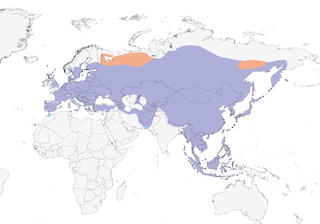
- Year-round
- Migration
- Breeding
- Non-Breeding