
Hostname: page-component-6766d58669-nf276 Total loading time: 0 Render date: 2026-05-24T19:52:18.962Z Has data issue: false hasContentIssue false

The “Diehards” and the Myth of the “Backwoodsmen”

Published online by Cambridge University Press:  16 January 2014

Gregory D. Phillips*
Affiliation:
Stanford University

Extract

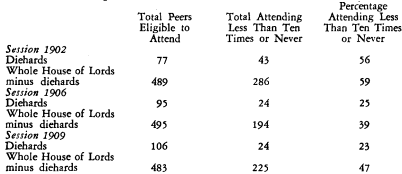
The term “backwoodsmen” originated in the rhetoric of an embattled Liberal Government intent on discrediting an overwhelmingly Unionist House of Lords during the struggle over the “People's Budget” of 1909. The description applied to those peers, supposedly the great majority of the Upper Chamber, who almost never attended debates and had nothing to do with national affairs. The “diehards”, the 112 temporal peers who voted against the Parliament Bill of 1911, have been characterized by both their contemporaries and later historians as conforming to the “backwoodsmen” stereotype. This politically motivated description of the “diehards” has been accepted as substantially accurate since it was first formulated. It is a prime example of a received historical “truth” repeated by many historians, but left uninvestigated.

Like other clichés used by historians, this characterization of the diehards as “backwoodsmen” has hindered the effort to understand the politics and society of the period in question. As Lord Willoughby de Broke, a prominent diehard, stated in his autobiography, the result of contemporary and later comment has been that “backwoodsmen” have “occupied a special niche in the public vision. They were presented as being a rare and rudimentary species of the human race.” The study of the diehards, believed to be composed of members of this odd species, has been perfunctory at best. For if the group is thought to be almost completely divorced from national politics and affairs, perhaps by its own choice, and if it is further thought to behave either simply in terms of landed reaction or as the willing tool of the Unionist leadership, further analysis would seem to be both unnecessary and unproductive for the understanding of modern British society.

Information

Type
Research Article
Copyright
Copyright © North American Conference of British Studies 1977

Access options

Get access to the full version of this content by using one of the access options below. (Log in options will check for institutional or personal access. Content may require purchase if you do not have access.)

Article purchase

Temporarily unavailable