

Abstract
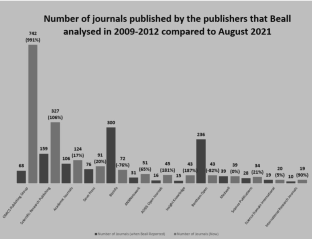
Between 2009 and 2012, Jeffrey Beall analyzed 18 publishers, which were publishing 1328 journals. He classified all but one of the publishers as predatory. In this paper we look again at these publishers to see what has changed since that initial analysis. We focus on the same 18 publishers so that we have a direct comparison with Beall’s original analysis. One publisher has been acquired by Sage (the publisher no longer exists) and another has been acquired by Taylor & Francis (the publisher still retains its identity). Three of the publishers can no longer be found and, of the thirteen that remain, they now publish 1650 journals, an increase of 24.25% over the 1328 journals being published when Beall carried out his analysis. Other ways of carrying out this analysis, could put this increase as high as 50.14%. The increase in the number of journals being published, by fewer publishers, suggests that the problem of predatory publishing is getting worse, although this may be largely due to mega-predatory publishers which have dramatically increased the number of journals they now publish, when compared to ten years ago. Unlike Beall, rather than classifying the publishers as predatory (or not), we classify them into four categories, using data which is publicly available, rather than making a subjective decision. Two publishers are classified as category 1 (the most reputable). One journal is in category 2, four in category 3 and six in category 4.
Notes
https://publicationethics.org, last accessed 07 March 2022.
https://doaj.org, last accessed 07 March 2022.
https://www.scopus.com/, last accessed 07 March 2022.
https://newsroom.taylorandfrancisgroup.com/dove-medical-press-joins-taylor-francisgroup/, last accessed 07 March 2022.
https://www.dovepress.com, last accessed 07 March 2022.
References
Eysenbach G. Black sheep among open access journals and publishers: Gunther Eysenbach random research rants blog. 2008. http://gunther-eysenbach.blogspot.ca/2008/03/black-sheep-among-open-access-journals.html. Accessed 7 March 2022.
Sanderson K. Two new journals copy the old. Nature. 2010;463(7278):148. https://doi.org/10.1038/463148a.
Beall J. “Predatory” open-access scholarly publishers. Charlest Advis. 2010;11(4):10–7.
Beall J. Bentham open. Charlest Advis. 2009;11(1):29–32.
Linacre S, Bisaccio M, Earle L. Publishing in an environment of predation: the many things you really wanted to know, but did not know how to ask. J Bus Bus Mark. 2019;26(2):217–28. https://doi.org/10.1080/1051712X.2019.1603423.
Kendall G. Case study: what happens to a journal after it accepts a spoof paper? Publ Res Q. 2021;37:600–11. https://doi.org/10.1007/s12109-021-09843-4.
Beall J. Update: predatory open-access scholarly publishers. Charlest Advis. 2010;12(1):50. https://doi.org/10.5260/chara.12.1.50.
Beall J. Five scholarly open access publishers. Charlest Advis. 2012;13(4):5–10. https://doi.org/10.5260/chara.13.4.5.
Kendall G. Beall’s legacy in the battle against predatory publishers. Learn Publ. 2021;34(3):379–88. https://doi.org/10.1002/leap.1374.
Shen C, Björk B-O. ‘Predatory’ open access: a longitudinal study of article volumes and market characteristics. BMC Med. 2015;13:230. https://doi.org/10.1186/s12916-015-0469-2.
Downes M. Why we should have listened to Jeffrey Beall from the start. Learn Publ. 2020;33(4):442–8. https://doi.org/10.1002/leap.1316.
Linacre S. Mountain to climb. 2021. https://blog.cabells.com/2021/09/01/mountain-to-climb/. Accessed 4 Apr 2022.
Kimotho SG. The storm around Beall’s list: a review of issues raised by Beall’s critics over his criteria of identifying predatory journals and publishers. Afr Res Rev. 2019;13(2):1–12. https://doi.org/10.4314/afrrev.v13i2.1.
Van Noorden R. Open-access website gets tough. Nature. 2014. https://doi.org/10.1038/512017a.
Beall J. Medical publishing triage-chronicling predatory open access publishers. Ann Med Surg. 2013;2(2):47–9. https://doi.org/10.1016/S2049-0801(13)70035-9.
Bloudoff-Indelicato M. Backlash after frontiers journals added to list of questionable publishers. Nature. 2015;526(7278):613. https://doi.org/10.1038/526613f.
Schneider L. Frontiers: vanquishers of Beall, publishers of bunk. Blog post from For Better Science. 2017. https://forbetterscience.com/2017/09/18/frontiers-vanquishers-of-beall-publishers-of-bunk/. Accessed 18 Sept 2017.
Holland K, Brimblecombe P, Meester W, Chen T. The importance of high-quality content: curation and reevaluation in Scopus. 2021. https://www.elsevier.com/data/assets/pdf_file/0004/891058/The-importance-of-high-quality-content-curation-and-re-evaluation-in-Scopus.pdf. Accessed 4 Sept 2021.
McCullough R. The importance of high-quality content in Scopus. 2021. https://blog.scopus.com/posts/the-importance-of-high-quality-content-in-scopus. Accessed 4 Sept 2021.
Federal Trade Commission. OMICS Group Inc. 2019. https://www.ftc.gov/enforcement/cases-proceedings/152-3113/federal-trade-commission-v-omics-group-inc. Accessed 9 Apr 2022.
Manley S. On the limitations of recent lawsuits against Sci-Hub, OMICS, ResearchGate, and Georgia State University. Learn Publ. 2019;32(4):375–81. https://doi.org/10.1002/leap.1254.
Bowman DE, Wallace MB. Predatory journals: a serious complication in the scholarly publishing landscape. Gastrointest Endosc. 2018;87(1):273–4. https://doi.org/10.1016/j.gie.2017.09.019.
Esfe MH, Wongwises S, Asadi A, Akbari M. Fake journals: their features and some viable ways to distinguishing them. Sci Eng Ethics. 2015;21:821–4. https://doi.org/10.1007/s11948-014-9595-z.
Manca A, Martinez G, Cugusi L, Dragone D, Dvir Z, Deriu F. The surge of predatory open-access in neurosciences and neurology. Neuroscience. 2017;353:166–73. https://doi.org/10.1016/j.neuroscience.2017.04.014.
Shahriari N, Grant-Kels JM, Payette MJ. Predatory journals: How to recognize and avoid the threat of involvement with these unethical “publishers.” J Am Acad Dermatol. 2016;75(3):658–9. https://doi.org/10.1016/j.jaad.2016.04.056.
Acknowledgements
The authors would like to thank Cabells for supplying data from its Predatory Reports database to aid the research conducted for this paper.
Author information
Authors and Affiliations
Corresponding author
Ethics declarations
Conflict of interest
Simon Linacre was directly employed by Cabells while research for this paper was being conducted, but is longer employed by them.
Additional information
Publisher's Note
Springer Nature remains neutral with regard to jurisdictional claims in published maps and institutional affiliations.
Rights and permissions
About this article
Cite this article
Kendall, G., Linacre, S. Predatory Journals: Revisiting Beall’s Research. Pub Res Q 38, 530–543 (2022). https://doi.org/10.1007/s12109-022-09888-z
Accepted:
Published:
Version of record:
Issue date:
DOI: https://doi.org/10.1007/s12109-022-09888-z