

Abstract
Parents of children with ADHD experience significantly more parenting stress in comparison to parents of typically developing children due to the emotional and behavioral difficulties related to ADHD. Additionally, approximately 30% of children with ADHD experience co-occurring anxiety. Parents of children with co-occurring anxiety and ADHD report increased stress due to role restriction and isolation compared to parents of children with ADHD alone. Poor emotional regulatory coping in children with ADHD has been linked to elevated negative affect and irritability, which also contributes to increased stress among parents. The present study examined the direct and indirect associations of child anxiety symptoms and emotional regulatory coping on elevated ADHD symptoms and parenting stress. Participants were 203 children aged 7–12-years-old and their parents. Parents completed a self-report measure of parenting stress and measures of their child’s ADHD symptoms, anxiety, and emotional regulatory coping. Additionally, children completed self-report measures of emotional regulatory coping. Model testing indicated that the overall model demonstrated excellent fit to the data. Parameter testing supported an indirect effect of child ADHD symptoms on parenting stress through child anxiety symptoms and an indirect effect of child ADHD symptoms on parenting stress through child emotional regulatory coping. These results suggest that child anxiety and emotion dysregulation in children with ADHD have a negative impact on parental stress. The current study adds to the understanding of the important roles emotional regulatory coping and anxiety play in children with ADHD to contribute to increased parenting stress.
Availability of data and material
Data and material available upon request.
References
Danielson ML, Bitsko RH, Ghandour RM et al (2018) Prevalence of parent-reported ADHD diagnosis and associated treatment among US children and adolescents, 2016. J Clin Child Adolesc Psychol 47:199–212. https://doi.org/10.1080/15374416.2017.1417860
American Psychiatric Association (2013) Diagnostic and statistical manual of mental disorders, 5th edn. American psychiatric association, Washington, DC
DeWolfe NA, Byrne JM, Bawden HN (2000) ADHD in preschool children: parent-rated psychosocial correlates. Dev Med Child Neurol 42:825–830. https://doi.org/10.1017/S0012162200001523
Vaughan EL, Feinn R, Bernard S et al (2013) Relationships between child emotional and behavioral symptoms and caregiver strain and parenting stress. J Fam Issues 34:534–556. https://doi.org/10.1177/0192513X12440949
Anastopoulos AD, Smith TF, Garrett ME et al (2011) Self-regulation of emotion, functional impairment, and comorbidity among children with AD/HD. J Atten Disord 15:583–592. https://doi.org/10.1177/1087054710370567
Biederman J, Spencer TJ, Petty C et al (2012) Longitudinal course of deficient emotional self-regulation CBCL profile in youth with ADHD: prospective controlled study. Neuropsychiatr Dis Treat 8:267–76
Skirrow C, Ebner-Priemer U, Reinhard I et al (2014) Everyday emotional experience of adults with attention deficit hyperactivity disorder: evidence for reactive and endogenous emotional lability. Psychol Med 44:3571–3583. https://doi.org/10.1017/S0033291714001032
Posner J, Kass E, Hulvershorn L (2014) Using stimulants to treat ADHD-related emotional lability. Curr Psychiatry Rep 16:478. https://doi.org/10.1007/s11920-014-0478-4
Sobanski E, Banaschewski T, Asherson P et al (2010) Emotional lability in children and adolescents with attention deficit hyperactivity disorder (ADHD): Clinical correlates and familial prevalence. J Child Psychol Psychiatry 51:915–923. https://doi.org/10.1111/j.1469-7610.2010.02217.x
Blader JC (2021) Attention-deficit hyperactivity disorder and the dysregulation of emotion generation and emotional expression. Child Adolesc Psychiatr Clin N Am 30:349–360. https://doi.org/10.1016/j.chc.2020.10.005
Musser ED, Galloway-Long HS, Frick PJ, Nigg JT (2013) Emotion regulation and heterogeneity in attention-deficit/hyperactivity disorder. J Am Acad Child Adolesc Psychiatry 52:163–171. https://doi.org/10.1016/j.jaac.2012.11.009
Fischer M (1990) Parenting stress and the child with attention deficit hyperactivity disorder. J Clin Child Psychol 19:337–346. https://doi.org/10.1207/s15374424jccp1904_5
Theule J, Wiener J, Tannock R, Jenkins JM (2013) Parenting stress in families of children with ADHD: A meta-analysis. J Emot Behav Disord 21:3–17. https://doi.org/10.1177/1063426610387433
Abdin RR (1995) Parenting stress index: Professional manual. Psychological assessment resources.
Williford AP, Calkins SD, Keane SP (2007) Predicting change in parenting stress across early childhood: child and maternal factors. J Abnorm Child Psychol 35:251–263. https://doi.org/10.1007/s10802-006-9082-3
Anderson LS (2008) Predictors of parenting stress in a diverse sample of parents of early adolescents in high-risk communities. Nurs Res 57:340–350. https://doi.org/10.1097/01.NNR.0000313502.92227.87
Raikes HA, Thompson RA (2005) Efficacy and social support as predictors of parenting stress among families in poverty. Infant Ment Health J 26:177–190. https://doi.org/10.1002/imhj.20044
Solem M, Christophersen K, Martinussen M (2011) Predicting parenting stress: children’s behavioural problems and parents’ coping. Infant Child Dev 20:162–180. https://doi.org/10.1002/icd.681
Johnston C, Mash EJ (2001) Families of children with attention-deficit/ hyperactivity disorder: review and recommendations for future research. Clin Child Fam Psychol Rev 4:183–207. https://doi.org/10.1023/A:1017592030434
Cunningham CE, Barkley RA (1979) The interactions of normal and hyperactive children with their mothers in free play and structured tasks. Child Dev 50:217–224. https://doi.org/10.2307/1129059
Rogers MA, Wiener J, Marton I, Tannock R (2009) Parental involvement in children’s learning: comparing parents of children with and without attention-deficit/hyperactivity disorder (ADHD). J Sch Psychol 47:167–185. https://doi.org/10.1016/j.jsp.2009.02.001
Deater-Deckard K (1998) Parenting stress and child adjustment: some old hypotheses and new questions. Clin Psychol Sci Pract 5:314–332. https://doi.org/10.1111/j.1468-2850.1998.tb00152.x
Bloomfield L, Kendall S (2012) Parenting self-efficacy, parenting stress and child behaviour before and after a parenting programme. Prim Health Care Res Dev 13:364–372. https://doi.org/10.1017/S1463423612000060
Crnic KA, Gaze C, Hoffman C (2005) Cumulative parenting stress across the preschool period: relations to maternal parenting and child behaviour at age 5. Infant Child Dev 14:117–132. https://doi.org/10.1002/icd.384
Flynn MM, Rosen PJ, Reese JS et al (2021) Examining the influence of irritability and adhd on domains of parenting stress. Eur Child Adolesc Psychiatry. https://doi.org/10.1007/s00787-021-01868-6
Kazdin AE (1995) Child, parent and family dysfunction as predictors of outcome in cognitive-behavioral treatment of antisocial children. Behav Res Ther 33:271–281. https://doi.org/10.1016/0005-7967(94)00053-M
Melis Yavuz H, Selcuk B, Corapci F, Aksan N (2017) Role of temperament, parenting behaviors, and stress on Turkish preschoolers’ internalizing symptoms. Soc Dev 26:109–128. https://doi.org/10.1111/sode.12192
Tan TX, Wang Y, Ruggerio AD (2017) Childhood adversity and children’s academic functioning: roles of parenting stress and neighborhood support. J Child Fam Stud 26:2742–2752. https://doi.org/10.1007/s10826-017-0775-8
Hammerness P, Geller D, Petty C et al (2010) Does ADHD moderate the manifestation of anxiety disorders in children? Eur Child Adolesc Psychiatry 19:107–112. https://doi.org/10.1007/s00787-009-0041-8
Schatz DB, Rostain AL (2006) ADHD with comorbid anxiety: a review of the current literature. J Atten Disord 10:141–149. https://doi.org/10.1177/1087054706286698
Xia W, Shen L, Zhang J (2015) Comorbid anxiety and depression in school-aged children with attention deficit hyperactivity disorder (ADHD) and self-reported symptoms of ADHD, anxiety, and depression among parents of school-aged children with and without ADHD. Shanghai Arch Psychiatry 27:356–367
Bowen R, Chavira DA, Bailey K et al (2008) Nature of anxiety comorbid with attention deficit hyperactivity disorder in children from a pediatric primary care setting. Psychiatry Res 157:201–209. https://doi.org/10.1016/j.psychres.2004.12.015
Angold A, Costello EJ, Erkanli A (1999) Comorbidity. J Child Psychol Psychiatry 40:57–87. https://doi.org/10.1111/1469-7610.00424
Mphahlele RM, Pillay B, Meyer A (2020) Internalising comorbidities in primary school children with attention-deficit hyperactivity disorder (ADHD): sex and age differences. J Child Adolesc Ment Health 32:119–129. https://doi.org/10.2989/17280583.2020.1848851
Lane SJ, Reynolds S, Thacker L (2010) Sensory over-responsivity and ADHD: Differentiating using electrodermal responses, cortisol, and anxiety. Front Integr Neurosci. https://doi.org/10.3389/fnint.2010.00008
Tai Y-M, Gau C-S, Gau SS-F, Chiu H-W (2013) Prediction of ADHD to anxiety disorders: an 11-year national insurance data analysis in Taiwan. J Atten Disord 17:660–669. https://doi.org/10.1177/1087054712437581
Read N, Mulraney M, McGillivray J, Sciberras E (2020) Comorbid anxiety and irritability symptoms and their association with cognitive functioning in children with ADHD. J Abnorm Child Psychol 48:1035–1046. https://doi.org/10.1007/s10802-020-00658-z
Reynolds S, Lane SJ (2009) Sensory overresponsivity and anxiety in children with ADHD. Am J Occup Ther 63:433–440. https://doi.org/10.5014/ajot.63.4.433
Bubier JL, Drabick DA (2009) Co-occurring anxiety and disruptive behavior disorders: the roles of anxious symptoms, reactive aggression, and shared risk processes. Clin Psychol Rev 29:658–669
Gair SL, Brown HR, Kang S et al (2021) Early development of comorbidity between symptoms of ADHD and anxiety. Res Child Adolesc Psychopathol 49:311–323. https://doi.org/10.1007/s10802-020-00724-6
Baldwin JS, Dadds MR (2008) Examining alternative explanations of the covariation of ADHD and anxiety symptoms in children: a community study. J Abnorm Child Psychol 36:67–79
Nigg JT, Goldsmith HH, Sachek J (2004) Temperament and attention deficit hyperactivity disorder: the development of a multiple pathway model. J Clin Child Adolesc Psychol 33:42–53
Hoza B, Mrug S, Gerdes AC et al (2005) What aspects of peer relationships are impaired in children with attention-deficit/hyperactivity disorder? J Consult Clin Psychol 73:411–423. https://doi.org/10.1037/0022-006X.73.3.411
Mrug S, Molina BSG, Hoza B et al (2012) Peer rejection and friendships in children with attention-deficit/hyperactivity disorder: contributions to long-term outcomes. J Abnorm Child Psychol 40:1013–1026. https://doi.org/10.1007/s10802-012-9610-2
LoParo D, Fonseca AC, Matos AP, Craighead WE (2023) A developmental cascade analysis of peer rejection, depression, anxiety, and externalizing problems from childhood through young adulthood. Res Child Adolesc Psychopathol. https://doi.org/10.1007/s10802-023-01053-0
Pliszka SR (2000) Patterns of psychiatric comorbidity with attention-deficit/hyperactivity disorder. Child Adolesc Psychiatr Clin N Am 9:525–540
Biederman J, Faraone SV, Keenan K et al (1991) Familial association between attention deficit disorder and anxiety disorders. Am J Psychiatry 148:251–256
Jensen PS, Shervette RE, Xenakis SN, Richters J (1993) Anxiety and depressive disorders in attention deficit disorder with hyperactivity: new findings. Am J Psychiatry 150:1203–1209. https://doi.org/10.1176/ajp.150.8.1203
Rockhill C, Violette H, Stoep AV et al (2013) Caregivers’ distress: Youth with attention-deficit/hyperactivtty disorder and comorbid disorders assessed via telemental health. J Child Adolesc Psychopharmacol 23:379–385. https://doi.org/10.1089/cap.2013.0019
Shaw P, Stringaris A, Nigg J, Leibenluft E (2014) Emotion dysregulation in attention deficit hyperactivity disorder. Am J Psychiatry 171:276–293. https://doi.org/10.1176/appi.ajp.2013.13070966
Maire J, Galera C, Bioulac S et al (2020) Emotional lability and irritability have specific associations with symptomatology in children with attention deficit hyperactivity disorder. Psychiatry Res. https://doi.org/10.1016/j.psychres.2020.112789
Compas BE, Connor-Smith JK, Saltzman H et al (2001) Coping with stress during childhood and adolescence: problems, progress, and potential in theory and research. Psychol Bull 127:87–127. https://doi.org/10.1037/0033-2909.127.1.87
Haga SM, Kraft P, Corby E-K (2009) Emotion regulation: antecedents and well-being outcomes of cognitive reappraisal and expressive suppression in cross-cultural samples. J Happiness Stud Interdiscip Forum Subj Well-Being 10:271–291. https://doi.org/10.1007/s10902-007-9080-3
John OP, Gross JJ (2004) Healthy and unhealthy emotion regulation: Personality processes, individual differences, and life span development. J Pers 72:1301–1333. https://doi.org/10.1111/j.1467-6494.2004.00298.x
Tajik-Parvinchi D, Farmus L, Tablon Modica P et al (2021) The role of cognitive control and emotion regulation in predicting mental health problems in children with neurodevelopmental disorders. Child Care Health Dev 47:608–617. https://doi.org/10.1111/cch.12868
Walerius DM, Fogleman ND, Rosen PJ (2016) The role of ADHD and negative emotional lability in predicting changes in parenting daily hassles. J Child Fam Stud 25:2279–2291. https://doi.org/10.1007/s10826-016-0381-1
Uhl K, Halpern LF, Tam C et al (2019) Relations of emotion regulation, negative and positive affect to anxiety and depression in middle childhood. J Child Fam Stud 28:2988–2999. https://doi.org/10.1007/s10826-019-01474-w
Wolraich ML, Lambert W, Doffing MA et al (2003) Psychometric properties of the vanderbilt ADHD diagnostic parent rating scale in a referred population. J Pediatr Psychol 28:559–568. https://doi.org/10.1093/jpepsy/jsg046
Achenbach TM, Rescorla LA (2001) Manual for the ASEBA school-age forms & profiles. University of Vermont, Research Center for Children, Youth, & Families, Burlington.
Zeman J, Shipman K, Penza-Clyve S (2001) Development and initial validation of the Children’s sadness management scale. J Nonverbal Behav 25:187–205. https://doi.org/10.1023/A:1010623226626
Suveg C, Zeman J (2004) Emotion regulation in children with anxiety disorders. J Clin Child Adolesc Psychol 33:750–759. https://doi.org/10.1207/s15374424jccp3304_10
Kendall PC, Puliafico AC, Barmish AJ et al (2007) Assessing anxiety with the child behavior checklist and the teacher report form. J Anxiety Disord 21:1004–1015. https://doi.org/10.1016/j.janxdis.2006.10.012
Luebbe AM, Bump KA, Fussner LM, Rulon KJ (2014) Perceived maternal and paternal psychological control: relations to adolescent anxiety through deficits in emotion regulation. Child Psychiatry Hum Dev 45:565–576. https://doi.org/10.1007/s10578-013-0425-3
Suveg C, Hoffman B, Zeman JL, Thomassin K (2009) Common and specific emotion-related predictors of anxious and depressive symptoms in youth. Child Psychiatry Hum Dev 40:223–239. https://doi.org/10.1007/s10578-008-0121-x
Kline RB (2015) Principles and practice of structural equation modeling, 4th edn. Guilford Press, New York, NY
MacKinnon DP (2008) Introduction to statistical mediation analysis. Taylor & Francis, New York, NY
Bunford N, Evans SW, Wymbs F (2015) ADHD and emotion dysregulation among children and adolescents. Clin Child Fam Psychol Rev 18:185–217
Barkley RA (2015) Attention-deficit hyperactivity disorder: a handbook for diagnosis and treatment, 4th edn. The Guilford Press
Rosen PJ, Leaberry KD, Slaughter K et al (2019) Managing frustration for children (MFC) group intervention for ADHD: an open trial of a novel group intervention for deficient emotion regulation. Cogn Behav Pract 26:522–534. https://doi.org/10.1016/j.cbpra.2018.04.002
Treacy L, Tripp G, Baird A (2005) Parent stress management training for attention-deficit/hyperactivity disorder. Behav Ther 36:223–233. https://doi.org/10.1016/S0005-7894(05)80071-1
Franke B, Michelini G, Asherson P et al (2018) Live fast, die young? a review on the developmental trajectories of ADHD across the lifespan. Eur Neuropsychopharmacol 28:1059–1088
Craske MG, Stein MB, Eley TC et al (2017) Anxiety disorders. Nat Rev Dis Primer 3:17024. https://doi.org/10.1038/nrdp.2017.24
Shimshoni Y, Lebowitz ER, Brotman MA et al (2020) Anxious-irritable children: a distinct subtype of childhood anxiety? Behav Ther 51:211–222. https://doi.org/10.1016/j.beth.2019.06.005
Leaberry KD, Rosen PJ, Fogleman ND et al (2020) Comorbid internalizing and externalizing disorders predict lability of negative emotions among children with ADHD. J Atten Disord 24:1989–2001. https://doi.org/10.1177/1087054717734647
Stringaris A, Cohen P, Pine DS, Leibenluft E (2009) Adult outcomes of youth irritability: a 20-year prospective community-based study. Am J Psychiatry 166:1048–1054. https://doi.org/10.1176/appi.ajp.2009.08121849
Funding
The authors have no funding sources to report.
Author information
Authors and Affiliations
Contributions
AO wrote the main manuscript text and prepared all tables and figures. PR was supervising author who ran the SEM analyses and contributed to parts of the manuscript text. All authors reviewed the manuscript.
Corresponding author
Ethics declarations
Conflict of interest
The authors declare that they have no conflicts of interest.
Appendix A: Tables
Appendix A: Tables
See Tables 1, 2, 3 and Figs. 1, 2.
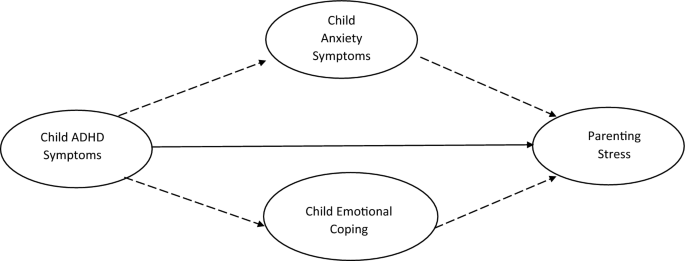
Proposed theoretical model of ADHD, anxiety, emotional coping, and parenting stress
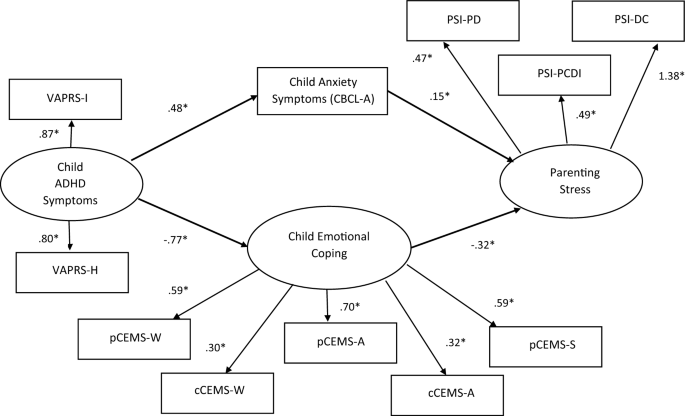
Indirect effects model of ADHD, anxiety, emotional coping, and parenting stress domains with standarized beta weights. Note. *p < 0.001. VAPRS-I Vanderbilt ADHD Parent Rating Scale, Inattentive; VAPRS-H Vanderbilt ADHD Parent Rating Scale, Hyperactive; CBCL-A Child Behavior Checklist-Anxiety Subscale; PSI-PD Parenting Stress Index, Parental Distress; PSI-DC Parenting Stress Index, Difficult Child; PSI-PCDI Parenting Stress Index, Parent–Child Dysfunctional Interaction; pCEMS-W Children’s Emotion Regulation Coping, Worry, parent report; pCEMS-A Children’s Emotion Regulation Coping, Anger, parent report; pCEMS-S Children’s Emotion Regulation Coping, Sad, parent report; cCEMS-W Children’s Emotion Regulation Coping, Worry, child report; cCEMS-A Children’s Emotion Regulation Coping, Anger, child report. The subscale beta weights are standardized regression coefficients that represent the degree to which the indicators change based on change in the latent factors, simultaneously. Several indicators were freed to covary in the model. These are not depicted in the above figure for visual clarity. The following indicators were freed to covary (with standardized weights): pCEMS-W←→pCEMS-A = 0.22; -W←→pCEMS-S = 0.40; cCEMS-W←→cCEMS-A = 0.39; PSI-PD←→PSI_PCDI = 0.73
Rights and permissions
Springer Nature or its licensor (e.g. a society or other partner) holds exclusive rights to this article under a publishing agreement with the author(s) or other rightsholder(s); author self-archiving of the accepted manuscript version of this article is solely governed by the terms of such publishing agreement and applicable law.
About this article
Cite this article
Olczyk, A.R., Rosen, P.J., Alacha, H.F. et al. Indirect effect of ADHD on parenting stress through increased child anxiety and decreased emotional regulatory coping. Eur Child Adolesc Psychiatry 33, 1407–1417 (2024). https://doi.org/10.1007/s00787-023-02246-0
Received:
Accepted:
Published:
Version of record:
Issue date:
DOI: https://doi.org/10.1007/s00787-023-02246-0