
B-29 Superfortress
1942 bomber aircraft family; heaviest bomber widely used by US forces in World War II
(Redirected from B-29)
1942 bomber aircraft family; heaviest bomber widely used by US forces in World War II   | |||||
| Upload media | |||||
| Instance of |
| ||||
|---|---|---|---|---|---|
| Subclass of |
| ||||
| Country of origin | |||||
| Designed by | |||||
| Has use | |||||
| Operator | |||||
| Manufacturer | |||||
| Developer | |||||
| First flight |
| ||||
| Service entry |
| ||||
| Service retirement |
| ||||
| Length |
| ||||
| Height |
| ||||
| Cruise speed |
| ||||
| Wingspan |
| ||||
| Total produced |
| ||||
| |||||
 | |||||


-
 Two B-29s in-flight
 -
 B-29 at AAF Training Command B-29 Transition School, Maxwell Field
 -
 B-29 with the huge B-36
 -
 B-29 on the ground
 -
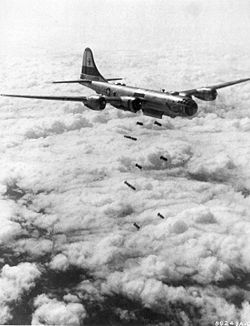 B-29 dropping bombs during the Korean War
 -
 Boeing B-29 Superfortress USAF
 -
 First B-29 to land on Iwo, 4 March 1945, and Marine observation plane on Airfield Number 1.
 -
 B-29s dropping bombs over Japan
 -
 Front side of OWI notice #2106, dubbed the “LeMay bombing leaflet”, which was delivered to Hiroshima, Nagasaki, and 33 other Japanese cities on 1 August 1945.
 -
 Dinah Might B-29 after making an emergency landing on Iwo Jima 4 March 1945
 -
 The immenseness of the 141 foot wing span of a Boeing B-29 Superfortress based at Davis-Monthan Field is vividly illustrated here with the cloud topped Santa Catalina Mountains as a contrasting background.
 -

-
 Rare color photograph of olive-drab painted B-29s.
 -
 In flight
 -
 flying with others


Enola Gay
edit-
Enola Gay after strike at Hiroshima, 08/06/1945.
-
Boeing B-29 Superfortress "Enola Gay" landing after the atomic bombing mission on Hiroshima, Japan.


Bockscar
edit-
B-29 Bockscar
-
B-29 Bockscar and a replica of Fat Man, on display at the National Museum of the United States Air Force
-
Bockscar on display at the National Museum of the United States Air Force


Experimental programs
edit-
Project Tom Tom: Boeing B-29 with Republic F-84 Thunderjet
-
B-29 carrying the X-1

