Maximize Your Phonics Instruction with Application Routines
Reading time
Date posted
by Mary Jo Fresch, author of The Phonics Handbook: A Comprehensive Guide for Reading Teachers
The lesson goes well, your students are working together and showing a gradual understanding of a new phonics concept you recently taught. But how well can they independently apply what they are learning? If you’re like me and your goal is to support independent, fluent readers, you likely find yourself asking – What else can I do to support continued phonics practice in an independent but meaningful way?
Daniel Willingham, a cognitive psychologist who focuses on how science informs K-12 instruction reminds us, “it is virtually impossible to become proficient at a mental task without extended practice.” (2009, 107). Application of the phonics skills students are learning is critical to orthographic mapping, or the process of connecting sounds to letters to instantly recognize words.
In my work with children, I’ve found that having predictable practice routines is a time-saver for me and provides a level of comfort for the students because they know how to proceed. Once students understand what the demands of the routine are, I can quickly change content, and they go right to work. So, any time they need a little extra practice I can say, “Today, at the learning station (or “after you’ve finished math” or “while you are waiting for your reading group to meet”), a Build It activity is waiting for you!” They will know what to do…and away they go! Here are two easy examples of ways to have students apply their budding phonics knowledge in any setting, regardless of group size or skill focus:
Build It
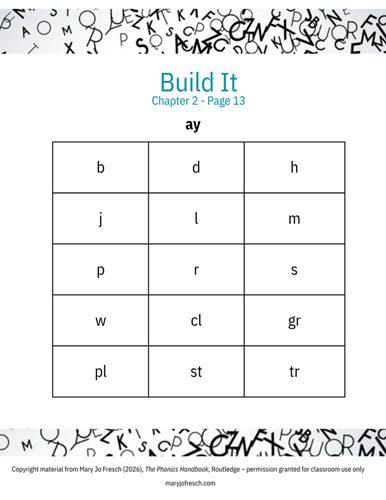
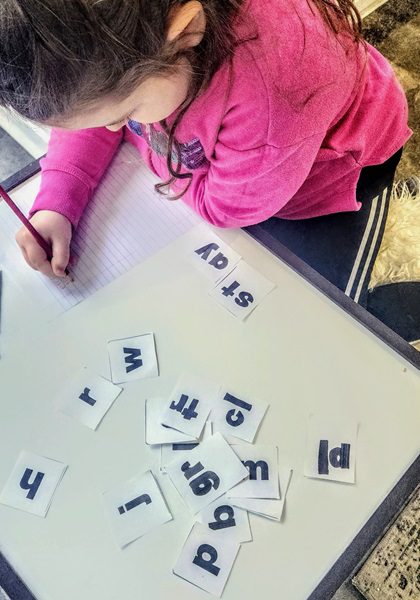
Give students manipulative cards or tiles with a phonic pattern they’re working on and extra cards with additional letters and invite them to “build” as many words as they can. In this routine, students demonstrate their understanding of mapping sounds to letters and blending across words. This hands-on engagement helps them experience how just a quick switch of one or two letters makes a whole new word. For instance, give students a card or letter tiles showing ay along with additional, individual letters such as b, d, h, j, l, m, p, r, s, w, cl, gr, pl, st, tr (the number will depend on the amount of time your plans allow). In this example students might build bay, day, hay, jay, lay, may, pay, ray, say, way, clay, gray, play, stay, and tray.
Download this activity from maryjofresch.com.
Find It
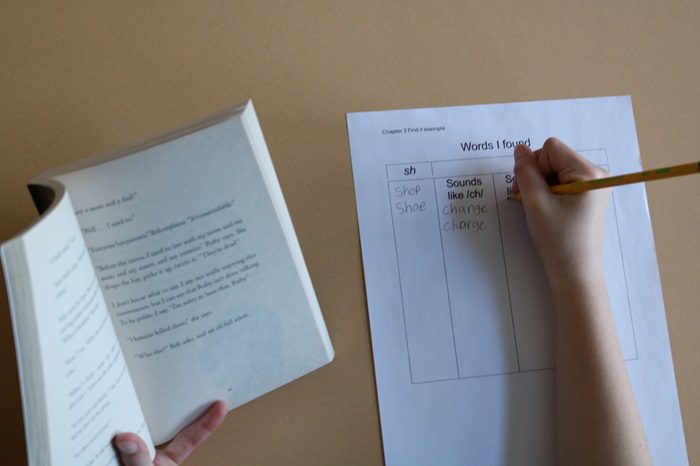
Give students texts they can independently read and show them how to search for words with specific phonic elements they’re learning. Using self-selected free reading texts gives students confidence in this application, since they will know most of the words. This is also a great way to double up by incorporating content texts from other subject areas like science or social studies. In this routine, students demonstrate their knowledge of sound/letter relationships by hunting for words with specific phonic patterns. For example, invite students to use their personal free reading text to search for words with the digraphs sh and ch (reminding or asking them about the sounds those two digraphs make – sh =/sh/, ch = /ch/, /sh/, /k/).
In addition to giving students valuable hands-on practice with newly learned concepts, once students learn these two routines, all you have to do is name the routine and change out the skill focus, and they can quickly get to work! If you’re interested in filling your toolbox with more routines like these, The Phonics Handbook: A Comprehensive Guide for Reading Teachers offers a total of six application routines that will help your students solidify their phonics knowledge. As Katharine Hepburn once said, “…if you don’t paddle your own canoe, you don’t move.” Maximizing instruction with these quick application routines builds independence as students learn how to “paddle” their own reading “canoe!”

The Phonics Handbook: A Comprehensive Guide for Reading Teachers
The current national focus on phonics demands that teachers become experts in the English language now more than ever. The Phonics Handbook provides a comprehensive guide to phonics by outlining the 44 sounds of English and how they work with its 26 letters to make reading and writing happen, featuring six easy-to-use application routines that, once established, can enhance any instructional phonics program and serve as replicable routines for immediate and ongoing practice.
References: Willingham, Daniel T. Why Don’t Students Like School?: A Cognitive Scientist Answers Questions About How the Mind Works and What It Means for the Classroom. Jossey-Bass, 2009.