
Discover, collect, analyze your games
Played
64.7M
Games
365K
Ratings
39.2M
Reviews
4.46M
Lists
788K
or log in if you have an account






































Recently trending
What is Backloggd?
Backloggd is a place to virtually track your game collection. Keep your backlog updated, rate the games you've played and add those upcoming to your wishlist. Share your gaming journey with your friends by following each other to keep up-to-date on your latest play sessions.

Track your personal game collection
Log any and every game you've played, are currently playing, and want to play. Be as detailed as you want with features such as time tracking, daily journaling, platform ownership and more.
Express your thoughts with reviews
See what everyone is thinking with reviews. Every game has an average rating comprised of everyone's rating to give you a quality score from a glance. Then once you're ready, add your review to define what the game means to you.
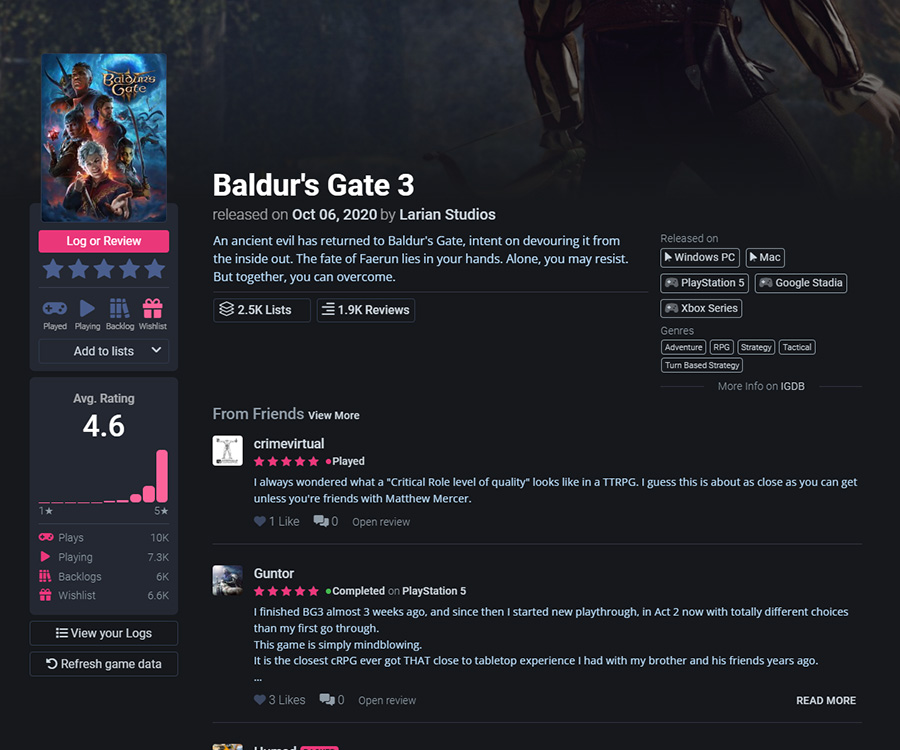

Keep up with the latest from friends
Follow others for an all-in-one activity feed that will keep you updated with their latest gaming progress. Games, reviews, and lists from friends appear directly on your home page so you don't miss a thing.
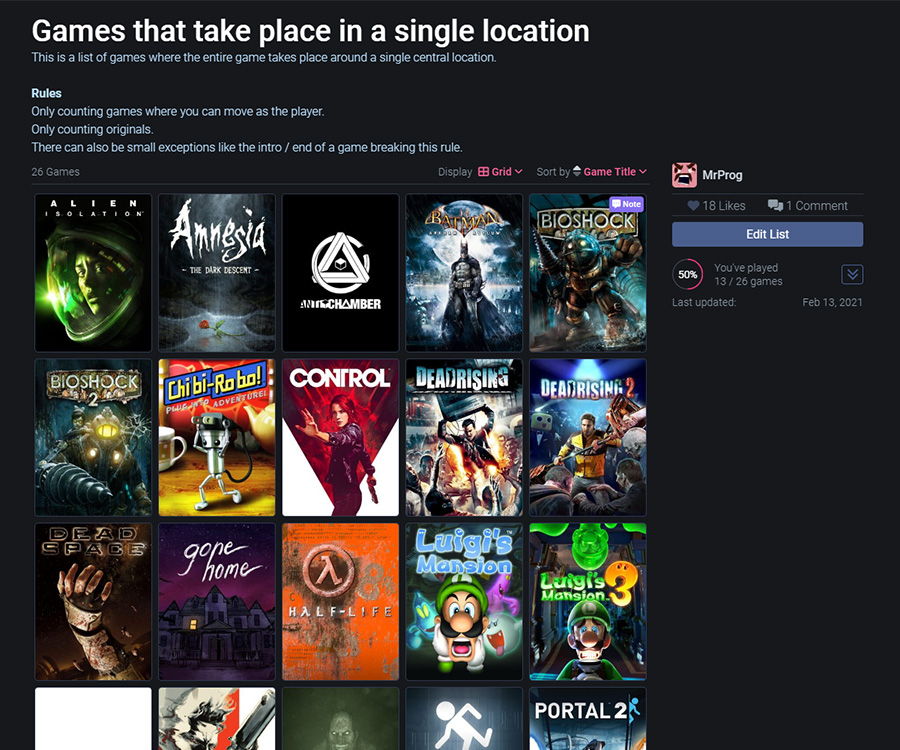
Create and organize games with lists
Lists allow you to create a custom collection of games with options such as tracking your progress or enabling rankings. You can then decide to share your list with the community or keep it private to yourself.
Popular reviews

This review contains spoilers
The most obvious example of architecture as a tool for telling the story would be the Nexus itself. Being a symbolic point of connection between the mundane world and the spirit world, it is presented as a monumental construction, which resembles a cathedral in its vertical dimension. The height of this building gives the feeling of hierarchy, where the player appears among the forgotten dead at the bottom, while colossal statues take the heights. With the help of architecture alone, the designers show where the player stands in this world created especially to imprison ancient creatures. The communication via space proves the idea of integrated narrative suggested by Henry Jenkins, when the story can be discovered in the process of space exploration, rather than being told with the help of cinematic exposition.
FromSoftware also uses the architectural approach known as "compression and release" in the game design. It is widely discussed in the theory of architecture and in the theory of level design. Alternation of narrow corridors and wide outdoor spaces allows regulating the emotional condition of the player through the contrast of the spaces. Claustrophobic corridors (Compression) increase the anxiety, making the player focus on moving in this restricted space and seeing the enemy in front. Those oppressive spaces are interrupted by big castle areas or courtyards (Release), which momentarily decrease the psychological tension before moving again into enclosed spaces. Such sequence of rhythm of the spaces turns architecture into an affective system, which shows how the level design can control emotions of the player without any verbal means. Demons Souls gives examples of the architectural spaces that allow or hinder the movement of the player. Narrow corridors restrict any kind of evasion, forcing the player to engage into direct fighting. Blind corners, collapsible corridors, traps, and difficult ledges turn the environment into an active participant in combat situations. Video games tell their stories via the rules and systems. In demons souls, architecture enforces spatial awareness, forcing the player to remember these values through repeated failures and mastery rather than explicit instruction. Among the most important design aspects that should be noted here is the interconnectedness of the levels of the game. Demon's Souls build environments where spaces loop onto each other. Following a series of dangerous and challenging encounter, the player opens up elevators, gates, or even ladders connecting remote areas with the Archstone. As a result the player receives a completely different mental map of the environment, but enemies' locations and the gameplay's difficulty remain unchanged. In this way, such design encourages the development of spatial memory and gives a feeling of accomplishment, turning the hostile labyrinth into a clear navigational space. Such accomplishments are not associated with a player's growing stats, but with his better understanding of architectural relations, in this way, spatial knowledge turns into progress in a traditional way.
In the end, the architecture of the game stands for the physical embodiment of the spiritual downfall of humankind. Castles, cathedrals, and institutions are all decaying, corrupt, and possessed.
Through the application of environmental storytelling, procedural rhetoric, and architectural symbolism, Demon's Souls shows the extent of creating narratives through the level design. The game spaces do not only test the mechanics of the player, but they also tell stories through his interaction with them. Thus, FromSoftware shows the unique feature of video games to tell stories through architecture and play, making Demon's Souls a landmark game of environmental storytelling.

Sua estrutura é bastante simples. As fases são organizadas em uma sequência de salas, cada uma construída em torno de uma disposição específica de objetos, inimigos e obstáculos. O progresso depende de um conjunto reduzido de ações: mover, carregar, empurrar e lançar objetos. Cada sala apresenta um pequeno problema cuja solução precisa ser encontrada a partir dessas mesmas ferramentas.
Os chefes seguem a mesma lógica. Em vez de introduzir novas mecânicas, exploram as ações que o jogador já domina e concentram o desafio na execução. Vencê-los depende de reconhecer seus padrões de movimento, escolher o momento certo para atacar e reagir com precisão aos seus golpes.
É no cooperativo, porém, que o jogo revela seu maior potencial. Com dois jogadores compartilhando o mesmo espaço, cada ação altera as possibilidades do outro. Um objeto lançado cedo demais, um inimigo deslocado pelo sino ou um bloqueio improvisado modificam o estado da sala e obrigam a dupla a improvisar. A experiência passa a depender tanto da comunicação quanto da capacidade de adaptação, produzindo situações que dificilmente se repetem da mesma forma.
No jogo solo, essa dinâmica perde força. As salas continuam bem construídas, mas a variedade de soluções se torna mais limitada e o conjunto de ações revela mais rapidamente seus próprios limites. Sem a imprevisibilidade criada pela interação entre dois jogadores, os desafios tendem a seguir um percurso mais previsível.
Revisitar Goof Troop me ajudou a colocar uma lembrança antiga em perspectiva. O jogo que permaneceu na minha memória sempre esteve ligado às partidas em dupla, às decisões tomadas no improviso e às soluções construídas em conjunto. Sozinho, seu sistema expõe com mais facilidade suas limitações. Em cooperação, transforma um conjunto simples de mecânicas em uma experiência muito mais rica e instigante.

For one reason or another, I always get stumped and throw in the towel on these doodoo calculator adventures. I'm a fake fan ik 🥀

i liked all of the heroines equally so i wont rank them, but rihoko, ai-chan, sae-chan, kaoru, and the hidden heroine are prob my faves…

Popular lists













Coming soon






Recently anticipated

Jan 15 2027

Feb 18 2027

Dec 31 2027

Jun 30 2027

Dec 31 2027

Sleeper hits
Avg 4.2★

Avg 3.7★
Avg 3.4★

Avg 3.9★

Avg 3.3★

Avg 3.3★