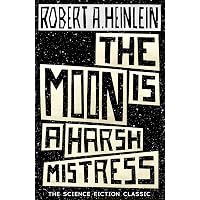
Book details
- Print length256 pages
- LanguageEnglish
- PublisherBAEN BOOKS
- Publication date1 Sept. 2002
- Reading age16 years and up
- Dimensions10.64 x 1.96 x 17.15 cm
- ISBN-109780743435611
- ISBN-13978-0743435611
About the Author
About the author
Follow authors to get new release updates, plus improved recommendations.Robert Heinlein was an American novelist and the grand master of science fiction in the twentieth century. Often called 'the dean of science fiction writers', he is one of the most popular, influential and controversial authors of 'hard science fiction'.
Over the course of his long career he won numerous awards and wrote 32 novels, 59 short stories and 16 collections, many of which have cemented their place in history as science fiction classics, including STARSHIP TROOPERS, THE MOON IS A HARSH MISTRESS and the beloved STRANGER IN A STRANGE LAND.
Customers who viewed this item also viewed
Product Information
| ASIN | 0743435613 |
| Publisher | BAEN BOOKS |
| Publication date | 1 Sept. 2002 |
| Language | English |
| Print length | 256 pages |
| ISBN-10 | 9780743435611 |
| ISBN-13 | 978-0743435611 |
| Item weight | 127 g |
| Reading age | 16 years and up |
| Dimensions | 10.64 x 1.96 x 17.15 cm |
| Customer Reviews | 4.2 out of 5 stars 580Reviews |
|---|
Top reviews from the United Kingdom
- 5 out of 5 starsVerified Purchase
Thought provoking. Great Heinlein.
Reviewed in the United Kingdom on 2 March 2013Format: Mass Market PaperbackHeinlein always amazes with his concepts. Here you have him formulating economic systems to support a non-communist utopia and a benevolent non-fascist eugenics programme. Truely inspiring.
- 4 out of 5 stars
A Grand Utopian Vision
Reviewed in the United Kingdom on 6 March 2015Beyond This Horizon, is the second of Heinlein's published novels, and introduces us to a future utopia where poverty no longer exists and genetic engineering has advanced to a point where it is possible to selectively breed children for increased health, intelligence and longevity. The biggest problem faced by most of this world's denizens is what to do with their time, leading to a society in which decadence is the norm and duelling with sidearms is considered an acceptable way of resolving disputes. Non-advanced citizens also exist, known as control normals, and are seen by the majority of others as a baseline with which to compare the genetic improvements found in the general populace.
The main bulk of the story follows the adventures of Hamilton Felix, a notably superior (others refer to him as an example of a star line), albeit mildly disillusioned citizen of this world's breeding program and his attempts to find a meaning in life. When he is approached by a synthesist (effectively an administrator of the breeding program) with a request to help propagate the next generation of advanced humans Felix's apathy towards the future, along with an unwillingness to propagate initially leads him to decline, but only after he is convinced to agree that if the synthesist can provide him with proof that a man's life is more than just the existence he experiences then he would be willing to reconsider.
Along the way he is also drawn into a burgeoning conspiracy by a group of citizens who feel that the current system needs to be overthrown, and that their society needs to be restructured under their control. Felix agrees to join this group, known as The Survivor's Club, though his decision is motivated more by a sense of loyalty to society, leading him to act as a double agent within their midst, than by any need to change the status quo. When the Survivor's Club do make their move Felix turns against them and helps to overturn their coup.
The second half of the novel then explores the results of Felix falling in love with and marrying Longcourt Phyllis, the woman selected for him by the synthesists. Between them they produce a son, Theobald, who they soon discover has powers that seem to equate to telepathy.
By the end of the book Felix has found a purpose for his life, and his original apathy no longer causes him concern.
Some have suggested that Beyond This Horizon represents one of the first examples of a post-singularity novel and to some degree I can agree with that assertion, though many of the elements required for a true post-singularity world are absent simply as a result of when it was written; computers were barely known of, and the idea of a world-wide interconnected communication network (the internet) was still a few decades away from being considered.
Personally I don't consider this to be one of Heinlein's best, though it's still better than much of the sci-fi of the time. In it he explores themes of reincarnation and the immortality (and possibly even the existence) of the human soul. He also presents a world of social equality, a world where things such as race, creed, faith and gender are simply portions of a person's make-up, and not things to get concerned over. In that respect it was a highly progressive novel for the times, and introduced a number of themes that continued to crop up in his future novels.
In all I still enjoyed re-reading this one, though if you're new to Heinlein I'd suggest starting with one of his later works.
- 3 out of 5 stars
Defining a 'Better' Human
Reviewed in the United Kingdom on 27 December 2002Format: Mass Market PaperbackHeinlein started his publishing career with quite a bang, with three novels, a couple of novellas, and numerous short stories all published in a short two-and-a-half-year time span. Due to this copious output, he frequently had more than one story in a single issue of Astounding magazine, necessitating his use of several pen names. This story, as it did not fall into his 'Future History' chart, was first published as by Anson MacDonald, though its style and subject material, being so different from most of what was being published at that time, pretty clearly marked who the author really was.
This is a book of many and various ideas, both social and scientific, some of which may seem a little ludicrous, others of which are very valid and of great import to today's society. One of the most confounding ideas presented here is the idea that government should not be taxing people, but rather should be distributing money to all citizens so as to provide as much new money in circulation as there has been in new production of products. Next up is an idea that an openly armed citizen will command respect and demand polite behavior, while those who choose to go unarmed are to some degree second class citizens - an idea that probably was not very well thought out for all of its implications, unusual for Heinlein. But most prevalent is the idea of managing the human genome to produce a 'better' human, better in this case being defined as 'entity most able to survive under changing conditions'. The converse of this is also shown, of what happens when genetics are manipulated to produce particular types of supermen (or monsters, depending on your point of view). This, written at the height of Hitlerian rhetoric, is remarkable for is perspicacity and its ultimate relevance to today's debate about the ethics of all forms of genetic engineering from cloning to stem-cell research. Not satisfied with just these ideas, the latter half of the novel tackles the age-old questions of life-after-death, reincarnation, and when a fetus becomes a human.
So this book is loaded with interesting ideas, but it is also very definitely an early effort, with numerous indicators that Heinlein had not fully learned the craft of writing. As it is, there is some evidence that at least parts of this novel were a re-write of his first never-published (and since destroyed) novel, For Us The Living, apparently written somewhere around 1937. That date may be significant, for as we start this book, we find a utopia where there is no hunger, no poverty, no need to work to earn a living, though many do. It is also around the time frame of 1937-1938 that Heinlein was heavily involved with the social program EPIC (End Poverty in California) that was championed by Upton Sinclair, and it is apparent that at least some of the ideals from that program provided some of the impetus for the society Heinlein presents in this book. As is typical for first novels, though, there is a tendency to include sub-plots and incidents that don't further the ultimate aim of the novel. The entire first half, with its emphasis on the actions of a misguided revolutionary group, has almost zero relevance to the second half of the novel - it's almost as if there were really two separate books here that have been forcibly mated, to the detriment of both halves. Coincidence plays far more of a role than it should. Characterization is very spotty, with Felix, the protagonist, reasonably well portrayed, but most of the other characters, and especially the women, are very two-dimensional. Dialogue is dated with forties slang, and there is too much telling, rather than showing, of much of the more scientific detail.
But even with all these flaws, this is still a fascinating book, with its multiple ideas and opinions to keep your head engaged, with the action fast enough to hide most of the problems. Not the best, nor even the second best of his works, but still very recognizably a Heinlein novel.
--- Reviewed by Patrick Shepherd (hyperpat)
- 2 out of 5 starsVerified Purchase
I just found this book really hard to follow. ...
Reviewed in the United Kingdom on 26 January 2016Format: Mass Market PaperbackI just found this book really hard to follow. The characters and scenes weren't distinct enough so I kept losing track of who was who and where was where. It's a decent premise but very poorly implemented.
- 5 out of 5 starsVerified Purchase
Horizon
Reviewed in the United Kingdom on 24 February 2026Format: HardcoverVery good book. One of heinlein's best novels.
Top reviews from other countries
Rob5 out of 5 starsVerified PurchaseFive Stars
Reviewed in Canada on 9 September 2016Format: Mass Market PaperbackI know I've read this sometime before but darned if I could remember when.
Sending feedback...Thank you. We’ll investigate in the next few days.Sorry, We failed to report this review. Please try again
KMA5 out of 5 starsVerified PurchaseHeinlein
Reviewed in the United States on 15 August 2018I've read almost all of R.A.H.'s works. I find them all outstanding. But, I admit to being prejudiced. He is/was my favorite author You cannot go amiss with anything he wrote whether new to the genre, or having read stories of this nature for over sixty years as I have. . Jules Verne would be his closest competitor. Visions of "future history" based on then current science and probability are remarkable. As well as any philosophical, theological or any other class you care to place it in.
But, it's your opinion that matters, not mine. Not one of his finest works, but a good read. As they all are.. But read them as "stories". and think of the possibilities they present. Thinking is what sets us apart from other life forms. And gives us hope, and inspiration to do more to improve our existence.. It is my belief that it is what Mr. Heinlein would want.
Sending feedback...Thank you. We’ll investigate in the next few days.Sorry, We failed to report this review. Please try again
Dr U.K. Bhadra5 out of 5 starsVerified PurchaseExcellent Service
Reviewed in India on 27 February 2019Format: HardcoverThe book came just as the description in the amazon listing - hardcover, very good quality, and the Dust Jacket intact.
Thanks.
Sending feedback...Thank you. We’ll investigate in the next few days.Sorry, We failed to report this review. Please try again
Nathan Brown4 out of 5 starsVerified PurchaseA must for Heinlein fans.
Reviewed in the United States on 22 June 2016Heinlein's first novel, I have read everything he wrote except this one until now. Pretty good for a first novel, covers a lot of themes the author explores in greater depth in other works. If you are a Heinlein fan, I highly reccommend that you read it.A good introduction to Heinlein if you haven't read him.
Sending feedback...Thank you. We’ll investigate in the next few days.Sorry, We failed to report this review. Please try again
Björn1 out of 5 starsVerified PurchaseWhy is this a classic???
Reviewed in Germany on 12 September 2020Format: Mass Market PaperbackI can't believe that I bought again a 'classic' and an awarded book only to be disappointed once again.
-- The dialogues are forced. I find it dreadfully to read.
-- Even if written in the 40-ties, it does not really describe a different world or different ideas. Asimov and others have much better ideas.
-- Really? Dueling as for gaining social status? Come on.
Sending feedback...Thank you. We’ll investigate in the next few days.Sorry, We failed to report this review. Please try again
How customer reviews and ratings work
Customer Reviews, including Product Star Ratings, help customers to learn more about the product and decide whether it is the right product for them.Learn more how customers reviews work on Amazon