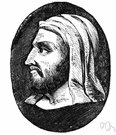
Plutarch

(redirected from Plutarchan)
Also found in: Medical, Encyclopedia.

Plu·tarch

 (plo͞o′tärk′) Originally Mestrius Plutarchus. ad 46?-120?
Greek biographer and philosopher. He wrote Parallel Lives, a collection of paired biographies of famous Greek and Roman figures that Shakespeare used as source material for his Roman plays.

Plu·tarch′an (-tär′kən), Plu·tarch′i·an (-tär′kē-ən) adj.
American Heritage® Dictionary of the English Language, Fifth Edition. Copyright © 2016 by Houghton Mifflin Harcourt Publishing Company. Published by Houghton Mifflin Harcourt Publishing Company. All rights reserved.

Plutarch

(ˈpluːtɑːk)
n
(Biography) ?46–?120 ad, Greek biographer and philosopher, noted for his Parallel Lives of distinguished Greeks and Romans
Collins English Dictionary – Complete and Unabridged, 12th Edition 2014 © HarperCollins Publishers 1991, 1994, 1998, 2000, 2003, 2006, 2007, 2009, 2011, 2014

Plu•tarch

(ˈplu tɑrk)

n.
A.D. c46–c120, Greek biographer.
Plu•tarch′i•an, adj.
Random House Kernerman Webster's College Dictionary, © 2010 K Dictionaries Ltd. Copyright 2005, 1997, 1991 by Random House, Inc. All rights reserved.
ThesaurusAntonymsRelated WordsSynonymsLegend:
Noun1.Plutarch - Greek biographer who wrote Parallel Lives (46?-120 AD)Plutarch - Greek biographer who wrote Parallel Lives (46?-120 AD)
Based on WordNet 3.0, Farlex clipart collection. © 2003-2012 Princeton University, Farlex Inc.
Translations
Plutarch
Plutarque
플루타르크
Plutarch

Plutarch

[ˈpluːtɑːk] NPlutarco
Collins Spanish Dictionary - Complete and Unabridged 8th Edition 2005 © William Collins Sons & Co. Ltd. 1971, 1988 © HarperCollins Publishers 1992, 1993, 1996, 1997, 2000, 2003, 2005

Plutarch

nPlutarch m
Collins German Dictionary – Complete and Unabridged 7th Edition 2005. © William Collins Sons & Co. Ltd. 1980 © HarperCollins Publishers 1991, 1997, 1999, 2004, 2005, 2007

Plutarch

[ˈpluːtɑːk] nPlutarco
Collins Italian Dictionary 1st Edition © HarperCollins Publishers 1995
References in periodicals archive ?
Duff, "The Structure of the Plutarchan Book," Classical Antiquity 30, 2011, 213-78, who divides the schema into four sections.
Van der Stockt (eds.), Virtues for the People: Aspects of Plutarchan Ethics, Leuven, 59-82.
The topics include Plutarchan prosopography: the cursus honorum, Tacitus on trial, the restoration of order after mutinies and indiscipline, a critical reappraisal of Dio Chrysostom as a local politician, the meaning of dioceses and their borders in the fourth century AD, the provinces and worldview of Velleius Paterculus, using sundials, and the healing springs of Latium and Etruria.
(49) Hardy has given the daughters names (which they do not have in the Plutarchan source) and voices.
Part One (Chapters 2-4) explores Bruni's early forays into history writing: his interest in Plutarchan biography informs the comparative analysis between the ancients and the moderns.
(11) Perhaps partly because animals were seen to be exemplars of health in the Plutarchan tradition, possessing a kind of natural medicine in their bodies, they came to represent a medical resource, what twenty-first-century terminology calls pharmazooticals, that is, medicine derived from animal bodies.
The Lavinia in this story is, however, vaguely analogous to Artemisia, insofar as there is a shred of evidence placing her definitively on the map of Plutarchan history of people and events.
Virtues for the people; aspects of Plutarchan ethics.
But as Caracalla and Domitian were parallel tyrants, (40) the plays, looked at side-by-side, appear as parallel lives in the Plutarchan sense: biographies of persons so similar that it is instructive to note their differences.
In context with Ovid, and with the Plutarchan and Apuleian versions of Isiac myth, Britomart's accumulation of creative power at the Church of Isis in canto 7 illustrates Spenser's "metamorphoses" in his representation of the sexual origins of generation.