
Having completed and fully annotated Ehrman’s new book Did Jesus Exist? The Historical Argument for Jesus of Nazareth (Harper 2012), I can officially say it is filled with factual errors, logical fallacies, and badly worded arguments. Moreover, it completely fails at its one explicit task: to effectively critique the arguments for Jesus being a mythical person. Lousy with errors and failing even at the one useful thing it could have done, this is not a book I can recommend.
Overall Impressions
I was certain this would be a great book, the very best in its category. And I said this, publicly, many times in anticipation of it. It’s actually the worst. It’s almost as bad, in fact, as The Jesus Mysteries by Freke & Gandy (and I did not hyperlink that title because I absolutely do not want you to buy it: it will disease your mind with rampant unsourced falsehoods and completely miseducate you about the ancient world and ancient religion). I was eagerly hoping for a book I could recommend as the best case for historicity (but alas, that title stays with the inadequate but nevertheless competent, if not always correct, treatment in Van Voorst’s Jesus Outside the New Testament and Theissen & Merz’s The Historical Jesus). I was also expecting it to be a good go-to rebuttal to the plethora of bad mythicism out there, so I could just refer people to this book every time they ask me why (for example) Freke & Gandy suck.
But I cannot recommend books that are so full of errors that they will badly mislead and miseducate the reader, and that commit so many mistakes that I have to substantially and extensively correct them. Did Jesus Exist? ultimately misinforms more than it informs, and that actually makes it worse than bad. Like the worst of mythicist literature, you will come away after reading it with more false information in your head than true, and that makes my job as a historian harder, because now I have to fix everything he screwed up. This is why I don’t recommend anyone ever read bad mythicist literature, because it will only fill your head with nonsense that I will have to work harder to correct. Ehrman’s book ironically does much the same thing. Therefore, it officially sucks.
The most alarming irony that struck me is that part of his failure is apparently a matter of professional qualifications. I say ironic because it’s something he makes so much of: we supposedly can’t do competent work because we don’t have degrees “specifically” in early Christian history (though in fact I and Robert Price do; Ehrman falsely claims my degree is only in “classics,” a strange ploy I’ll remark on later); but it is his incompetence in classics (e.g. knowledge of ancient culture and literature) and ancient history (e.g. understanding the methodology of the field and the background facts of the period) that trips him up several times. In the next part of this article I will document several examples.
This book is also badly written (I’ll give some examples of that, too) and almost useless in its treatment of mythicist authors (even when he’s right). The latter failure I find the most disappointing. Almost none of this 361 page book is a critique of the “bad” mythicists. He barely even mentions most of them. Indeed, if he mentioned Atwill even once it was in passing at best, and for the few authors he spends any time discussing (mainly Murdock and Freke & Gandy), he is largely dismissive and careless (indeed, his only real refutation of them amounts to little more than nine pages, pp. 21-30). I was hoping for a well-researched refutation of these authors so I could recommend this book to students, so they could see what sound scholarship looks like and to correct the errors in their heads after reading authors like these. But this book simply doesn’t do that.
That alone I could live with (although I would have rather he not addressed them at all if he wasn’t going to address them competently). But even his treatment of the “good” mythicists (which comprises maybe half the book) is weak to the point of useless. This would be (principally) myself, Robert Price, Earl Doherty, G.A. Wells, Thomas Thompson, and (perhaps) Frank Zindler. He treats our arguments only selectively, never comprehensively, and I never once saw him actually engage directly with any single mythicist case for their theory of Christian origins–as in, describing the theory correctly, listing the evidence its proponent offers for each element, and then evaluating that evidence and the logical connection between it and their conclusion. You won’t find this done once, anywhere in this book, for any author. He just cherry picks isolated claims and argues against them, often with minimal reference to the facts its proponent has claimed support it.
The next most alarming thing about this book is its astonishing plethora of blatant logical fallacies and self-contradictions. An attentive reader, who was aware of the actual facts, would come away from this book believing historicity can only be defended by deploying a methodological framework that would produce absurd conclusions if applied to any other subject in the history of myth and religion (I’ll demonstrate what I mean in the last half of this article). I wrote Proving History in part to bring to public attention the fact that even specialists in the methodology of Jesus studies have all concluded that its methodology is logically fallacious and urgently in need of replacement. But Ehrman not only uses that fallacious methodology (completely unaware of any of the literature in his own field refuting it), he makes the field’s methodology look even worse, routinely resorting to the most egregiously illogical arguments for his positions, yet with such absolute confidence one might not think they are reading the work of a careful and cautious scholar but a wild sensationalist, like some Christian apologist or the whackiest of mythers.
Like Freke & Gandy, Ehrman is occasionally right. For example, that many mythicists are incompetent or do not argue their case well; or that they are often fanatically unmoved by evidence and logic and won’t abandon their theory no matter what is presented them. But historicity proponents are sometimes just as guilty of these faults–Ehrman included, as I’ll demonstrate below. Ehrman will also decry bad mythicist literature, quite rightly, as “filled with patently false information and inconsistencies” (p. 27), but as we shall see, this sentence also describes Ehrman’s book. In fact, there are so many errors and fallacies and questionably worded statements in his book that documenting them all would produce a monstrously long article. So I will restrict myself to explaining several key examples, which are representative of countless other defects throughout the book. I might catalog more examples in future blog posts (and if I do I will link to them here). But I need to get on with doing what I must do here, which is give evidence for all that I have claimed above.
[For those who want more examples, there are other reviews that address the flaws in this book, from the Preliminary Overview of Thomas Verenna to the extensive rebuttal series of Earl Doherty and Neil Godfrey. I am interested in any others you deem worth reading, so post any you know of in comments later and I might include them here. Also, for those who read my critique of Ehrman’s Huffington Post article, and my response to his inept defender James McGrath, who want to know if Ehrman’s book repeats the same errors as his article, the answer is technically no, it treats the same issues somewhat less erroneously or fallaciously, although the mistakes he made in that article remain relevant evidence of his carelessness and unreliability on this issue, and my responses to it likewise illustrate many elements of the mythicist case that are misrepresented or not even addressed in Ehrman’s book. For an up-to-date summary of everything see Ehrman on Historicity Recap.]
Errors of Fact
This is just a selection, to collectively illustrate a general point:
The Priapus Bronze: In response to D.M. Murdock’s claim that there is a statue of a penis-nosed cockerel (which she says is a “symbol of St. Peter”) in the Vatican museum, Ehrman says that “there is no penis-nosed statue of Peter the cock in the Vatican or anywhere else except in books like this, which love to make things up” (p. 24). Ehrman evidently did no research on this and did not check this claim at all. Murdock quickly exposed this by providing numerous scholarly references, including actual photographs of the object (see The Phallic Savior of the World). Most important of these is Lorrayne Baird, “Priapus Gallinaceus: The Role of the Cock in Fertility and Eroticism in Classical Antiquity and the Middle Ages,” Studies in Iconography 7-8 (1981-82): 81-112. It does not have the name “Peter” on it (Murdock never claimed it did; that it represents him is only an interpretation), but it apparently exists (or did exist) exactly as she describes.
At the very least I would expect Ehrman to have called the Vatican museum about this, and to have checked the literature on it, before arrogantly declaring no such object existed and implying Murdock made this up. I do not assume Murdock’s interpretation of the object is correct (there is no clear evidence it has anything to do with Christianity, much less Peter). But its existence appears to be beyond dispute. She did not make that up. The reason this error troubles me is that it is indicative of the carelessness and arrogance Ehrman exhibits throughout this book: like Freke & Gandy, he often doesn’t check his facts, and clearly did little to no research. This makes the book extremely unreliable. A reader must ask, if he got this wrong, what other assertions in the book are false? And since making sure to get details like this right is the only useful purpose this book could have had, how can we credit this book as anything but a failure? I needed this book to do a good job of refuting bad mythicism. Because if it doesn’t do that, it’s useless.
The Doherty Slander: Ehrman says Earl Doherty “quotes professional scholars at length when their views prove useful for developing aspects of his argument, but he fails to point out that not a single one of these scholars agrees with his overarching thesis” (p. 252). This claim is so completely false I cannot believe Ehrman read the work of Doherty with any requisite care. Neil Godfrey documents the fact (in Devious Doherty or Erring Ehrman?) that Doherty repeatedly points out exactly what Ehrman claims he doesn’t. This is actually a typical error I found in Ehrman’s book. He often makes blanket false statements that make mythicists look incompetent, thus the reader is misled into thinking they are.
This is a serious error, because it makes Ehrman’s book into nothing more than falsified propaganda. It is his responsibility as a scholar to have read these writings and accurately represent them to his readers so they don’t have to read them themselves. That he doesn’t do that erases any scholarly value this book could have had. Here, for example, the key point is that Doherty engaged himself like a competent scholar, used mainstream scholarship extensively, and correctly identified where his conclusions and interpretations differed from the scholars he cites and from mainstream scholarship generally. Ehrman hides this fact from his readers, and even misleads his readers by declaring exactly the opposite. Where else does Ehrman completely hide and misrepresent the views, statements, and methods of the mythicists he criticizes? If we cannot trust him in this case (and clearly we can’t, since what he says is demonstrably exactly the opposite of the truth), why are we to trust anything he says in this book?
The Pliny Confusion: Ehrman almost made me fall out of my chair when he discusses the letters of Pliny the Younger. He made two astonishing errors here that are indicative of his incompetence with ancient source materials. First, he doesn’t correctly cite or describe his source (yet in this particular case that should have been impossible); and second, he fails to understand the difference between a fact and a hypothesis. Ehrman says that Pliny discusses Christians in his correspondence with emperor Trajan in “letter number 10,” and that “in his letter 10 to the emperor Pliny discusses” the problem of the imperial decree against firefighting societies in that province, “and in that context he mentions another group that was illegally gathering,” the Christians (pp. 51-52). This is all incorrect, and demonstrates that Ehrman never actually read Pliny’s letter, and doesn’t even know how to cite it correctly, and has no idea that the connection between Pliny’s prosecution of Christians and the decree against illegal assembly affecting the firefighters in Bithynia is a modern scholarly inference and not actually anything Pliny says in his letters.
In fact, Pliny never once discusses the decree against fire brigades in his letter about Christians, nor connects the two cases in any way. Moreover, neither subject is discussed in “letter number 10.” Ehrman evidently doesn’t know that all of Pliny’s correspondence to Trajan is collected in book 10 of Pliny’s letters. His letter on the fire brigades is, in that book, letter 33; and his letter on Christians is letter 96 (and therefore nowhere near each other in time or topic). On their possible connection (which I do believe scholars have correctly inferred), see my discussion in Not the Impossible Faith (pp. 418-22). But Ehrman has still gotten the context wrong. The law against illegal assembly was not a special law in that province, but had long been a law throughout the whole empire, and it was not targeted at fire brigades. Existing law required all social clubs to be licensed by the government, and many clubs were so licensed (including religious and scientific associations, burial clubs, guilds, and, of course, fire brigades). What was unique about Pliny’s province was that the state had been denying these licenses even to fire brigades, and Pliny asked Trajan to lift that injunction (and in letter 34, Trajan denies Pliny’s request, citing recent unrest in that province).
The connection between the Bithynian fire brigades and Christianity is not that there was any special injunction against Christians (Trajan, in letter 97, explicitly says there wasn’t), but that in letter 96 Christianity appears to be treated by Pliny like any unlicensed club, and both letters (96 and 97) make it clear there was no specific law or decree against Christians. Therefore, modern scholars conclude, the same law is probably what was being applied in both cases (prosecuting Christians and banning firefighting associations). And that’s kind of what Ehrman confusingly says (except he is evidently unaware that this is a modern conclusion and not actually stated in the source).
Ehrman’s treatment of the sources and scholarship on this issue betray the kind of hackneyed mistakes and lack of understanding that he repeatedly criticizes the “bad” mythicists of (particularly his inability even to cite the letters properly and his strange assumption that both subjects are discussed in the same letter–mistakes I would only expect from an undergraduate). But if even historicists like Ehrman can’t do their research properly and get their facts right, and can’t even be bothered to read their own source materials or understand their context, why are we to trust the consensus of historicists any more than mythicists? And more particularly, how many other sources has Ehrman completely failed to read, cite, or understand properly?
The Pilate Error: In the past I have noted that I don’t trust G.A. Wells to be sufficiently competent in ancient history because he makes mistakes that exhibit ignorance of basic background knowledge of Roman history. The example I often give is his argument that Tacitus’ passage about Christians cannot be from a reliable source because it “incorrectly” claims Pilate was a procurator, when in fact everyone knows he was a prefect. This betrays ignorance of the fact that provincial prefects were often also imperial procurators, and from his treatment of the scandal of this fact throughout the Annals Tacitus has a particular motive to emphasize that fact here (see my discussion in Herod the Procurator, particularly the section “So Was Pontius Pilate a Prefect or a Procurator?”). In other words, Pontius Pilate was both a procurator and a prefect. And the recent literature on the subject confirms this, as would any consultation with an expert in Tacitus or Roman imperial administration. [I now conclude that knowing this would require a more advanced skill in the field than that, so I’m being too harsh on Ehrman for getting it wrong.]
Imagine my surprise when I saw Ehrman making the same argument, that “Tacitus is precisely wrong” in saying Pilate was a “procurator” (p. 56). Like Wells, Ehrman doesn’t understand his source (why Tacitus would choose to say “procurator”) or the historical context (why prefects were often also procurators). Moreover, he speaks with absurd hyperbolic certainty: Tacitus is “precisely” wrong; as opposed to, say, Tacitus “appears” to be or “might” be wrong, or “according to Wells, Tacitus is wrong,” or any of a dozen other more accurate and suitably cautious remarks one would expect from someone who ought to know he is out of his element when treating Roman imperial administration or sources (like Tacitean literature) that he is not well versed in. If I cannot rely on Wells because of this error, this means I cannot rely on Ehrman, either.
Now, one or two mistakes like this would be excusable. We all make them. And we can’t all know everything. But my point is that this is an example of a pervasive number of similar errors throughout the book that indicate Ehrman doesn’t actually know what he is talking about. And since a lay reader won’t know that, they will come away from this book with more false information in their heads than true. And as I said, that makes this book worse than bad.
The “No Records” Debacle: Ehrman declares (again with that same suicidally hyperbolic certitude) that “we simply don’t have birth notices, trial records, death certificates—or other kinds of records that one has today” (p. 29). Although his conclusion is correct (we should not expect to have any such records for Jesus or early Christianity), his premise is false. In fact, I cannot believe he said this. How can he not know that we have thousands of these kinds of records? Yes, predominantly from the sands of Egypt, but even in some cases beyond. I have literally held some of these documents in my very hands. More importantly, we also have such documents quoted or cited in books whose texts have survived. For instance, Suetonius references birth records for Caligula, and in fact his discussion of the sources on this subject is an example I have used of precisely the kind of historical research that is conspicuously lacking in any Christian literature before the third century (see Not the Impossible Faith, pp. 182-87).
From Ehrman’s list, “birth notices” would mean census receipts declaring a newborn, tax receipts establishing birth year (as capitation taxes often began when a child reached a certain age), or records establishing citizenship, and we have many examples of all three; as for “trial records” we have all kinds (including rulings and witness affidavits); we have “death certificates,” too (we know there were even coroner’s reports from doctors in cases of suspicious death); and quite a lot else (such as tax receipts establishing family property, home town, and family connections; business accounts; personal letters; financial matters for charities and religious organizations). As one papyrologist put it, “a wealth of papyrus documents from the Graeco-Roman era have come to light on the daily lives of ancient people in Egypt, including their love letters and marriage contracts, tax and bank accounts, commodity lists, birth records, divorce cases, temple offerings, and most other conceivable types of memoranda, whether personal, financial, or religious” (see Greco-Roman Papyrus Documents from Egypt).
That Ehrman would not know this is shocking and suggests he has very little experience in ancient history as a field and virtually none in papyrology (beyond its application to biblical manuscripts). Worse, he didn’t even think to check whether we had any of these kinds of documents, before confidently declaring we didn’t. Instead, Ehrman only demonstrates how little we can trust his knowledge or research when he says such silly things like, “If Romans kept such records, where are they? We certainly don’t have any” (p. 44). He really seems to think, or is misleading any lay reader to think, that (a) we don’t have any such records (when in fact we have many) and that (b) our not having them means Romans never kept them (when if fact it only means those records have been lost, because no one troubled to preserve them; which leads us to ask why no one in Jesus’ family, or among his disciples or subsequent churches, ever troubled to preserve any of these records, or any records whatever, whether legal documents, receipts, contracts, or letters).
We can certainly adduce plausible answers for why we don’t have any of these documents for Christianity, answers that do not entail Jesus did not exist. Which is what a competent author would have done here: admit that we have lots of these kinds of records and know they once existed, but due to factors and conditions relating to where Christianity began and how it developed, it would be unreasonable to assume any of these records would be preserved to us (see my discussion of the corresponding logic of evidence in regard to the trial records under Pontius Pilate in Proving History, pp. 220-24). But we have to accept the consequences of any such answer we give.
For example, we cannot claim the Christians were simultaneously very keen to preserve information about Jesus and his family and completely disinterested in preserving any information about Jesus and his family. An example is the letter of Claudius Lysias in Acts, which if based on a real letter has been doctored to remove all the expected data it would contain (such as the year it was written and Paul’s full Roman name), but if based on a real letter, why don’t we still have it? It makes no sense to say Christians had no interest in preserving such records. Moreover, if a Christian preserved this letter long enough for the author of Acts to have read it, why didn’t they preserve any other letters or government documents pertaining to the early church, just like this one?
I personally believe we can answer these questions (and thus I agree with Ehrman that this argument from silence is too weak to make a case out of), but not with this silly nonsense. A good book on historicity would have given us educationally informative, plausible, and thoughtfully considered answers and information about ancient documents and the total Christian failure to retain or use them. Instead Ehrman gives us hackneyed nonsense and disinformation. Again, the relevance of this is that if he failed so badly in this case, how many other statements and claims of his are misinforming us about the evidence and the ancient world? And if he didn’t do even the most rudimentary fact checking (“Let’s see, do we have any Roman documents?”) and didn’t know so basic a background fact as this about the field of ancient history (that we have tons of these documents, as any ancient historian cannot fail to know because she will have worked with them many times, even in graduate school), then how can we assume any of his work in this book is competently researched or informed?
The Tacitus Question: Ehrman says “I don’t know of any trained classicists or scholars of ancient Rome who think” the passage about Christians in Tacitus is a forgery (p. 55). Now, I agree with Ehrman that it’s “highly unlikely” this passage wasn’t what Tacitus wrote [I have since changed my mind about that–ed.]; but the fact that he doesn’t know of the many classical scholars who have questioned it suggests he didn’t check. See Herbert W. Benario, “Recent Work on Tacitus (1964–68),” The Classical World 63.8 (April 1970), pp. 253-66 [and in 80.2 (Nov.–Dec. 1986)], who identifies no less than six classical scholars who have questioned its authenticity, three arguing it’s an outright interpolation and three arguing it has been altered or tampered with [correction: he names five scholars, one of them arguing in part for both–ed.]. This is important, because part of Ehrman’s argument is that mythicists are defying all established scholarship in suggesting this is an interpolation, so the fact that there is a lot of established scholarship supporting them undermines Ehrman’s argument and makes him look irresponsible.
That the overall consensus of scholarship, myself included, sides with Ehrman on the conclusion is true (I am sure [or at least was-ed.] that the passage is authentic and has not been relevantly altered), but that does not change the fact that readers are being seriously misled by Ehrman’s characterization of the matter. For him to claim that mythicists “just made this up” because it was convenient for them is false. But more alarming to me is the fact that this demonstrates that he didn’t even check. And again, if he didn’t check this, what else didn’t he check? This kind of sloppy work, the failure to check his facts, to do any basic research we should expect of a scholar, and consequently to misrepresent his opponents and their position, and misinform the public about the debate, is the same kind of crap we get from the bad mythicists. Why, then, are we now getting it from a prestigious historicist? Can we speculate that it’s because Ehrman is simply defending a dogma, and as such is simply a priori “certain” he is right and therefore “doesn’t need to check”? What credibility can arguments against mythicism have, when they rest on this kind of arrogantly dogmatic and irresponsible thinking?
The “Other Jesus” Conundrum: Ehrman says the fact that “the life, death, and resurrection of Jesus were recent events” is “the view of all of our sources that deal with the matter at all” (p. 251). This is false. And it’s astonishing that he would not know this, since several other scholars have discussed the sources that place Jesus in the reign of Jannaeus in the 70s B.C. Ehrman seems to think (and represents to his readers) that G.A. Wells just made this up (pp. 247-51). In fact, Wells is discussing a theory defended by others, and based in actual sources: Epiphanius, in Panarion 29, says there was a sect of still-Torah-observant Christians who taught that Jesus lived and died in the time of Jannaeus, and all the Jewish sources on Christianity that we have (from the Talmud to the Toledot Yeshu) report no other view than that Jesus lived during the time of Jannaeus. Though these are all early medieval sources, it nevertheless means there were actual Christians teaching this and that the Jews who composed the Babylonian Talmud knew of no other version of Christianity.
This is indeed a strange curiosity, since it is hard to explain how a religion that taught from its inception a Jesus who lived and died under the Romans, and Pontius Pilate specifically, could ever evolve a sect that placed him a hundred years earlier, or how this sect could become so ubiquitous east of the Roman Empire that the Jews there had not heard of any other. Make of that what you will. My point here is that Ehrman falsely claims no sources say this (when in fact several do) and misleads readers into thinking Wells just made this up, when in fact others have made the same argument, including:
- Alvar Ellegård, Jesus: One Hundred Years before Christ (Overlook 1999)
- Michael Wise, The First Messiah (Harper 1999)
- Frank Zindler, The Jesus the Jews Never Knew (American Atheist 2003)
- John Marco Allegro, The Dead Sea Scrolls and the Christian Myth (Prometheus 1984).
These are all arguably “fringe” scholars, and they may well be as wrong as Wells or even more so. I am not defending anything they argue (I do not believe Christianity originated in the 70s B.C.). I am merely pointing out that Ehrman misleads his readers (and demonstrates his shoddy and careless research) by not even mentioning any of this (neither the many other scholars nor the primary sources), but in fact even arrogantly and ignorantly declaring the contrary (that there are no sources that say this), as if he checked (which is what a naive reader will assume he did).
That Dying-and-Rising God Thing: Case in point. Regarding the claim that Osiris “returned to life on earth by being raised from the dead,” Ehrman insists that in fact “no ancient source says any such thing about Osiris (or about the other gods)” (p. 26). He relies solely on Jonathan Z. Smith, and fails to check whether anything Smith says is even correct. If Ehrman had acted like a real scholar and actually gone to the sources, and read more widely in the scholarship (instead of incompetently reading just one author–the kind of hack mistake we would expect from an incompetent myther), he would have discovered that almost everything Smith claims about this is false. In fact, Plutarch attests that Osiris was believed to have died and been returned to life (literally: he uses the words anabiôsis and paliggenesis, which are very specific on this point, see my discussion in The Empty Tomb, pp. 154-55), and that in the public myths he did indeed return to earth in his resurrected body (Plutarch, On Isis and Osiris 19.358b).
Although Plutarch does say that in the private teachings Osiris’ death and resurrection took place in outer space (below the orbit of the moon), after which he ascended back to the heights of heaven in his new body (not “the underworld,” as Ehrman incorrectly claims on p. 228), that is irrelevant to the mythicist’s case (or rather, it supports it, by analogy, since this is exactly what competent mythicists like Doherty say was the case for Jesus: public accounts putting the events on earth, but private “true” accounts placing it all in various levels of outer space: see my Review of Doherty). In fact the earliest Christians also believed Jesus was resurrected into outer space: he, like Osiris, ascended to heaven in his resurrection body, appearing to those below in visions, not in person (see my survey of the evidence in The Empty Tomb, pp. 105-232; the same is true of many other dying-and-rising gods, like Hercules). The notion of a risen Jesus walking around on earth is a late invention (first found in the Gospels).
That these kinds of beliefs about Osiris’ death and resurrection long predate Plutarch is established in mainstream scholarship on the cult: e.g. S.G.F. Brandon, The Saviour God: Comparative Studies in the Concept of Salvation (Greenwood 1963), pp. 17-36 and John Griffiths, The Origins of Osiris and His Cult, 2nd ed. (Brill 1980). But we hardly need point that out, because there is already zero chance that the entirety of Isis-Osiris cult had completely transformed its doctrines in imitation of Christianity already by 100 A.D. (I shouldn’t have to explain why such a claim would be all manner of stupid). Ehrman’s claim that Plutarch is making all this up because he is Platonist is likewise nonsense. Ehrman evidently didn’t check the fact that Plutarch’s essay is written to a ranking priestess of the cult, and Plutarch repeatedly says she already knows the things he is conveying and will not find any of it surprising.
So regarding the death and resurrection of Osiris, Ehrman states what is in fact false. And this is most alarming because much of his case against mythicism rests on this false assertion. But worse, Ehrman foolishly eats his foot again by hyperbolically generalizing to all possible gods (he repeatedly insists there are no dying-and-rising gods in the Hellenistic period). Which is really bad, because that proves he did no research on this subject whatever. I shouldn’t have to adduce passages such as, from Plutarch, “[about] Dionysus, Zagreus, Nyctelius, and Isodaetes, they narrate deaths and vanishings, followed by returns to life and resurrections” (Plutarch, On the E at Delphi 9.388f-389a). That looks pretty cut and dried to me. But it’s worse than that. Because for Romulus and Zalmoxis we undeniably have pre-Christian evidence that they actually die (on earth) and are actually raised from the dead (on earth) and physically visit their disciples (on earth). And likewise for Inanna, a clear-cut death-and-resurrection tale exists on clay tablets a thousand years before Christianity (she dies and rises in hell, but departs from and returns to the world above all the same).
I was very alarmed to see that Ehrman never once mentions Romulus or Zalmoxis or Inanna. Thus demonstrating he did no research on this. He didn’t even read my book Not the Impossible Faith, even though he claims to have and even cites it. I know he can’t have actually read it, because I document the evidence, sources, and scholarship on these gods there (pp. 17-20 and 85-128), yet his book shows no awareness of these gods or any of the evidence I present for their resurrection cults. As well as many others, besides those I’ve just here named. (Do not mistake me for supporting false claims in this category, however; Mithras was almost certainly not a dying-and-rising god, and Attis only barely was.)
Even if Ehrman had done any responsible literature review on this, he would have found the latest peer reviewed scholarship establishing, for example, that vanishing bodies as elements of resurrection tales were a ubiquitous component of pagan mythmaking: Richard C. Miller, “Mark’s Empty Tomb and Other Translation Fables in Classical Antiquity,” Journal of Biblical Literature 129.4 (2010): 759-76. And thus a dying-and-rising hero theme was incredibly ubiquitous, even if highly flexible in the different ways this theme could be constructed. To be fair, Ehrman does address Tryggve Mettinger’s work on pre-Hellenistic dying-and-rising gods, dismissing it as questionable but ultimately admitting he might have a case for there being such gods (Ehrman arguing instead, albeit implausibly, that they can’t have influenced Christianity). But Ehrman doesn’t address any of the evidence for these same (much less other) gods in the Hellenistic period, the period actually relevant to Christianity, which proves he did no checking, and isn’t even aware of such evidence, nor even thought it was important for him to be.
Again, Ehrman exposes himself as completely uninformed, and incompetent as a scholar (like any hack, trusting a single biased scholar and not checking any of the evidence or reading any of the other literature), and as consistently misinforming his readers on the actual facts, and thus hiding from them almost everything that actually adds strength to the mythicist thesis. That he does this on a point so central and crucial to his book’s entire argument is alone enough to discredit this book as worthless.
The Baptism Blunder: Ehrman says “we don’t have a single description in any source of any kind of baptism in the mystery religions” (p. 28). That is outright false, and one of the most appallingly incompetent statements in this book. Apuleius gives us a first person account of baptism in Isis cult, which he describes as a symbolic death and resurrection for the recipient, exactly as Paul describes Christian baptism in the NT (see Not the Impossible Faith, p. 376; and e.g. Romans 6:4), a fact that surely undermines Ehrman’s entire argument and makes the mythicist case look significantly stronger. So this is certainly important for him to know (and yet he would know it, if he actually read my work, which as we’ve seen, he did not), and crucial for the reader to know. Evidence of baptism in Osiris cult (and that it granted eternal life) exists in pre-Christian papyri, and several other sources: see Brook Pearson, Corresponding Sense: Paul, Dialectic, and Gadamer (Brill 2001), pp. 206-18, 312-29.
We also know that something like baptism into eternal life was a feature of the cult of Bacchus-Dionysus, and we know this not only because Plato mentions it (Plato, Republic 364e-365a, where we’re told of Orphic libations “for the remission of sins” that secure one a better place in the afterlife), but also from actual pre-Christian inscriptions (that’s right, words actually carved in stone). See examples in Hans Conzelmann, 1 Corinthians (Fortress 1975), pp. 275-76, n. 116. Both sources (Plato and inscriptions) also confirm the Bacchic belief that one could be baptized on behalf of someone who had already died and thus gain them a better position in the afterlife. It cannot be a coincidence that exactly the same thing, baptism for the dead, is attested as a Christian rite in Paul (1 Corinthians 15:29). We have hints of baptismal rituals in other cults (Tertullian, for example, in On Baptism 5, describes numerous pagan rituals of baptism for the remission of sins, clearly understanding it to be a common practice everywhere known). Sure, in many of these cases the baptism was part of a larger ritual (perhaps involving prayer or incense), but Christian baptisms were not free of their own ritual accoutrements, so those hardly matter to the point.
This also undermines Ehrman’s claim that there is no evidence that the death of Osiris (or any other god) “brought atonement for sin” (p. 26). We know Egyptian afterlife belief made the physical weight of sin a factor in deciding one’s placement in the afterlife, and that (as just shown above) baptism into the death and resurrection of Osiris washes away those sins and thus lightens the soul to obtain the best place in heaven. It is hard to imagine how this does not entail that the death and resurrection of Osiris somehow procured salvation through remission of sins (and clearly a similar belief had developed in Bacchic and other cults). One could perhaps get nitpicky as to what might be the exact theology of the process, but whatever the differences, the similarity remains: the death and resurrection of Osiris was clearly believed to make it possible for those ritually sharing in that death and resurrection through baptism to have their sins remitted. That belief predates Christianity. Ehrman is simply wrong to say otherwise. And the evidence for this is clear, indisputable, and mainstream. Which means his book is useless if you want to know the facts of this matter. Or any matter, apparently.
The Dying Messiah Question: Ehrman declares “there were no Jews prior to Christianity who thought Isaiah 53 (or any other ‘suffering’ passages) referred to the future messiah” (p. 166), yet he does not even mention much less address the Dead Sea pesher (11Q13) or the 1st century targum that both explicitly evince this belief. And he knows about all this, so I cannot explain why he doesn’t even attempt a rebuttal, or even in fact mention this evidence, which can only misinform the reader, who will think there is none, and mistakenly conclude his assertion has not been disputed. That is simply irresponsible. See my discussion of this in The Dying Messiah Redux [updating and correcting my earlier article The Dying Messiah, which I know he had read well in advance of publishing his book, so it appears like he is suppressing arguments and evidence presented by mythicists, in order to make our claims look weaker than in fact they are.]
Besides his false (or at least debatable) statement, there is a logical fail here as well, since he bases his conclusion that no Jews would develop a belief in a dying messiah on the premise that no Jews had a belief in a dying messiah, which apart from being a circular argument (all novel beliefs start somewhere; you can’t argue that x would not arise because x hasn’t arisen), and apart from the fact that the inference is refuted by the fact that Jews later did develop such a belief (independently of Christianity, as I also demonstrate in the preceding link) so clearly there was no ideological barrier to doing so, but besides all that, his premise requires knowing what all Jews, of all sects, everywhere, believed or imagined, which knowledge Ehrman doesn’t have (not even close: see my discussion of what I and other scholars have said about such preposterous claims to omniscience in Proving History, pp. 129-34). He even knows his own inference is illogical, because he makes the exact same argument I just did (on p. 193): “how would we know this about ‘every’ early Christian, unless all of them left us writings and told us everything they knew and did?” Substitute “Jew” for “Christian” and Ehrman just refuted himself. (This is not the only instance in which Ehrman contradicts himself in this book; I will cite another egregious example below.)
The Matter of Qualifications: I could list dozens more of these kinds of serious factual errors. They plague the book, cover to cover. But I will end my sample of them with this, because it’s indicative of both his carelessness and his skewed attempts to distort the facts in his favor:
Twice Ehrman says I have a Ph.D. in “classics” (p. 19, 167). In fact, my degrees are in ancient history, with an undergraduate minor in Classics (major in history), and three graduate degrees (M.A., M.Phil., and Ph.D.) with four graduate majors (Greco-Roman historiography, philosophy, religion, and a special major on the fall of Rome). One of those, you’ll notice, is in the religions of the Roman empire–which included Christianity (and my study of Christianity featured significantly in my dissertation work). I shouldn’t have to explain that the classics and ancient history departments aren’t even in the same building, much less the same major. Although I did take courses from each and studied under both classicists and historians, and have a considerable classics background, it’s a rather telling mistake of his to think (and then report) that I am just a classicist and not a historian, much less a certified historian of Christianity (and, incidentally, its surrounding religions, ignorance of which we have seen is Ehrman’s failing).
Ehrman can’t have learned my degree is in classics from any reliable source. He can only have invented this detail. I am left to wonder if this was a deliberate attempt to diminish my qualifications by misrepresentation. Or if he is really so massively incompetent it never even occurred to him to check my CV, which is on my very public website (he also has my email address, and we have corresponded, so he could even have just asked). Did he not even think to check? Why? And if he didn’t check, why did he decide to say my degree was in “Classics”? Where did he get that notion? This is important, because Ehrman makes such an absurd issue out of exactly what our degrees are in, so for him to even get it wrong is again damaging to his reliability.
Why These Factual Errors Matter
I also notice that Ehrman ignores a larger category of historians: historicity agnostics. He insists no historians of Christianity with professorships in the history of Christianity exist who doubt the historicity of Jesus, but I happen to know of at least one: Arthur Droge, professor of early Christianity at UCSD. At the Amherst conference in 2008 Droge said publicly that he had no idea whether there was a real Jesus, and gave a presentation using Ned Ludd as an example of a quickly historicized fictional person, around whom a whole movement grew, which Droge argued demonstrated that we could not be confident the same thing hadn’t happened to Jesus. Here we have someone who meets all of Ehrman’s hyper-specific requirements, yet who does not share Ehrman’s certitude about the historicity of Jesus. I suspect there are many more like him. Droge simply hasn’t published on this. How many other scholars are there out there, who likewise have not published an opinion in the matter, but nevertheless are far more skeptical than Ehrman? [There are now dozens who either doubt the historicity of Jesus or admit doubting it is plausible that he should be counting–ed.]
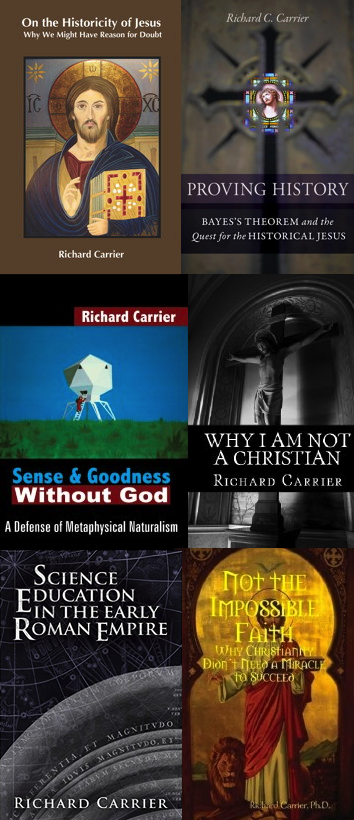
At any rate, competence to argue a case on this issue cannot be decided by precisely what degrees one has (whether they are in “ancient history” or “ancient Judaism” or “classics,” or as he desires, “Christianity” specifically), or where one works (whether someone holds a professorship is wholly irrelevant). No. This will be decided by the quality and informedness of one’s work. And on that score I would ask that Ehrman’s Did Jesus Exist? be compared with my latest on the same subject, Proving History. Just compare the extent and content of our endnotes alone, much less the way we argue, the difference in our attention to method and its logical soundness, the diverse range of scholarship we cite. Even my book Not the Impossible Faith is superior on all these measures, and it was a deliberately colloquial book designed to be entertaining. Both undoubtedly have occasional errors (as all scholarly work does)–but I doubt anything even remotely like what I have documented above (in degree, quantity, and cruciality).
Proving History also illustrates how Ehrman is out of touch with the extensive work in his own field discrediting the very methods he assumes are still valid (and naively relies on throughout). As I said before, every expert who has published a study of these methods has concluded they are invalid. Ehrman doesn’t seem to be aware of any of this literature, even though it is now quite extensive. Proving History also refutes many of his specific arguments for historicity (such as that Christians would not invent the baptism by John or a Nazareth origin for Jesus), on every point citing peer reviewed scholarship or presenting clear logical demonstrations from primary evidence. So it is already an adequate rebuttal (even though I will not actually defend the thesis that Jesus didn’t exist until my next book, which is nearly completed: On the Historicity of Jesus Christ). But as you can see from my many examples above, Ehrman’s book is so full of egregious factual errors demonstrating his ignorance, sloppiness, and incompetence in this matter, it really doesn’t even need a rebuttal. It can be thrown straight into the trash without any loss to scholarship or humanity. It is, quite simply, wholly unreliable.
The Methodologically Absurd
I could end with that. But it’s crucially important to address another side of how Did Jesus Exist? fails at its central task: the bankruptcy of Ehrman’s methods. Even with sound methods, to start with dozens of false facts (which this book does, as just demonstrated with a sample of them) will produce false or logically unsound conclusions. Which is why that is enough to discredit the book. One needn’t even question his methods. We know he made so many factual errors, we can’t trust any of his factual claims. And in light of that even a perfect method couldn’t have rescued this book. But the failure of his methods remains important precisely to the extent that other historians in this field might be fooled into trusting them and continuing to use them. And lay readers might similarly be duped into trusting and using them themselves.
I will not address here the one aspect of his methodology that the scholarly literature has already soundly refuted (the “method of criteria”). My book Proving History already does that, in meticulous detail. Instead, I will here address his strange method of inventing sources and witnesses.
I could call out many examples of his use of ordinary fallacies and self-contradictions, too, but I will have to leave those for perhaps a later blog (if I even care to bother). I will just give one example that simultaneously illustrates both: Ehrman attacks Robert Price for using the “criterion of dissimilarity” negatively (on p. 187), insisting that’s a “misuse” of the criterion, and then defends using it negatively himself (on p. 293), a blatant self-contradiction. It is also fallacious reasoning. Price was using it “negatively” (in Ehrman’s sense) to show that the case for historicity from the Gospels is weak because for every story about Jesus the Christians had a motive to invent it, which is a logically valid way to argue: he is rebutting the contrary claim (that some of these stories must be true because they didn’t have a motive to invent them) and thereby removing a premise that ups the probability of historicity, which necessarily lowers the probability of historicity (by exactly as much as that premise being true would have raised it). Ehrman outright denies this (on p. 187) which betrays a fundamental ignorance of how logic works. Perhaps what Ehrman meant to say was that this argument cannot alone prove Jesus didn’t exist, but Price never says it does.
As bad as those kinds of self contradictions and fallacies are (and there are more than just that one), far worse is how Ehrman moves from the possibility of hypothetical sources to the conclusion of having proved historicity. He argues that because Mark, Matthew, Luke, John, Thomas (yes, Thomas) and various other documents all have material the others don’t, that therefore we “have” a zillion earlier sources, which he sometimes calls by their traditionally assigned letters like M, L, and Q (he is irrationally dismissive of Mark Goodacre’s refutation of Q, and claims no one is convinced by it but cites not a single rebuttal; I myself find Goodacre’s case persuasive, well enough at least to leave us in complete doubt of the matter). We don’t in fact have those sources, we aren’t even sure they exist, and even if we were, we have no way of knowing what they said. To illustrate why that matters, take a look at the second redactions of the Epistles of Ignatius and ask yourself how you would know what the first redactions of those epistles said if you didn’t in fact have them (then go and look at those first editions and see if you guessed successfully!). Just try that, and you’ll see why Ehrman’s entire procedure is methodologically ridiculous.
According to Ehrman’s method, the material added and changed in the second redaction of the Ignatians had a “source” and therefore we can rely on it. But that’s absurd. The material added to the second redactions of the Ignatian epistles is made up. It did not “have a source.” The same is true of most if not all the material unique to any given Gospel. The miracle at Cana is something John just made up. He did not “have a source” for it. And even if he did, that source made it up. Obviously. That’s why no one had ever heard of it before, or anything even remotely like it before, and why it involved a patently impossible event (the transmutation of matter; or if you have a rationalist bent, a deceptive magician’s trick that would make no sense in context and could not have any plausible motive). There is no argument for historicity here. The story is false. And false stories cannot support the existence of real people. And yet Ehrman repeatedly cites false stories, even stories he himself confesses to be false (indeed, even false stories in forged documents!) as evidence for the existence of Jesus, which is the most unbelievably illogical thing I could imagine any historian doing.
Ehrman’s examples of finding hypothetical “Aramaic sources” exemplify this fallacy.
(1) He cites Jesus’ cry on the cross, which Mark gives in Aramaic and translates, as evidence Mark was using an Aramaic source (p. 88). Well, yes. His source is the Bible. If he was not translating the Hebrew into Aramaic himself, then he was using a targum (which would explain the biblical citations in the Gospels to verses that we can’t find in our Bible, like Matthew’s Nazarene prophecy: Mt. 2:23; because the Aramaic targums often altered the text, and we don’t have most of the targums that were then in use). Everyone knows this. Scholar after scholar has pointed out that the entire crucifixion scene is created out of material extracted from the Psalms, this specific cry on the cross in particular, which is a quotation from Psalm 22 (see my discussion of the evidence and the scholarship in Proving History, pp. 131-33). Ehrman doesn’t mention this (misleading his readers already, by concealing rather crucial information that undermines his point). But notice what happens when we take it into account: Mark dressed up a scene by borrowing and translating a line from the Bible, and Ehrman wants us to believe this is evidence for the historicity of Jesus. Really. Think about that for a moment. Then kick his book across the room to vent your outrage.
(2) Mark does the same thing (puts a sentence in Jesus’ mouth in Aramaic, then translates into the Greek) in the story of the raising of Jairus’ daughter, which Ehrman again cites as evidence that Mark was using Aramaic sources (p. 87). Apart from the fact that we should sooner suspect Mark drew this line from the same targum (and we just don’t have that targum to confirm), the bigger problem is that everyone knows the Jairus story is fabricated. It didn’t happen. It’s a literary creation, a reworking of an Old Testament story (a targum of which may have contained, for all we know, the very line quoted by Jesus), with obvious puns, and a symbolic and allegorical purpose (see Randel Helms, Gospel Fictions, pp. 65-67). It’s possible it was invented in Aramaic, but why would that matter? How does a story being fabricated in Aramaic prove the characters in that story existed? Jairus (whose name means “he will awaken [or be enlightened]” ; get it?) is most likely a fictional character. So why couldn’t Jesus (whose name means “savior” [lit. “God saves”]; get it?) be just as fictional? But even the notion that the story originated in Aramaic cannot be proved. If Mark is an Aramaic speaker, then he may simply be translating his own Aramaic thoughts and ideas into Greek. And even if he is using an Aramaic source (and that source is not simply a targum), then that source made this up. And made up stories cannot be used as evidence for the existence of the characters in them. Yet that is what Ehrman does with them.
Consider how his “method” would work if we applied it to the nativity stories (which Ehrman himself concludes are fiction). According to Ehrman’s methodology we have six independent sources for the miraculous birth of Jesus: Matthew, Luke, the Protevangelion of James, Ignatius (Ephesians 19), Justin Martyr, and Q (because some elements of the nativities in Luke and Matthew are shared in common). And there are probably others. Now, we know these are all made up. Not a stitch of them is true. But Ehrman’s method would compel us to assert that we have undeniable proof of the miraculous birth of Jesus. For example, every one of these attests that a miraculous star or light from heaven attended his birth.
These are all different stories, written in different words, so (by Ehrman’s logic) they “cannot” have been influenced by each other; except where they are nearly identical, then (by Ehrman’s logic) they corroborate each other. This is actually the way Ehrman argues for the historicity of Jesus. That his very same method produces absurd conclusions (“a miraculous star or heavenly light attended the birth of Jesus”), demonstrates its logical invalidity. He is simply not allowing for the obvious fact that all the new material in these stories is made up (even if they used now lost sources; the material is still made up, it was just made up in those sources), and that people can use a source by completely rewriting it in their own words and changing any detail they please (which is why nearly every specialist I have read on the Gospel of John disagrees with Ehrman’s claim that John did not use Luke as a source: see The Christian Delusion, p. 312, n. 11; I think Ehrman is not nearly honest enough with his readers about this).
Someday I might compose a blog applying Ehrman’s method to prove a flying saucer crashed at Roswell and alien bodies were recovered from it. Because I have a dozen independent sources (which by Ehrman’s method I can convert into several dozen sources, by inventing a “Q” for material two sources share but change up, and an “M” for material unique to one source but not in the others, and so on), which contain stories written in the original language of the time and place the event happened (namely, American English; because analogously, Aramaic, you see, was not only spoken in first century Judea; it was spoken in parts of Syria and to an extent across the diaspora, continually for centuries, so “Aramaic source = Judean source written in the 30s A.D.” is a ridiculous inference, yet Ehrman uses it again and again), all written within fifty years of the event (thus an even better source situation than we have for the historicity of Jesus!). If I limited myself only to material written by “believers” and people quoting them or relying on them alone as a source, then by Ehrman’s method I would have to believe a flying saucer crashed at Roswell and alien bodies were recovered from it.
Needless to say, Ehrman has no logically credible method. Is this really the only way to defend historicity?
Faking It
Omitting mention of these kinds of facts is irresponsible. Because most readers won’t know these things. Yet concealing this information from them makes Ehrman’s case seem stronger than it is. His readers should rightly feel betrayed by this. It also seems to me that Ehrman did not do any discernible research into ancient literary or educational methods. And to illustrate this (this being another glaring error of omission; these are by no means the only ones) I will close with just one example:
Ehrman appears to be blithely unaware of the routinely fabricatory nature of ancient biography, as documented throughout the literature on the subject (which is cataloged under his despised category of “classics,” a section of the library Ehrman seems never to visit), which demonstrates that things an author said or wrote (even fictionally) were often converted into stories about them, and these legends then spread and were collected by biographers and became the ancient pagan equivalent of “Gospels” for such luminaries as Euripides, Homer, or Empedocles. Lest you think I’m making this up, here is a bibliography to get you started:
- Mary Lefkowitz, The Lives of the Greek Poets (Johns Hopkins University 1981)
- Mary Lefkowitz, “Biographical Mythology,” in Ueli Dill, ed., Antike Mythen (de Gruyter 2009), pp. 516-31
- Janet Fairweather, “Fiction in the Biographies of Ancient Writers,” Ancient Society 5 (1974): 231-75
- Janet Fairweather, “Traditional Narrative, Inference, and Truth in the Lives of the Greek Poets,” Papers of the Liverpool Latin Seminar 4 (1983): 315-69
- Barbara Graziosi, Inventing Homer (Cambridge University 2002)
- Ava Chitwood, Death by Philosophy: The Biographical Tradition in the Life and Death of the Archaic Philosophers Empedocles, Heraclitus, and Democritus (University of Michigan 2004)
The significance of this is that it demonstrates Ehrman’s naivety when it comes to interpreting ancient literature and source materials and tradition formation. He is evidently not a competent classicist. And yet understanding how the Gospels likely came together requires being a competent classicist: you have to study and understand how ancient literature operated, especially comparable literature like this (for example, knowing that schools of the time specifically taught students to redact and alter stories in their own words–contrary to Ehrman’s baseless assumption that John cannot be a redaction of Luke because it does not follow Luke verbatim).
If things a person said were routinely transformed into stories about them (for example, Euripides occasionally made remarks about women in his plays that were transformed into a story about his troubled marriage–a completely fabricated story, that nevertheless became a standard element of his biography), doesn’t this change substantially how we view the possible tradition history behind the stories in the “biographies” of Jesus? Especially considering how many times we have caught them fabricating! (As even Ehrman admits several times in this book.) Biographies were also written of non-existent people (like Romulus, Numa, Coriolanus, Hercules, and Aesop). And we know for a fact Jesus said all kinds of things to the earliest Christians in revelations. And Ehrman concedes this is true. So we don’t have any need of a historical Jesus to get sayings of Jesus out of which to construct a life of Jesus.
The book of Revelation itself is an example of how easily Christians believed this: Jesus even there dictates whole letters from heaven, yet no one would argue that this is therefore evidence of a historical Jesus. Paul in his own letters frequently talks about revelation as a source of Jesus’ teachings. Again, Ehrman even agrees that some of the teachings of Jesus were probably “learned” that way. But if some, why not all? Paul never once mentions any other source (except scripture: Romans 16:15-26; e.g. Hebrews 10:5-7 records a saying of Christ, which is in fact simply Psalms 40:6-7, so evidently Christians were also learning the “teachings” of Jesus by reading them as hidden messages in scripture). Even in Galatians 1, Paul is explicitly denying not only that he received any human tradition, but that such traditions would even have any worth to him or his fellow Christians.
When we combine that fact, with what we know of the literary practices of the time, in the way stories and biographies were fabricated from sayings by (or even just attributed to) famous people (which often included nonexistent people), the mythicist case does not look as improbable as Ehrman portrays it. Which I find to be yet another example (among the great many I have already cataloged here, which again are just the tip of the iceberg) of how Ehman didn’t do his job as a scholar, and doesn’t inform (but in fact substantially misinforms) his readers, and comes to silly conclusions based on exactly the kind of naive ignorance of the relevant scholarship that he accuses mythicists of.
Conclusion
It is for all the reasons documented in this article (which are again just a sample of many other errors of like kind, from false claims, to illogical arguments, to self-contradictions, to misrepresentations of his opponents, to errors of omission), especially this book’s complete failure to interact with even a single complete theory of mythicism (which alone renders the book useless, even were it free of error), that I have no choice but to condemn this thing as being nothing more than a sad murder of electrons and trees.
[For my reply to Ehrman’s responses to this review see Ehrman’s Dubious Replies (Round One) and Ehrman’s Dubious Replies (Round Two). And the final denouement is summarized in Ehrman on Historicity Recap.]






Yes, Dr. Carrier, but what do you really think? Your review is subtle, and I’m not sure, but I think you didn’t like the book. Am I correct?
Are you saying you prefer that I be obscure, evasive, and unclear?
“Are you saying you prefer that I be obscure, evasive, and unclear?”
You woulda stayed in academia if you wanted to be like that, right, Richard? (buh-DUM-bum)
Impressive. The confident reliance on sources we don’t have and logical failings even I picked up meant I didn’t think too highly of the book. But as your post points out, he doesn’t seemed to have done any research, nor fairly represented mythicist arguments. Something I would not have known about. I’m glad you took the time to explain all the issues Richard. thanks.
I read a commentator, perhaps on this blog, or another, point out that using Ehrman’s methodology, we’d have to conclude that Sherlock Holmes existed as we do have multiple, independent sources attesting to him living in Baker Street in Victorian London. I thought that just a rhetorical swipe, but perhaps not!
Is this book even worth reading? I found a *ahem* copy, but if it isn’t worth my time, I might as well delete it.
I’d say, don’t delete it. I’ve read portions of Did Jesus Exist? — with my teeth clenched, mostly — and I really don’t want to read the rest, but I feel I may have to, in order to participate in discussions like these without being guilty of things somewhat like what Carrier and Price have been accusing Ehrman of.
Another strongly argued broadside, Richard. Long but very useful. Thanks!
This is quite a pounding. Frankly, though, I’m mystified as to why Ehrman feels the need to carry this torch in the first place; I am one of those “historical agnostics” you mentioned, and that seems to me to be the only intellectually defensible position. Surely we cannot conclusively prove that some rabbi named Jesus (or something similar) lived, taught, had some followers, and maybe was even arrested and executed.
It’s a pretty benign historical point either way, and it seems obvious to me that all that really matters is whether Jesus existed as he is described in the Gospels, which even Ehrman would argue (and has argued) he did not. Okay, so maybe there was some rabbi 2,000 years ago. It’s plausible, if not provable. But… who gives a shit?
Hello Mike D: That’s a good point. All that really matters is showing the Christ of Faith as described in the canonical Gospels was a mythological fictional literary construct. Whether there was or was not some delusional guy, religious guru or not, who may have said something subsequently penned into Gospel Jesus’ mouth really doesn’t matter except as an excuse to study ancillary Greco-Roman-Jewish history. If there was an HJ or some guy as the basis of an legendary Jesus, so what? The mother fraker has been deader than a door nail for a real long time.
There are still about 2 billion Christians. That’s why it matters, in a nutshell. If it can be shown that almost right from the start there’s been no real solid reason to assume that the guy even existed — then some of those 2 billion people might be induced to say “Whoops!” and reconsider some of their basic assumptions about things, to think about them a little more carefully.
That would be progress, overall, I think.
So did you like the book?
Answered in the first paragraph. I’m very efficient that way.
This is a monumental review: 10,500 words.
And the great merit in it is that every thought is clearly delineated, sharply put in focus, and not drowned in a lot of prolix prose that many writers on religion love to produce as if they were writing a novel instead of a sharp discussion of points and counter-arguments.
It is long, but never suffocating or confusing. Every sentence stands out and is immediately intelligible. This is an example of clear, logical writing, some may say even lawyer-like, too logical and analytical. As a result, to some, this style may feel “dry” and lacking the kind of emotionalism that novelistic writers and popularizers favor.
A lot of readers, especially those with no knowledge in the field, who tend to read pre-digested popularizing work and are not ready for precise scholarly discussion, prefer a fluid novel-like style that reads smoothly, creates excitement and an easy high without forcing their brains to pay close attention to the thread of the demonstration.
But at the top level of scholarly examination, a clear and focused style, closer to lawyer argumentation than novel-like prose is eminently preferable. This review of Ehrman’s book is a good example of its merits.
As one of those readers “with no knowledge in the field, who tend to read pre-digested popularizing work and are not ready for precise scholarly discussion” I found this illuminating. Having read a claim by Ehrman in, I believe, “Forged” , that no scholar seriously doubted the existence of the historical Jesus – at least to my untrained mind that’s what he said – with some surprise I accepted the claim. Why? Because Ehrman had laid out his credentials/qualifications as someone who had taken the trouble to learn to read Greek and Hebrew and had studied these ancient writings. He was also challenging the “inerrancy” argument after initially subscribing to that view, so I suppose I was seduced by his scepticism on that to his “genuineness” as a scholar.
A discussion with a friend led me here and I can only say, “Thank you”, for opening up new vistas …….. and books.
Fantastic review Richard! I actually appreciate this alot because as a lay person I detected a few of the flaws you reviewed here but had no idea of many of the others. His zeal and confidence in swatting down mythicist strawmen can be very deceptive to the casual reader like myself. Anyway, just wanted to say thanks for bringing in some clarity for us.
I hope you get a chance to engage him in public dialogue on this issue… i think it would be a great service to bring more visibility to the substantive critiques of his positions… and people being sucked in by his work really need to hear the other side.. kudos my friend!
Well…that’s awkward.
A truly excellent summary.
Thank you.
I *was* going to buy Ehrman’s book, but do not need to raise my blood-pressure to a dangerous level.
I continue to place the most charitable explanation in the hypothesis, (for this abberation), that Ehrman has cryptically acquired some form of minor brain injury, such a mini-stroke.
That is far better for him than that he actually wrote this garbage out of ignorance or worse.
Oh, and re: “The Doherty Slander”.
If a defamation is publically written, it becomes a “libel”.
Richard:
You seem like a nice guy and I wish you luck arguing against Jesus’ historicity. Be careful about method, though. Price and Doherty get sloppy some times and try to argue things like an ENTIRE New Testament story is completely midrash.
No competent scholar on the planet would argue that, and I’ll show you why:
Take this example of a hypothetical midrash:
All Paul tells us in 1 Corinthians about the crucifixion is just one line: “Jesus died for our sins in accordance with the scriptures.”
Did Paul record no narrative details of that event because there were no narrative details at the time he was writing? That is quite probable, because Mark tells us that when Jesus was arrested ALL the disciples “took flight and fled (14:50).” There is no reason for Mark to recount the embarrassing abandonment if it were not true. This would mean Jesus in all probability died alone, without any eyewitnesses. This would, of course, have made the details of the crucifixion impossible to record, since no one witnessed the event.
Accordingly, the well known events in the narrative of the crucifixion could have been invented through midrash, exactly as Dr. Price describes below:
“The substructure for the crucifixion in chapter 15 is, as all recognize, Psalm 22, from which derive all the major details, including the implicit piercing of hands and feet (Mark 24//Psalm 22:16b), the dividing of his garments and casting lots for them (Mark 15:24//Psalm 22:18), the “wagging heads” of the mockers (Mark 15:20//Psalm 22:7), and of course the cry of dereliction, “My God, my God, why have you forsaken me?” (Mark 15:34//Psalm 22:1). Matthew adds another quote, “He trusts in God. Let God deliver him now if he desires him” (Matthew 27:43//Psalm 22:8), as well as a strong allusion (“for he said, ‘I am the son of God’” 27:43b) to Wisdom of Solomon 2:12-20, which underlies the whole story anyway (Miller), “Let us lie in wait for the righteous man because he is inconvenient to us and opposes our actions; he reproaches us for sins against the law and accuses us of sins against our training. He professes to have knowledge of God, and calls himself a child of the Lord. He became to us a reproof of our thoughts; the very sight of him is a burden to us because his manner of life is unlike that of others, and his ways are strange. We are considered by him as something base, and he avoids our ways as unclean; he calls the last end of the righteous happy, and boasts that God is his father. Let us see if his words are true, and let us test what will happen at the end of his life: for if the righteous man is God’s son he will help him and will deliver him from the hand of his adversaries. Let us test him with insult and torture that we may find out how gentle he is and make trial of his forbearance. Let us condemn him to a shameful death, for, according to what he says, he will be protected.” As for other details, Crossan points out that the darkness at noon comes from Amos 8:9, while the vinegar and gall come from Psalm 69:21. It is remarkable that Mark does anything but call attention to the scriptural basis for the crucifixion account. There is nothing said of scripture being fulfilled here. It is all simply presented as the events of Jesus’ execution. It is we who must ferret out the real sources of the story. This is quite different, e.g., in John, where explicit scripture citations are given, e.g., for Jesus’ legs not being broken to hasten his death (John 19:36), either Exodus 12:10, Numbers 9:12, or Psalm 34:19-20 (Crossan). Whence did Mark derive the tearing asunder of the Temple veil, from top to bottom (Mark 15:38)? Perhaps from the death of Hector in the Iliad (MacDonald). Hector dies forsaken by Zeus. The women of Troy watched from afar off (as the Galilean women do in Mark 15:40), and the whole of Troy mourned as if their city had already been destroyed “from top to bottom,” just as the ripping of the veil seems to be a portent of Jerusalem’s eventual doom.”
Even if everything in Price’s interpretation is true, if all the details of the narrative were just made up in the writer’s creative imagination, it doesn’t mean Jesus’ crucifixion wasn’t a real historical event. Under the reconstruction posted here, even the fact that the apostles abandoned Jesus really happened.
Any competent scholar will tell you that haggadic midrash as a literary form in the New Testament always presents two opposing poles of interpretation. As I said, (1) on the one hand we can say the entire story was invented through midrash, (2) and on the other we can say a little bit of the story is midrash and the rest is historical fact. And there is a lot of room in between
That’s just the way biblical hermeneutics works. Mythicists may not like it but there is no way to argue that it is more likely than not that the core of the Christian story never really happened because of midrash.
Note that I did not defend any particular argument of Price (so your comment, though interesting, is not relevant here). I defended the methodological principle that underlies it, which Ehrman was talking about. Your comment does not pertain to that. Your last statement even repeats what I myself said.
John,
A statement like “There is no reason for Mark to recount the embarrassing abandonment if it were not true” is simply not defensible, a slight modification of the old “of course the tomb was empty, because Mark says only women saw it, and everyone knows women were seen as totally lame back then.”
First, it seems in line with Mark’s perspective on the disciples throughout his text, which is that they are a confederacy of dunces who excel at missing the point.
Second, and more importantly, you simply can’t query authorial intent like that, as if the motives of a man who lived 20 centuries before are positively pellucid to you. There is no reason? Perhaps no reason that is immediately apparent. To you. Writing now. There is no way to know with any degree of certainty why Mark chose to make this detail part of his story. As they say, the past is a foreign country. They do things differently there.
I also have to object to your and Price’s use of the term ‘midrash’, strictly on terminological grounds. While it’s certainly true that there were innumerable expansions on the Jewish corpus in the Jewish communities of this time, you can’t assess a Gospel story using the criteria of midrash.
Formalized midrash is only developed much later within post-Destruction rabbinic circles. It’s just incorrect for you or Price to use the structure of later rabbinic midrash to critique a gospel narrative. Methodologically, it is like saying that the ‘Life of Jesus’ by Renan is an incisive piece of post-structuralist analysis.
I had the experience of studying under both Drs. Tabor and Ehrman, so I’m always intrigued by Dr. Carrier’s criticisms. I will say that, particularly with regards to Dr. Tabor, his credulousness towards some rather dubious historical claims always seemed motivated to me by the fact that it’s, well, simply more fun to work within a discipline in which the Pseudo-Clementines and Talpiot tomb and all the rest are lively centers of debate. The articles are more interesting. The discussions are more animated. Tabor long ago gave up on rigorous criteria as unsatisfying and self-defeating, and accepts that since the full shape of the past he is studying will never be recoverable, he will at least try to make it engaging.
I’ve often thought that Ehrman’s insistence on a historical Jesus follows a similar path. That is, so much of Ehrman’s project is geared towards popularizing some of the findings of critical Jesus scholarship made in the past century. He already takes great care to establish common ground with his potentially-devout reader by recounting his own conversion experience. If he were to begin with the premise that Jesus never existed, well then… who is he writing about? Who is he writing for? What is the point of analyzing the history of Jesus when it’s as imaginary as the history of Romulus?
Right or wrong, a mythic Jesus strands him at too far a remove from the audience he is trying to reach, who have probably never seriously entertained the idea that Jesus never existed, and can’t make that sort of leap all at once.
That said, he would have done better to leave his historical Jesus as an operational assumption upon which he builds accessible popularizations, rather than defending it as badly as he does here.
This seems to me to be hair-splitting over terminology. We know the gospel writers as such were exposed to Greco-Roman literary training (to varying degrees of skill).. so i would expect the line between midrashic Jewish thinking would be blurred with Greco-Roman mimetic literary techniques. In fact i would expect that these two creative literary processes would not be hermetically sealed off from one another in the mind of educated hellenized jews. They seem so similar and complementary that i can’t imagine they would not be merged in hellenistic jewish communities…or gentile circles that took an interest in judaism. But maybe it would be more precise of Price to have used a term like “midrashic mimesis” to make the synthesis of the two cultural traditions more clear. Anyway, that’s my take on it.. What do you think about this Richard?
Regarding the “midrash” debate, as Ehrman rightly says what we are really talking about is haggadic midrash or midrashic haggadah. This did exist at the time and was similar to the Hellenistic and Roman practices of mimesis and imitatio. McDonald, Helms, Thompson, Brodie, and others have demonstrated this. There are even examples of it in Josephus. But it is still worth distinguishing later medieval forms. One must be able to argue that any parallel one draws did hold. But Price does not need the NT to be “identical” to medieval Jewish forms of midrashic haggadah. He only requires a few parallel features, which are fully defensible as ancient. At least, one must seriously debate this before dismissing it.
Sorry. My point got away from me as I was tired after work. My point being that between midrash and mimesis of other literature fueled by the need for Judaic redefinition in the absence of the temple, the Jesus myth could have easily been created without some kind of HJ at the bottom. I can’t see how minimal historicism is necessarily more probable. Sorry, I’m all over the place here. Hope u get what im driving at. It’s oversimplified I know. But I just don’t agree that “Mythicists may not like it but there is no way to argue that it is more likely than not that the core of the Christian story never really happened because of midrash.” Firstly I think that’s just the wrong way to frame it. It’s not just because of midrash…that’s the point I was trying to make. There was a historical context that provided a cultural vacuum that invited the creation of a catastrophic messianism of the jesus story using a synthesis of Jewish midrash and greco-roman mimetic creativity….without a historical core needed at all.
Regarding the exchange between Will and John above, IMO the issue is not whether there was a historical core behind the Gospels, but what that historical core actually was. Was it revelations and scripture-mining producing a belief in a cosmic death and resurrection of an “actual” (in their view) heavenly being? Because then the core is historical, it just doesn’t have what we would call a historical Jesus in it (but it had what they would call that; just as we would say the angel Gabriel does not exist, but early Muslims would beg to differ).
By analogy, the Roswell myths all have a historical core behind them, too. It just doesn’t include a flying saucer or alien bodies. It was just tinfoil. Here the tinfoil = the revelations (and their content) Paul talks about (in 1 Cor 15, 2 Cor 12, Rom 16:25-26, Gal 1, etc.). The flying saucer and alien bodies = a human man named Jesus preaching in Galilee and being crucified on earth by Pontius Pilate. (Not that I assume Mark must be the first to have introduced those elements; but someone did, at some point.)
i take your point Richard.. i agree.. perhaps i didnt phrase things properly.. i guess i used “historical core” as a euphemism for a minimally historical Jesus with some broad features in common with the gospel portraits.. but u are right.
One bloody obvious reason why an author would say that everyone ran away: to explain the absence of any actual witnesses.
Ergo, the argument that truth is the only reason why Mark would include this incident cannot be true. We’ve just thought of at least one other reason.
I’m not a historian, but I really don’t get the ‘argument by embarrassment’. There were plenty of embarrassing stories told of the Norse, Greek and Roman gods, and by this argument, they would be adjudged to exist too.
First!
Seriously, I had been looking forward to this review. Since you said yesterday it was coming out today, I checked your blog several times looking for it. I will be interested in seeing what response Ehrman might make.
Errors of lazy thinking are inevitable (Silberman once implied something like the Moabite Stone couldn’t exist, despite obviously knowing better) and some of these errors fall into that category. I’d incline to be forgiving except that so many others are just preposterous.
It’s a bit reminiscent of some early responses to Thompson’s work on Israel, in that critics fail to see that it’s a difference of kind. One side is questioning the foundation, while the other has treated speculation as fact for so long that nothing exists outside that foundation. I doubt Ehrman is as incompetent as one might infer from this, he just doesn’t take it seriously.
That isn’t to excuse him, he shouldn’t have written the book in the first place if he couldn’t take it seriously. But the fact that the types of mistakes he made were wholly predictable speaks to the larger problem, which isn’t Ehrman.
He’s just blinded by his context. I very much doubt we will see a serious look at Mythicism by any presently established researcher.
To be clear, Ehrman is perfectly competent in the subjects he has mastered and (to draw on your point) takes seriously enough to actually study properly.
But note that Ehrman repeatedly says in this book that the best mythicists are to be taken seriously and that he is taking them seriously. This may be a more subtle self-contradiction: he claims to take them seriously, but as you observe, he really doesn’t appear to. The way he rebutted opponents of his positions in Forged, for example, shows a real effort at checking facts and researching his points and citing primary evidence for his claims and attending closely to points of logic. He does not extend to mythicists even a fraction of that same care.
Make of that what one will.
You should listen Ehrman’s interview on the The Infidel Guy podcast. It was a few years ago, but Ehrman made the same egregious omissions, denials, and leaps of logic (while being a condescending) as in this book.
Infidel Guy – But there are many historians who disagree with you. Aren’t they?
Ehrman – No. None that I’ve ever heard of. Not serious historians.
Infidel Guy – Not serious historians?
Ehrman — No, not a TRUE Scotsman. Not a single one.
I just listened to that again this afternoon.
Bart Ehrman VS Atheist The Infidel Guy Part 1.wmv
Neither Ehrman nor The Infidel Guy comes out if it very well. Reggie came off as a Robert Price fanbois who completely bought into the worst of the mythicist side, but Ehrman made a comparison to Julius Caesar, compared Jesus mythicism to Holocaust denial and Abraham Lincoln denial, and said, “We have more evidence for Jesus than we have for almost anybody from his time period.”
I had such high hopes for this book. Thank you for saving me the trouble of reading it. I’ve enjoyed many of Ehrman’s other books, are they similarly shoddy? I look forward to your upcoming book.
In answer to your question, no. Many of Ehrman’s other books are excellent and well worth reading, especially Jesus Interrupted and Forged (among popular works) and Orthodox Corruption of Scripture (his most detailed scholarly book, not light reading). The first of these because he is simply reporting (correctly) what the most common consensus is on the NT (which makes this book required reading for anyone who wants to get up to speed on that), the second for the same reason, and because it adduces informative primary evidence in support of some of its key points, and the last because the subject is defintely in his wheelhouse of skills, background knowledge, and competence.
I would say The Orthodox Corruption of Scripture *is* light reading. It is very well written.
Bart Ehrman has a Dawkins or Feynman like way of making complicated arguments very accessible to the general reader.
The Orthodox Corruption of Scripture is that rare thing for a work of scholarship – a page-turner. It is one of the best works of scholarship I have ever read.
Which makes me wonder how Bart could write ‘Did Jesus Exist?’
“An attentive reader, who was aware of the actual facts, would come away from this book believing historicity can only be defended by deploying a methodological framework that would produce absurd conclusions if applied to any other subject in the history of myth and religion”
I think a great many people already believed that, in part because of the standard curt and condescending position of the strict historicists when addressing the great unwashed: “This discussion is over, it’s certain Jesus existed, no educated man doubts it, move along, nothing to see here[…]”
In part, perhaps, because, in fact,historicity can only be defended by absurd arguments and methods? I say perhaps. I haven’t read Van Voorst or Thiessen or Merz.
Ehrman could have cited Kloppenborg’s review of Goodacre, which was substantial. Yet, reading the two against each other leaves me, as a layperson, in a 50-50 position in regard to Q.
Thanks for this review, it confirms my initial impression, after skimming it at the bookstore, that it wasn’t worth purchasing.
This is merely speculation, not accusation, but one possible explanation for things like “The Pliny Confusion” could be that Ehrman has other people — graduate assistants, perhaps — read and summarize things for him which he then claims to have read himself.
See what I did there? I implied unreputable behavior on Ehrman’s part, but I can still just barely make a technically-sound claim that I didn’t accuse him of anything, and am sorry for any damage to his reputation I may inadvertantly have caused. I’m learning from Ehrman.
To be fair (as we’ve discussed in comments elsewhere), Ehrman has explicitly denied such charges.
Richard Carrier:
Ehrman has explicitly denied such charges.
Statements like this leave me a little bit verblufft. Of course he denied the charges. Someone in a situation like that is almost always going to deny the charges, at least at first. An honest person will continue to say the truth, which is that the accusations are false; and a habitual Ganove will not confess at the first accusation. In my opinion, a person denying such charges in such a situation tells us just about nothing concerning the accuracy of the charges.
Great read!
Excellent review, I had intended trying to at least borrow this, but I probably won’t even bother doing that now.
One point that struck me is just how little overlap there is between your criticisms and the responses of Godfrey and Doherty – you both found plenty wrong, but focus on different problems.
Your review explains, to me at least, why Ehrman seemed too happy to dismiss the argument that the gospel stories are just re-telling of Old Testament stories as not being relevant – it would destroy his Aramaic sources argument (and no doubt there are other examples where the story originated in an old testament tale, but he is claiming as a primary source)
Ouch!
Do you think it’s partially his desire to snipe mythicists and overconfident atheists (people who obviously annoy him) that made his produce such a sloppily written book? You previously stated that you would recommend his book Jesus Interrupted (and even called it fine), so how could such a competent historian drop the ball in such a manner as this? It seems as if his personal dislike for a this theory, or more specifically, the type of people who typically put this stuff out, caused him to write a more reactionary piece of work that is really just a book length fuck you. Im talking about the bonehead atheists and mythicists who think Zeitgeist was a good scholarly documentary. Ehrman was just so pissed off at them that he just slapped a book together so that he can throw it at them. Yeah, thats it…… (Wishful thinking)
I have speculated the same (e.g. my remarks in the comments section of Ehrman Trashtalks Mythicism). I worry that he is suffering intellectual PTSD. To paraphrase Festus in Acts: Ehrman has read so many crappy arguments his outrage has driven him mad.
Wow. So, does this mean that, in accordance with the Embarrassment Criterion, you’ve just proven Did Jesus Exist? is, in fact, Forged! I guess we can only hope that it was better in the original Aramaic.
Wow, just…wow.
I’ve read a number of Ehrman’s books about the bible and have seen nothing like this before. I’ve admired his writing; he’s entertaining and makes his subject seem understandable to me, a definite layman in this subject.
Being an atheist, since I believe there’s no god, of course, I can’t believe in a son of that god either, but whether the Jesus figure is/was based on a real man has always been a subject of interest, since it is so important to the christians among us.
I have waffled between “it doesn’t matter since he couldn’t be divine anyway” and thinking that proving Jesus was a myth pretty much disproves christianity, and several places in between, which is why I am looking forward to YOUR book, Dr. Carrier.
When I heard that Ehrman was doing one too, I thought this would be a pretty good knock down drag out between two well regarded scholars! Then I thought about how long it’s been since you announced your intentions to write this book, how long it took to obtain the funding, etc., and realized that, regardless of how good he is, unless he’s been at it as long as you have, his research couldn’t possibly match the depth of yours.
From this, it seems I was correct, and I am disappointed. I will most likely forgo purchasing his book, in favor of getting yours instead.
Looking forward to the next part in this review.
Good work. On chapter 3 of Proving History now and your attention to detail there and here is greatly appreciated, even as a layperson regarding history.
For another review see: http://www.radikalkritik.de
It’s in German by Herman Detering, the author of “The fabricated Paul”
and “Falsche Zeugen – Außerchristliche Jesuszeugnisse auf dem Prüfstand”.
Frans-Joris Fabri
Please correct me if I’m wrong but don’t all of Ehrman’s contain similar blanket statements as facts? It seems to be the way he does things, rather than get into serious dialog with the people he doesn’t agree with, he makes assertions and leaves it at that. I wonder if you read his other with the same critical eye what fallacies you’d come away with.
Jesus Interrupted has a different purpose: to get the reader up to speed on what the common view of things is (for which blanket statements are appropriate, once the general qualifier is stated that this is what he is doing). What would be closer to what you have in mind is Forged. If you can identify any false claims or false generalizations in that, do cite them here. I would be willing to consider them. None that I am aware of undermine his essential arguments there. But if you can prove otherwise, do let me know.
I’m wondering if you’d entertain an alternative hypothesis.
Perhaps the book was written for Ehrman by someone else — a ghost writer.
After many years of demonstrating himself to be a careful and competent historian, to go so far off the rails with this specific book in the manner you describe seems … well … odd.
Almost as if he turfed the project to someone else while he tended to other knitting.
I had met Bart Ehrman when he was writing for Oxford Press and I had crossed paths with him incidentally on several occasions. I recall a conversation with him on the historicity of Jesus around 2002 and he still held the same opinion that he holds today. Based on your assessment of his latest book it seems that he has not changed at all on this matter. Not only that but that he is suffering from that ailment that plagues many known as confirmation bias. Any argument that contradicts his conclusions on the historicity of Christ must be wrong, and any evidence produced to the contrary must be incorrect.
I am not a scholar or philosopher but I have enjoyed reading many of Erhman’s books. I personally have a hard time understanding how so many “scholars” can’t seem to fathom the idea of a mythical Christ. Or even how Christianity could have started without an historical figure as it basis. Whole religions have been founded by a persons purported claims to revelation. Mormonism is just one of the many modern day examples. Thanks for this review Richard, I was going to buy the book but when I read the blurb on Amazon I changed my mind.
You give me hope for the future. What a magnificent dissection of the multiple problems with Ehrman’s new book. My hat is off to you, sir!
-D
Richard,
I have always been curious about the claim that there were Christians who believed Jesus had lived and died around 70BC, so I followed up on the source you listed, Panarion 29. I found an online translation (for what that’s worth), here http://www.natzraya.org/Library/Panarion29.html
But after reading it, I see no reference to any belief that Jesus lived and died at an earlier time. Is it only in conjunction with other passages/writings that this can be concluded?
Thanks.
I should add that upon further reading it seems that what you have said is a scholarly conclusion based on the evidence in Epiphanius, and not something he says directly himself, which you imply here:
“Epiphanius, in Panarion 29, says there was a sect of still-Torah-observant Christians who taught that Jesus lived and died in the time of Jannaeus[.]”
Since this is precisely what you criticize Ehrman for doing regarding Pliny, I think you should word your this section more carefully if I am correct that it is a scholarly inference, rather than something Epiphanius himself says.
Either way, I look forward to hearing your thoughts and comments on this, thanks!
Epiphanius says it himself (it is stated clearly in his paraphrase of their beliefs).
Read section 3.3 in that very link you provide.
Thanks, Richard. I had someone point this out to me (because I couldn’t wait!) while you were gone. I’d misunderstood that section to mean that Alexander (who I didn’t know was the same as Jannaeus) was the last in line, and that with the coming of Christ, the line broke as Herod took over. I imagine I would have read it more carefully if I had known that Jannaeus *was* Alexander.
Anyway, thanks again.
Was Ehrman this sloppy in Jesus, Interrupted and Forged? Should I stop using the arguments I gained from them?
No.
First, Jesus Interrupted only summarizes the common consensus in NT studies. It should only be cited as saying that, and nothing more (it does not cut new ground on anything, except where Ehrman says he is, and on those points one should always treat what he says with the very caution Ehrman intends you to, when he draws attention to the fact that other scholars disagree with him).
Second, Forged is correct in all essentials. So far as I know. I did not vet it on anything it says that is inessential, so I can’t assure you on that material. But the rest repeats what I already knew as a historian of antiquity (e.g. I had already long been familiar with the evidence he draws from Galen, etc.). So I believe you can still trust it.
I have not read your blog yet – I will do so in a bit – but I was listening to The Bible Geek and Dr. Price has been saying something to the effect that Dr. Ehrman farmed out his research to his students. Have you heard this?
You probably included it in this blog, but if not, can you comment on it (supposing you heard it).
Thanks,
Ehrman has denied this charge. I linked to his denial on Vridar in comments elsewhere, but as I am writing this from my iPad, I’ll just repost the Vridar link as extracted from Google: http://Vridar.Wordpress.com/2012/04/18/bart-ehrman-assures-us-he-read-all-the-mythicist-books-himself-very-carefully/
Wow !!!
How disappointing. My husband and I had stopped going to church for quite some time before it came out but his “Misquoting Jesus” was my push towards athiesm. Before that I’d never really given any serious thought to where the bible came from (and so on).
I would seriously love to see the two of you discuss this. Not so much as in a debate, but a back-and-forth discussion. It just seems odd that he chose to write this book in this way after some of his past works.
I’m impressed by the thoroughness and erudition of this review. I wonder what defense Ehrman could raise. Being a non-scholar, I can only guess at that, but I’ll go ahead and guess that one possible response to these charges is that they’re nitpicky. I think you’ve done a good job of showing that many of these mistakes hurt/discredit Ehrman’s case, but I can only wonder if, for instance, Egyptian papyri regarding birth/death records etc. might be argued to be irrelevant to Ehrman’s argument?
Also, I just read Misquoting Jesus last week, and I found it very interesting. Now, reading this, I am beginning to wonder whether I can take it seriously. I read some of the hostile reviews of that book, which alleged bias and misrepresentation of scholarly consensus. Do you think Ehrman’s other work should be called into question? On the one hand, Misquoting Jesus ought to be Ehrman’s area of expertise, whereas this question of Jesus’ historicity is more of a stretch for him; my inclination is to trust him there…
Incidentally, I also listened to half of Jesus Interrupted on audiobook, and found it pretty dull and pedantic (got the audiobook electronically from my library, and the loan period expired – I don’t intend to renew). The style of the prose was repetitive in a way that made listening to it really annoying. (The style is the classic “say what you’re going to say; say it; then say what you said” essay style I learned in 7th grade, and then had beaten out of me in high-school. There are better ways to engage a reader, though standardized test essay graders apparently disagree.) It wasn’t nearly as interesting as Misquoting Jesus.
On your first point I agree, and even make the point in my review, that the existence of thousands of Egyptian records does not undermine his conclusion, but rather demonstrates his general unreliability throughout the book, and the general uselessness of this book (as compared to one that arrived at the same conclusion by a correct argument, one that was informed and well reasoned). I would ask that that section of my review be read again with care to it’s actual point. I don’t want anyone to misunderstand what I am actually arguing, or why it is actually important (and not an irrelevant nitpick).
On your second point, if you encounter any claim that he misrepresents the consensus in Jesus Interrupted, and it comes from a fundamentalist, you can be pretty well sure it’s the fundamentalist who is in the wrong (most likely, they mean by “the consensus” only those scholars that agree with them, which is an abuse of the term). But if you find that charge from any secular or liberal scholar, then ask if they actually prove he did this (by citing numerous scholars or standard reference books; ditto if a fundamentalists does this, and the scholars or references he lists aren’t fundamentalist), or merely claim he did. But in either case, cite them here if you want and I’ll give you my opinion of them.
I see James McGrath has again responded to you, in a similar manner to his previous response, whining that many of the errors are trivial (while ignoring your point they show a lack of research by Ehrman), ignoring what you actually say (such as his claim that Ehrman is correct about Peter the cock, as most people don’t think it is a statue of Peter) and picking out the occasional poorly phrased part of your response, such as Mark Goodacre’s refutation of Q, allowing him to claim that you use apologist type tactics and so should not be taken seriously, rather than paying attention to the context of the paragraph, where it is clear you merely think it is persuasive and allows for doubt in the area.
Please provide a link here.
(But in the meantime, thank you for your summary; it is reassuring to me that I’m not the only one who sees that McGrath is doing these stupid things. Ironically, McGrath is only digging the grave of historicity. By demonstrating that it can only be defended by illogical and disingenuous argumentation devoid of any coherent relation to what historicity’s critics actually say, eventually people will notice that this means historicity cannot be defended by any honest and competent argument.)
Here is McGrath’s reaction if you are interested.
http://www.patheos.com/blogs/exploringourmatrix/2012/04/carrier-and-other-mythicists-reacting-to-ehrman.html
I don’t know how scholars address other scholars work and arguments. It appears McGrath objects to Richard’s tone greatly. Is scholarly debate conducted in a different tone? I was tempted to suggest some concern trolling was occurring. But I have no idea.
Scholarly debate is routinely heated and harsh, and often in proportion to dessert. Ehrman’s treatment of the mythicists is itself an example of this. Which is why it’s amusing to see McGrath complain when his side is the recipient, while hardly issuing any complaint when it was his side dishing it out.
When you have no honest rebuttal, your only recourse is to move the goal posts and argue about the tone rather than the content. It’s a rhetorical tactic, not a valid issue.
Damn I’m disappointed, I’ve enjoyed Ehrman’s books for some years now & they helped me jump from pantheism to atheism. Yet from your analysis there are some holes even a theologically uneducated goober like me could poke in this book – and partly I could use Ehrman’s own arguments to do so.
All I can figure is he is undergoing a crisis in non-faith. I’m saying this as it would explain why he rehashes his own deconversion story in each of his books I’ve read – he’s still trying to live without a god, its not easy when one has been brought up as a believer.
At the risk of angering Mr. T, I pity Mr. Ehrman.
You might be interested to know that Ehrman has his own blog now, so you could keep an eye on it for the sake of discussion and respective criticism. Unfortunately there is a paywall if you want to comment on blog posts (due to a charity purpose, if I understood correctly).
http://ehrmanblog.org/
If anyone notices him replying to me there, feel free to post the link here.
I have signed up.
See my comment below:
http://www.richardcarrier.info/archives/1026/comment-page-1#comment-8685
The trouble here, Dr. Carrier, is that this borders on a rant.
Moreover, there are some people over at Amazon questioning the Peer Review of your own book.
The fact that you won’t say who did the Peer Review makes it worthless…the idea of secret peer review is a farce in this supposed age of open investigation.
Since almost all academic peer review is secret (for the reasons I have explained elsewhere, and I suspect you are the same person I explained it to the first time), everyone knows you are bullshitting us here. Maybe when you can name the peer reviewers of anything Ehrman has ever published, then we can have a conversation about the role of single and double blind peer review in preserving academic freedom again.
Based upon word usage one should also suspect he is the same person who is “some people over at Amazon”
This book really illustrated how fast and loose Ehrman treats his sources. I’m halfway through, and beside the absurd multiplication of sources you listed (M and L as separate from Matthew and Luke? Seriously?), or his use of the Gospel of Thomas or letters of Clement as independent verifications of the existence of a man who supposedly lived at least hundred years before (seriously?), the most egregious example was his treatment of Josephus, and in particular the Testimonium Flavianum. Here he strips out things that he supposes were added by Christian scribes, but then inexplicably retains a theoretical “core” — and uses that core as a defense against arguments launched at the Testimonium. The whole argument was bizarre, and left me wondering if that was how historians really conducted the study of history.
Clarifications: the date of Thomas is unknown; some scholars place it early, some late. And the traditional date of 1 Clement would be the 90s, which is half a century, not a full century, after the purported death of Jesus.
However, (1) a careful reading of 1 Clement actually supports Mythicism (I’ll demonstrate this in my next book); (2) Ehrman does also mention, I believe, the other Clementine literature as evidence for historicity (despite those being indeed a century or more later, and wholly fabricated besides, filled with obvious legends and patent absurdities); and (3) you are right about the TF, in fact this is one of his self-contradictions: he repeatedly denounces “scholarship of convenience” in which a mythicist says a text once read differently than we have it, when there is no manuscript or other evidence of this, and a reading conveniently exactly what would support the mythicist’s case; then Ehrman turns around and does exactly the same thing here, fabricating a non-existent version of the TF, with no manuscript support or any evidence whatever, and one that just conveniently supports his case. So, “scholarship of convenience” is okay as long as it is only used to defend historicity. Nice.
(And before anyone tries to pull the “Arabic TF” defense here, be warned: recent scholarship has proved that derives from Euesbius, not Josephus. And I suspect Ehrman knows that, because I sent him a reference to that scholarship. Which might explain why he was smart enough not to use the “Arabic TF” defense himself.)
Hello Richard Carrier,
I can’t say I was shocked by Ehrman’s DJE as I had occasion to e-mail with him last spring and got into a tangle with him on the issue of Paul personally knowing Jesus’ brother (as he claimed on a radio show). He carried on like a a man possessed; kind of reminded me of Arthur Koestler describing his brilliant Indian acquiantances who were on top of every scientific issue, turning into raving lunatics the instant one would question the ability of their favourite guru to levitate.
I don’t think Ehrman is accessible on this issue. He does not have the background and immediately becomes defensive when challenged.
I see you have your doubts regarding Q: great ! You might want to read my take on the unwisdom of mythicists trying to fit into that theoretical straight jacket: http://ecs1.blogspot.ca/2011/09/mystery-of-dohertys-defence-of-q.html
enjoy !
Best,
Jiri
That was a proper spanking.
Richard,
I could feel your disdain oozing from every sentence and rightfully so. As soon as I watched Ehrman’s teaser vid on his site, and in fact within the first 15 seconds, I was face palming. I am a HUGE JM proponent ala Doherty et al. So, I was very excited when someone told me Ehrman was doing a book on this topic. I was like YEAH! THIS ought to be good. Then… like the proverbial balloon being popped and I walked away kind of sad.
I’m still doing my Excavating The Empty Tomb series on YT and it’s getting great feedback. Thanks for all your efforts!
TS
You’ve previously recommended Ehrman’s other books in fairly strong terms. In light of his poor scholarship in this one, would you retract or qualify those recommendations, or do you think Did Jesus Exist? is an aberration?
Aberration.
There is nothing even remotely like these errors, fallacies, omissions, and absurdities in his other works, not in degree, quantity, or cruciality. I and other scholars disagree with things he says in his other books, but usually Ehrman says as much or near enough and leaves it at that. And there may be errors in his other books, as I believe errors will exist in most books no matter the genius, qualifications, and erudition of their authors, simply because humans aren’t infallible or omniscient. But this book is far beyond the pale on every measure of failure, and thus is no longer in the same category as “most other works of scholarship.”
Something else is going on here.
Be fair: you have no evidence Ehrman uses positrons, so he can’t have actually murdered any electrons 🙂
Oh, but rumor has it he used an PET scanner when writing it.
Was the rumor in Aramaic? If so, we can conclude that it is most probably true.
Wow, it was, at least in large part, Ehrman’s lectures and books that led me to question the bases of Christianity as the one true religion. Perhaps I need to reconsider!
Actually, one should always reconsider. Everything. At least twice.
I just finished the book myself. I was very disappointed because I have come to expect more from Ehrman. I am not an academic but the scholarship seemed more like that of Lee Strobel. I know enough about the gospels to know that the authors are all drinking from the same well. When near the end of the the book he started adding in “Q” as an independent source, I was doing a face palm.
I appreciate your efforts on the blog. I have a copy of your latest book and will be reading it soon. I am a bit bibled out just now and my forehead hurts.
Trying to read Panarion 29, the Nazoreans, on an iPad is difficult. But what I found doesn’t seem to say anything abouut a BC Jesus. Can you give the verse number, or whatever? Also there seems to more claims on the net that Jarius means “he enlightens” or “he shines” rather than “he wakes up”. Is wakes up metaphoric? Thanks.
I guess I should say “enlightens” is the metaphoric meaning, “wakes up” is the literal?
Michael:
No, you had it right the other way around.
Epiphanius: section 29.3.3.
Jairus: metaphorically.
The Hebrew is ya-or, lit. “he enlightens,” hence “he brings to light” (from or, “enlighten”). On its use as “awaken” I am deferring to scholars who know the Hebrew (e.g. Helms); but see how the verb is used in Job 33:30. We could extract a pun on the literal sense, too, but the derivative (enlightens = awakens) in this context I think is the most likely. But I don’t want to mislead anyone on this, so I will revise to include both meanings in the text.
If this is wrong, forgive me. In Panarion 29 3.3 the Alexander mentioned refers to Alexander Jannaeus who ruled as king of Judea from 103 BC to 76 BC. | not a highly rated page ->
http://en.wikipedia.org/wiki/Alexander_Jannaeus
Not as a scholar, but as a fluent speaker of modern Hebrew, my first thought is that any ideas about making “Ya’ir” mean “awakening” result from confusion. The use of an “alef” in the spelling is clear-cut; it has to do with illumination. In the absence of the correct pronunciation of the “silent” consonant “ayin” (which too few have been brought up to do), “ya’ir” spelled with either “alef” or “ayin” will sound the same, but it is only the one with an “ayin” that has the connotation of waking up. The name “Me’ir” (or Meyer, more Yiddishised) comes from the same root connected to light (“or”). The only names I can think of offhand that contain the root with an “ayin” are those derived from the word “ya’ar,” meaning forest.
Of course, McGrath has replied to you and pointed to available online translations of Plutarch’s Isis and Osiris and On the E at Delphi. I don’t want yet another extended round of SIWOTI syndrome, so I’ll try to avoid extended argument.
The online translation to which McGrath points reads as follows:
I’m not sure, but I think that’s a reference to Dionysus being born, torn apart, and then his remains implanted in Semele to birth him again.
You mean this?
If this is not the passage to which you’ve referred, can you tell me the passage that you do mean?
No. Plutarch discusses several versions of the myth, and distinguishes these, as the public myths, from the “true” story, which he elsewhere explains is that Osiris descends to the sublunar air, becomes incarnate, dies, and is restored to life (anabiôsis, “back to life”; and paliggenesis, “regenerated,” that being the same word once used for resurrection in Matthew). For his return to life in the public myths, too, see the passage I referenced explicitly in my article above. (And for all this I provide all the references in the literature I cite in the main article above.)
As for the archaic public domain translation of the E at Delphi passage, I fail to see how it rebuts anything I said (the translation I used is literal). Unless you (or McGrath?) are confused by the context (Plutarch is talking about how the public myths, of gods actually dying and rising, are, in one view, metaphors for natural phenomena; in On Isis and Osiris Plutarch explains at length that he rejects this view in favor of the demonic resurrection in outer space, while the masses reject the metaphor view in favor of the literal dying and rising god stories).
And baby or not, Dionysus does indeed die, and is indeed resurrected. Plutarch says the other gods he names there suffer similar fates, but we know little about them (that they are the “same” god is most likely meant the same way Plutarch says Dionysus and Osiris are the “same” god in On Isis and Osiris).
I tried to find the passage of which you spoke, On Isis and Osiris 19.358b. I can find a section 19, and a section 358B, but section 358B appears to be within section 18, not 19. Either that, or the online version uses a different labeling of the parts of the text.
Would you be so kind as to actually quote the text that’s supposed to be On Isis and Osiris 19.358b? That way, we can actually judge if it says what you say it does.
I’m away from home, but if you found the paragraph number (358b, that’s all you need) you can read around there to see that Osiris returns from the dead to tutor Horus.
358b begins “the traditional result of Osiris dismemberment is that there are many so called tombs of Osiiris …”
358c begins “Later as they relate Osiris came to Horus from the other world and exercised and trained him …”
I look forward to hearing that it wasn’t three days later and Osiris never showed anyone the scars to prove his dismemberment and death, and never ate fish to prove he wasn’t a ghost so it’s completely different. But he did have lots of conversations with Horus.
[Note from Richard Carrier: the above comment was in reply to J.J. Ramsey, so I am assuming this is not meant seriously but to mock Ramsey’s fallacious argument.]
It’s worth noting that no resurrected god’s story was identical to any other’s, so difference-hunting in the case of Osiris would just be an evasion of the fact that when all is said and done we still have a resurrected god visiting his followers [in this case, his son Horus] on earth, and that is the only relevant fact. Of course, we could still mention that Osiris was resurrected on the third day after his death (I discuss the evidence for that in my Spiritual Body FAQ), and Paul does not say Jesus appeared on the third day but that he was raised on the third day (just like Osiris, although as I explain in that link, and in The Empty Tomb, that does not entail Paul borrowed the idea from Osiris cult). Paul does not actually specify when the first appearances occurred. That it was also on the third day is a Gospel claim.
Ah, c’est dommage.
Apparently Dr. Ehrman has posted a response to this and other responses as he was “surprised, shocked, dismayed, incredulous, and well, OK, pretty ticked off and aggravated” by the reception his book received, making sure to mention he feels that Dr. Carrier, et al., “made it personal.” I would love to read his response, but apparently it will cost me at least $4 to do so in order to become a (trial) member on his site. Booo.
If anyone gets ahold of it, send me a PDF.
I have signed up to the site, which is a paysite but all the proceeds go to charity.
I cannot yet see anything which looks like a response to critics of Did Jesus Exist?
The site is very new, the archive only extends to April 2012.
It is smart but not particularly well built since even when you are signed in you still see items which suggest you should join. Also posts by Bart do not carry date and time stamps which is something that annoys me!
If anything of interest turns up I will let you all know.
Bart Ehrman has blogged today about Richard’s ‘take-down’ of the HuffPo article.
In fact, the post is solely regarding the claim that:
“there are no scholars trained in the relevant fields of academic inquiry (e.g., New Testament; early Christianity) and teaching at a recognized institution of higher learning who takes the position that he and his fellow mythicists take, that Jesus never existed.”
Professor Ehrman stands by this claim and specifically rebuts the charge that Thomas Thompson meets the criteria, since Thompson is a scholar of “the Hebrew Bible. His books are on the Pentateuch, the history of Israel in the Bronze Age, the alleged lives of the Jewish patriarchs.”
Ehrman has now posted a brief rebuttal of Carrier’s accusation re the penis-nosed Cockerel.
This is on his public blog:
http://ehrmanblog.org/acharya-s-richard-carrier-and-a-cocky-peter-or-a-cock-and-bull-story/
Felix: See Dan Finke’s analysis and that of commentators there.
I take it that Ehrman won’t be writing a cover blurb for On the Historicity of Jesus Christ.
Fascinating stuff! I’ve been watching the Historicist vs. Mythicist debate from the sidelines, and liked your post well enough to link to it via our club’s Google Group.
One part of it came under immediate fire, though. You name Zalmoxis as a pre-Christian example of someone who died, was physically resurrected, and came back to visit their followers. It was pointed out by Lucas, however, that in Herodotos 4.95.4 we’re told he goes into a cave. I don’t know ancient Greek from Hebrew (Lucas is the expert there), but based on a translation available online (Macaulay, [1890]), his interpretation seems highly plausible. He goes on:
I’ll be looking into this one myself over the next little while, but I was curious if you had any comment on it.
That is what the Greeks were saying to disparage the Thracian religion (it’s a slander). It’s analogous to the Jews saying Mary was an adulteress. See my discussion of the passage and it’s context, language, and meaning in Not the Impossible Faith (page numbers as given in the article above). Where you will also find citation of the actual scholarship on Zalmoxis. The notion that Herodotus was talking about a wisdom quest and not a death and resurrection is ridiculous, even to anyone who actually reads his actual words in context, but my discussion in NIF makes it painfully clear.
Hey Dr. Carrier: I Just bought Not The Impossible Faith for Kindle. It’s only $5.95. Thanks for the good deal.
Ah, excellent! I’ve passed on the relevant information, and it looks like I’m going to buy another one of your books. Do you offer a “frequent flier” card or something?
The only nit I can find to pick is your incessant beating around the bush; please, just let us know what you really think. But seriously, thanks for the in-depth overview.
Small quibble: when railing about Ehrman’s methodology, you mention drawing “logically invalid” conclusions from false facts, but the true or false nature of ‘facts’ used in an argument never affects the *validity* of an argument. Validity is a claim about the logical structure of an argument without reference to the truth-state of its inputs.
False premises cause an argument to be *unsound*, but never *invalid*. (And while colloquially people might be permitted to incorrectly use invalid to mean unsound, when you specifically preface it with “logically” I really should be justified in assuming you mean it in a technical sense).
Of course, but one can still draw logically invalid conclusions from false premises.
So I don’t fathom what you are objecting to. Maybe you can give a more extensive direct quote of what you are taking issue with?
You certainly can draw invalid conclusions from false premises, but the fact that the premises are false has nothing to do with the invalidity of the conclusions. You can equally well make a valid argument despite false premises.
Deductive logic recognizes two requirements for an argument to hold. The argument must be valid. That is, the logical structure of the argument must be legitimate and without error. The argument must also be sound, ie, that the premises entered into the structure of the proof are true. If an argument’s logical structure fails, it is invalid. If an argument can be shown to be taking false inputs, it is unsound. An argument can be sound without being valid, and valid without being sound. Only an argument that is both sound and valid has reached a legitimate deductive conclusion. (By analogy the terms could be used for other types of argument as well).
So when you’re indicting the truthfulness of his ‘evidence’, you aren’t indicting the *validity* of his arguments at all, you’re indicting their soundness. He may also argue invalidly, but that’s not what you’re claiming here:
“Even with sound methods, to start with dozens of false facts (which this book does, as just demonstrated with a sample of them) will produce false or logically invalid conclusions.”
The quoted sentence perfectly reverses the sense in which sound and valid are used. Methods should be valid or invalid, false facts -> unsound conclusions.
Oh I see, you are nitpicking the word. Okay. Revised.
(You’ll find that I already make the same points you are, about the difference between soundness and validity, in Proving History. I thought you were questioning that.)
Yes, just nitpicking the wording, which I apparently inexpertly thought I was conveying by stating it was a small quibble. Sorry to be so verbose about it, but we were obviously talking past each other and that’s never good. =P
I otherwise greatly respect the things you have written and most importantly the ways you reason to conclusions. Proving History is on my to-read list.
I’m very disappointed. I’ve long been a fan of Ehrman (read several books, watched his Teaching Company DVDs), and had for a long time viewed mythicism in a very poor light, largely because of his dismissive attitude. I only recently started following you, but your writing and the work of others you recommend have convinced me that mythicism is a very respectable position. I had hoped that Ehrman’s book would be the best historicist refutation to the best of the mythicist arguments. It’s unfortunate that he appears to think mythicism is so unserious that he doesn’t even take the time to properly argue against it. I’ll have to fall back on the other books you suggested for the best historicist arguments.
What a thorough review, though the amount of references to just how useless the book was got tiresome by the end. That said, as someone who doesn’t care one way or the other and only really wants an understanding of the question because theists keep bringing up the historicity of Jesus, I was looking forward to getting Ehrman’s book so I at least could have an understanding of the evidence. Now I don’t know where to turn.
Is there a good source of the facts without any specific narrative being pushed to support it?
Nothing without flaw, but the best are the two I named in the article, second paragraph.
Richard,
I have a question about Daniel 9. Ehrman quotes Louis Hartman saying that the passage is not referring to a (the) future messiah, as you had suggested in your book and in your post about the dying messiah. Do you agree with him? Is it perhaps your view that this passage could have been interpreted messianically before the advent of Chrisitianity even if this wasn’t the intention of the original author?
He is confusing what the author of Daniel intended his text to mean, with what later Jews had to take it to mean. Since the prophecy in Dan. 9 didn’t come true as told, they could not continue treating Daniel as scripture unless they found a new interpretation of which Christ was meant. We have an example of one such attempt in the Melchizedek pesher. This is how the Jewish pesherim treat most of OT prophecy: they did not accept the meaning we now conclude the OT authors intended, but assumed something else was meant, which pertained to their own time or its near future. That Ehrman doesn’t explain this to his readers (that Jews were doing this, rampantly) is another example of how his book simply miseducates people.
Historicists not happy. Apparently you are very mean to Dr Ehrman and should get a real job, and those are the most important issues to consider.
So much for “rational”wiki. I couldn’t even make it through all the commentary there because almost none of it is even on point and poorly argued regardless.
And since it is the umpteenth time I’ve seen this, what is it with the “Why does it even matter if Jesus was an historical person if you are trying to disprove Christianity” argument? For one, it isn’t even relevant. Carrier is an historian doing his job, not trying to “disprove Christianity”. Second, I’m baffled by anyone posting, in a place supposedly devoted to rationality, about “disproving Christianity”. This is not how it works. Of course, I’m assuming here that “Christianity is a false belief” is the intent of the phrase, because one certainly cannot “disprove” that millions of people are not part of Christianity when in fact they are.
The discussion has continued with a little more sanity, and pretty clear notice that Biblical history standards of epistemology are not sufficient, and the basis of claims actually have to not be obviously stupid applied to anything else whatsoever. Most have bowed out due to the main disputants’ fondness for argumentum ad tl;dr, but as long as they’re happy I’m learning lots …
Having no professional credentials in this field, and even less interest in religion of any type (with or without gods); but providing editorial services for an aspiring writer in this field, I immediately reached a conclusion that I am very prepared to document and argue. As evidenced in the (in my opinion) spurious Doubting Thomas story, an epistemological war has raged, from the time of Eusebius until now, between mysticism (and magic, its subset) and naturalism. Across the board of citations I have read, Christians adamantly refuse to directly address and defend their spurious theory of knowledge (what knowledge is and how it is acquired). The correct accusation that they uniformly and all but universally “cherry pick” evidence shows that the one book they will never read just happens to be one of the most important epistemological treatises of modern times: Pepper’s WORLD HYPOTHESES, in which knowledge is very well defined: scope and cohesion are inversely proportional. Shrinkologists call the practice of cherry-picking “disorientation”, a manifestation of paranoia in which a person feeling under attack darts from one isolated topic to the next, not to win an argument but merely to defeat an attack by any means. Cherry-picking by definition destroys scope by introducing random gaps (facts that should be there but are not) and contradictions (facts that are there but should not be). In sum, the goal of Jesus historicists is the same as the goal of Creationists and of Progressive Dispensationalists: to destroy naturalistic (empirically-based) knowledge in any and every field. Give them what they deserve: ignore them.
I don’t believe Ehrman, a professed unbeliever, has any interest in refuting or undermining naturalism. So I don’t see this as a plausible motive here. But your idea of reactionary defensive argument substituting for sound and fair analysis is still possible.
I should have stated more clearly that I was not commenting narrowly upon Ehrman (I have his book but have not yet read it) but broadly upon (especially American Fundamentalist) Christian self-styled scholars as a class. In the West Texas desert, I live amidst such people who have raised cultured ignorance to an art form. As a class, I wouldn’t give them so little as the time of day because it would be immediately denied as invalid, having come from a pagan non-believer. In other words, EVERTHING, no matter how great or trivial, is filtered though ideology and I am desperately tired of it.
Best thing I have ever read by Richard Carrier. This is what good blogging looks like, people. Thanks for taking the time to put all this into words so ignoramuses like me can understand the geography of the issues.
I’m curious: is ‘Not the Impossible Faith’ enough to innoculate oneself against this kind of bologna?
It helps. But it wasn’t written to prove Jesus was a myth, but only that the resurrection narratives were. Nevertheless, it covers a lot of relevant background information about the culture and assumptions and practices and religions of the time, which is just as relevant to the historicity debate, and it sources everything it says so your can check the evidence or scholarship on every key point if you want to. (There are some typos in the source references, but they are obvious enough that you can see how to correct them without any help from me.)
If we can’t trust Ehrman on the facts in this book, maybe we should not be so quick to trust him on the facts in his other books attacking the New Testament.
I am going to have to reconsider my view of Ehrman.
An excellent post. I enjoy your work, particularly on 1 Corinthians 15.35–53 and the “soma pneumatikos.”
Some minor suggestions and queries:
(1) On the issue of Mystery religion rites and Christianity, H. Maccoby has argued that the eucharist was basically invented by Paul (that is, another one of his delusional hallucinations), and that there was influence on this process from contemporary “Lord’s meals” in pagan Mystery religion rites, the idea of salvation through eating the god’s body and blood being already a pagan idea. If you can use the word (without any Freudian undertones) Paul may have been “unconsciously” influenced by contemporary pagan culture and religion when he dreamed up the Eucharist:
Maccoby, H. 1991. “Paul and the Eucharist,” New Testament Studies 37: 247–269.
Maccoby, H., 1991. Paul and Hellenism, SCM Press, London; Trinity Press International, Philadelphia.
G. A. Wells, 1996. The Jesus Legend, Open Court, Chicago and La Salle, Ill.
—–
(2) You say:
“Even in Galatians 1, Paul is explicitly denying not only that he received any human tradition, but that such traditions would even have any worth to him or his fellow Christians.”
That passage reads:
“Now I want to make it clear to you, brothers, about the Gospel that was preached to me, that it was no human message. It was not from any human being that I received it, and I was not taught it, but it came to me through a revelation of Jesus Christ” (Gal. 1:11-12)
But surely the implication here is that there were Christian preachers who had authority from human beings – the leaders in Jerusalem:
“I was in no hurry to confer with any human being, or to go up to Jerusalem to see those who were already apostles before me. Instead, I went off to Arabia, and later I came back to Damascus. Only after three years did I go up to Jerusalem to meet Cephas. I stayed fifteen days with him but but did not set eyes on any of the rest of the apostles, only James, the Lord’s brother.” (Gal. 1: 17-19).
Why were leaders in Jerusalem supposedly superior to him? Why did he feel he needed to gain their approval and lay his whole gospel before them (Gal. 2:1-3). And despite the attempts dismiss “James, the Lord’s brother” as just a title, it suggests to me to be a person who was biologically related to the founder: Jesus. If so, he must have been a recently deceased real person.
Also, Paul’s soteriology clearly requires that Jesus was incarnated in the flesh like a human being: in Galatians (which I assume you accept as an authentic Pauline letter) Paul says “God sent his son, born of a woman, born subject to the Law, to redeem the subjects of the Law” (Gal. 4.5-6).
—-
I make this latter criticism not because mythicism doesn’t deserve a hearing, but because I think Christianity, like all religions, is delusion, but can be debunked perfectly well even if you admit there was some historical figure called Jesus of Nazareth.
Their superiority was established by their having received these revelations first. Nothing more.
Paul’s whole argument here is that someone had evidently accused him of not receiving his gospel by direct revelation, which evidently undermined his authority, since human tradition was apparently so unreliable to the Galatians (hence, Christians) that he had to swear up and down not to have gotten his gospel that way. This entails that Peter and James must have also gotten their credal info by revelation (and Paul says they did in 1 Cor. 15), otherwise they would be unreliable. The whole chapter demonstrates that human tradition was not respected by Chistians, that authority was only established by claiming a direct revelation of the Lord. And of course Paul’s point is accordingly that none of his gospel was handed down to him by humans, not even from the first apostles. (One can dispute how much that is true, since we doubt he could really have not been influenced by prior Christians, but this is nevertheless what Paul is claiming, and clearly what he needed to claim to reestablosh his credentials with the Galatians, which tells us what Christians at this stage thought of human traditions.)
As to the brother and incarnation issues, those are all addressed by good mythicist literature, e.g. Doherty’s The Jesus Puzzle. On the former, see my previous two articles on Ehrman’s treatment of this (see main post above, paragraph 9); on the latter, see my review of Doherty.
Regarding the link between the Eucharist and mystery cult meals, there may indeed be connections, but the exact nature of them is hard to prove. Either way, though, it is true that many scholars (e.g. Gerd Lüdemann) do believe Paul made it up.
Thanks very much for your reply.
(1) You say of Jesus “born of a woman”:
“I am surprised he doesn’t point out the most important support for his position: the fact that Paul actually says in the same letter that one woman he is talking about is allegorical, representing the “heavenly” Jerusalem, not an actual woman (Gal. 4:23-31).”
http://www.infidels.org/library/modern/richard_carrier/jesuspuzzle.html
But even with an allegory here that woman stand for two covenants (Gal. 4.24). Does Paul really think there never existed two real women by whom Abraham had children? No.
Also, saying that Paul’s woman in “born of a woman” is merely an allegory does not explain why Paul think Jesus was born under the law: the Mosaic law can only apply to actual human beings (think of the dietary laws, purity laws etc), not celestial beings dying and rising in a heavenly realm.
Actually, Paul does appear to say those stories were fictional and not about real women. He would have believed some woman or women in the past produced the Jewish race, but that’s not the same thing as his believing it was these women, as the bible describes. To the contrary, he says the bible is speaking in allegory, not literally. He is thus not treating it as a history book at this point.
As to whether the Mosaic law can apply to celestial beings begs the question against itself. As Phil. 2 says, Jesus descended into human form for that very reason (to be subject to the corresponding law). God can form any seed he wants (1 Cor 15, again). Thus he can make Jesus a body of flesh subject to the powers of death and hence the law. And he can do this in heaven if he wants. He’s God. By the same token, in Jewish lore of the time the corpse of Adam was buried in outer space, in the vicinity of Mars (the “third heaven”); and demons, who are corrupt and thus subject to the powers of sin as well, live in outer space, too (they just aren’t part of God’s covenant).
That’s why you need to actually read mythicist arguments, Doherty’s in particular. They are not saying Jesus did not become a fully incarnate human (who ate and had a foreskin and so on). They are saying the belief was that he did–in outer space (in the sublunar sphere, which is technically not “heaven” in the higher sense, but still part of the corrupt world order blow it, although the term “heaven/heavens” could sometimes encompass both).
Thanks for sharing your thoughts on this book for the tour.
I’ve read Ehrman’s book, as well as several of his others, and I note that you didn’t discuss in your review his argument of who a historical Jesus could have been: an apocalyptic prophet. What do you think of this argument? He wrote another book on the same subject a while ago that presented a similar story. Do you think this idea is plausible given the evidence we have?
I would say it is the second most likely hypothesis. So if Mythicism is false, then Ehrman’s theory is most probably true (and I’ve said this before).
The problem with it, though, is that apocalyptic prophecy in that period often came to a mortal by communication with a celestial power (e.g. Enoch converses with an angel; and in the NT book of Revelation the apocalyptic declarations of Jesus also come from a celestial being in heaven, the risen Jesus, not the historical Jesus even if such there was). And Ehrman even concedes that revelation and not the historical Jesus is a likely source for Paul’s “saying of the Lord” in 1 Thess. 4 about the coming end of the world.
If the apocalyptic prophecies of Jesus are coming from hallucinations (actual or invented) of an undead Jesus in outer space, then they needn’t have come from any historical Jesus in the first place.
Richard, wouldn’t Ehrman be relying mainly on the Gospel tradition for his view? In the Gospels, Jesus is portrayed walking around Galilee saying “the Kingdom of Heaven is at hand,” i.e., being an apocalyptic prophet. He is also portrayed giving apocalyptic discourses, predicting the destruction of the Temple, etc.. I’m not sure how much of those discourses are supposed to have come from the historical Jesus and how much was added later, but Ehrman is saying that Jesus made pronouncements like that while he was alive, right? Does Ehrman say that Jesus gave his apocalyptic prophecies as an undead figure appearing in visions? In the Book of Revelation, Jesus isn’t the apocalyptic prophet, John of Patmos is.
Jesus is not generally portrayed as having visions given by celestial intermediaries in the Gospels. Instead, he gets his prophecies from “the spirit of the Lord,” more like the prophets of the Hebrew Scriptures. There is the one passage where Jesus is portrayed saying, “I saw Satan fall from heaven like lightning,” implying a report of a visionary experience.
I’m not really sure where you’re going with the suggestion that Jesus’ apocalyptic prophecies came from an undead visionary figure, when the Gospel traditions Ehrman and the historicists base their arguments on say otherwise. If the mythicist model is correct, then I suppose apocalyptic “sayings of Jesus” originally “received” by believers as channeled revelations would have ended up being put in the mouth of the narrative Jesus of the Gospels.
If it could be shown that the “red-letter stuff” in the Gospels originated as a disconnected “sayings” tradition (as we see in the Gospel of Thomas, sayings without narrative context in a life of Jesus) and was later inserted into such contexts (Jesus teaching in a synagogue, Jesus preaching a sermon on the Mount of Olives, etc.), would this tilt the probabilities in favor of mythicism, or would it be an example of a historical person’s words being inserted into narrative contexts in semi- or mostly-fictitious “biographies” as you describe in your post (“Faking It”). How would we tell the difference?
KevinC:
No, of course his theory is that Jesus gave apocalyptic prophecies in life; but that because people continued to hallucinate conversations with him after he died, they got more apocalyptic prophecies from him that way, too (Ehrman says he suspects this was the case for the apocalyptic prophecy of Jeaus reported in 2 Thess. 4, for example).
On Mythicism, all the prophecies actually received from Jesus came by that latter means. Then additional ones were made up later by others. The book of Revelation would signify both: it is almost certainly a complete fabrication; but it is passed off as a hallucinated conversation with Jesus, because that was the known and respected way to get information from Jesus (as Paul attests in his letters, e.g. Gal. 1 and 2 and 2 Cor. 12).
I studied under one of the Jesus Seminar fellows when I was in seminary. His view, which is shared by John Crossan, Marcus Borg, Burton Mack, and Robert Funk, is that Jesus was NOT an apocalyptic preacher. Rather, he was more of a Jewish sage, who preached that the kingdom of heaven was a present reality (not a future eschatological event).
Ehrman is essentially echoing Albert Schweitzer’s thesis from 1906. My understanding has always been that most current scholars think that Schweitzer, while brilliant, was wrong. Therefore, I’d have to disagree with the statement that Jesus the “apocalyptic prophet” is the “most popular view among scholars” or that it is the “most likely” explanation.
It’s possible my impression is wrong, but Crossan, Borg, Mack, and Funk do appear to be in the minority on this. I certainly haven’t conducted a poll of experts to verify this, but it would be great if someone did. And I personally do not find their arguments persuasive on this; I find the case for apocalyptic prophet far stronger.
This is so disappointing.
I have argued with many internet apologists using Dr. Ehrman’s works as my reference and I don’t think that I have ever been caught misrepresenting the evidence or the state of the relevant scholarship. This is because I have never known Ehrman to say things like “No scholars believe this” when he should have said “A few scholars believe this, but I don’t agree with them.” Nor have I ever known him to say “There is no evidence of this” when he should have said “There is some evidence, but I think it’s weak.” If Ehrman had made these kind of careless statements in his other books, I would have stopped reading him long ago because I would have wound up with egg on my face so often.
The only scholar I have found to be similarly reliable is Dr. Carrier.
Richard, I am perplexed as to why Erhman needed to write a book in the first place to dismiss the mythicist claims? Seems rather an isolationist perspective reflective of someone uncomfortably unwilling to engage with those that have already dedicated many years of scholarship into the issue of whether a Jesus figure actually existed on not. A number of excellent treatises are already out there, from G.A. Wells, Earl Doherty, Robert Price, Bruno Bauer, that Erhman could have bundled up and rebutted head on, point for point.
He says he wrote the book to counter the growing trend within the community about the ‘fallacious’ notion that a real Jesus person did not exist. I would have thought a direct and an academically robust confrontational approach would have dispensed with the ‘apparent’ mythicist claims right at the source, right then and there. But he seems to have chosen to muddy the waters and blur what would normally be regarded as good evidence, lowering the bar to include stuff that is highly problematic at best.
I suspect Erhman may not have been completely successful in excising the woo from his DNA, despite the rhetoric.
by the way Richard.. i know you expressed some hesitance about posting further critical scrutiny of Ehrman’s book.. but IMO i think you should keep going on it because eventhough this book is not the best case for the HJ thesis, it is the most publicly visible and will probably be the most popular case yet made.. so i think there would be alot of utility to addressing it further.. just my 2 cents anyway..
have u made a decision regarding that yet?
It’s a question of whether it’s even worth the bother. His book is demonstrably unreliable garbage. Do we really even need to parse it further? I think I should just get on with completing and publishing my book on the Jesus myth theory, which will fully rebut anything said in this book anyway.
ya, i get alot out of the scholarly back and forth. but i can see your point.. there are only so many hours in a day after all.. and the sample of mistakes that you have already exposed by ehrman is pretty damning.
already got Proving History but havent cracked it yet.. its next on my reading list though..
Excellent review Dr. Carrier. I sent you an email regarding the best URL code to use to order your book from Amazon in Canada, since your online mini-store doesn’t appear to work through Amazon.ca. Not sure if it got spam filtered or if you’re just busy. But I’m hoping to ensure you get that little extra bonus from the purchase (actually a gift from a friend). Any help would be appreciated. Thanks. 🙂
No need to post this comment on your blog, BTW. Great review, nonetheless. Invaluable, in fact.
Well, on a hunch, I’m going to try this link: http://www.amazon.ca/Proving-History-Richard-C-Carrier/dp/1616145595/?tag=richardcarrier-20
Hope it works!
Thanks for trying! But I have no account with Amazon.ca. I would then be doing business in Canada and there are Canadian laws I’d have to deal with, which I know nothing about. I don’t want to run afoul of Canadian income tax law, for example. And who knows what else.
Even so, I can’t get commission on those sales, but I still get the royalty.
Bart Ehrman says the penis statue is not Peter because “SOTER KOSMOU is Greek for ‘Savior of the World.’ No Christian ever thought that Peter was the Savior of the World.” Christians think Jesus was the Savior of the World. What could possibly possess the Vatican to have a penis reference to Jesus? The Babylonian Talmud criticizes Jesus for practicing Egyptian magic with his penis. Source: Babylonian Talmud, Tractate Sanhedrin 105a. Here, Balaam is Jesus because after reading Numbers chapters 22-24, it would not be the Balaam of the Torah who was practicing Egyptian sorcery but Jesus.
My gut tells me that Jesus existed as a real person, but even before reading your articles (the rebuttals of Ehrman), I could not see how anyone could use historical methods to show that he did, in fact, exist.
Richard – Ehrman has posted the first of his responses (he says he plans on posting more) to your review here:
http://ehrmanblog.org/acharya-s-richard-carrier-and-a-cocky-peter-or-a-cock-and-bull-story/
I guess I should add that no payment is required.
Thanks. See upthread.
Thanks for this Richard — it will be useful in my own longer review. I plan to quote it extensively!!!
A couple of things to note. The methodology section in DJE also withholds the last 15 years of scholarship on methodology and the growing sense that criteria-based methods are useless. Can’t wait for the upcoming Keith volume on that, but that is already in nascent form as far back as Crossan’s _The Birth of Christianity_, and of course, Stanley Porter’s later book and Ludemann too.
Also, re Aramaic, you are absolutely correct in the first two examples you give — and its was extremely distressing that he withheld from the reader the fact that Jesus’ death cry is a translation — something he notes in Orthodox Corruption, but his first example, Mark 2.27-28, is also problematic. As a number of exegetes have noted, it is not in either Matt or Luke, meaning that it may not have been original to Mark, a position held by Koester, among others. Of course that information is not available to the reader of DJE. *sigh*
On one hand, I’m delighted by this book’s incompetence, on the other, I find it terribly distressing, because I admired Ehrman and felt a deep kinship with him, watching how he had taken blows for his atheism from the Xtians around him, and DJE *is* so awful, and reflects badly on him.
Once again, thanks.
Michael Turton
Dear people, I have found Prof. Ehrmans first answer on the net:
http://ehrmanblog.org/acharya-s-richard-carrier-and-a-cocky-peter-or-a-cock-and-bull-story/
See upthread.
Ehrman has now written a rather evasive and condescending response. It’s visible for free here:
http://ehrmanblog.org/acharya-s-richard-carrier-and-a-cocky-peter-or-a-cock-and-bull-story/
I agree with your assessment. See upthread.
The best review I have read in months. Thanks Richard. Ehrman’s response in the link below: http://vridar.wordpress.com/2012/04/20/richard-carriers-on-bart-ehrmans-did-jesus-exist/
Yet Bart Ehrman was right (and Richard Carrier wrong) about there not being a Peter the cock statue in the Vatican: http://ehrmanblog.org/acharya-s-richard-carrier-and-a-cocky-peter-or-a-cock-and-bull-story/
Except he fails to identify anything I said that was wrong. In fact, he confirms everything I actually said (he admits the statue exists and that, exactly as I said, its association with Peter was only an inference). Instead, he claims he meant something other than what he clearly implied. See this analysis (read the whole nested thread) for why what he is claiming now is only just embarrassing himself.
Richard, I know this one jumped out at you too.. but I thought i would bring it up anyway. While discussing the criterion of dissimiliarity On page 187 of DJE, Ehrman says, “The criterion may make us suspicious of this or that tradition, but it cannot demonstrate on its own merits whether or not it is historical. In other words, by its very character the criterion does not and cannot indicate what Jesus did NOT do or say, only what he DID do or say.”
I can’t believe he wrote that.. usually people have a few paragraphs or pages between two statements that directly contradict each other. He’s got them back to back here.. lol. maybe I’m just missing something but it seems to me that if a criterion “cannot demonstrate on its own merits WHETHER or not” something is historical, then it cannot simultaneously indicate what Jesus “Did do or say.” I see only two options…. terrible writing or incompetent logic. can i get an amen?
That I think would be bad writing. See the discussion in my article above for how Ehrman is confusingly trying to say something correct, but in the process not getting it quite right; and how he then fallaciousky draws the wrong conclusion (from this muddled argument) against Price. What he wants to say is something more like the distinction between strong and weak arguments from silence, on which see my index in Proving History (only in this case it is motivated storytelling, rather than silence, that is at issue, and on that see my analysis of the embarrassment criterion in Proving History).
An excellent commentary, Dr Carrier, thank you for the time and effort spent also in answering others comments here. I wish that some of my fellow posters would take a bit of time and read the comment string before posting.
It’s rather annoying to see the same questions being asked which have been previously answered
Grumpy this morning, I am.
To be fair, I run full moderation, so many duplicate questions are posted before the others are visible, and it isn’t a poster’s fault they don’t know the same question had been asked already. True, sometimes commentators are ignoring already-posted comments, so you’re not wholly wrong. But that’s not always the cause.
So, one of Ehrman’s responses to you is not behind the paywall
http://ehrmanblog.org/acharya-s-richard-carrier-and-a-cocky-peter-or-a-cock-and-bull-story/
Which is what Mcgrath argued. Unfortunately, I don’t think it saves Ehrman. Firstly, it strains the reading of what he wrote, but more importantly, it is dishonest. The honest, and intellectually rigorous response would be to say there is a penis nosed cock, explain why she thinks it is Peter, and explain why that is wrong. The honest but lazy response is to acknowledge the statue exists, but to state that she is wrong that it is Peter the cock. I can’t see how simply stating “no such statue exists”, while not explaining you mean the statue does exist, but it has been misinterpreted, is anything bot deliberately trying to deceive people.
I concur.
If neither McGrath nor Ehrman can see how perfectly misleading his paragraph is, then they cannot call themselves competent writers or communicators. If you can’t see how a sentence you wrote is completely misleading in every way, then you must not know the difference between good and bad writing.
Likewise, your point about laziness is apt; I would even make it more a matter of responsibility. Not conceding the statue exists, and explaining why it is not a statue of Peter, is the way hack mythicists behave, not competent and conscientious scholars.
And for them not even to admit this means they don’t know what competent and conscientious scholarly behavior is, either. And that’s worse.
That the statue is a reference to a Christian figure higher than Peter goes unnoticed.
stephencampbell:
I’m not sure I understand this remark. The statue is most likely of the pagan god Priapus. It does not represent any Christian figure (historical or celestial).
Dr. Carrier, here is Ehrman’s response:
http://ehrmanblog.org/acharya-s-richard-carrier-and-a-cocky-peter-or-a-cock-and-bull-story/
What do you think?
I agree with Dan Finke’s analysis in Ehrman Evades Carrier’s Criticisms (and with most of the commentators there).
Frank Zindler is slandered by Carrier as “fringe.” It will take me many hours to review Carrier drivel to see how he might defend such an insult within this blog. I see no purpose in slapping a genius translator with such a name. American Atheists have long been “blessed” to have an editor and writer of impeccable skills and rationality. Sneer quotes. 843-926-1750 Dial An Atheist Larry Carter Center
Why is the fact of being a fringe scholar a slander?
I did not assert he was fringe, of course, but that people could argue he is (because Zindler has no degrees in any relevant field and no peer reviewed publications in it; he does indeed have the languages down, but that’s not what they consider sufficient).
In other words, I was anticipating their rebuttal to my listing of Zindler as a published scholar on that point.
Thanks for the excellent critique of Ehrman’s book. Here a link to another critical look at the book from Hermann Detering. It’s in German, so that will limit the number of readers, but it does show the trans-national level of the feelings about the book.
http://www.radikalkritik.de/Ehrman.htm
sure Carrier, I see how you anticipate others after minimizing great Atheist scholarship yourself…. is Erhman going to fess up to all his errors?…. is it possible you might show more respect to your elder Zindler? is there such a thing as scholarship in the land of religious fiction? How would you critique the translation of the King James Bible into Klingonese? Are we all WAITING FOR GODOT here? All this typing is overdose. Reminds me of my Atheist days in Medbury Hall, Drake University when a professor there lectured AS A CHRISTIAN scholar the validity of faith without a historical Jesus…. an absurdity within a delusion or simple redundant oxymoron
I don’t understand why you think Carrier is disrespectful to Zindler.
He thinks the word “fringe” is an insult. It’s actually just a value-neutral statement of fact. It is people who use it as an insult who are in the wrong.
R. Joseph Hoffman weighs in:
http://rjosephhoffmann.wordpress.com/2012/04/23/mythtic-pizza-and-cold-cocked-scholars/
And tells lies about me again (he is apparently fond of doing that, as he did it last time: see the comments thread after my critical review of Hoffman’s book), and again doesn’t address anything I actually said. Dude’s off his rocker, IMO.
Okay, Richard, I no longer have any trouble understanding why you dislike Hoffmann. None whatsoever. That piece on Hoffmann’s blog was vile.
Excuse me, I mean
http://rjosephhoffmann.wordpress.com/2012/04/23/mythtic-pizza-and-cold-cocked-scholars/
Wow, Hoffman’s posts (and the following comments from his admirers) are really bitter, mean spirited, and down right nasty. And all while being almost entirely content free. And he tries to claim such an air of sophistication.
another response from the academy…again claiming Richard is just plain mean. http://rjosephhoffmann.wordpress.com/
Hoffman makes no points of substance here.
Richard,
Hoffman has just launched the most vicious rant against you I have ever seen and has thrown down the gauntlet (last paragraph) here:
http://rjosephhoffmann.wordpress.com/2012/04/23/mythtic-pizza-and-cold-cocked-scholars/
Dear Professor Carrier,
thank you for reading Bart for me.
Perhaps Newsweek & NY Times should be printing your review? If you do send a brief version of this expose please remove the needless commentary on Frank Zindler.
He is neither “perhaps” nor “fringe” & you don’t need to “anticipate” those who would attack us thus.
American Atheists have been getting it in the neck for decades. No sense peers making remarks many enemies will use against us. Too many adjectives when we need to fight for Atheist proper noun respect.
I like your factual errors brief sub titles…. feels like Atheist humor to me. We have many hundreds of mutual friends.
Please forgive me if my words distracted from your explicit rejections of Erhman. It takes courage to shoot down a high flying author.
If Zindler got a MacArthur Fellowship or was paid enough to live on while writing, the book you wanted so desperately from Erhman has a expert in my friend. But why don’t you write the book?
I find your response disturbing. You may be correct on every point and I find your response disturbing. I believe in deference and respect to Mr. Ehrman’s scholarship and prior works he deserves courtesy and respect. I would ask that all scholarship regardless of side or belief deserves better. In this day and age we have become Limbaugh and Riley refutation as the norm. Instead of a 10,000 word response, get on a stage and debate the merits. Now we will have the endless back and forth in place of what could have been a great debate instead of a pissing contest. Your entire response feels like a cheap shot from a second rate writer looking for attention.
My response is nothing but statements of fact and analysis of the errors in Ehrman’s book, and my very reasonable reactions to those facts. There is no way in which that is inappropriate. To the contrary, it is my moral duty as a scholar and educator to have written what I did. If you choose to ignore all the facts in it and focus only on the idea that pointing these things out is “mean” then that says more about your concern for the truth than mine.
Richard, thank you for your response. I appreciate your efforts in striving for accuracy. As you say, your reaction is one based on the facts in your opinion. Eherman’s response in which he includes some world renown scholars find your opinions inaccurate. Regardless, you misinterpret my thoughts as you being “mean” when in all candor I was really looking for civility from one scholar to another. You get personal in you review. There is no need for it. So let me quote Richard Carrier taken directly from Eherman’s response to you, “For all readers, I ask that my work be approached with the same intellectual charity you would expect from anyone else…. [O]rdinary language is necessarily ambiguous and open to many different interpretations. If what I say anywhere in this book appears to contradict, directly or indirectly, something else I say here, the principle of interpretive charity should be applied: assume you are misreading the meaning of what I said in each or either case. Whatever interpretation would eliminate the contradiction and produce agreement is probably correct. So you are encouraged in every problem that may trouble you to find that interpretation. If all attempts at this fail, and you cannot but see a contradiction remaining, you should write to me about this at once, for the manner of my expression may need expansion or correction in a future edition to remove the difficulty, or I might really have goofed up and need to correct a mistake.”
I indeed followed my own rule of charity. See my discussion at the end of my reply to Ehrman on this.
Debate the merits on a stage? Wow, that’s a really well established method for establishing truth!
http://rjosephhoffmann.wordpress.com/2012/04/23/mythtic-pizza-and-cold-cocked-scholars/
Richard,
I’m troubled by your response to Ehrman’s comment regarding the statue. What troubles me is that, in your review, you seemed to indicate that it was a sign of his incompetent research that he didn’t realize that there really is a penis-nosed statue. Ehrman’s reply is quite instructive: He actually claimed there was no such statue of Peter.
Now, in responding to the many comments about this above, you seem to want to say that Ehrman is backpedaling, and that your interpretation of his comment is the natural one.
But look, there’s a quite straightforward interpretation of the passage in which the claim is true. What you’ve done is saddled him with an interpretation which ends up making it look like he said something false, and calls into question his competence. This is a pretty good example of a failure to read your opponent charitably.
This is interesting, given that you stress the importance of reading others charitably in the introduction to Sense and Goodness Without God, even pointing out that “ordinary language is necessarily ambiguous and open to many different interpretations.”(5)
Just to take an example from your own work: In Sense and Goodness, you make a peculiar claim on p. 273: “Since there is no observable divine hand in nature as a causal process, it is reasonable to conclude that there is no divine hand. After all, that there are no blue monkeys flying out of my butt is sufficient reason to believe there are no such creatures, and so it is with anything else.”
One might interpret you in one of two ways: (i) the fact that there are no blue monkeys flying out of my butt is evidence that there are no blue monkeys flying out of my butt, or (ii) the fact that there are no blue monkeys flying out of my butt is evidence that there are no blue monkeys. In fact, neither of these is the most charitable interpretation, even though each of them seem like a natural way to read your comment. The most charitable way to read your comment is perhaps (iii) the fact that we don’t detect any blue monkeys flying out of my butt is evidence that there are no blue monkeys flying out of my butt. I’ve defended you in the past for this comment of yours, arguing (with David Wood) that he was reading you uncharitably. You say the same thing in your response to David Wood.
There’s an important lesson in all of this. When there’s a quite straightforward interpretation of something that somebody wrote, in which the claim turns out to be true, and there are other interpretations in which the claim turns out to be false, you should assume they meant the true thing. That you expect others to read your work charitably, but fail to acknowledge your own mistake on this score in reading Ehrman uncharitably, is worrisome.
Landon, that is simply not what his words in the book say. He clearly meant that the statue Murdock depicted with a drawing did not exist (he even implied she fabricated the drawing; when in fact it accurately represents the object). He said this even more clearly in a podcast, BTW, so I think there can be little doubt now that his latest excuse is post-hoc damage control. He has made other remarks that I think betray the fact that he didn’t actually check her sources or research the object. I will discuss all of this in my next blog post, which should go up tomorrow sometime. I’m in transit now (Denver airport to be exact).
The blue monkey incident is not at all analogous, because that misreading is not a plain reading in context of what I said, whereas in this case it is.
It’s even philosophically absurd to say a statue both does and doesn’t exist merely depending on what you call it. So I am surprised you would find any merit in such a ploy. This is a variant of the masked man fallacy: “I know the statue exists. The statue is not of Peter. There is no statue of Peter. Therefore, the statue does not exist.” That fallacy is bad enough. But to only write down the conclusion and not the premises, makes it so much worse.
Either way, we still can’t trust a book written this way. So even his backpedal is not successful.
Landon – it’s good to assume good faith, as you do, but the original interpretation Dr Carrier put on Dr Ehrman’s words is the interpretation Dr Ehrman espouses elsewhere:
Homebrewed Christianity: “Bart Ehrman on Jesus’ Existence” 2012-Apr-03, Timestamp: 20:45-21:10 in regards to the penis statue, Ehrman exclaims: “It’s just made up! There is no such – it’s completely made up. [laughs]”
http://homebrewedchristianity.com/2012/04/03/bart-ehrman-on-jesus-existence-apocalypticism-holy-week/
So his claims in his blog are not setting the record straight, but backpedaling.
Richard,
Regarding your reply to my earlier comment:
(1) Here are Ehrman’s words from p. 24 of the book: “There is no penis-nosed statue of Peter the cock in the Vatican or anywhere else except in books like this, which love to make things up.”.
I say this has two plausible interpretations. First, it might mean that there isn’t a penis-nosed statue in the Vatican, or anywhere else. Alternatively, it might mean more specifically that there are no statues of Peter with a penis for a nose. You evidently want to claim that Ehrman’s words can only reasonably be interpreted in the first way. I don’t see how you can make that judgment based on the actual sentence that Ehrman wrote. The reasoning you give seems to appeal to two facts.
(i) Ehrman implied that Murdock fabricated the drawing of the statue, when in fact she didn’t. But I don’t see how this proves that Ehrman meant the former thing rather than the latter. Notice, by the way, that he didn’t actually imply that Murdock fabricated the drawing. He merely implied that, for all he knew, the drawing she put in her book may have been her own. Saying “Acharya shows (her own?) hand drawing…” does not imply the same thing as saying “Acharya shows (I suspect, her own) hand drawing…” And neither of these imply that the actual statue that is depicted in the drawing doesn’t exist. The mere fact that Acharya herself might have drawn a picture of the statue is irrelevant to the issue of whether or not the statue that is depicted actually exists.
(ii) In a podcast, Ehrman evidently claimed that the statue that’s depicted in the drawing doesn’t exist. Note that, even if this is true, it doesn’t change the fact that there were two plausible readings of the original passage. The fact remains that you simply saddled him (uncharitably, it seems) with the claim that the penis-nosed statue that’s depicted in the drawing is not an actual statue. Even if that’s what he meant, there was another straightforward reading of the sentence which would have come out true (though I realize that you don’t think it’s a straightforward reading of the sentence). Did you contact him to ask him what he actually meant with that sentence? Did you try to find a reading of the sentence which didn’t make him come out looking incompetent? The mere fact that Ehrman did mean what you thought he meant (as evidenced by a later podcast) does not imply that you were being charitable in the first place. (Unless, of course, you had this extra evidence at hand when you wrote your book review. So, did you listen to the podcast interview before writing the book review?)
(2) The blue monkey incident isn’t perfectly parallel, that’s right. I was merely using it as an example of somebody reading your sentence uncharitably, even though your actual sentence was badly worded to begin with. Fortunately there was a little bit of context with your sentence which allows charitable readers to figure out what you really meant. (By the way, I’m still not sure you have it right in your reply to David Wood. Look again at my more charitable interpretation in my last comment, and then look at what you say in reply to Wood. Which did you really mean?) Unfortunately, Ehrman’s comment doesn’t have much context, so it’s not easy to figure out precisely what he meant. You’re right that this is a difference between the two cases. But the mere fact that we lack sufficient context with Ehrman’s statement should have tempered your confidence that you had the right interpretation.
(3) Lastly, I have no idea what you’re talking about when you point out the absurdity of saying that a statue both does and does not exist–depending on what you call it. Is that what you think Ehrman is now saying? That a particular statue exists when you call it one thing but that the same statue doesn’t exist when you call it something else? I can’t speak for Ehrman here, but that would be an uncharitable interpretation. I assume you aren’t saying that.
Just to be clear, Ehrman is claiming that, even though there is a statue of a penis-nosed man with a rooster head (which the drawing in Acharya’s book actually depicts), it is not a statue of Peter. So there is no such statue of Peter. There is such a statue of somebody else (perhaps), but no such statue of Peter. He could also go on to say: “There is no penis-nosed statue of Bill Clinton in the Vatican or anywhere else…” Would such a claim be true? Probably so! Because the statue that is depicted in Acharya’s drawing does not satisfy the description “penis-nosed statue of Bill Clinton,” and there probably isn’t any other such statue that fits the description either.
Perhaps you’re confused about the reference of the description “penis-nosed statue of Peter.” You might think that this description refers to an actual statue just in case there is a penis-nosed statue that somebody, somewhere, has claimed is a statue of Peter. But in that case, if I were to merely claim that the statue in question is a statue of Bill Clinton, it would follow that “penis-nosed statue of Bill Clinton” refers to that statue. Would we actually be referring to that statue when we use that description? That seems implausible. More likely, the description doesn’t refer to anything, because there is nothing that satisfies the descriptive content.
So if you think that Ehrman’s phrase was actually referring to the statue in question, I can see why you might be concerned. But it seems strange for you to think that the description does refer to that statue, given that you don’t think it’s a statue of Peter.
Landon Hedrick: None of your attempts to reinterpret his words is plausible. And as I have reported, I did “contact him to ask him what he actually meant with that sentence” and he never replied. He only came up with this excuse after I published my conclusion (weeks later).
Ehrman in the book (and podcast) gives no argument whatever for why it is not a statue of Peter. His only argument is that the statue doesn’t exist. It therefore makes no logical sense to say he “meant” the statue exists but it is not of Peter, since he makes no such argument. Merely declaring it is not a statue of Peter is not an argument. It is an unsupported assertion. It’s just gainsaying. So you have two choices: believe he instead made no logical or valid argument against Acharya’s interpretation but just fallaciously gainsaid her and gave no evidence or reason why he’s right and she’s wrong, or admit he did give an argument: that the statue itself doesn’t exist.
Given that Acharya says she never claimed it was a Penis nosed statue of Peter the cock, Ehrman is wrong even if we bend over backwards to ignore what he wrote and interpret it in a positive way as just poor writing.
Richard,
Yes, a few days after I posted my last comment I saw that, in another blog post, you claim to have emailed Ehrman about this without getting any response. I wonder why you didn’t mention that in your original review. And I wonder why you emailed him to ask him what he meant by that sentence when you’re so sure that the only thing he could have meant was that the statue portrayed in Acharya’s book doesn’t exist.
You’re right that Ehrman doesn’t give any argument for why it’s not a statue of Peter. That’s precisely correct. He simply claims that there’s no such statue of Peter, and he leaves it at that. You must think that this is not the right interpretation of Ehrman’s words, since you’re so confident about your own interpretation. You say that, on my interpretation, Ehrman “just fallaciously gainsaid her and gave no evidence or reason why he’s right and she’s wrong.”
This is, roughly, what I think happened. I think he simply made a contrary claim and left it at that, without citing any evidence or going into any detailed analysis. And I think there’s evidence that this is what Ehrman is up to. Look again at pp. 23-24. Ehrman is simply picking out some of Acharya’s “howlers” and writing quick little responses to them. In most of those cases, does he actually cite and quote the relevant evidence that proves Acharya wrong? No, he simply makes a contrary claim. Acharya claims that Justin never quotes or mentions the Gospels, and Ehrman’s reply is that this is false, that he does, in fact, mention them and quote them. He doesn’t provide the quotes. He doesn’t point us to the relevant scholarship. He just thinks that Acharya’s claim is absurd, points out that it’s false, and leaves it at that. In some of the cases he offers brief explanations, but he doesn’t actually offer any detailed argument with citations to show that she’s wrong.
I think that when Ehrman was replying to Acharya’s claim about the statue, he simply offered more of the same: He just claimed that there is no such statue of Peter and left it at that. It would have been nice if he would have offered a detailed argument in each case to really put the nails in the coffin, but he didn’t. All of his replies to her “howlers” were brief, and without citations.
Now, you don’t actually respond to most of the remarks I made in my last comment to you. You just claim that what I said is implausible. But just think about a common sense view of descriptions, setting aside all technicalities. Here’s what I take the common sense view to be, in this case. The description refers to that statue only if two conditions are satisfied: (i) the statue depicts somebody with a penis for a nose, and (ii) the person it depicts is Peter. By your own admission, the second condition is not satisfied. So at least on the common sense view (or, what I take to be the common sense view), Ehrman’s claim is true.
Now you might want to say that Ehrman’s claim isn’t true on the common sense view. If so, fine. Explain why. Or you might want to say that Ehrman’s claim isn’t true on a more sophisticated view about descriptions and their referents. If so, fine. Explain why. And while you’re at it, explain why this shows Ehrman to be incompetent. (Because he was just working with a rough-and-ready common sense view of descriptions rather than a more sophisticated view?)
One can easily imagine the following scenario. Somebody reads Acharya’s book, and after doing so decides to ask Ehrman: “Is there really a penis-nosed statue of Peter in the Vatican?” It seems to me that, in saying “No, there is no penis-nosed statue of Peter in the Vatican,” Ehrman would be saying something true. The reason he would be saying something true is because there is no penis-nosed statue of Peter in the Vatican. You might want to complain that Ehrman should have said more about this. In addition to saying that, he should have pointed out that the statue Acharya has in mind does exist, but that it’s a statue of someone else. That would have been even more informative. Granted. Ehrman wasn’t as informative as he could have been, that much is clear. But that doesn’t show that his claim is false, and that it betrays incompetence.
Landon Hedrick:
Take note of how your prejudice is changing your perception. I never said I asked him what he meant. I said I asked him what response he had to Acharya’s evidence, because it didn’t look good for him. The best hope I had was that he had checked her sources and found them fraudulent or contacted the Vatican and verified the statue never existed. It never once occurred to me that he would claim he meant the statue existed. That took me totally by surprise and is quite shocking, frankly. That’s why I didn’t notice that he gave no argument against her interpretation until recently, because until then I assumed his argument was that the statue didn’t exist.
Really? Let’s test this. Joe says the Vatican symbolizes Nazi power. According to you, then, the Vatican doesn’t exist. How is that a common sense view?
We don’t say “there is no Vatican that symbolizes Nazi power, in Italy or anywhere,” we say “the Vatican does not symbolize Nazi power, it’s just a center of Christian power.”
This requires no more elaborate wording or effort. And is the obvious common sense thing to say. Unless you don’t think the Vatican exists and your only argument against a Vatican that symbolizes Nazi power is that there is no Vatican.
Richard,
You’re right about one thing in your last comment to me. On the blog post in question, you did indeed say that you asked Ehrman for his response to Acharya in the email you sent him, not that you asked him what he meant by his sentence. When I wrote my last comment, I didn’t bother to go back to your blog post and re-read what you actually wrote there.
But now you’re saying that my “prejudice is changing [my] perception,” because I didn’t realize what you actually wrote, and mistakenly thought you wrote something else. There’s a much more straightforward explanation for why I said what I did in my last comment. Rather than being blinded by my own prejudice, I was simply taking for granted that you were accurately reporting what you wrote in the email when you said to me:
“And as I have reported, I did “contact him to ask him what he actually meant with that sentence” and he never replied. (May 2, 2012 at 9:09 am)
Now, first of all, don’t tell me that you asked him what he meant by that sentence, and then when I assume you asked him what he meant by that sentence turn around and tell me that you never said that, and that my prejudice is changing my perception. Secondly, what did you ask him in the email? If you asked him what he meant by that sentence, as you reported to me in your comment on May 2, then I still have the same question as before: Why would you ask him something like that if you’re so confident that his sentence can only mean one thing? If you didn’t ask him what he meant by that sentence, then why did you say on May 2 that you did?
You wrote: “It never once occurred to me that he would claim he meant the statue existed. That took me totally by surprise and is quite shocking, frankly.”
I’m certainly not claiming that he meant the statue existed when he said what he said in the book. I’m not sure whether Ehrman is claiming that, either. If he meant to say that the statue depicted in the picture existed, he would have said so. No, what he meant to say is just that there isn’t a penis-nosed statue of Peter. The mere fact that he (allegedly) believed that the statue depicted in the drawing was real does not entail that he meant that by his sentence.
You wrote: “Really? Let’s test this. Joe says the Vatican symbolizes Nazi power. According to you, then, the Vatican doesn’t exist. How is that a common sense view?”
No, not “according to me.” I was talking about a common sense view of descriptions. The common sense view of descriptions I was talking about would hold that “the penis-nosed statue of Peter” refers to the statue in question (i.e. the one depicted in the drawing) only if (i) the statue in question is penis-nosed, and (ii) it is a statue of Peter.
Your alleged counterexample involves the term “the Vatican,” which, I take it, is a proper name. And it involves an individual who simply says something false about the object referred to by “the Vatican.” I don’t think I’m committed to denying the existence of any object that has had something false said about it. I could say “Bart Ehrman is an alien,” but that would be false. It’s false because the person referred to by the name “Bart Ehrman” is not an alien. The falsity of that sentence does not entail that Bart Ehrman doesn’t exist. “The Vatican” has a referent; the referent is the Vatican. “The penis-nosed statue of Peter,” at least on a fairly commonsensical view, does not have a referent because there is no penis-nosed statue of Peter.
Take the description “the first human being to step foot on Venus.” Does it refer to Neil Armstrong? Suppose someone were to write an (allegedly nonfiction) book claiming that human beings have visited Venus. They include a depiction–an accurate drawing, say–of Neil Armstrong, with the caption “the first human being to step foot on Venus.” A debunker comes along and writes a book which says: “There is no human being who has walked on Venus.” Has the debunker said something false? Well, what, is he saying that Neil Armstrong doesn’t exist? Did he even bother to check his facts?! I mean, if he meant to say that the person depicted in the drawing did exist, he would have said it like any other normal human being: “The person depicted in the photograph is Neil Armstrong, and he does exist, but he hasn’t stepped foot on Venus.” Since he didn’t say that, and he merely said that the human being doesn’t exist, he must mean that Neil Armstrong doesn’t exist! And he must therefore be an incompetent researcher!
First, I was quoting you, so don’t quote that back at me as if I said it. You asked if I queried him, I said I did. Yes, I did not ask the literal question you did (not being psychic, I could not have asked your question, verbatim, two months ahead of you asking me), but I asked him what his response to Acharya was (exactly as my post says; which, again, is not what you said, but what I said), which is the same thing you were asking me to do. That I quoted your words was just to reflect the fact that my question amounted to yours, if we assume Ehrman misspoke (which is a post hoc assumption you are now defending, not one I made at the time). If that confused you, I apologize. But I think my original post was clear enough on this point. You are again projecting onto me assumptions you are now making, not assumptions I was making a month ago.
Second, the Venus analogy is a false analogy. That is a statement of physical fact, not of symbolism. A better analogy would be “Armstrong’s stepping on the moon symbolized Nazi power,” and then saying “no such Armstrong ever stepped on the moon.”
“there is no penis-nosed statue of Peter the cock in the Vatican or anywhere else except in books like this, which love to make things up”
The average person is going to believe that Ehrman is saying this is just made up whole cloth and that no statue exists. If he knew such a statue exists he could have simply said “such a statue exists (or may exist) but it is certainly not a statue of Peter”.
Carrier is certainly right to point this out. Whatever he actually believed at the time he wrote it, this is a grossly misleading statement. It was either intentionally misleading, made in ignorance of the actual facts, or terrible writing. In any case it is a mark against Ehrman.
To battle endlessly about single points like this is silly. The point is this is just one of many. Its part of a pattern of sloppiness.
Richard,
You’re right, you were quoting me, but that doesn’t mean you didn’t say it. When you tell me that you contacted Ehrman to ask him what he meant by that sentence, it isn’t prejudice clouding my perception when I assume that you contacted Ehrman to ask him what he meant by that sentence. It simply doesn’t matter that you quoted my words here. What you plainly said to me is that you contacted him to ask him what he meant by that sentence. Perhaps you should apologize not for confusing me, but for the accusation that I was misreading your words due to my own prejudice.
I guess I’m about done having this conversation with you, since very little of what I say seems to be getting through. Note also, by the way, that “Armstrong” is a proper name. In my analogy, I worded the debunker’s claim as involving a description, not the proper name “Armstrong.” You complain that this is a statement of physical fact, not a statement of symbolism. But Ehrman himself was making a statement of physical fact (there is no penis-nosed statue of Peter).
I wonder if it’s just a coincidence that, minus the subtitle, Ehrman’s new book has the same title as G.A. Wells’ 1975 (revised ’86) book “Did Jesus Exist?”. Of course, they come to different conclusions. Did Ehrman read the earlier book? Is he in some sense responding?
Hi Dr. Carrier
I don’t like the way mainstream academia rejects the Christ Myth hypothesis as absurd without fully looking into it. For instance, why must we assume Jesus existed if there is no reason to suppose the climax of his story is relating any historical information?
Consider The Passion of the Christ in Mark:
Christians say the clearest Prophecy about Jesus is the entire 53rd chapter of Isaiah. Isaiah 53:3-7 is especially unmistakable: “He was despised and rejected by men, a man of sorrows, and familiar with suffering. Like one from whom men hide their faces he was despised, and we esteemed him not. Surely he took up our infirmities and carried our sorrows, yet we considered him stricken by God, smitten by him, and afflicted. But he was pierced for our transgressions, he was crushed for our iniquities; the punishment that brought us peace was upon him, and by his wounds we are healed. We all, like sheep, have gone astray, each of us has turned to his own way; and the LORD has laid on him the iniquity of us all. He was oppressed and afflicted, yet he did not open his mouth; he was led like a lamb to the slaughter, and as a sheep before her shearers is silent, so he did not open his mouth.”
The only thing is, Isaiah wasn’t making a prophesy about Jesus. Mark was doing a haggadic midrash on Isaiah. So, Mark depicts Jesus as one who is despised and rejected, a man of sorrow acquainted with grief. He then describes Jesus as wounded for our transgressions, bruised for our iniquities. The Servant in Isaiah, like Jesus in Mark, is silent before his accusers. In Isaiah it says of the servant with his stripes we are healed, which Mark turned into the story of the scourging of Jesus. This is, in part, is where atonement theology comes from, but it would be silly to say II Isaiah was talking about atonement. The servant is numbered among the transgressors in Isaiah, so Jesus is crucified between two thieves. The Isaiah servant would make his grave with the rich, So Jesus is buried in the tomb of Joseph of Arimathea, a person of means.
Then, as Dr. Robert Price says
The substructure for the crucifixion in chapter 15 is, as all recognize, Psalm 22, from which derive all the major details, including the implicit piercing of hands and feet (Mark 24//Psalm 22:16b), the dividing of his garments and casting lots for them (Mark 15:24//Psalm 22:18), the “wagging heads” of the mockers (Mark 15:20//Psalm 22:7), and of course the cry of dereliction, “My God, my God, why have you forsaken me?” (Mark 15:34//Psalm 22:1). Matthew adds another quote, “He trusts in God. Let God deliver him now if he desires him” (Matthew 7:43//Psalm 22:8), as well as a strong allusion (“for he said, ‘I am the son of God’” 27:43b) to Wisdom of Solomon 2:12-20, which underlies the whole story anyway (Miller, p. 362), “Let us lie in wait for the righteous man because he is inconvenient to us and opposes our actions; he reproaches us for sins against the law and accuses us of sins against our training. He professes to have knowledge of God, and calls himself a child of the Lord. He became to us a reproof of our thoughts; the very sight of him is a burden to us because his manner of life is unlike that of others, and his ways are strange. We are considered by him as something base, and he avoids our ways as unclean; he calls the last end of the righteous happy, and boasts that God is his father. Let us see if his words are true, and let us test what will happen at the end of his life: for if the righteous man is God’s son he will help him and will deliver him from the hand of his adversaries. Let us test him with insult and torture that we may find out how gentle he is and make trial of his forbearance. Let us condemn him to a shameful death, for, according to what he says, he will be protected.” As for other details, Crossan (p. 198) points out that the darkness at noon comes from Amos 8:9, while the vinegar and gall come from Psalm 69:21. It is remarkable that Mark does anything but call attention to the scriptural basis for the crucifixion account. There is nothing said of scripture being fulfilled here. It is all simply presented as the events of Jesus’ execution. It is we who must ferret out the real sources of the story. This is quite different, e.g., in John, where explicit scripture citations are given, e.g., for Jesus’ legs not being broken to hasten his death (John 19:36), either Exodus 12:10, Numbers 9:12, or Psalm 34:19-20 (Crossan, p. 168). Whence did Mark derive the tearing asunder of the Temple veil, from top to bottom (Mark 15:38)? Perhaps from the death of Hector in the Iliad (MacDonald, pp. 144-145). Hector dies forsaken by Zeus. The women of Troy watched from afar off (as the Galilean women do in Mark 15:40), and the whole of Troy mourned as if their city had already been destroyed “from top to bottom,” just as the ripping of the veil seems to be
a portent of Jerusalem’s eventual doom.
And so we can at least propose there may not be any historical content with a fairly comprehensive haggadic midrash reading of The Passion of the Christ in Mark.
Take care,
John Andrew MacDonald
Ontario
Canada
Related to your argument is the very similar point deftly argued by Stephen Law in Evidence, Miracles, and the Existence of Jesus (he uses miracle claims, but the kind of content and constructions you refer to make his argument even stronger).
I have a question for you Dr. Carrier.
I really enjoyed Ehrman’s book “Jesus, Interrupted.” As a layman, it covered a lot of ground that hadn’t been covered in my own intellectual wanderings. Better yet, it seems to have your approval, and based on what I’ve read on your blog, it makes me a lot more confident about the content of that book.
But I was curious if there were a comparable book for the Old Testament, and if so, what might it be? Not quite your field, Dr. Carrier, but I guessed that you might have some recommendations.
Jesus Interrupted is still an excellent book, for what it aims to do, it does well, and there is nothing even close to it in that regard. I still recommend it without reservation. The equivalent for the OT is Bible Unearthed.
Your critics keep calling you a New Atheist and a member of the Dawkinsia. What are your thoughts on that?
Why would anyone care? I’m obviously part of the New Atheist movement, as most atheists are. And I don’t know what the word “Dawkinsia” means.
I may be the tenth person to mention this, but in case you are interested, JP Holding has commented on the affair
http://tektonticker.blogspot.com/2012/04/ehrman-carrier-murdock-cockfight.html
He also did his own review
http://tektonticker.blogspot.com/search/label/Bart%20Ehrman%3B%20Did%20Jesus%20Exist%3F
Which seems to accept all the flimsy reasons Ehrman gave for the absence of evidence, but overall isn’t that keen. It’s quite an amusing review really (not deliberately, just his overinflated sense of competence)
I have seen that before, but have never understood it.
For one, we know (and Ehrman mentions it in his other books) that there were false gospels and teachings floating around (as an aside, given how much Ehrman has put into studying the “true” sayings and life of Jesus, might this explain his attitude to the idea that there was none?). The idea that all the Christian communities had exactly the same ideas about Jesus and what he said isn’t true.
And secondly, even if it were true, it only weakens the argument. If the people he was writing to were very familiar with what Jesus said, it makes it more likely he would have mentioned it “You are doing X, but remember, Jesus said Y” and that sort of thing
I was also wondering if Ehrman’s mental powers are failing as this seems beneath the author I remember from “Misquoting Jesus.”
Hoffman has an initial reply to your review.
http://rjosephhoffmann.wordpress.com/2012/04/23/mythtic-pizza-and-cold-cocked-scholars/
That is not a reply, as such; it is an unhinged rant, as the author more or less confesses.
If anyone were looking for corroboration of Carrier’s opinions on Hoffman which formed part of his review of the conference papers book that Hoffman edited, “Sources of the Jesus Tradition: Separating History from Myth” (Prometheus Books, 2010), then the New Oxonian ranting you cited would be a primary source.
We all have are blind spots and this is clearly Bart D. Ehrman’s. Such dogmatic certainty deserves to be ridiculed.
Perhaps Mr Ehrman has a Time Machine.