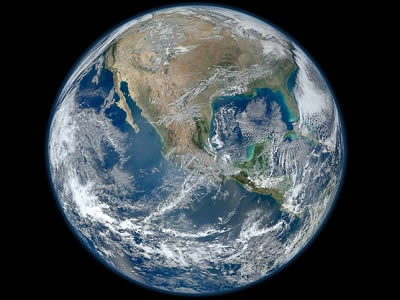
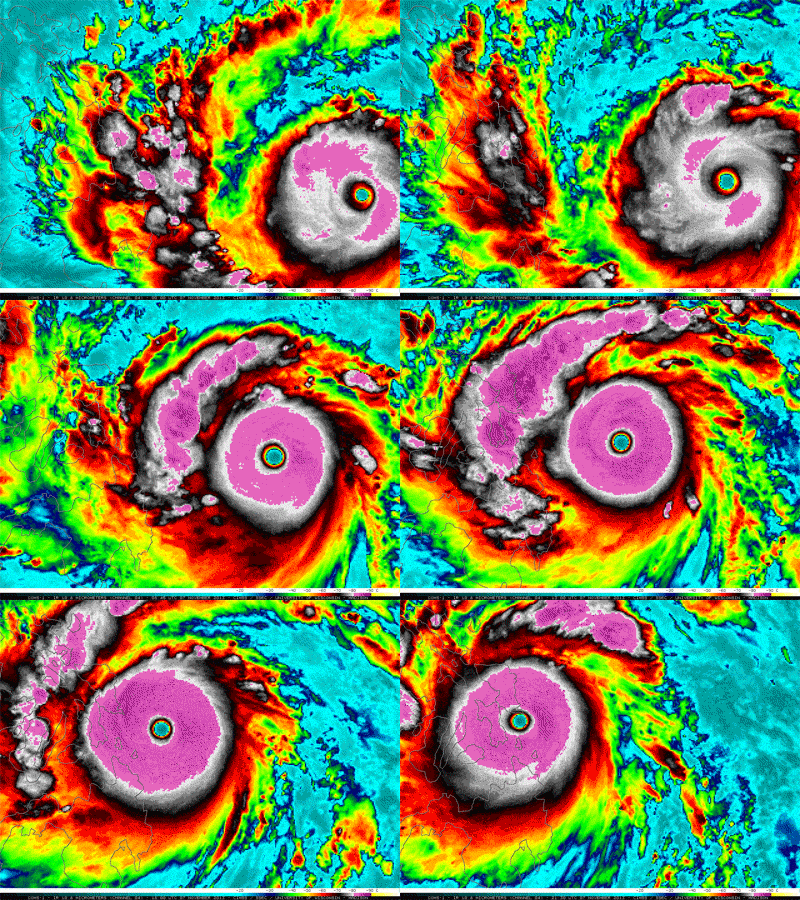
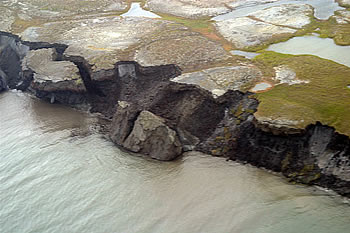
This image is a montage of high resolutions photographs of the Earth taken in January 2012 by the Visible/Infrared Imager Radiometer Suite (VIIRS) instrument on the Suomi NPP satellite.  The image shows many stunning details of <a href="http://www.windows2universe.org/earth/earth.html">our home planet</a> - <a href="http://solarsystem.nasa.gov/multimedia/gallery/VIIRS_4Jan2012.jpg">particularly at high resolution</a>. The beauty of our planet is obvious from space - our blue <a href="http://www.windows2universe.org/earth/Water/overview.html">waters</a>, our white <a href="http://www.windows2universe.org/earth/Atmosphere/cloud.html">clouds</a>, and the green from <a href="http://www.windows2universe.org/earth/Life/life.html">life</a> abundant at the surface.<p><small><em>Image courtesy of NASA</em></small></p>On November 7, 2013, Typhoon Haiyan (Yolanda in the Philippines) made landfall, with imated wind speeds of ~315 km/hr - the strongest <a href="/earth/Atmosphere/hurricane/intensity.html">tropical cyclone</a> to make landfall in recorded history.  As Haiyan moved across the Philippines before reaching Vietnam and China, its <a href="/earth/Atmosphere/wind.html">winds</a> and <a href="/earth/Atmosphere/hurricane/surge.html">storm surge</a> left devastation in its wake, leading to massive loss of life, destruction of homes, and hundreds of thousands of displaced inhabitants. <a href="http://www.cnn.com/2013/11/09/world/iyw-how-to-help-typhoon-haiyan/index.html">How to Help</a><p><small><em>Image courtesy of COMS-1, SSEC, University of Wisconsin-Madison</em></small></p>Stars don't last forever. Occasionally, a star bigger than our Sun will end its life in a huge explosion, called a <a href="/the_universe/supernova.html">supernova</a>. The center of the star collapses in less than a second, blowing away the outer layers of the star.  There are many beautiful images of supernova remnants, the expanding shell of gas made up of the outer layers of the original star. This image is the Vela Supernova Remnant.<p><small><em>Image courtesy of the Anglo-Australian Observatory/Royal Observatory Edinburgh</em></small></p>As permafrost thaws, the land, atmosphere, water resources, ecosystems, and human communities are affected. Coastal areas and hillsides are vulnerable to erosion by thawing of permafrost.  Thawing permafrost also causes a positive feedback to global warming, as carbon trapped within the once-frozen soils is released as <a href="/physical_science/chemistry/methane.html">methane</a>, a powerful <a href="/earth/climate/cli_greengas.html">greenhouse gas</a>.
Watch the NBC Learn video - <a href="/earth/changing_planet/permafrost_methane_intro.html">Thawing Permafrost and Methane</a> to find out more.<p><small><em>Image courtesy of the    USGS</em></small></p>The spinning vortex of <a href="https://www.windows2universe.org/saturn/saturn.html">Saturn</a>'s north polar storm resembles a giant deep red rose surrounded by green foliage in this false-color <a href="http://www.nasa.gov/mission_pages/cassini/multimedia/pia14944.html">image</a> from NASA's <a href="https://www.windows2universe.org/missions/cassini.html">Cassini spacecraft</a>. The eye is 2,000 kilometers across with cloud speeds as fast as 150 meters per second.
It is not known how long this newly discovered north-polar <a href="https://www.windows2universe.org/earth/Atmosphere/hurricane/hurricane.html">hurricane</a> has been active.
The view was acquired at a distance of approximately 419,000 kilometers from Saturn.<p><small><em>NASA/JPL-Caltech/SSI</em></small></p>