
Virology
Abstract
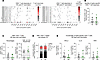
BACKGROUND Among people living with HIV (PLWH), immunological nonresponders (INR) fail to adequately restore CD4+ T cell counts despite effective antiretroviral therapy (ART), placing them at greater risk for adverse outcomes and reduced vaccine efficacy. We aimed to study the robustness and longevity of vaccine-induced virus-specific cellular immune responses in INR.METHODS Virus-specific CD8+ T cell responses were analyzed in INR (CD4+ T cell count < 300 cells/μL) and immunological responders (IR) (CD4+ T cell count > 500 cells/μL), receiving ART, and HIV-uninfected controls following COVID-19 mRNA vaccination and infection. Virus-specific CD8+ T cells were characterized using peptide-loaded MHC I tetramer technology, after in vitro expansion and cytokine production assays. Virus-specific CD4+ T cells and IgG levels were determined by activation-induced marker (AIM) assay and ELISA, respectively.RESULTS We demonstrated that, while long-lasting virus-specific cellular immune responses were generated in INR, CD8+ T cell immunity remained limited compared with robust CD4+ T cell reactivity. CD8+ T cell responses in INR exhibited reduced breadth and frequency, accompanied by altered memory differentiation and suboptimal activation and effector response upon antigen exposure. This deficiency correlated with low CD4+ T cell counts, independent of other disease markers, highlighting the pivotal role of CD4+ T cells in orchestrating vaccine-induced immunity. Notably, repeated booster vaccinations enhanced virus-specific CD8+ T cell responses.CONCLUSION INR elicit limited vaccine-induced virus-specific CD8+ T cell immunity, but booster vaccinations can enhance these responses, suggesting better immune outcomes with tailored vaccination strategies.FUNDING Helmholtz Society, German Research Foundation, Federal Ministry of Education and Research.
Authors
Vivien Karl, Anne Graeser, Anastasia Kremser, Liane Bauersfeld, Florian Emmerich, Nadine Herkt, Siegbert Rieg, Susanne Usadel, Bertram Bengsch, Tobias Boettler, Hendrik Luxenburger, Christoph Neumann-Haefelin, Matthias C. Müller, Robert Thimme, Maike Hofmann
Abstract
Elite controllers (ECs) maintain undetectable levels of plasma viremia in the absence of treatment, but small reservoirs of replication-competent proviruses persist in the vast majority of these persons. We longitudinally studied paired blood and inguinal lymph node samples (LNMC) from two ECs to better characterize distinguishing features of viral reservoir cell dynamics in ECs. In both participants, we observed a 7- to 10-fold lower frequency of intact proviruses in LNMC samples relative to reservoir cells circulating in blood. The landscape of intact proviruses in both tissue compartments was dominated by shared large clones that were frequently integrated in non-coding DNA regions, but the frequency and diversity of intact proviruses was more limited in LNMCs. Of note, over 9-10 years of longitudinal follow-up, a 3- to 18-fold reduction of intact proviruses was observed. Together, these data support the hypothesis that viral reservoirs in ECs’ blood and lymphoid tissues are under strong, likely immune-mediated selection pressure.
Authors
Samantha K. Marzi, Chloé M. Naasz, Leah Carrere, Carmen Gasca-Capote, Isabelle C. Roseto, Ce Gao, Matthias Cavassini, Andrea Mastrangelo, Mathias Lichterfeld, Matthieu Perreau, Xu G. Yu
Abstract
Empirical data from survivors of Lassa fever and experimental disease modelling efforts, particularly those using mouse models, are at odds with respect to T cell-mediated pathogenesis. In mice, T cells have been shown to be imperative in disease progression and lethality, whereas in humans, an early and robust T cell responses has been associated with survival. Here, we assessed the role of CD4+ and CD8+ T cells on disease progression and severity of Lassa virus infection in a non-human primate model. Using an antibody-mediated T cell depletion strategy prior to and post-inoculation, we were able to examine Lassa virus infection in the absence of specific T cell responses. In animals depleted for either CD4+ or CD8+ T cells, Lassa virus infection remained uniformly lethal, with only a slight delay in disease progression observed in the CD4-depleted group when compared to non-depleted controls. Milder pulmonary pathology was noticed in the absence of CD4+ or CD8+ T cells. Overall, our findings suggest that T cells have a limited impact on the development of Lassa fever in non-human primates.
Authors
Jérémie Prévost, Nikesh Tailor, Geoff Soule, Jonathan Audet, Yvon Deschambault, Robert Vendramelli, Jessica Prado-Smith, Kevin Tierney, Kimberly Azaransky, Darwyn Kobasa, Chad S. Clancy, Heinz Feldmann, Kyle Rosenke, David Safronetz
Abstract
Acute lower respiratory infections are the primary cause of global mortality in post-neonatal children. Most respiratory viruses primarily involve upper airway infection and inflammation, yet nasal responses are poorly characterized. Using a mouse model of human metapneumovirus (HMPV), we found viral burden was higher in nasal airways and exhibited delayed clearance. Despite high burden, there was low nasal expression of type I and III interferon (IFN). Single-cell RNA-sequencing (scRNA-seq) from HMPV-infected mice showed lower nasal interferon-stimulated gene (ISG) expression and nasal enrichment of genes negatively regulating IFN. scRNA-seq of COVID-19 patients confirmed lower ISG expression in upper airways. HMPV infection downregulated nasal expression of interferon regulatory factor-3, suggesting a mechanism for limited response. To rescue the quiescent environment, we administered type I or III IFN to upper airways early post-infection, leading to lower nasal HMPV titer and virus-specific CD8+ T-cell upregulation. Intranasal immunization adjuvanted with type I or III IFN improved immune response, reduced clinical disease, and enhanced viral clearance in HMPV and influenza infection. IFN adjuvant increased recruitment of dendritic cells, resident-memory T-cells, and neutralizing antibodies. These findings reveal locally suppressed IFN production contributes to a quiescent nasal immune landscape that delays viral clearance and impairs mucosal vaccine responses.
Authors
Jorna Sojati, Olivia B. Parks, Taylor Eddens, Jie Lan, Monika Johnson, John V. Williams
Abstract
X-linked Lymphoproliferative Syndromes (XLP), arising from mutations in SH2D1A or XIAP genes, are characterized by fulminant Epstein-Barr Virus (EBV) infection. Lymphomas occur frequently in XLP-1 and in other congenital conditions with heightened EBV susceptibility, but not in XLP-2. Why XLP-2 patients are apparently protected from EBV-driven lymphomagenesis remains a key open question. To gain insights, newly EBV-infected versus receptor-stimulated primary B-cells from XLP-2 patients or with XIAP CRISPR editing were compared to healthy controls. XIAP perturbation impeded outgrowth of newly EBV-infected B-cells, but not that of CD40 ligand and interleukin-21 stimulated B-cells. XLP-2 deficient B-cells showed significantly lower EBV transformation efficiency than healthy controls. Interestingly, EBV-immortalized lymphoblastoid cell proliferation was not impaired by XIAP knockout, implicating an XIAP role in early EBV B-cell transformation. Mechanistically, nascent EBV infection activated p53-mediated apoptosis signaling, which was counteracted by XIAP in control cells. With XIAP deficiency, EBV markedly elevated apoptosis rates over the first two weeks of infection. Interferon-gamma, whose levels are increased with severe XLP2 EBV infection, markedly increased newly EBV-infected B-cell apoptosis. These findings underscored XIAP's crucial role in support of the earliest stages of EBV-mediated B-cell immortalization and provide insights into the curious absence of EBV+ lymphoma in XLP-2 patients.
Authors
Yizhe Sun, Janet Chou, Kevin D. Dong, Steven P. Gygi, Benjamin E. Gewurz

Abstract
Parkinson’s disease (PD) is a neurodegenerative disorder with both genetic and environmental factors contributing to pathogenesis. Viral infections are potential environmental triggers that influence PD pathology. Using ViroFind, an unbiased platform for whole virome sequencing, along with quantitative PCR (qPCR), we identified human pegivirus (HPgV) in 5 of 10 (50%) of PD brains, confirmed by IHC in 2 of 2 cases, suggesting an association with PD. All 14 age- and sex-matched controls were HPgV negative. HPgV-brain positive patients with PD showed increased neuropathology by Braak stage and Complexin-2 levels, while those positive in the blood had higher IGF-1 and lower pS65-ubiquitin, supporting disruption in metabolism or mitophagy in response to HPgV. RNA-Seq revealed altered immune signaling in HPgV-infected PD samples, including consistent suppression of IL-4 signaling in both the brain and blood. Longitudinal analysis of blood samples showed a genotype-dependent viral response, with HPgV titers correlating directly with IL-4 signaling in a LRRK2 genotype–dependent manner. YWHAB was a key hub gene in the LRRK2 genotypic response, which exhibited an altered relationship with immune-related factors, including NFKB1, ITPR2, and LRRK2 itself, in patients with PD who are positive for HPgV. These results suggest a role for HPgV in shaping PD pathology and highlight the complex interplay between viral infection, immunity, and neuropathogenesis.
Authors
Barbara A. Hanson, Xin Dang, Pouya Jamshidi, Alicia Steffens, Kaleigh Copenhaver, Zachary S. Orban, Bernabe Bustos, Stephen J. Lubbe, Rudolph J. Castellani, Igor J. Koralnik
Abstract
H7N9 avian influenza virus is a zoonotic influenza virus of public health concern, with a 39% mortality rate in humans. H7N9-specific prevention or treatments for humans have not been approved. We previously isolated a human monoclonal antibody (mAb) designated H7-235 that broadly reacts to diverse H7 viruses and neutralizes H7N9 viruses in vitro. Here, we report the crystal structure of H7 HA1 bound to the fragment antigen-binding region (Fab) of recombinant H7-235 (rH7-235). The crystal structure revealed that rH7-235 recognizes residues near but outside of the receptor binding site (RBS). Nevertheless, the rH7-235 IgG potently inhibits hemagglutination mediated by H7N9 viruses due to avidity effect and Fc steric hindrance. This mAb prophylactically protects mice against weight loss and death caused by challenge with lethal H7N9 viruses in vivo. rH7-235 mAb neutralizing activity alone is sufficient for protection when used at high dosed in a prophylactic setting. This study provides insights into mechanisms of viral neutralization by protective broadly reactive anti-H7 antibodies informing the rational design of therapeutics and vaccines against H7N9 influenza virus.
Authors
Iuliia M. Gilchuk, Jinhui Dong, Ryan P. Irving, Cameron D. Buchman, Erica Armstrong, Hannah L. Turner, Sheng Li, Andrew B. Ward, Robert H. Carnahan, James E. Crowe Jr.
Abstract
Epstein-Barr virus (EBV) infection precedes multiple sclerosis (MS) onset and plays a poorly understood etiologic role. To investigate possible viral pathogenesis, we analyzed single-cell expression in peripheral B cells from people with early MS collected longitudinally during the Immune Tolerance Network (ITN) STAyCIS Trial. Expression profiles were compared to scRNA-seq from in vitro EBV models, autoimmune disorders, chronic infectious diseases, and healthy controls. Analyses focused on CD19+/CD20+/CD21lo/CD11c+/T-bet+ atypical B cells (ABCs). ABCs were significantly enriched in early MS PBMCs versus healthy controls by scRNA-seq and flow cytometry, establishing ABC expansion as a clinical feature. EBV-associated ABC expression including CXCR3, PD-L1, and PD-L2 was enriched in early MS; however, direct EBV infection of ABCs was not detected. Early MS ABCs exhibited significantly upregulated inflammatory cytokine mRNAs (CXCL8, IL18, VEGFA). Further de novo EBV-infected B cells secreted IL-8 and VEGF. MS activity stratification revealed rare distinctive inflammatory ABCs significantly underrepresented in individuals with no evidence of activity long-term (LTNA) versus people with additional RRMS activity at the primary endpoint. Moreover, CXCR3+ ABCs increased after baseline diagnosis and were significantly enriched in people with disease exacerbation during the study. Thus, ABC expansion and inflammatory responses correlate to early MS activity, possibly as a bystander response to EBV.
Authors
Elliott D. SoRelle, Ellora Haukenfrers, Gillian Q. Horn, Vaibhav Jain, James Giarraputo, Karen Abramson, Emily Hocke, Laura A. Cooney, Kristina M. Harris, Scott S. Zamvil, Simon G. Gregory, Micah A. Luftig
Abstract
Measles remains one of the most important causes of worldwide morbidity and mortality in children. Measles virus (MeV) replicates extensively in lymphoid tissue and most deaths are due to other infectious diseases associated with MeV-induced loss of circulating antibodies to other pathogens. To determine whether remdesivir, a broad-spectrum direct-acting antiviral, affects MeV-induced loss of antibody to other pathogens, we expanded the VirScan technology to detect antibody to both human and macaque pathogens. We measured the antibody reactivity to MeV and non-MeV viral peptides using plasma from MeV-infected macaques that received remdesivir either as post-exposure prophylaxis (d3-14, PEP) or as late treatment (d11-22, LT) in comparison with macaques that were not treated. Remdesivir PEP, but not LT, limited the loss of antibody to non-MeV pathogens. Remdesivir PEP also limited the antibody response to MeV with a decrease in both the magnitude and breadth of the epitopes recognized. LT had little effect on the magnitude of the MeV-specific antibody response but affected the breadth of the response. Therefore, early, but not late, treatment of measles with the direct-acting antiviral remdesivir prevents the loss of antibody to other pathogens but decreases the response to MeV.
Authors
Andy Kwan Pui Chan, Liting Liu, William R. Morgenlander, Manjusha Thakar, Nadine A. Peart Akindele, Jacqueline Brockhurst, Shristi Ghimire, Maggie L. Bartlett, Kelly A. Metcalf Pate, Victor C. Chu, Meghan S. Vermillion, Danielle P. Porter, Tomas Cihlar, Michael J. Mina, H. Benjamin Larman, Diane E. Griffin

Abstract
Patients with immune-mediated inflammatory diseases (IMIDs) like rheumatoid arthritis (RA) are at higher risk for severe COVID-19 and long-term complications in bone health. Emerging clinical evidence demonstrated that SARS-CoV-2 infection reduces bone turnover and promotes bone loss, but the mechanism underlying worsened bone health remains elusive. This study sought to identify specific immune mediators that exacerbated preexisting IMIDs after SARS-CoV-2 exposure. Plasma samples from 4 groups were analyzed: healthy, IMID only, COVID-19 only, and COVID-19 + IMID. Using high-throughput multiplexed proteomics, we profiled 1,500 protein biomarkers and identified 148 unique biomarkers in COVID-19 patients with IMIDs, including elevated inflammatory cytokines (e.g., IL-17F) and bone resorption markers. Long-term circulating SARS-CoV-2 ORF8, a virulence factor for COVID-19, was detected in the COVID + IMID group. RA was one of the most common IMIDs in our study. ORF8 treatment of RA-derived human osteoblasts (RA-hOBs) increased levels of inflammatory (TNF, IL6, CCL2) and bone resorption (RANKL/osteoprotegerin ratio) markers compared with healthy controls. Supernatants from ORF8-treated RA-hOBs drove the differentiation of macrophages into osteoclast-like cells. These findings suggest that SARS-CoV-2 exposure can exacerbate IMIDs through ORF8-driven inflammation and osteoclastogenesis, highlighting potential therapeutic targets for managing COVID-19–induced bone pathologies.
Authors
Ivonne Melano, Tamiris Azamor, Camila C.S. Caetano, Nikki M. Meyer, Chineme Onwubueke, Anabelle Visperas, Débora Familiar-Macedo, Gielenny M. Salem, Brandy-Lee Soos, Cassandra M. Calabrese, Youn Jung Choi, Shuyang Chen, Younho Choi, Xianfang Wu, Zilton Vasconcelos, Suzy A.A. Comhair, Karin Nielsen-Saines, Leonard H. Calabrese, M. Elaine Husni, Jae U. Jung, Nicolas S. Piuzzi, Suan-Sin Foo, Weiqiang Chen
No posts were found with this tag.


