Go to The Journal of Clinical Investigation
  • About
  • Editors
  • Consulting Editors
  • For authors
  • Publication ethics
  • Publication alerts by email
  • Transfers
  • Advertising
  • Job board
  • Contact
  • Physician-Scientist Development
  • Current issue
  • Past issues
  • By specialty
    • COVID-19
    • Cardiology
    • Immunology
    • Metabolism
    • Nephrology
    • Oncology
    • Pulmonology
    • All ...
  • Videos
  • Collections
    • In-Press Preview
    • Resource and Technical Advances
    • Clinical Research and Public Health
    • Research Letters
    • Editorials
    • Perspectives
    • Physician-Scientist Development
    • Reviews
    • Top read articles

  • Current issue
  • Past issues
  • Specialties
  • In-Press Preview
  • Resource and Technical Advances
  • Clinical Research and Public Health
  • Research Letters
  • Editorials
  • Perspectives
  • Physician-Scientist Development
  • Reviews
  • Top read articles
  • About
  • Editors
  • Consulting Editors
  • For authors
  • Publication ethics
  • Publication alerts by email
  • Transfers
  • Advertising
  • Job board
  • Contact
Top
  • View PDF
  • Download citation information
  • Send a comment
  • Terms of use
  • Standard abbreviations
  • Need help? Email the journal
  • Top
  • Abstract
  • Supplemental material
  • Version history
  • Article usage
  • Citations to this article
Advertisement

ResearchIn-Press PreviewGeneticsMuscle biology Open Access | 10.1172/jci.insight.197759

Proteomics-based evaluation of AAV dystrophin gene therapy outcomes in mdx skeletal muscle

Erynn E. Johnson,1 Theodore R. Reyes,2 Jeffrey S. Chamberlain,2 James M. Ervasti,1 and Hichem Tasfaout2

1Department of Biochemistry, Molecular Biology and Biophysics, University of Minnesota - Twin Cities, Minneapolis, United States of America

2Department of Neurology, University of Washington School of Medicine, Seattle, United States of America

Find articles by Johnson, E. in: PubMed | Google Scholar

1Department of Biochemistry, Molecular Biology and Biophysics, University of Minnesota - Twin Cities, Minneapolis, United States of America

2Department of Neurology, University of Washington School of Medicine, Seattle, United States of America

Find articles by Reyes, T. in: PubMed | Google Scholar

1Department of Biochemistry, Molecular Biology and Biophysics, University of Minnesota - Twin Cities, Minneapolis, United States of America

2Department of Neurology, University of Washington School of Medicine, Seattle, United States of America

Find articles by Chamberlain, J. in: PubMed | Google Scholar |

1Department of Biochemistry, Molecular Biology and Biophysics, University of Minnesota - Twin Cities, Minneapolis, United States of America

2Department of Neurology, University of Washington School of Medicine, Seattle, United States of America

Find articles by Ervasti, J. in: PubMed | Google Scholar

1Department of Biochemistry, Molecular Biology and Biophysics, University of Minnesota - Twin Cities, Minneapolis, United States of America

2Department of Neurology, University of Washington School of Medicine, Seattle, United States of America

Find articles by Tasfaout, H. in: PubMed | Google Scholar

Published November 27, 2025 - More info

JCI Insight. https://doi.org/10.1172/jci.insight.197759.
Copyright © 2025, Johnson et al. This work is licensed under the Creative Commons Attribution 4.0 International License. To view a copy of this license, visit http://creativecommons.org/licenses/by/4.0/.
Published November 27, 2025 - Version history
View PDF
Abstract

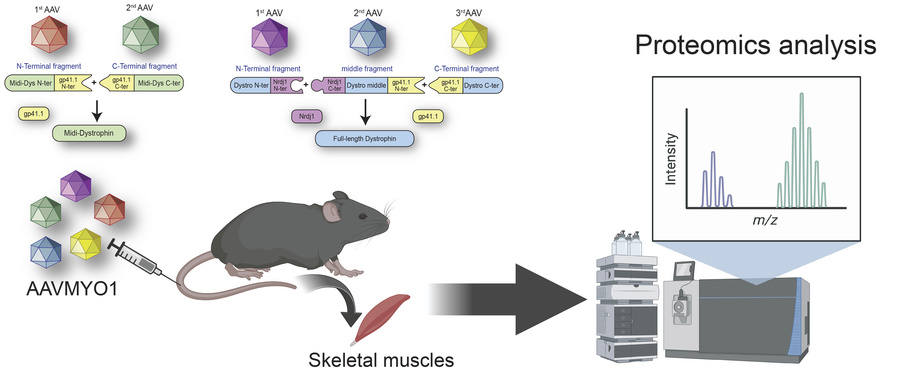
Duchenne muscular dystrophy (DMD) is a fatal genetic muscle-wasting disease characterized by loss of dystrophin protein. Therapeutic attempts to restore a functional copy of dystrophin to striated muscle are under active development, and many utilize adeno-associated viral (AAV) vectors. However, the limited cargo capacity of AAVs precludes delivery of full-length dystrophin, a 427 kDa protein, to target tissues. Recently, we developed a novel method to express large dystrophin constructs using the protein trans-splicing (PTS) mechanism mediated by split inteins and myotropic AAV vectors. The efficacy of this approach to restore muscle function in mdx4cv mice was previously assessed using histology, dystrophin immunolabeling, and western blotting. Here, we expand our molecular characterization of dystrophin constructs with variable lengths using a mass spectrometry-based proteomics approach, providing insight into unique protein expression profiles in skeletal muscles of wild-type, dystrophic mdx4cv, and AAV-treated mdx4cv. Our data reveal several affected cellular processes in mdx4cv skeletal muscles with changes in the expression profiles of key proteins to muscle homeostasis, whereas successful expression of dystrophin constructs results in an intermediate to complete restoration. This study highlights several biomarkers that could be used in future preclinical or clinical studies to evaluate the effectiveness of therapeutic strategies.

Graphical Abstract
graphical abstract
Supplemental material

View Unedited blot and gel images

View Supplemental data

View

Version history
  • Version 1 (November 27, 2025): In-Press Preview

Article tools

  • View PDF
  • Download citation information
  • Send a comment
  • Terms of use
  • Standard abbreviations
  • Need help? Email the journal

Metrics

  • Article usage
  • Citations to this article

Go to

  • Top
  • Abstract
  • Supplemental material
  • Version history
Advertisement
Advertisement

Copyright © 2025 American Society for Clinical Investigation
ISSN 2379-3708

Sign up for email alerts