vane
Also found in: Dictionary, Thesaurus, Medical, Wikipedia.
Related to vane: vain
vane
1. a flat plate or blade of metal mounted on a vertical axis in an exposed position to indicate wind direction
2. any one of the flat blades or sails forming part of the wheel of a windmill
3. any flat or shaped plate used to direct fluid flow, esp a stator blade in a turbine, etc.
4. a fin or plate fitted to a projectile or missile to provide stabilization or guidance
5. Ornithol the flat part of a feather, consisting of two rows of barbs on either side of the shaft
Collins Discovery Encyclopedia, 1st edition © HarperCollins Publishers 2005
Vane
A metal banner that turns around a pivoted point, moving with the prevailing wind, to indicate the direction of the wind.

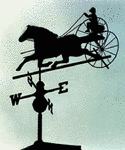
Illustrated Dictionary of Architecture Copyright © 2012, 2002, 1998 by The McGraw-Hill Companies, Inc. All rights reserved
vane
[vān] (aerospace engineering)
A device that projects ahead of an aircraft to sense gusts or other actions of the air so as to create impulses or signals that are transmitted to the control system to stabilize the aircraft.
(mechanical engineering)
A flat or curved surface exposed to a flow of fluid so as to be forced to move or to rotate about an axis, to rechannel the flow, or to act as the impeller; for example, in a steam turbine, propeller fan, or hydraulic turbine.
(navigation)
A sight on an instrument used for observing bearings, such as on a pelorus or azimuth circle.
(vertebrate zoology)
The expanded web part of a feather.
McGraw-Hill Dictionary of Scientific & Technical Terms, 6E, Copyright © 2003 by The McGraw-Hill Companies, Inc.
weather vane
A metal plate, often decorated, or in the shape of a figure or object, which rotates freely on a vertical spindle to indicate wind direction; usually located atop a spire or other elevated position on a building.
McGraw-Hill Dictionary of Architecture and Construction. Copyright © 2003 by McGraw-Hill Companies, Inc.
vane
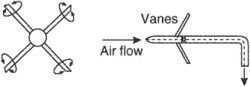

Vanes for pickup of data for angle of attack indicator and autopilot.
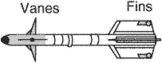
An air-to-air missile.
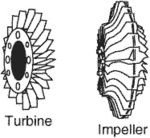
ii. A fixed or movable surface used to control or give stability to a rocket or a missile.
iii. A blade or paddlelike object, often fashioned like an airfoil and usually one of several, that rotates about an axis, either being moved by a flow or creating a flow itself, such as the blade of a turbine, a fan, a rotary pump, an air compressor, etc.
iv. Any of certain stationary blades, plates, or the like that serve to guide or direct a flow, or to create a special kind of flow, as in (i) any of the blades in the nozzle ring of a gas turbine engine; (ii) any of the plates or slatlike objects that guide the flow in a wind tunnel; or (iii) a plate or fence projecting from a wing to prevent a span-wise flow. See nozzle guide vanes.
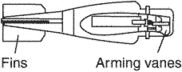
v. A bomb-arming vane. When a bomb is released from the aircraft, the vanes start rotating and, after a predetermined period, arm the bomb.
vi. A weather vane. A device that shows the direction in which the wind is blowing. See weather vane.
An Illustrated Dictionary of Aviation Copyright © 2005 by The McGraw-Hill Companies, Inc. All rights reserved
The following article is from The Great Soviet Encyclopedia (1979). It might be outdated or ideologically biased.
Vane
the lamellar part of a bird’s feather that lies on both sides of the shaft. It consists of numerous flattened formations, or barbs, that project from the shaft. Each barb has two rows of small lamellae, or barbules, equipped with hooked projections, or barbicels. The barbicels hook adjacent barbs tightly together, forming an elastic, air-resistant surface.
The Great Soviet Encyclopedia, 3rd Edition (1970-1979). © 2010 The Gale Group, Inc. All rights reserved.